Crackdown on holiday renters failing to register

Lawmakers on Tuesday called for a crackdown on people renting out their properties but who continue to evade the taxman by not registering as Airbnb.

The House commerce committee discussed the matter during an extraordinary session. Due to the intervening presidential elections, normally parliament is in recess and will reconvene regularly in March.

Committee chair Kyriacos Hadjiyiannis later said that only some 5,000 properties out of the estimated 15,000 have applied to register as self-catering tourist accommodation or Airbnb.

“That is why it has been decided to apply pressure, but also for the junior ministry of tourism to provide assistance, so that the remaining 70 per cent also file an application.”

The MP stressed that “we shall not help anyone who has not shown interest in filing an application or who wants to operate on their own terms, because competition cannot be distorted but rather must take place according to the law and the market.

“Hotel beds and Airbnb beds are meant for different types of tourists. If Airbnb properties operate without paying taxes, it means they are breaking the law, so we must provide solutions to a problem that has existed for decades.”

Parliamentarians have drafted two bills, intended as a carrot-and-stick for wayward Airbnb providers.

The first involves giving facilities to property owners so that they register as self-catering tourist accommodation; the second bill would grant an extension to such properties to properly register.

Hadjiyiannis said incentives would be given to those possessing a title deed and a town planning permit and to those generating electricity from renewables if they are not hooked up to the grid.

The extraordinary session of the committee was held because February 7 was the deadline for Airbnb providers to register with authorities. However, there was no quorum as only three MPs attended, so the proceedings took the form of an unofficial discussion.

Also attending was outgoing Deputy Minister for Tourism Savvas Perdios, in his last appearance in parliament.

Apartment rental & purchase prices rise

4

Property prices across Cyprus year-on-year rose by 9.9% for apartments, 1.0% for houses and 0.3% for offices, according to the Q4 2022 Ask WiRE property index.

Prices also rose by 4.7% for holiday apartments and 0.9% for holiday houses over the year, while retail and warehouse prices fell by 1.4% and 3.7% respectively.

Nicosia stood out from the other districts, as sale prices of apartments continued to rise throughout the year (2.5% in Q4 2022).

On a quarterly basis, sale values increased by 1.6% for apartments, 0.1% for houses, 0.4% for offices and remained stable for retail and warehouses. Sale values for holiday apartments and holiday houses rose by 1.9% and 0.4% respectively.

Rental prices

Compared to Q4 2021 there was an 18.2% rise in rental values for apartments, an 11.6% rise for houses, a 0.9% rise for retail, a 6.3% rise for offices, a 16.9% rise for holiday apartments and a 12.8% rise for holiday houses. However, the rental value of warehouses fell by 0.4%.

Paphos stood out from the other districts with rental values of holiday apartments and holiday houses increasing significantly for another quarter (by 5.0% and 11.8% respectively in Q4 2022).

On a quarterly basis rental values increased by 2.7% for apartments, 1.1% for houses, 1.7% for retail, 0.8% for offices, and remained stable for warehouses. As for holiday apartments and holiday houses rental values increased by 3.6% and 5.9%, respectively.

CEO of Ask WiRE Pavlos Loizou said that “the influx in population due to in-migration throughout 2022 and pend-up demand over the past couple of years continues to drive the residential market.

“With inflation eroding disposable incomes and interest rates rising, we have seen a slowing down of demand in the second half of the year and prices stabilizing in Nicosia and Limassol.

“We expect pricing of commercial properties to come under pressure, as alternative investment classes offer appealing returns on a risk adjusted basis.

“Looking ahead to 2023, we expect residential property prices to remain broadly stable, albeit with slowing demand and less transaction volume, whilst commercial real estate will face various challenges, with investor demand remaining relatively thin.”

For a breakdown of movements in sale and rental values by district, visit Ask WiRE Data Analytics.

Property Type Sale Value Rental Value
Apartments 1.9% 2.7%
Houses 0.1% 1.1%
Commercial 0.0% 1.7%
Warehouses 0.0% 0.0%
Office spaces 0.4% 0.8%
Holiday apartments 1.9% 3.6%
Holiday houses 0.3% 5.9%
Source: Ask WiRE – Quarterly percentage change in property values (Q3 2022 with Q4 2022)


Property Type Sale Value Rental Value
Apartments 9.9% 18.2%
Houses 1.0% 11.6%
Commercial -1.4% 0.9%
Warehouses -3.7% -0.4%
Office spaces 0.3% 6.3%
Holiday apartments 4.7% 16.9%
Holiday houses 0.9% 12.8%
Source: Ask WiRE – Annual percentage change in property values (Q4 2021 with Q4 2022)

Foreign sales hit 16 year high

0

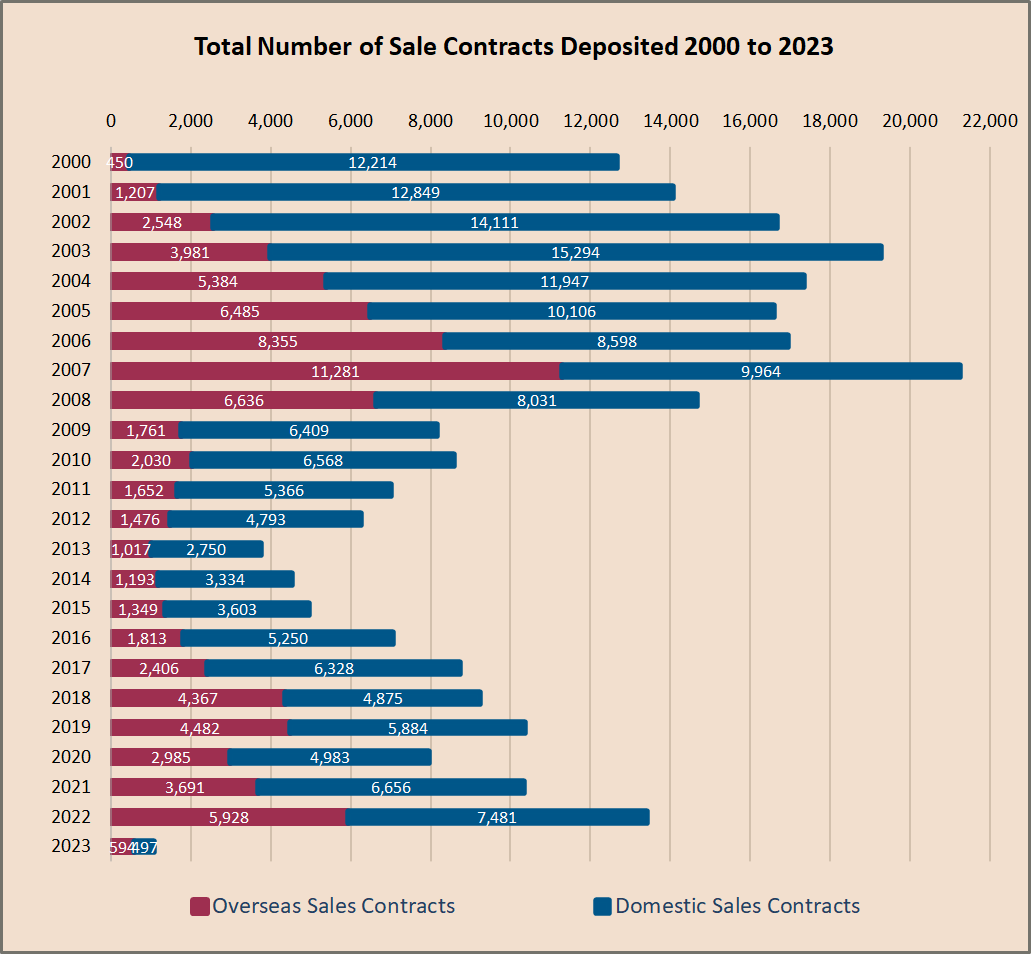
Property sales to foreign (non-Cypriot) buyers in January were the highest on record since January 2007 according to official figures from the Department of Lands & Surveys.

During January 2023 foreign buyers deposited 594 contracts of sale at Land Registry offices across the island. Moreover, these accounted for 54% of all sales; the first time since 2007 that the number of foreign sales has exceeded domestic sales.

Foreign nationals from EU member states deposited 150 sales contracts in January; a fall of 32% compared to the 221 contracts deposited in January 2022.

Contracts deposited by foreigners from non-EU countries (third country nationals) in January rose a starting 148% reaching 444 compared to 179 in January 2022.

Domestic sales

Cypriot citizens deposited a total of 497 contracts in January compared to 455 in January 2022; an increase of 9% and the highest figure recorded since January 2012.

However, these figures include an unreported number of ‘non-sale’ agreements such as loan restructurings, recoveries and debt-to-asset swaps agreed between financial institutions and defaulting borrowers in efforts by the banks to reduce their non-performing loan portfolios.

The freeze that protected defaulted borrowers with primary residences valued at €350,000 or less, businesses with a turnover under €750,000 and land with a value of €100,000 or less from repossession ended on 31st January. As a consequence, we can expect an increase in ‘non-sale’ agreements in the coming months.

Sales analysis 2000-2023

Thinking of investing in real estate? Don’t do it

Lack of financial literacy can lead people to consider investing in direct real estate. A provocative statement to say the least, so let me explain.

There are three dimensions when considering your finances: how much you earn and the stability of those income streams, your spending and how to keep it check, and what steps you are taking to plan for future expenses including your pension.

The younger you are the more you should be investing in you, i.e., education, training, networking, etc. As you grow older, you should start saving for your pension and major expenses, e.g., buying a car, a home, etc.

When you approach retirement, it’s all about being able to access your investments to sustain your lifestyle and mitigating future losses as you have less time to recover.

Where does investing in direct real estate come into consideration? Real estate is illiquid, has high management and running costs, and, if you are going to use a loan to finance its purchase, carries with it the risk of turbulence in credit markets, i.e., fluctuations in interest rates.

Thus, it’s not suitable for older individuals approaching their pension age or for those at the start of their careers who need to be channelling their money, time, and focus on learning and networking (which also means remaining flexible as to where they live).

Those in the age bracket of 35-45 (or even 30-55) could be looking at investing in real estate, only if they have maxed-out the tax incentives granted by government to save for their pensions (this is essentially free money), have significant savings in international shares and bonds, and have a “rainy day” fund which equates to 6-12 months expenses.

With the above in place, they can consider real estate as an investment option provided that that investment isn’t more than 10-15% of value of their overall portfolio (this ratio is the one used by pension funds, provident funds, etc.).

But what type of real estate? Not a one- or two-bedroom apartment! No. No. No. Investing in real estate through an Exchange Traded Fund (ETF) provides the owner with liquidity, diversification, and less time needed to manage their investments.

An ETF is a type of investment fund that is traded on stock exchanges like individual stocks. It holds a number of real estates, such residential, offices, shopping malls, etc which are professionally managed, and can be bought or sold through a brokerage account.

Let’s investigate further “liquidity” and “being able to pick a winner”.

At what point does a problem of liquidity become a problem of solvency? A problem of liquidity in real estate investing refers to the difficulty in converting assets into cash quickly and without a significant discount.

For example, if an investor needs to sell a property quickly but the real estate market is slow, they may have to sell at a lower price than they expected. This lack of liquid assets can make it difficult for the investor to meet their short-term financial obligations, such as paying bills or making loan payments.

On the other hand, a problem of solvency refers to the inability of an investor to meet their long-term financial obligations, such as paying off debt or funding their retirement.

For example, if an investor has taken out a mortgage to purchase a property and the property’s value decreases significantly, the investor may owe more on the mortgage than the property is worth. In this case, the investor may have difficulty selling the property and paying off the mortgage, and they may eventually face the risk of default or foreclosure.

Does this remind anyone of what we have been experiencing since 2008 across South Eastern Europe? Most people approaching “real estate investment age”, i.e., 30-35 years old, don’t have such memories because they were in high school or university when the Great Financial Crisis (GFC) was happening.

Current examples include the blocking of withdrawals from some of the biggest real estate funds, such as Blackstone’s BREIT (a $69 billion vehicle), and the (hilarious) reference in Norway’s sovereign fund’s presentation of 2022 performance where it stated that real estate values of listed vehicles (i.e., those traded in the stock market) were down 31% whilst those of unlisted real estate (i.e. for which their pricing is based on valuers’ opinions) remained stable/ the same.

And what about your ability to pick “a winner” because of your connections and deep insights.

In 2008, Warren Buffett placed a $1 million bet with the top hedge fund investors on Wall St. He bet that over 10 years, a simple index tracker fund would outperform the best hedge funds. The results were surprising as Buffett’s plain-vanilla stock fund averaged 7.1% while the hedge fund portfolio produced only 2.2% after fees. Buffett won the bet and donated the winnings to a non-profit organization.

He advised both large and small investors to stick with low-cost index funds, stating that when trillions of dollars are managed by Wall St. charging high fees, it will usually be the managers who reap the profits.

Standard & Poor’s has been tracking the record of active managers and found that 84% underperform after 5 years and 90% after 10 years. The performance was “worse than would be expected from luck.” Large fees are still deducted despite the poor results.

Direct real estate investing is great! You get to see and touch your investment, get a loan to finance it, receive rental income, and then sell it when prices are high. At the same time, it limits your flexibility, its costly to manage, its highly taxed, and you are unlikely to be able to outperform simpler and more liquid options out there.

Nobody listens to this advice.

It hasn’t stopped me from giving it.

About the Author

Pavlos Loizou, CEO, Ask WiRE

 

Residential property prices rise 2.1 percent

0

Construction costs and increased demand from foreign and Cypriot buyers contributed to the acceleration in residential property price increases during the third quarter of 2022.

According to the Central Bank, the Residential Property Price Index (RPPI) continued its upward trend in Q3 2022, increasing by 2.1% from 1.7% the previous quarter.

Year-on-year, the property index increased by 6.3% compared to a 4.7% increase in the previous quarter.

Real estate transactions in the first nine months of 2022, as recorded in the Lands and Surveys Department’s sales document data, show accelerated growth attributed to year-on-year increases in demand from domestic and foreign investors.

Inflationary pressures, which significantly impact construction costs, continued in Q3, but so far do not seem to be negatively impacting demand.

The RPPI concerning houses and apartments registered a quarterly increase of 2.1% in Q3.

The rise comes from a 2.2% increase in apartment prices over the previous quarter and a 2.0% jump in house prices over the same period.

On a year-over-year basis, house price growth also accelerated by 6.3% in Q3 2022, compared to 4.7% in Q2.

Apartment prices during the quarter recorded an annual increase of 8% and house prices by 5.2%.

Demand by professionals in the context of the government’s international headquartering programme is considered the most important drive for the demand by foreign investors.

In Q3 2022, house prices increased quarterly in all districts.

An increase of 1.2% was recorded in Nicosia, 3.0% in Limassol, 1.2% in Larnaca, 2.6% in Paphos and 2.3% in Famagusta.

An increase was also recorded in all districts on an annual basis.

Nicosia house prices increased by 4.4%, in Limassol by 8%, in Larnaca by 2.8%, in Paphos by 8.2% and in Famagusta by 8%.

According to the Department of Lands and Surveys (DSS), the number of sales documents increased in Q3 by 33.8% year-on-year (3,347 from 2,502), reflecting increased demand for real estate.

Additionally, during the quarter, there was a 67.3% year-on-year increase in the number of properties traded to foreign buyers (1,506 from 900), driven by a 32% spike in purchases by residents within the EU and a 1% increase in purchases from non-EU residents.

At the same time, inflationary pressures and the rise in key ECB interest rates seem to have negatively affected the demand for new housing loans.

According to the CBC’s Monetary and Financial Statistics, new mortgage loans in Q3 2022 decreased by 12.3% and 6.7% on an annual and quarterly basis, amounting to €238.8 million from €273 million in Q3 2021 and €256.1 million in Q2 2022.

Expect many foreclosure notices today

Yesterday, Tuesday, January 31, 2023, marked the end of the most recent three-month suspension of divestments imposed by a resolution of the House of Representatives. Starting today, February 1, a flood of foreclosure letters are expected to be sent out.

Many foreclosure proceedings will begin in mid-March, 45 days after the letters are sent, a process that has not occurred since early November. As a result, starting today, we will begin to see a large number of publications for property sales in Cyprus, as required by law for press publication.

After two years of foreclosure suspensions due to the pandemic on the part of the banks, and three months of consecutive suspensions at the initiative of the MPs, it is estimated that a sufficient level of foreclosure sales will be accomplished by March 2023.

If there is no extraordinary three-month suspension of foreclosures once Parliament reopens, K estimates that there will be between 100 and 200 foreclosure sales per month going forward. And these figures are justified because a sizable “stockpile” of properties linked to troubled lending has accumulated.

The entire framework of foreclosures and how to make it more equitable for the borrowers’ side while also making it more advantageous for the banks and credit buyout firms are now in the hands of the new Government and Parliament.

In order to determine whether or not we will be led back into a continuous suspension, the new government will have to consult with Parliament and examine both sides of the issue.

First, it remains to be seen whether the much-touted “special court” will actually be established to hear only cases involving real estate, loans, banks, and credit buyout firms and to serve as a “focal point” to which every borrower can turn if he is truly entitled to it in order to get justice.

Second, they should work with the Treasury to determine when and how the mortgage-to-rent “project” will move forward in order to assist the most vulnerable borrowers, those who are unable to make any payments to keep their homes.

Old transgressions

When the decision to suspend sales for a continuous three months was made, the banks emphasized – a stance they maintain today – that the cases that were being sold had nothing to do with the pandemic or its effects. They were cases of non-performing loans from the past, some of which were older than ten years. They emphasized the fact that some of them also had court rulings.

According to data in “K’s” possession for the years 2020 and 2021, only 233 properties were sold during the 1,528 auctions that were held in total.

Given the fragmentation, 128 fields and plots were put up for auction in 2020, and 30 fields and plots were put up for auction in 2021.

Regarding the fields and plots with buildings, six were put up for auction in 2020 and five in 2021.

In 2020, there were 46 apartments and homes up for auction, and in 2021, there were 10.

Just two industrial spaces totalled in both years’ auctions, as did one shop, one vacant home, and two residential spaces with shops.

On the basis of the same data from banks, it is also noted that the auctions that were held did not involve “first” or “main” residences and that their value is neither below nor close to EUR 350,000.

€2.7 billion down from €28.4 billion

According to the Central Bank of Cyprus’ most recent financial bulletin, which mentions non-performing loans in the banking industry, these have decreased by 90.5%, from €28.4 billion in December 2014 to €2.7 billion in October 2022, largely as a result of the actions taken by the biggest banks, from €28.4 billion to €2.7 billion.

However, the NPL ratio as of October 31, 2022, was 10.5%, which is still significantly higher than the European Union average of 1.8%. As a result of the Russian invasion of Ukraine, which has had an impact on many different aspects of the financial system, the CBC warns that there is a real risk that the asset quality of banks will deteriorate.

Preventive restructuring

In terms of the bank loan portfolio’s quality, despite the pandemic-related crises that followed and Russia’s invasion of Ukraine, the balance of non-performing loans (NPLs) continued to decline in 2022 at a slower rate than in recent years, primarily as a result of the sales/transfers of loan portfolios to credit acquisition companies and loan write-offs.

The CBC adds that the economy continues to be burdened by high levels of private debt resulting from loans transferred to Credit Acquisition Companies. It notes that there has been an increase in the percentage of loans identified as presenting an increased credit risk since the pandemic.

The ease with which companies can service their loan debts in the near future will depend on changes in households’ disposable income and businesses’ profit margins.  Therefore, further careful observation and prudent restructuring by banks are imperative in light of the CBC’s warnings in this regard.

[This article was translated from its Greek original]

First published in KNEWS, the English edition of Kathimerini Cyprus