People providing accommodation services will be afforded a transitional period to register with the governmental Airbnb register, under tweaks made to the relevant law announced on Tuesday in parliament.
The House commerce committee again discussed the issue of self-catering tourist accommodations or Airbnb lets.
To date, only some 5,000 properties out of the estimated 15,000 have applied to register as Airbnb. The existing law – which is being amended – aims to crack down on tax evasion from the proceeds of such rental services.
Committee chair Kyriacos Hadjiyiannis (Disy) later told reporters that under the amendments proposed a transitional period will be given until the end of 2024 for wayward properties to register.
This applies to properties lacking a final building permit because zoning plans for their area are pending.
Once Airbnb providers register, they will be able to advertise on electronic platforms. Certification will come from the junior ministry of tourism.
Another issue concerned electricity metres. According to Hadjiyiannis, a solution has been found, where a single electricity metre on a property will suffice for applicants to register for an Airbnb license.
For instance, in a building block with 10 or more apartments, the applicant can cite just one electric metre.
Another tweak is that the ‘overnight stay tax’ will feature on the Airbnb provider’s invoice. Government inspectors will then check the invoice.
The Disy MP thanked colleagues for working together in plugging loopholes in the existing legislation.
He said the committee would agree the final text of the bill likely at its next session, after which the bill would be forwarded to the House plenum.
Attending the session were officials from the junior ministry of tourism, the Department of Town Planning and Housing, the land registry, the Union of Municipalities and the hoteliers association.
Lawmakers on Monday revisited the issue of reduced VAT on homes, with some trying to instil a sense of urgency on the matter as the European Commission continues breathing down Cyprus’ neck having launched infringement proceedings against the Republic.
The House finance committee discussed the issue in an extraordinary session, given that technically parliament is still in recess due to the intervening presidential elections. Complicating matters further, next Monday is Green Monday, a holiday, so the committee will not be meeting formally for a fortnight. In addition, MPs will have to discuss the matter with the executive – but the new government has yet to take office. This will happen next week once President-elect Nikos Christodoulides is sworn in.
Once the new finance minister takes office, he or she will need to be briefed. Also, whenever MPs do agree a final text for the bill on reduced VAT, under parliamentary regulations two weeks must pass before the bill goes to the House plenum.
“Realistically, we’re looking at a plenum date around late March,” Elias Myrianthous, an Edek MP on the House finance committee, told the Cyprus Mail.
He added that a few days ago the European Commission communicated with the finance ministry, letting the latter know that – given the circumstances with the elections – they would wait until the end of March for Cyprus to enact legislation before they advance infringement proceedings any further.
Committee chair Christiana Erotokritou (Diko) likewise said that, to date, the government has not received a reasoned opinion from Brussels. A reasoned opinion is the second stage – a formal request to a national government to comply with EU law. If a country still doesn’t comply within a specified timeframe – usually two months – the Commission may decide to refer the matter to the European Court of Justice. In practice, most cases are settled before being referred to the court.
In the worst-case scenario, Brussels can impose a fine on a country for non-compliance. Such fines may be “significant”, Erotokritou said.
Brussels contends that Cyprus does not properly apply VAT rules for homes purchased or built here.
The European VAT Directive allows member states to apply a lower rate for first homes as part of social policy. But the broad interpretation of the Cyprus provision apparently exceeds the social policy aim stated in the directive, for such an exemption.
The policy was also flagged when it emerged that recipients of the ‘golden passports’ scheme – who invested in property in exchange for citizenship – likewise benefited from the lower VAT rate.
Meantime the government had come up with a ‘sweet spot’ – a bill amending the levying of the reduced 5 per cent (as opposed to the full 19 per cent) VAT rate for homes.
Under the government proposal, the reduced VAT rate would apply to the first 170 square metres of a home of a total surface area of 220 square metres and with a property value up to €350,000. For apartments, the lower rate would apply to the first 90 square metres of a total surface area of 110 square metres and with a property value up to €200,000. In addition, a special clause stipulates that the total surface area criterion does not apply to persons with a disability.
However, the idea has met with stiff resistance from several organisations – the Employers and Industrialists Federation, the Chamber of Commerce, the Cyprus Land & Property Owners Organisation and the Property Valuers Association.
They have instead suggested raising the value of eligible properties – both homes and apartments – to €500,000. And they point out that with the current inflation and increasing cost of building materials, no one would find a home or apartment with the square metres and value cited in the bill – making the legislation a damp squib.
In February last year the government came up with a bill intending to find a balance. But opposition inside parliament forced it to go back to the drawing board and come up with an amended bill, first shown to MPs in late June.
Opposition legislators like Edek’s Myrianthous argue the government bill’s provisions will exclude many young people looking to buy or build their first home. And some MPs want the lower VAT rate to also apply to extensions to homes. Throwing a spanner in the works, other lawmakers even suggest that the government try to renegotiate the issue with the European Commission, pointing to the example of Greece who earlier managed to get significant leeway from Brussels.
Currently, the law provides for the application of a lower VAT rate of 5 per cent for the first 200 square metres of primary residences, without any qualifications. This lower rate is applied irrespective of the income, property or economic conditions of the person or his family residing in the house. Moreover, the total surface area of the home bears no relevance.
Editor’s note on the VAT debacle
In July 2021, the European Commission decided to take action against Cyprus by sending a letter of formal notice for its failure to comply with EU VAT rules for dwellings as follows:
“The European Commission has decided to send a letter of formal notice to Cyprus for its failure to properly apply EU VAT rules for dwellings purchased or constructed in Cyprus.
“Cyprus allows a reduced rate of VAT of 5% on the first 200m2 of dwellings used as the principal and permanent residence by the beneficiary, without any other limitations. In particular, the reduced rate is applied regardless of the income, assets and economic situation of the beneficiary, the members of the family that will reside in the dwelling, and the maximum total area of the dwellings concerned.
“The VAT Directive does allow Member States to apply a reduced rate of VAT on housing as part of a social policy. However, the wide scope of the Cypriot legislation and the lack of limitations therein indicate that the measure goes beyond the objective of a social policy. Consequently, the Commission considers Cyprus has failed to fulfil its obligations under the VAT Directive.
“Cyprus now has two months to address the shortcomings identified in this letter of formal notice. If Cyprus does not take appropriate steps within the next two months, the Commission may decide to send a reasoned opinion.”
House prices and rents are pushed up by a lack of supply, with real estate analysts proposing that authorities take drastic action to bring new properties onto the market, even by taxing unused land.
Pavlos Loizou, CEO of Ask WiRE, told the Financial Mirror that a survey carried out by his firm has shown that during this period of heightened demand, the land is being held from the market or not exploited to the maximum.
Ask WiRE has found this was the case in Limassol, which analysts have said is close to saturation, and Nicosia, where demand for housing is at an all-time high.
“Focusing on the Acropolis area in Nicosia, which is in high demand, Ask WiRE found room for another 10,180 apartments.
“The reason these properties have not been built is that land is being withheld, or project developers are not making the most of the building coefficient allowed,” said Loizou.
He argues that this, combined with an increase in the population, is one of the reasons behind the inflated prices of housing and renting.
“The population has grown by 85,000 in ten years, according to the 2021 census, while another 30,000 to 50,000 people have come in since then, either as refugees following the war in Ukraine or attracted by government incentives for high-tech companies and their employees.
“Thus, we are currently faced with a supply problem rather than a demand problem”.
Annually, average Cyprus real estate prices increased by 9.9% for apartments, 1.0% for houses, and 0.3% for offices, according to the Q4 2022 Ask WiRE property index.
Sales prices also increased by 4.7% for holiday apartments and 0.9% for holiday homes but decreased by 1.4% for retail and 3.7% for warehouses.
Nicosia stood out from other districts as sale prices of apartments continued to rise last year (2.5% in Q4 2022).
Quarterly sale values increased by 1.6% for apartments, 0.1% for houses, and 0.4% for offices and remained stable for retail and warehouses.
For rental values, it was a different story compared to Q4 2021.
There was an 18.2% rent rise for apartments, 11.6% for houses, 0.9% for retail, 6.3% for offices, 16.9% for holiday apartments and 12.8% for holiday homes, whilst warehouse rents decreased by 0.4%.
Ask WiRE’s latest survey identified 2,369 plots with a total area of 1,689,921 square meters.
Within these blocks, Ask WiRE’s surveyors recorded 9,240 residential units with a total area of 1,131,791 sqm.
Based on the existing urban planning zones, a total of 2,149,741 sqm can be built.
Therefore, the unutilized building factor is 1,017,950 sq.m.
“Our findings show that in Acropolis, just 53% of the allowed building coefficient has been used.
“If we calculated that the average flat takes up 100 sqm, we find that there is room for another 10,180 flats to be built”.
Ask WiRE contacted a similar survey in an area close to the Limassol city centre, finding similar results.
According to surveyors, there is room for another 8,000 apartments in the uptown area.
“It is clear that authorities must address the high rents and the cost of buying a home.
The solution is simple and staring us in the face.
“As we have mentioned, this can come through the taxation of idle properties in areas with high demand,” said Loizou.
He believes this would force landowners to either develop their land or sell it to third parties with the means to do so.
“Our suggestion is not for authorities to start taxing owners of homes with unused coefficient, but rather on developers not making full use of the coefficient.
“It is clear that prices of homes and rents will continue to rise in the foreseeable future, while rents in city suburbs will also start to rise if nothing is done”.
Government has earmarked funds to stabilise the landslide that has caused houses to crumble, but there is still no decision over compensating the owners
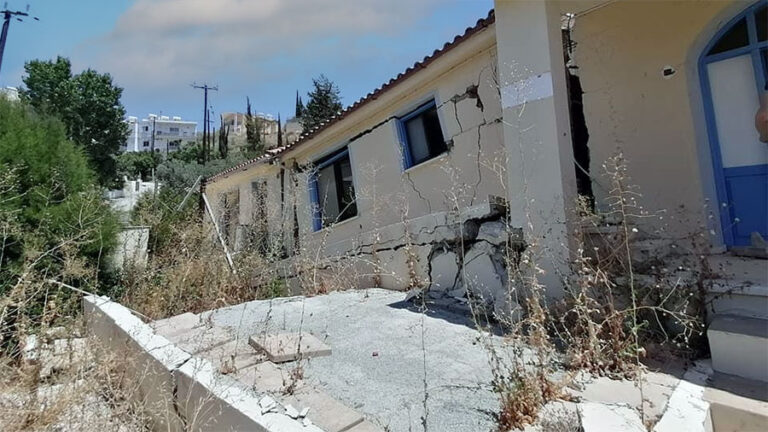
The government is about to pay €33 million to correct the landslide that has destroyed up to 250 homes in the Pissouri area, cracking walls, buckling streets and driveways and smashing water and drainage pipes.
But not one euro of that €33 million will go to compensate homeowners who have had to vacate their properties and watch their homes crumble over the past 11 years through no fault of their own.
And it is doubtful whether the sum is even enough to correct the negative effects of landslide, with the Pissouri Housing Initiative Group (PHIG) saying the state should have acted earlier, when the problem first appeared in 2012. They say the area will probably need more than what is budgeted, as the landslide is continuing to affect hundreds of homes in the area.
Meanwhile residents have been involved in an ongoing battle to receive some form of compensation from various interior ministers, who have been ping-ponging them around for almost a decade.
During a December 2022 session of the cabinet, a plan was approved for support works in the vicinity of the landslide that is affecting the village and specifically the ‘Limnes’ area.
According to the PHIG group’s lawyer Elina Zoi, around 250 homes have been built on the landslide, but not all have seen the effects yet.
However, she added that it is only a matter of time before the subsidence impacts other homes in the area.
“I don’t exaggerate when I say that the area resembles a bombed-out landscape,” she told parliament in December.
The works, according to the cabinet decision, will be overseen by the public works department, who will be further staffed with two civil engineers and two technical engineers. The overall oversight of the multi-million projects will be given to the department, the Limassol regional office, the Geological Survey Department, the waterboard, and the mining department.
The first phase of the project included the creation of an arched pile wall, to stabilise the more elevated area, while the second phase will include the construction of an embankment at the foot of the landslide to stop it.
These two works are set to cost the state €33 million, of which €5.8 was allocated in 2022.
Limassol district began the first phase of the project already, and is set to complete it by September 2023.
However, Zoi insists that the works should have started earlier, and the arched pile wall already constructed by the Limassol district office is not enough.
She said that the two projects are not sufficient as proper drainage needs to be created for other homes to avoid subsidence. The drainage is for upstream of the landslide and fails to include the landslide area.
But she conceded that at the point they have reached, the residents would benefit from any works conducted, as the situation continues to worsen.
Zoi confirmed that no compensation has been given to any of her clients and insists that compensating homeowners should be a political decision, as when buying the houses, the owners were unaware of the issue, as were the builders, who were mostly small construction companies.
“The moment I will be forced to file a lawsuit against the Republic of Cyprus for the compensation of those affected by the landslide in Pissouri, will be the moment I will have to admit that the Republic of Cyprus does not respect either the people or the principles it preaches,” she told the House interior committee in November 2022.
She said that the picture of the houses that are now ruined is ‘depressing’ as they once housed lives.
“The picture is depressing and affects the psychology and health of the people who have remained there because they have nowhere else to go,” she said.
Paying off bank loans on a crumbling house you were forced to leave while paying rent on another property is also an issue.
“In addition, the problem of banks demanding loan instalments from people who have been forced to pay rent after their homes have been declared uninhabitable is still not resolved,” she said.
Speaking to the Sunday Mail, one of the former residents and the head of the PHIG Peter Fields said that they had been writing to local authorities since 2012.
“Nothing has happened, and at the start we were told to leave,” he told the Sunday Mail.
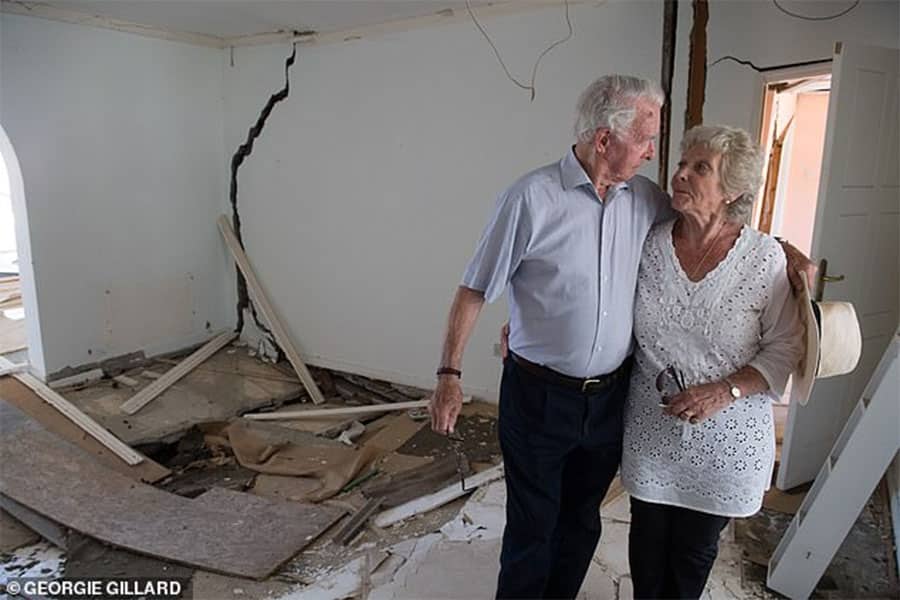
Peter Field and Kayt Field’s house that has been torn apart by the landslide pictured in 2019 (Daily Mail)
He added that many residents were given notice, when the cracks appeared, and told to uproot and leave the area.
Many, he said, like him are pensioners, who have no other income but their pensions, while insurance companies did nothing to help them.
Commenting on the compensation they expect, Fields said that the Interior Ministry is now saying they would look into the matter, once the support works are completed.
“We hope a just end comes of it,” he said, describing the ordeal they have been going through for the past ten years.
Meanwhile the technical chamber, ETEK, also echoed the sentiments expressed by the PHIG lawyer, saying that the studies for the second phase could have been completed earlier.
“We consider that the required slope measurements for the purposes of ensuring the effectiveness of the second phase of the project, could have already been completed, utilising the time period before the completion of the first phase of the project or the time period between the first and second phases of the project, due to the time required by the process of preparing the tender documents for the second phase of the project,” ETEK said last month, adding this was clarified by participants in the November session of the House interior committee.
They added that for several years the chamber has raised the urgent need to investigate the Pissouri problem and that the active landslide in the community requires immediate measures to be taken to protect human life.
Commenting on whether problem could have been foreseen, ETEK said that geohazards concerning specific regions cannot be dealt with using individual studies per development, but rather need a broader mapping by the state, showcasing the specific risks in each area, and informing residents and engineers.
And in the meantime, the residents are still waiting.
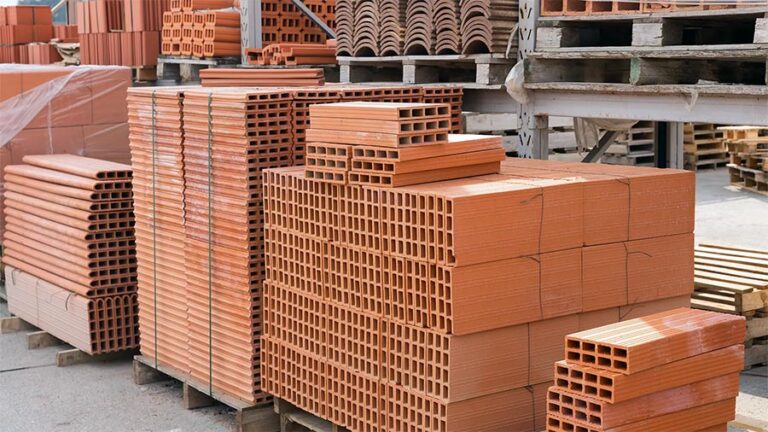
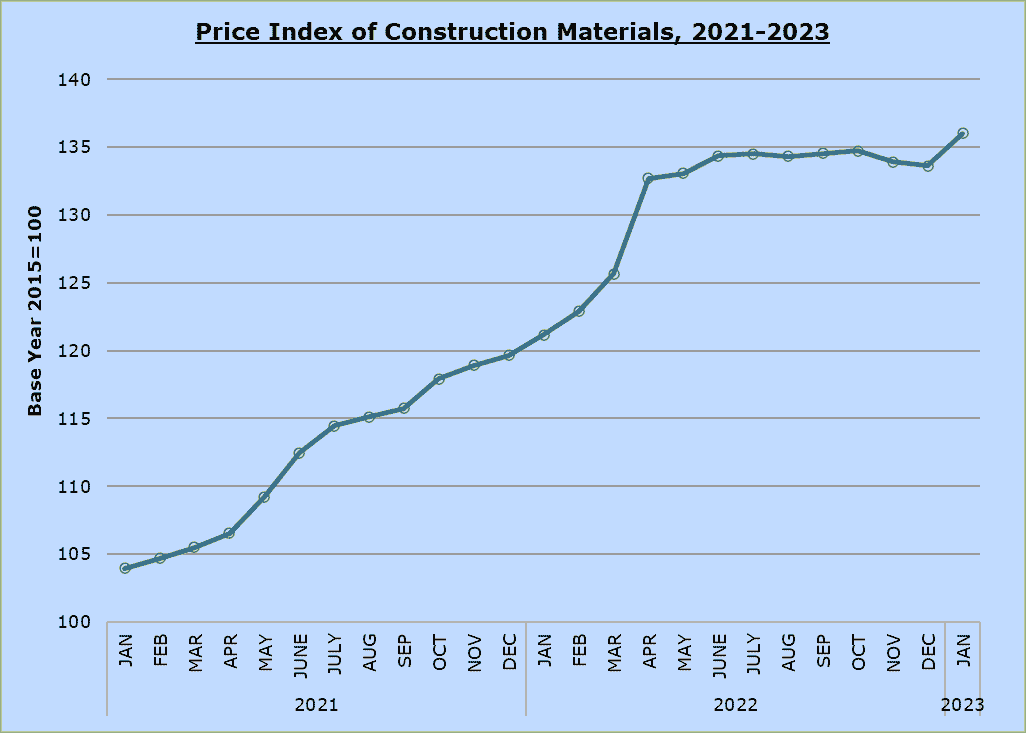
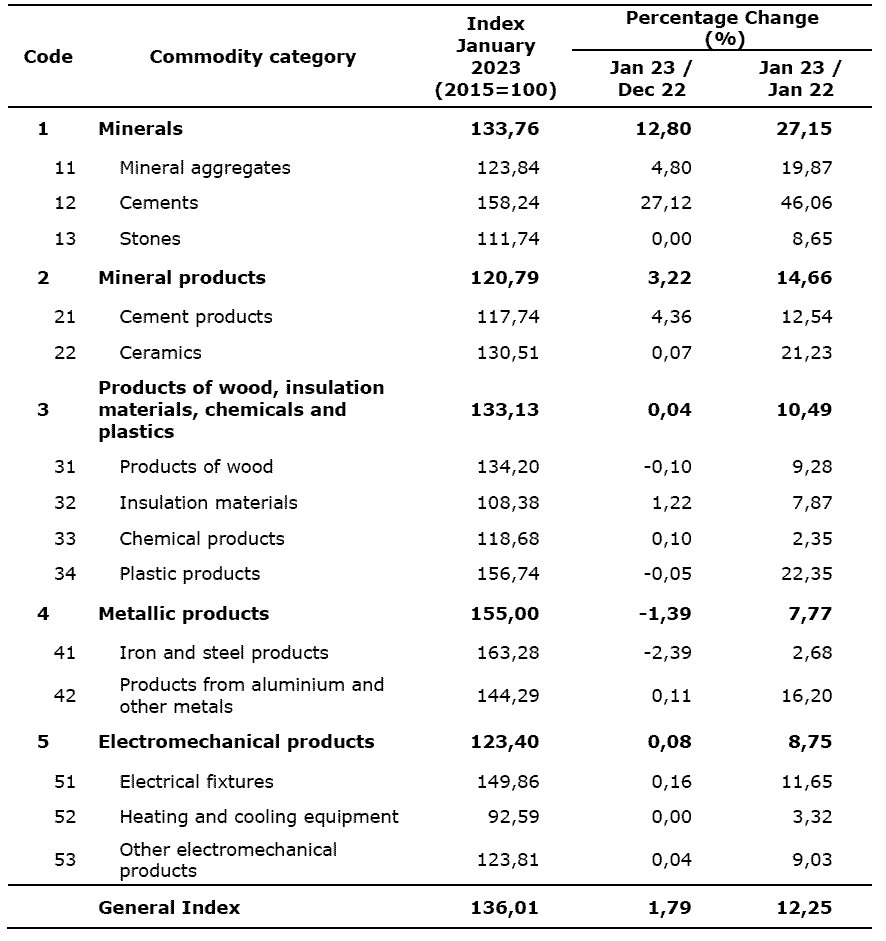
The price index of construction materials rose 12.25 per cent in January on an annual basis; an increase of 1.79% compared with December according to the Cyprus Statistical Service.
Compared to January 2022, the Cyprus Statistical Service reports price rises in metallic products of 7.77%, minerals 27.15%, products of wood, insulation materials, chemicals and plastics 10.49%, mineral products 14.66% and electromechanical products 8.75%.
The index, which rose to 136.01 in January, is the highest on record since 2006 when the Statistical Service started to record the data.
The index has risen significantly over the past three years.
Compared to the 2020 average, in January 2023 minerals had increased by 34.9%, mineral products by 22.2%, products of wood, insulation materials, chemicals and plastics by 32.7%, metallic products by 47.7% and electromechanical products by 25.6%.
Cumulatively, since 2020 the price index in January 2023 is up 34.7%, 21.4% compared to 2021 and 3.6% compared to 2022.
Although the growth rate is declining, prices remain at record highs.
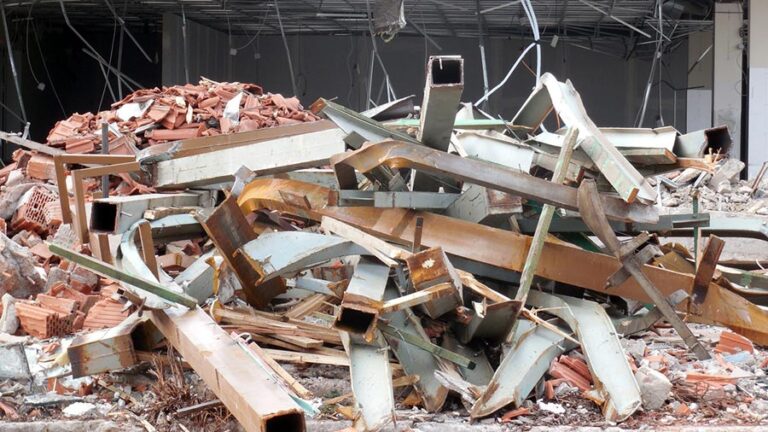
Cyprus’ goal is to recycle 70 per cent of construction and demolition waste, Agriculture Minister Costas Kadis said on Friday.
Speaking at a conference on a robotic method used to separate waste from construction and demolition part of the DEFEAT programme, Kadis said that the programme is implemented by Frederick University in collaboration with the environment department, the federation of building contractors associations of Cyprus and several other private bodies.
“It aims to develop a composite material from construction and demolition waste,” he said.
He said that this material will be fire-resistant, characterised by low thermal conductivity and suitable mechanical and fireproof properties, and will be able to be used in the facade, either in existing or in new buildings, with obvious benefits and advantages both in terms of fire safety and in terms of energy efficiency.
The minister added that as part of the programme, an innovative robotic method of separating construction and demolition waste was developed, through a detailed experimental study and on a pilot scale.
Congratulating the prototype’s inventors, the minister noted that even in the most modern of construction waste units, separation is done manually without the benefit of cutting-edge technologies such as those incorporated in the DEFEAT project.
“Today, through presentations by reputable speakers, we will have the opportunity to learn about the methodological approach that was applied to the design and implementation of this method, as well as how it works,” he said.
In the EU, he said that construction and demolition waste represents about a third of the total, amounting to approximately three billion tonnes of waste produced annually by economic activities and by households.
Currently each year, approximately 2.2 million tonnes of excavation, construction and demolition waste is generated in Cyprus, with 57 per cent of this ending up in landfills. The goal is to turn some of this rubble into a useful composite material, in line with the EU’s green deal circular economy aspirations, the minister said.
He added: “For this reason, the European Commission has prioritised the promotion of the circular management of said waste in the member states of the union.”
Kadis also said that in Cyprus the ambitious European targets for increasing sorting at the source and recycling and reusing materials have been adopted.
“Especially for construction and demolition waste, the goal is to recycle at least 70 per cent of this waste,” he said.
Kadis added that ministry is encouraging the private sector to create construction and demolition waste management facilities, resulting in their number increasing from two facilities in 2016 to 11.