Construction materials prices up 12.65%

0

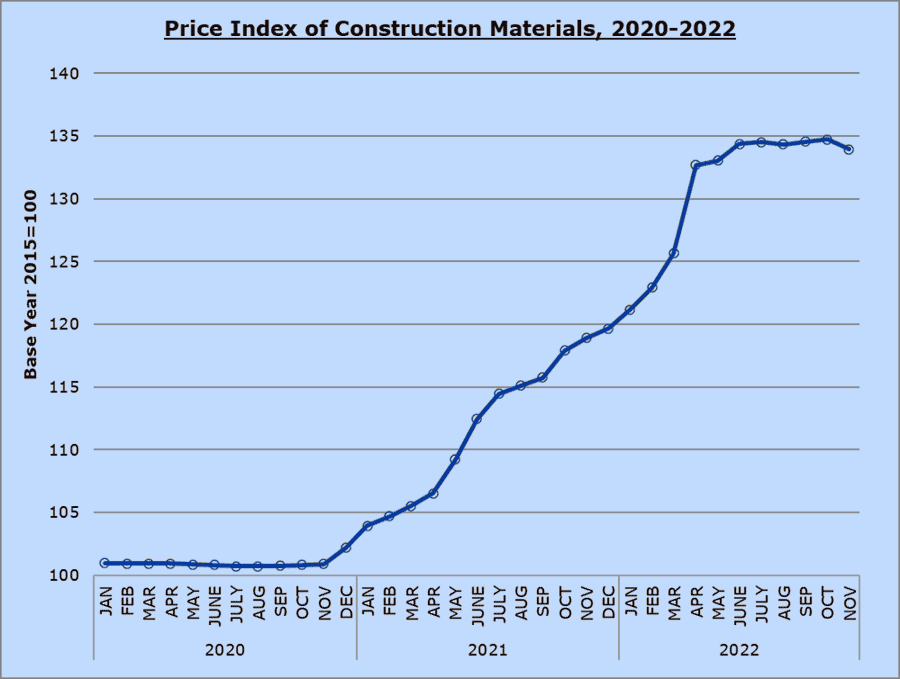
The price index of construction materials rose 12.65 per cent in November on an annual basis, while falling by 0.58% compared with October according to the Cyprus Statistical Service.

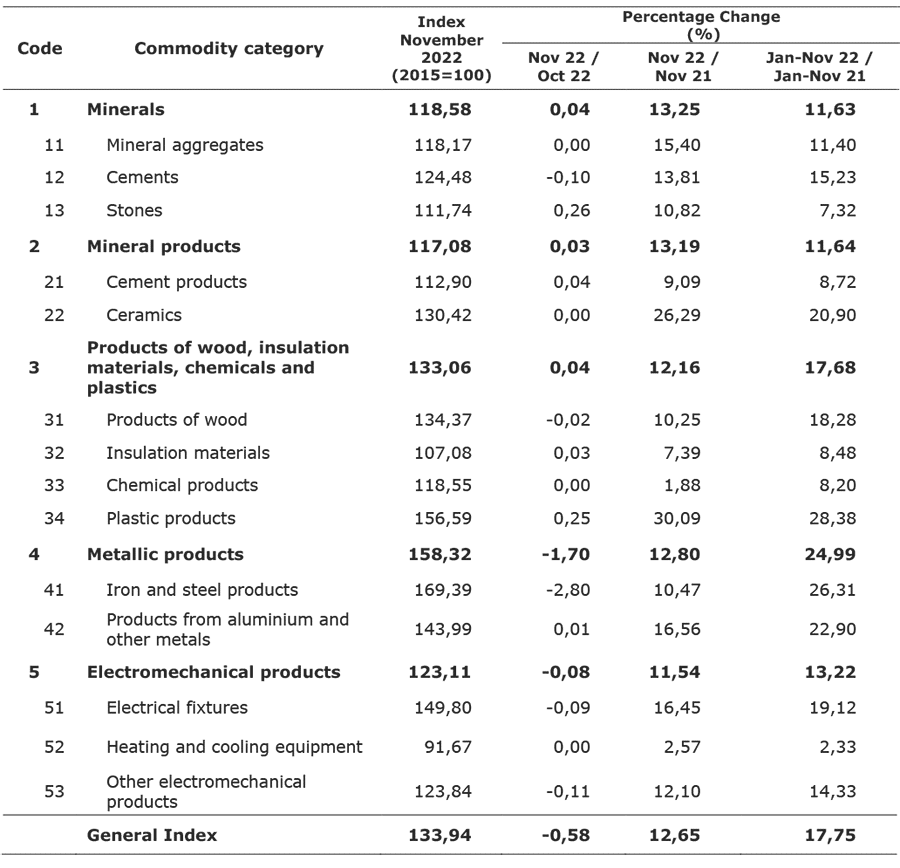
Compared to November 2021, the Cyprus Statistical Service reports price rises in metallic products of 12.80%, minerals 13.25%, products of wood, insulation materials, chemicals and plastics 12.16%, mineral products 13.19% and electromechanical products 11.54%.

chart

table

Building permits continue to fall

0

The number of building permits authorised in Cyprus during September 2022 stood at 670. The total value of these permits reached €226.9 million and their total area 202.8 thousand square metres. These permits provide for the construction of 687 dwelling units.

Compared to September 2021, the number of permits issued fell -12.8%, their total area fell by -3.8%, but their total value rose by 10.0%.

Building permits and the construction sector in general is being impacted by increasing prices of construction materials, the effects of the war in Ukraine and inflation (that stood at 9.0% at the end of September.)

The 670 permits were authorised for the following:

  • Residential buildings – 457 (-11.6% from 517 in September 2021)
  • Non-residential buildings – 96 (-33.3% from 114 in September 2021)
  • Civil engineering projects – 41 (-18.0% from 50 in September 2021)
  • Division of plots of land – 56 (up 21.7% from 46 in September 2021)
  • Road construction – 11 (up 81.8% from 11 in September 2021)

Permits for new homes

The 457 residential permits provided for the construction of 760 new homes (dwellings), comprising:

  • Single houses – 290 (-11.3% from 327 in September 2021)
  • Two housing units – 83 (up 18.6% from 70 in September 2021)
  • Dwellings in residential apartment blocks – 374 (-18.2% from 457 in September 2021)
  • Dwellings in residential/commercial apartment blocks – 13 (-75.5% from 53 in September 2021)

Of those 760 new homes, 322 are destined for Nicosia, 235 for Limassol, 121 for Larnaca, 48 for Paphos and 34 for Famagusta.

There’s a significant shift from the construction of single houses to apartments, which may be attributed to the increased costs of building materials, energy and inflation (that stood at 8.90% at the end of September.)

Building Permits Issued for the Construction of New Homes
(Number of Dwelling Units)

Month 2021 (Dwellings) 2022 (Dwellings) Increase/Decrease Change
January 702 640 -62 -8.8%
February 663 901 238 35.9%
March 1,033 962 -71 -6.9%
April 955 601 -354 -37.1%
May 1,061 893 -168 -15.8%
June 998 1,146 148 14.8%
July 874 776 -98 -11.2%
August 554 687 133 24.0%
September 970 760 -147 -16.2%
Totals 7,747 7,366 -381 -4.9%

Building permits year to date

During the first nine months of 2022, 5,701 permits were issued compared to 6,008 in the same period last year; down -5.1%. The total value of these permits fell -1.0%, their total area fell -7.2%, while the total number of dwelling units fell -4.9%.

Although more new homes are being built is Nicosia and Famagusta; up 8.7% and 5.9% respectively, the numbers are down in the three remaining districts; Limassol -7.5%, Paphos -17.0% and Larnaca -18.7%.

Building permits 2020-2022

According to the Cyprus Statistical Service “Building permits constitute a leading indicator of future activity in the construction sector.”


Continued growth in Limassol apartment values

0

During the third quarter of 2022, the sale values of properties across Cyprus rose 3.9% for apartments, 1.1% for houses, 0.6% for offices compared to the second quarter, according to the Ask WiRE Index for Q3 2022.

The sales values of holiday apartments and holiday houses rose by 1.9% and 0.6% respectively but, on the downside, the values of retail premises and warehouses fell by 0.3% and 1.5% respectively over the same period.

On an annual basis, prices for apartments rose 9.4%, houses by 1.4%, while the prices of holiday apartments rose by 3.9% and holiday houses by 0.4%. However, the prices of retail premises fell by 1.9% and warehouse fell by 5.6%.

Limassol stands out from the districts, as sale values of apartments continued to rise for the fourth consecutive quarter (4.8% in Q3 2022).

Rental values over the third quarter rose by 6.0% for apartments, 4.2% for houses, 0.9% for retail, 0.5% for warehouses, and 4.1% for offices, while the rental values for holiday apartments and holiday rose by 6.4% and 3.0% respectively.

On an annual basis, rental values increased by 16.2% for apartments, 12.2% for houses, 3.9% for offices, 14.5% for holiday apartments and 10.2% for holiday houses, but fell by 1.3% for retail and 1.6% for warehouses.

Paphos stands out from the districts, as rental values of apartments and holiday apartments rose significantly for another quarter (by 12.5% and 11.1%, respectively, in Q3).

Property Type Sale Value Rental Value
Apartments 3.9% 6.0%
Houses 1.1% 4.2%
Commercial -0.3% 0.9%
Warehouses -1.5% 0.5%
Office spaces 0.6% 4.1%
Holiday apartments 1.9% 6.4%
Holiday houses 0.6% 3.0%
Source: Ask WiRE – Quarterly percentage change in property values (Q2 2022 with Q3 2022)


Property Type Sale Value Rental Value
Apartments 9.4% 16.2%
Houses 1.4% 12.2%
Commercial -1.9% -1.3%
Warehouses -5.6% -1.6%
Office spaces -0.4% 3.9%
Holiday apartments 3.9% 14.5%
Holiday houses 0.4% 8.7%
Source: Ask WiRE – Annual percentage change in property values (Q3 2022 with Q3 2021)

Pavlos Loizou, CEO of Ask WiRE, commented “The influx in population due to in-migration over the first three quarters of 2022 and pend-up demand over the past couple of years continues to drive the residential market.

“However, we are seeing signs of pull-back in investor appetite due to the higher cost of credit and availability of other investment opportunities in bonds, stocks, etc.

“Inflation and the higher costs of credit continue to affect local households, whilst migrants, typically earning above average salaries, are driving the top-end of the market.

“We are increasingly seeing a two-tier market evolving, each having its own characteristics and drivers.

“We are still away from seeing a return to stability, as the landscape around the global economy and geopolitics keeps shifting.”

Housing booms over as prices fall

2

Housing booms across many advanced economies are coming to a halt due to rising mortgage rates and weak economic growth prospects, according to Moody’s analysis.

“Slowing home sales and a moderation of house price appreciation, if not outright corrections, are now likely in most markets where house prices appreciated rapidly in 2021 and earlier this year.

“Although we do not envision disorderly downturns similar to those during the global financial crisis, housing activity will slow, with prices normalising toward levels more consistent with economic fundamentals,” Moody’s said.

It argues the speed and degree of adjustments will depend on macroeconomic and housing-specific factors such as mortgage market structures, housing supply conditions and demand drivers such as demographics.

“The cooling of housing markets will improve affordability, which has worsened significantly over the last two years. It will also reduce financial stability risks.”

And housing markets across countries have differing sensitivities to rising mortgage rates.

“House price corrections may be significant in some markets, while other markets may experience sustained zero-to-low nominal price growth that erodes real house values over time.

“Next year, we expect house prices to fall by larger amounts in the UK, the US and Germany, with more minimal declines or gains in Portugal, Ireland, Italy, and France.”

Moody’s said housing markets with more variable-rate or short-term fixed-rate borrowing are at higher risk of a correction.

“In markets such as the UK, where there is a preponderance of mortgages that reset as interest rates rise, current homeowners will face particular challenges from rising housing costs over the next one to three years.

“In some markets, rising mortgage rates will not only curtail demand, but they will also increase supply as some current homeowners will look to sell properties they can no longer afford.”

While home affordability will improve, it will remain stretched for the next two to three years, according to analysis.

“In a number of countries, housing affordability is worse than just before the global financial crisis.

“Even in markets with declining house prices, higher borrowing costs and tighter financial conditions will limit affordability.”

Home buyers cheated state of €16.2 mln VAT

Over 270 people, mostly foreign investors eyeing a Cypriot passport, benefited from the reduced rate of 5% VAT for first-time home buyers instead of paying the standard 19% rate, with state coffers denied €16.2 million in taxes.

The revelation was made by Finance Minister Constantinos Petrides, who said the state intends to collect due taxes.

He said the 275 cases were identified following proof collected from on-site checks earlier this year.

Since the beginning of October, the Tax Department has been conducting on-the-spot inspections at homes and apartments to establish whether owners were actually living there or renting them out.

He said that checks discovered that 275 homeowners were found to be ineligible for the reduced 5% and, therefore, should be charged with a 19% VAT.

More than 1,700 on-the-spot checks have been carried out in less than two months.

Petrides expressed satisfaction with the results of the checks noting the money owed will be collected.

“However, this also demonstrates an abuse of the 5% VAT scheme”.

“Mainly foreign investors who bought an apartment or house took advantage of the legislation for a reduced rate of 5% VAT but live permanently abroad and rent the property through the Airbnb platform.

“Also, Cypriots who live in Nicosia or another city bought a country house in a coastal town declaring it as their main residence, but which they rent to third parties,” said Petrides.

He pledged the checks would continue, and they would also begin on other categories of taxpayers.

RICS with KPMG reports rising property values

0

In their overview of real estate activity in Cyprus during the third quarter of 2022 RICS Cyprus with KPMG reports increases in the values of most property categories in their Cyprus Property Index, albeit they all still remain below where they were in the base period for the series (2009Q4).

Residential continues to be a strong performer with the trend in both houses and apartments solidly positive. For the commercial sector, all categories have shown increases, to a greater or lesser extent, over the past quarter, with offices at the top end of the spectrum and retail recording the most modest gains.

Market values year-on-year

An island-wide increase was observed in the value of all property types:

  • Apartments up 11.48%
  • Houses up 7.56%
  • Retail premises up 2.32%
  • Warehouses up 4.26%
  • Offices up 7.92%

Holiday homes

Holiday apartments and houses continue to experience a firm upward trend in their values following the Covid related drop in 2020 and the early part of 2021.

  • Holiday apartments up 7.65%
  • Holiday houses up 6.93%

Rental values year-on-year

Rental values showed an increase across all property types, with the largest increase recorded in houses, followed very closely by holiday apartments. The smallest increases were recorded in retail and warehouses.

  • Apartments up 15.54%
  • Houses up 16.76%
  • Retail premises up 1.50%
  • Warehouses up 2.71%
  • Offices up 9.18%
  • Holiday apartments up 16.36%
  • Holiday houses up 6.39%

Rental yields

In the third quarter of 2022, rental yields stood at:

  • Apartments 5.11%
  • Houses 2.79%
  • Retail 5.64%
  • Warehouse 4.38%
  • Office 5.22%
  • Holiday Apartments 5.27%
  • Holiday Houses 2.69%

Comments from KPMG and RICS

On behalf of KPMG in Cyprus, Christophoros Anayiotos, Head of Real Estate Industry Group, stated:

“The third quarter of 2022 shows an endurance of the increasing trend in property values, with notable increases in Famagusta in almost all categories. The best performers are again Apartments, whilst Offices are making a comeback. Retailing and Warehouses exhibited minor adjustments, with minor decreases demonstrated in Paphos. The upward trend of construction costs has begun to slow down, albeit still at a high level, however increasing inflation and supply chain issues are still expected to affect the property sector overall”.

On behalf of RICS, Simon Rubinsohn, RICS Chief Economist, commented:

“Although the real estate sector remains resilient for now according to the latest results, the more challenging the macro environment is, it is likely to gradually have some impact both on activity and pricing. That said, feedback to the RICS sentiment survey which complements this report suggests forward looking expectations have not materially shifted in the face of the uncertainty fuelled by the global energy crisis with demand indicators still showing a positive trend”.

Full details may be found in the RICS Cyprus Property Index with KPMG in Cyprus for Quarter 3 2022