Is the property market cooling?

0

Official figures from the Department of Lands & Surveys indicate that the Cyprus real estate market may be cooling although the number of property sales in November was the highest since 2007.

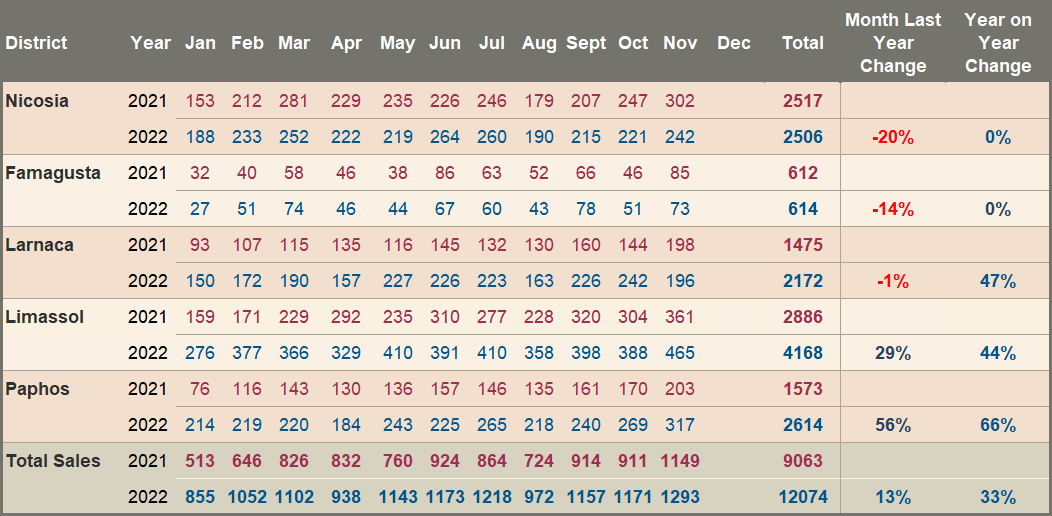
During November a total of 1,293 property sales contracts were deposited at Land Registry offices across Cyprus compared with 1,149 in the same month last year; a rise of 13%.

However, the number of sales in Nicosia fell for the second consecutive month while sales in Famagusta and Larnaca also fell. But these falls were outweighed by increased sales in Limassol and Paphos, the areas most popular with foreign buyers.

In terms of the number of sales, Limassol lead the way with 465, followed by Paphos (317), Nicosia (242), Larnaca (196) and finally Famagusta with 73 sales.
Total Property Sale Transactions – 2021/2022 Comparison

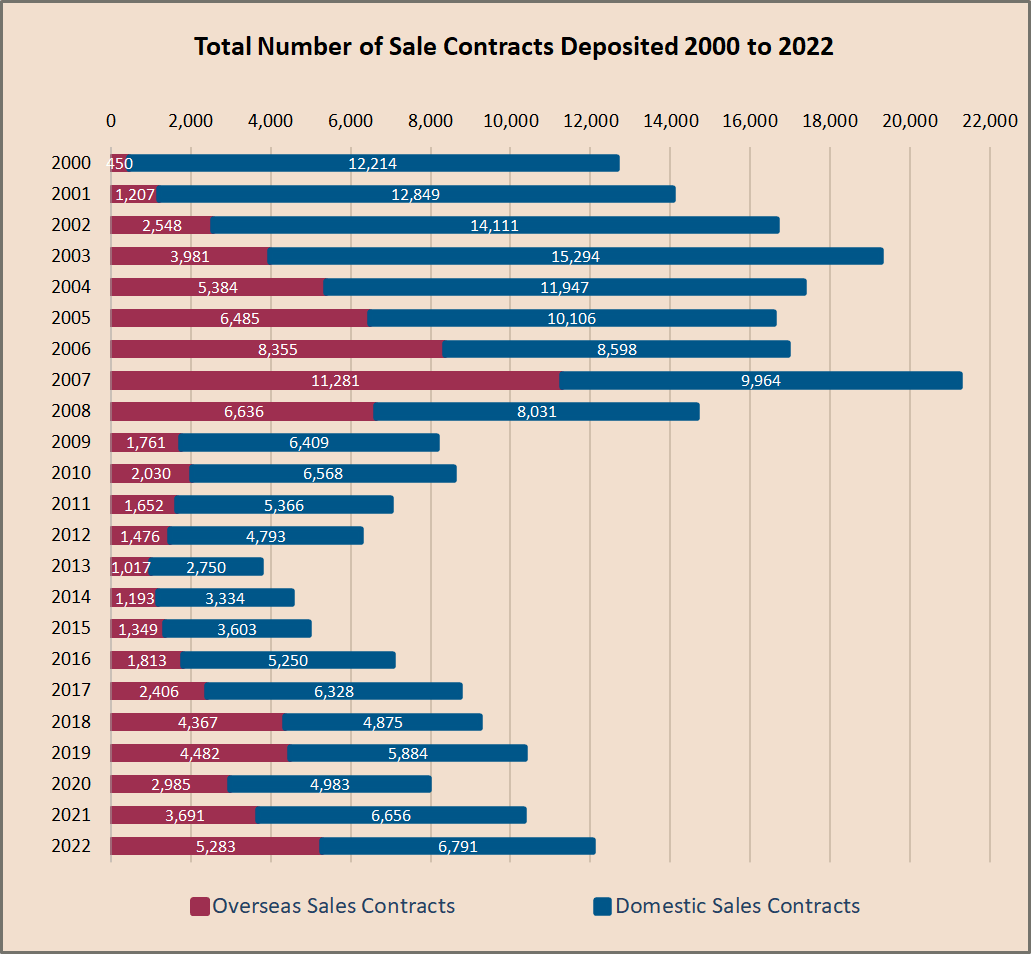
In the first eleven months of 2022 a total of 12,074 contracts were deposited at Land Registry offices, a rise of 33% compared to the 9,063 deposited during the same period in 2021, with the number of sales at their highest level since 2008.

Sales in the capital (Nicosia) were slightly down compared to 2021 and sales Famagusta remained steady. However, double-digit increases in the number of sales in Paphos, Larnaca and Limassol districts are set to make 2022 the best year for the sector since 2008.
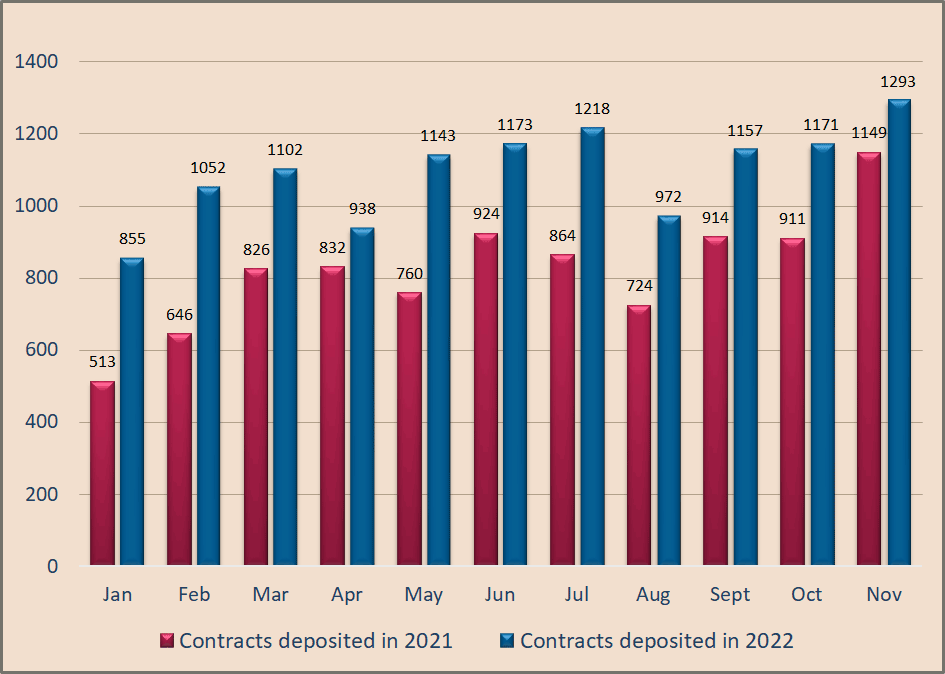
Total number of sale contracts deposited for years 2021 and 2022 by month

Market segment analyses

Property sales to the domestic market

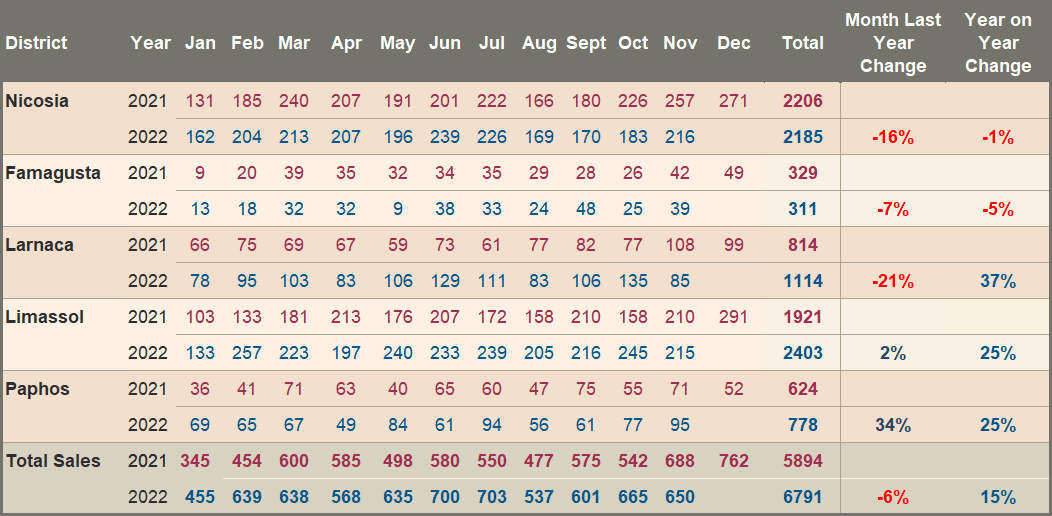
Domestic real estate sales in November, as measured by the number of sale contracts deposited at Land Registry offices, fell 6% compared to November 2021 with sales in Nicosia, Famagusta and Larnaca all recording falls.

Nicosia saw the greatest number of sales followed by Limassol, Paphos, Larnaca and Famagusta.
Domestic Sale Transactions – 2021/2022 Comparison

Sales to the domestic market during the first eleven months of 2022 sales reached 6,791, a 15% increase on the 6,791 achieved during the same period last year.

Property sales to the overseas market

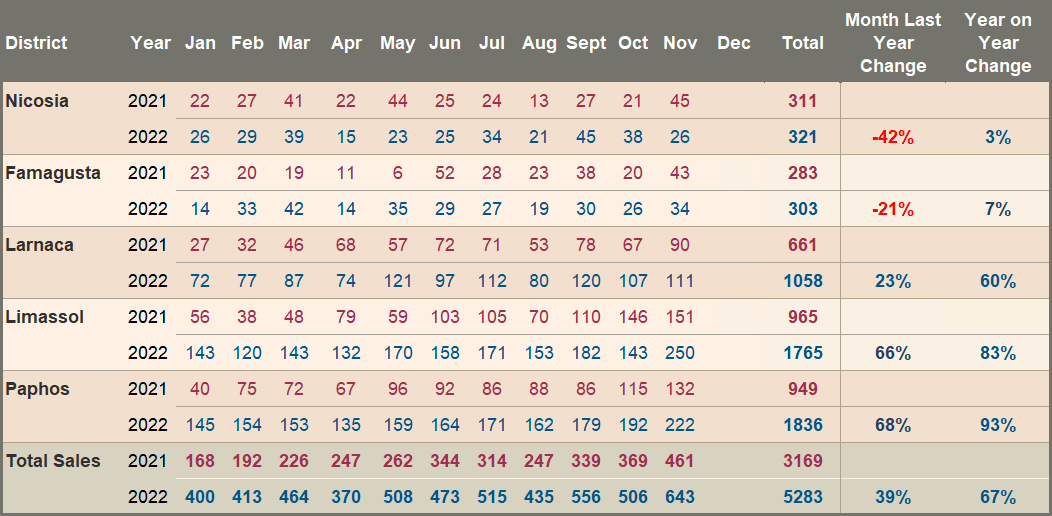
Sales to foreigners (non-Cypriots) were up 39% compared to November 2021 with sales rising in all districts with the exception of Nicosia and Famagusta, where they fell by 42% and 21% respectively.

Limassol achieved the greatest number of sales, followed by Paphos, Larnaca, Famagusta and Nicosia.
Property sales to the overseas market

Sales to overseas buyers during the first eleven months of 2022 reached 5,283; a 67% increase on the 3,169 achieved in the same period last year.

Property sales to EU nationals

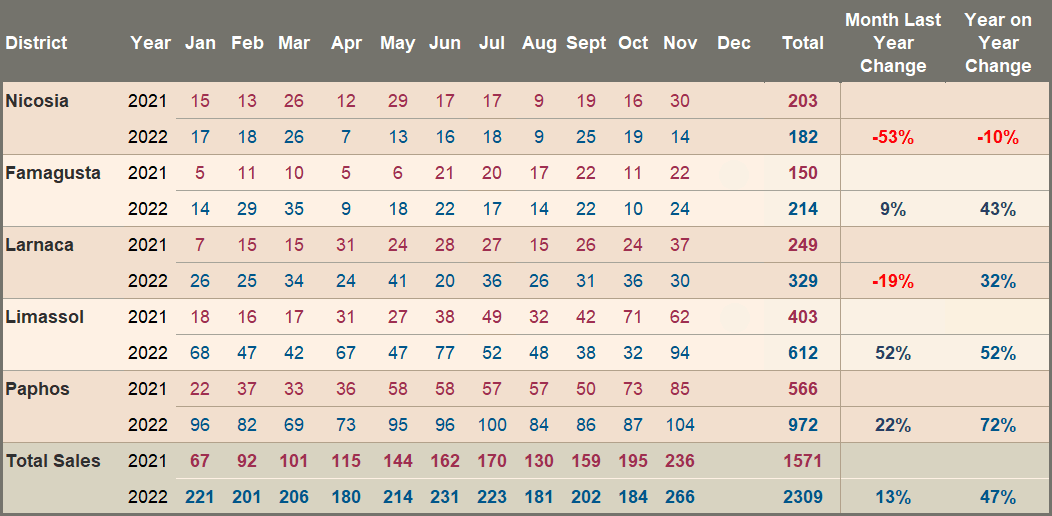
Sales to EU nationals rose 13% compared to November 2021, despite the number of sales falling in Nicosia and Larnaca.

Paphos achieved the greatest number of sales, followed by Limassol, Larnaca, Famagusta and Nicosia.
Overseas (EU) Sale Transactions – 2021/2022 Comparison

Foreign real estate sales to EU nationals during the first eleven months of 2022 reached 2,309; a 47% increase on the 1,571 achieved in the same period last year.

Property sales to non-EU nationals

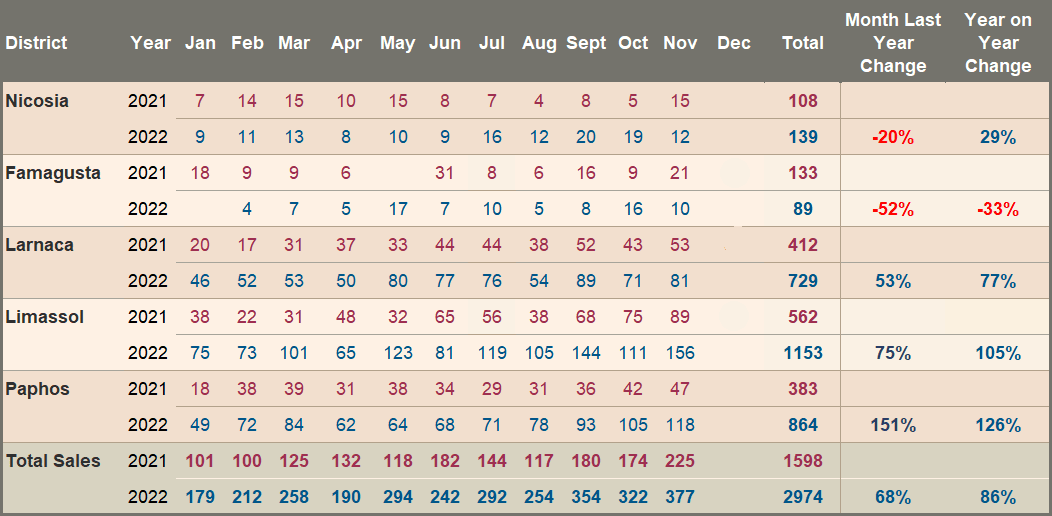
Sales to non-EU Nationals rose by 68% compared to November 2021, although sales fell in Nicosia and Famagusta.

Limassol recorded the highest number of sales, followed by Paphos, Larnaca, Nicosia and Famagusta.
Overseas (non-EU) Sale Transactions – 2021/2022 Comparison

Overseas sales to non-EU nationals during the first eleven months of 2022 reached 2,975; an 86% increase on the 1,598 achieved in the same period last year.

 

Bar raised for Cyprus retirees

UK and other non-EU pensioners eyeing a retirement home in Cyprus are being pushed to rethink their plans as authorities raise the bar for residence permits, temporary or otherwise.

The changes come amid a surge of demand from retirees from the UK, Israel, and Germany, with real estate agents worried the government’s plans will prematurely burst a mini-boom in the sector.

The Interior Ministry has recently posted changes to its temporary residence scheme, tightening requirements which allow non-EU passport holders to extend their stay in Cyprus for more than 90 days.

Detailed statements of bank account transactions in a financial institution in the Republic of Cyprus need to be provided, showing an income not less than €2,000 per month or €24,000 per year for one person.

This amount increases by 20% for the spouse and 15% for each child.

So, a couple retiring to the island will need proof of €28,800 income per year.

A cash transfer or deposit of at least €10,000 is also accepted during the first permit.

Currently, retirees only need an annual income of €10,000 to be accepted as candidates for a residence permit.

Cyprus also requires blood tests, proving that the third-country national does not suffer from hepatitis B and C, HIV, or syphilis, as well as a chest X-ray for tuberculosis with a doctor’s opinion stamped by a specialist doctor from the Republic.

“This could endanger the boom in demand we have seen in recent months for property in the coastal areas, especially Paphos,” said Esme Palas, Barrister at Law, Partner at Michael Kyprianou and Co LLC Paphos.

She told the Financial Mirror that since news broke over the government’s intentions to increase requirements for people intending to reside in Cyprus without exercising any economic activity, requests have flooded in from UK citizens.

“We were not informed of these changes, which come into effect in just a month.

“This has resulted in stakeholders on the island having to inform their clients of the new requirements, which they may not be able to meet,” said the barrister.

“They are concerned, as many of these people rely on selling property they own back in the UK and their pension.

“Many people may have money in the bank to back a property purchase but do not have a yearly income to meet the new criteria,” said Palas.

She said that stakeholders had requested clarifications from authorities on whether the deposits counted as part of the yearly income.

Real estate

Real estate agents in Limassol and Paphos are reporting the highest demand from foreign buyers and Cypriots for homes since 2020 when the government ended the disgraced citizenship for an investment scheme.

Palas said the influx in demand is powered mainly by UK expats looking for a retirement home, Israelis, and Germans looking to relocate.

“Sales in Paphos are flying.

“This is the most traffic we have seen in recent years, with our clientele growing rapidly as more foreigners are looking for a home on the island”.

Paphos has seen sales to foreign nationals rise by 113% in the first five months, compared to last year, as 746 sales documents were submitted to the Land Registry.

Of the 746 properties sold, 415 were bought by non-EU nationals; they bought 186 in the first five months of 2021.

Real estate stakeholders and service providers in Limassol report similar issues, although not to the extent recorded in Paphos.

A service provider catering mainly to Russian expats looking to retire in Cyprus echoed Palas’ has seen many cancellations, while many clients are reconsidering their options.

“We are probably witnessing the biggest movement we have seen in the local market since the end of the citizenship for investment scheme, coinciding with two years of inaction due to COVID restriction,” said the service provider.

Preferring to keep their anonymity, the service provider said the problem is not as sizeable as it is in Paphos, as Limassol is mainly preferred by clients looking to buy high-end properties.

“Nevertheless, we have a large number of Russian and other third-country nationals looking to retire in Cyprus, with money in the bank from property sales in their country, but do not have the yearly income now required.

“It feels like the government is trying to make things difficult for us.

“Just recently, they were mulling over increasing requirements for the permanent residency permit, raising the bar for property purchases”.

There is speculation the government may toughen income criteria for non-EU newcomer retirees by €100,000 to at least €250,000.

The Interior Ministry confirmed to the Financial Mirror the cabinet had approved amendments to the regulations governing how immigration permits are granted to foreign nationals.

A ministry source said that the changes resulted from EU directives and pressure to “raise the bar”.

The source said Brussels had instructed member states to tighten controls and regulations on residency permits handed out to third-country nationals.

It is understood that the war in Ukraine and sanctions on Russia have directly impacted EU directives sent out.

Construction materials prices rise 14.26%

0

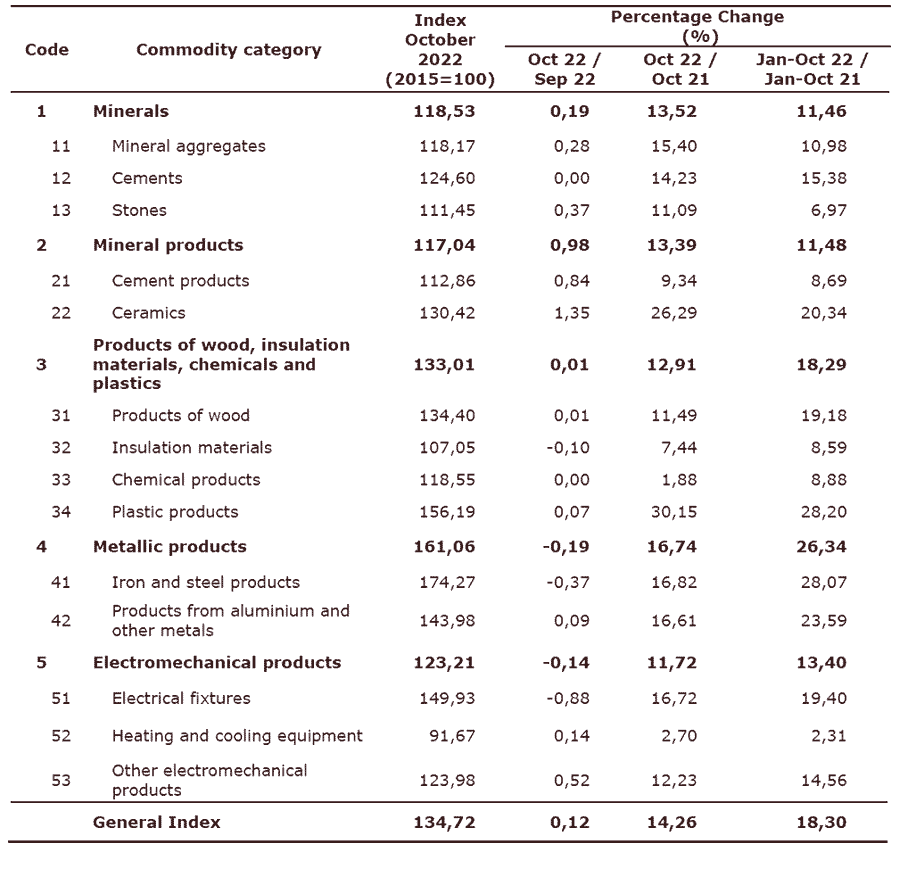
The price index of construction materials rose 14.26 per cent in October on an annual basis and 0.12% compared with September according to the Cyprus Statistical Service.

Compared to October 2021, the Cyprus Statistical Service reports price rises in metallic products of 16.74%, minerals 13.52%, products of wood, insulation materials, chemicals and plastics 12.91%, mineral products 13.39% and electromechanical products 11.72%.

Temporary residency made harder for expats

4

Undoubtedly the law amendments on the registration and acquisition of a temporary residency permit in the Republic, published on the government website, will affect British nationals relocating to Cyprus post-Brexit.

Those of us working in the field of immigration law have been taken aback by reforms to the current regime and regulations governing the granting of temporary residence permits to third-country nationals (which de facto now includes British Nationals post-Brexit).

We have been anticipating reforms to the law on permanent residency but were not aware that regulations on temporary residency permits would undergo revision.

According to the Aliens and Immigration Regulations, third-country nationals can extend their stay in Cyprus for more than 90 days for the purpose of:

  1. entering the Republic for short or long-term holidays
  2. touring
  3. investigating the possibility of settlement in the Republic, they can apply for a temporary residence permit – the so-called “pink slip” – which allows non-EU passport holders to extend their stay in Cyprus for more than 90 days.

Under this permit, a person can live in Cyprus for one year as a visitor but cannot normally carry out any economic activity in the Republic.

Spouses and children under 18 can also get a temporary residence permit as dependents.

To be eligible for this type of permit, the applicant mainly needs to show the following:

  • adequate income from abroad to cover living expenses while residing in Cyprus
  • they are renting or have bought a house or apartment in Cyprus
  • they have health insurance for medical care valid in Cyprus

This permit is valid for one year and can be renewed annually, provided that the relevant criteria are met.

It is important that a holder of this temporary residence permit cannot stay out of the country for more than three months at a time, as this will result in the permit being cancelled.

Until now, there was no requirement for a clean criminal record to be provided from the country of origin or residence nor for medical tests to be taken.

Furthermore, there was no specific amount of the deposits required in a Cypriot bank, and the amount of annual income that had to be received from abroad was not quantified.

The indication was that the income had to be sufficient to cover living expenses whilst in Cyprus.

From January 1, 2023, however, this will change.

In addition to the documents required to date, such as proof of a residence in Cyprus (rented or owned) and private health insurance, new requirements have been added, and applicants are required to produce the following:

  • Original Clear Criminal Record Certificate from the country of origin or residence, if the applicant resides in a country other than the country of origin, with a duly certified official translation in Greek or English.
  • Original medical examination certificate of blood tests proving that the third-country national does not suffer from hepatitis B and C, HIV, syphilis, and a chest X-ray for tuberculosis with a doctor’s opinion, stamped by a specialist doctor from the Republic of Cyprus.
  • Original letter of guarantee from a banking institution in the Republic of Cyprus, with a duration of ten (10) years, to cover possible repatriation expenses in the applicant’s name from their bank account. The amount depends on the country of origin. To date, this was not required to be provided by UK Nationals, and we anticipate that this will continue to be the same in the New Year.
  • Evidence that the applicant has sufficient and stable resources derived from a stable or satisfactory income of the applicant outside the Republic.

Income includes salary, pension, deposits in a bank account abroad, rents, dividends, interest on deposits or by exception from dividends from a company in the Republic (with certification by the Company’s Accountant, they do not receive any salary from his position) or rents in the Republic, or from income in the bank account in the Republic from a salary from previous work in a company of foreign interests.

  • Detailed statements of bank account transactions in a financial institution in the Republic of Cyprus need to be provided from the date of opening the bank account in the case of a first permit, showing the foreign remittances in the name of the applicant, which in total should be not less than €2,000 per month or €24,000 per year for one person. This amount increases by 20% for the spouse and 15% for each child. For the purposes of calculating the amount, transfers abroad or to third parties will not be considered.
  • A cash transfer or deposit of at least €10,000 is also accepted during the first permit. The cash declaration at customs must be submitted in case of a cash deposit.

When applying for the renewal of the visitor’s permit, the balance in the account must, in any case, not be less than €6,000, which corresponds to three months’ income, regardless of the size of the family.

For purposes of calculating sufficient funds, the bank statement will be accompanied by the following:

  1. a declaration of the number of family members that the sponsor will support in the Republic
  2. a summarised statement of income.

There is some vagueness in the new requirements, and no doubt there will be more guidance given once the regulations come into force.

Obviously, the government’s policy is to raise the bar on who will be allowed to reside in Cyprus on a temporary residence permit. There are no doubt additional hurdles imposed on prospective applicants in the new year, making compliance slightly harder.

We anticipate that these amendments will particularly affect British Pensioners who wish to retire in Cyprus.

By Esme Palas Barrister at Law, at law firm Michael Kyprianou & Co LLC

This article is intended to provide a general guide to the subject matter and does not constitute legal advice. For further information or advice, please contact Esme Palas, Partner at Paphos Office, by email [email protected] or telephone ++357 26930800.

Golden passport trial delayed until next year

Four accused of selling Cypriot passports (the so-called ‘golden passports’) to dubious investors for cash were called to plead the five charges against them before the Nicosia criminal court on Wednesday, with the process for three delayed.

Lawyer Andreas Pittadjis denied the charges, while the hearing for the other three key players allegedly involved in the now defunct ‘golden passport’ scheme was adjourned until 11 January.

Pittadjis’ trial is scheduled for March 8-9 next year.

The other three defendants, former House speaker Demetris Syllouris, ex-AKEL MP and businessman Christakis Giovani, senior manager of the Giovani Group Antonis Antoniou, were given time until January to answer the charges.

The four men face five charges, including conspiracy to subvert the Republic and bribing a public official.

Attorney General George Savvides ordered the prosecution following an Al Jazeera exposé and after assessing the findings of the public enquiry.

In August 2020, broadcaster Al Jazeera claimed high-ranking officials were ready to help a Chinese investor with a criminal past obtain a Cypriot passport through investment.

Syllouris and Giovani were secretly filmed trying to facilitate a passport for the fugitive investor.

Prominent Famagusta lawyer Pittadjis also featured in the video and others linked to Giovani’s property development company.

On Wednesday, only Pittadjis, representing himself, answered the charges.

“I am not seeking acquittal but vindication.

“In the temple of justice, let us all be heard,” Pittadjis said as he denied the charges against him.

Lawyers representing the other three defendants raised pretrial objections.

Syllouris is represented by Chris Triantafyllides and a team of defence lawyers, while lawyer George Papaioannou represents Giovanis and Antoniou.

Antoniou did not appear before the court as he is ill with covid.

Triantafyllides argued that there was an abuse of process at the start of the proceedings, claiming a conflict of interest by the Attorney General and his deputy Savvas Angelides.

He argued that three charges relate to two passports issued to foreign nationals and approved by the cabinet in 2019, highlighting that both Savvides and Angelides were ministers at the time.

Fictitious

He also claimed the other two charges “relate to the involvement of a foreigner who is a fictional person”.

The latter referred to the fictitious Chinese criminal Al Jazeera journalists who had asked the defendants to help acquire a Cypriot passport.

The passport scheme was scrapped in a hurry in November 2020 following the damaging fallout from the Al Jazeera report.

Following the allegations, the government commissioned former judge Myron Nicolatos to conduct an enquiry.

It found that the government broke the law countless times to grant citizenship to over 6,700 people from 2007 to 2020.

The damning report said that over half (53%) of the 6,779 passports granted were done so illegally, encouraged by a due diligence vacuum or insufficient background checks.

Cyprus’ passport scheme generated over €8 billion during its lifespan.

Nicosia began offering citizenship in exchange for substantial investment as early as 2007; the scheme was stepped up following the 2013 economic crisis.

It also said that politicians and institutions were accountable, while certain applicants and service providers may be criminally culpable.

The Qatar-based broadcaster reported that dozens of those who applied for the so-called ‘golden passports’ were under criminal investigation, international sanctions, or serving prison sentences.

Under the scheme, the government granted a passport for an investment of €2.5 million.

Climate change affects the property market

One of the last print editions of the Economist had the title ‘Say goodbye to 1.5° C’, which refers to the goal of limiting the increase in the planet’s average temperature to 1.5 degrees Celsius.

The article provided an extensive analysis of the reasons why climate change policies have failed.

The magazine was released a few days before the United Nations COP27 Climate Change Conference.

A few days later, the COP27 decided to create a special fund to financially support vulnerable countries expected to be hit by weather-related disasters— ‘The Loss and Damage Fund‘, as they called it.

The creation of the Fund is an indirect admission that the goal of containing climate change will not be achieved.

In fact, according to research presented during the summit, with the current data, the temperature will increase by at least 2.5 degrees Celsius by the end of the century.

Sea levels in the Mediterranean rose by 7cm between 2000 and 2018, according to the UK’s National Oceanographic Centre.

As might be expected, in Cyprus, many developed areas are at sea level or remarkably close, especially in the eastern part of the island.

Natural phenomena present a significant risk for financial institutions, especially banks that grant long-term loans and insurance companies whose operations are directly linked to losses from various events, e.g., floods and wildfires.

It is clear that extreme physical events affect the value of a property.

As previously mentioned, if a project is very close to the coast and at sea level today, it may be… floating in a few years!

Landslide

If a piece of land is in a landslide area or an area where the ground is subsiding, such as in the ‘Limnes’ (Lakes) area in Pissouri. In that case, its value will obviously be dramatically affected.

Any change in the value of a property directly affects the financial organisation that has financed its development/purchase or the insurance company that has offered it coverage.

Additionally, in this era where the ESG (Environmental, Social, Governance) criteria form the new reality, the energy efficiency of each property affects its value.

If a house or other building does not have a high-energy efficiency score, e.g., thermal insulation, photovoltaics, and so on, its attractiveness and value are reduced.

This concerns both properties aimed at retail buyers and institutional investors.

At Ask Wire, we collect data on all phenomena that can affect the value of a property.

Whether it is acute (one-off) risks such as a wildfire or an earthquake or chronic risks that evolve over time, such as the frequency of storms or floods because of climate change.

We even collect data about the condition of the ground or the correct inclination that the photovoltaics must have to be more efficient.

All this dynamic data is combined with satellite data to create a comprehensive package of information that financial organisations can leverage in a variety of ways, either to adjust their pricing policy and avoid surprises or to create new innovative products that meet the needs of our time, even to meet the ever-increasing supervisory requirements around ESG issues.

Cyprus alone can do little to prevent climate change.

Adopting and implementing solutions that at least predict the consequences and effects of potential acute and climate risks are imperative to facilitate companies and individuals to mitigate them.

About the Author

Pavlos Loizou, CEO, WiRE FS