No shift in house prices after rates hike

The increase in interest rates has not affected real estate price tags, as hiking construction costs and healthy investor demand looking for alternatives to low returns from savings keep prices buoyant.

The course of interest rates in the future is expected to determine property values, as an increase in the cost of borrowing could deter buyer interest.

Before the summer, the key rate was negative; there have already been three increases to 2%, while the European Central Bank is expected to push rates even higher during the meeting of its Governing Council on 15 December.

This will make access to credit more difficult, as borrowing will be considerably more expensive, according to ECB analysts.

“Mortgage interest rates rose significantly in the first half of this year, which may particularly affect house prices and real estate investment,” European Central Bank researchers were quoted by Phileleftheros daily.

“In particular, at a time when the ECB is raising interest rates, the models suggest that a one percentage point increase in mortgage rates could lead to a drop in prices of around 9% after two years,” the researchers note.

However, house prices are still high.

A 93 sqm apartment in Kaimakli (Nicosia) is for sale at €160,000, and a 130 sqm one is sold at €280,000.

An apartment of 72 sqm in Nicosia’s more prestigious Strovolos has a price tag of €145,000, and an 85 sqm flat in the same area is going for €220,000, while an apartment of 100 sqm in Engomi is sold at €340,000.

The Phileleftheros data refers to old apartments and not newly built ones.

House prices have yet to come down. For example, a 240 sqm detached house in Strovolos is €375,000, and a 233 sqm house in Lakatamia sells at €395,000.

In Limassol, a new apartment of 115 sqm in Agios Tychonas, on the outskirts of the city, sells for €470,000, while in the centre, a 97 sqm flat costs €240,000 and a 112 sqm in the tourist area of Moutayiaka is €1.35 million.

Buying a new house in the centre of Limassol is only affordable for high-end clients, as the cheapest house has a price tag of €700,000, with the majority exceeding €1 million.

Foreclosures freeze a ‘threat to recovery’

Finance Minister Constantinos Petrides will ask President Nicos Anastasiades to return the House’s decision to extend a freeze on foreclosures, arguing that Cyprus’s credibility among foreign investors and creditors will be shaken.

“Unfortunately, the passing of the proposal to extend a freeze on foreclosures does not leave any room for the Finance Ministry other than to recommend to the President of the Republic to exercise the powers granted to him by the Constitution to refer back the voted law,” said Petrides in a statement on Friday.

The comments followed the House approval on Thursday to extend the foreclosure freeze until the end of January 2023, evoking the tough financial climate created by the coronavirus pandemic and the Ukraine war.

It is the latest in a series of such extensions, with the initial freeze on foreclosures dating back to August 2021, which was imposed as borrowers came under pressure from COVID-19 lockdowns.

The last extension expired at the end of October.

Petrides said that the government is disappointed with the MPs’ decision as it delivers a blow to the economy, hindering efforts to overcome the financial crisis.

“Such practices harm the creditworthiness of Cyprus vis-à-vis the rating agencies.

“As a government, we will do what is possible to mitigate the negative consequences”.

He described parliament’s decision as an unnecessary development after the commitment given by credit acquisition companies not to sell off first homes.

He said this is a development which does not have a substantial impact but creates negative consequences given that the adoption of the law is tied to the disbursement of the first instalment from the Recovery Fund.

“Foreclosures are suspended without income or other criteria, thus rewarding strategic defaulters and burdening their debts on compliant citizens,” said Petrides.

Opposition parties blamed the government for not presenting an alternative to tackle the issue of non-performing loans.

The extension was voted by 34 votes of MPs belonging to opposition parties, with 12 ruling DISY MPs against it.

Foreclosures on first homes

First homes worth up to €350,000, commercial premises with a value of up to €750,000 and plots of land worth €100,000 will not be going under the hammer until after January.

MPs were not convinced by a commitment by banks and debt-acquiring companies that they would not be auctioning any main residencies.

The Finance Minister added that the law governing foreclosures would be in effect alongside a protection framework.

He referred to mediation and insolvency mechanisms protecting defaulters and government plans to help people who default on their mortgages, such as the ESTIA scheme and a mortgage-to-rent scheme promoted by the government.

The mortgage-to-rent scheme will cover all non-viable households who have applied for the ESTIA scheme but whose income is insufficient to keep up with payments.

Under the envisioned mortgage-to-rent scheme, households will pay a low rent for five years, after which they can buy their residence.

ESTIA was launched in September 2020 to reduce Cyprus’ bad debt mountain.

It saw the state subsidising one-third of toxic borrowers’ monthly instalments after a loan restructure agreed with the lender.

However, the scheme was declared a failure due to low participation, as only 20% of applications submitted were approved.


EC pushes for short-term letting regulation

The European Commission has adopted a proposal for a Regulation to enhance transparency in the field of short-term accommodation rentals and help public authorities ensure their balanced development as part of a sustainable tourism sector.

While short-term accommodation bookings offer benefits for hosts and tourists, they can create concerns for certain local communities struggling, for instance, with a lack of affordable housing. The new rules will improve the collection and sharing of data from hosts and online platforms. This will, in turn, inform effective and proportionate local policies to address the challenges and opportunities related to the short-term rental sector.

The new proposed rules will help to improve transparency on the identification and activity of short-term accommodation hosts, and on the rules they have to comply with, and will facilitate the registration of hosts. They will also tackle the current fragmentation in how online platforms share data and, ultimately, help prevent illegal listings. Overall, this will contribute to a more sustainable tourism ecosystem and support its digital transition.

New requirements for data sharing for short-term rentals

The new proposed framework will:

  • Harmonise registration requirements for hosts and their short-term rental properties when introduced by national authorities: registration schemes will have to be fully on-line and user-friendly.  A similar set of relevant information on the hosts and their properties, namely the “who”, “what” and “where”, should be required. When completing registration, hosts should receive a unique registration number.
  • Clarify rules to ensure registration numbers are displayed and checked: online platforms will have to facilitate hosts to display registration numbers on their platforms. They will also have to randomly check whether hosts register and display the correct numbers. Public authorities will be able to suspend registration numbers and ask platforms to delist non-compliant hosts.
  • Streamline data sharing between online platforms and public authorities: online platforms will have to share data about the number of rented nights and of guests with public authorities, once a month, in an automated way. Lighter reporting possibilities are foreseen for small and micro platforms. Public authorities will be able to receive this data through national ‘single digital entry points’. This will support well-targeted policy making.
  • Allow the reuse of data, in aggregate form: the data generated under this proposal will, in aggregate form, contribute to tourism statistics produced by Eurostat and feed into the upcoming European data space for tourism. This information will support the development of innovative, tourism-related services.
  • Establish an effective framework of implementation: Member States will monitor the implementation of this transparency framework and put in place the relevant penalties for non-compliance with the obligations of this Regulation.

Next Steps

The Commission’s proposal will be discussed in view of adoption by the European Parliament and the Council.

After its adoption and entry into force, Member States will have a two-year period to establish the necessary mechanisms for data exchanges.

Background

Short-term rentals are developing fast in the EU, largely boosted by the platform economy. They represent about one quarter of all tourist accommodation in the EU and their number is increasing significantly across the EU. This trend was confirmed during the COVID crisis: the number of short-term rental bookings during the summers of 2020 and 2021 were above the equivalent 2018 levels. In addition, the number of bookings over the first half of 2022, has increased by 138% compared with the same period in 2021. Short-term rentals have become critical for the EU tourism ecosystem, including guests and hosts, and for many communities, creating both opportunities and challenges.

The proposal for a Regulation on data collection and sharing relating to short-term accommodation rental services is a key action of the tourism transition pathway, published in February 2022. The proposal was announced in the Commission’s SME Strategy of March 2020 with a view to promoting the balanced and responsible development of the collaborative economy across the Single Market, in full respect of public interests.

It will also complement existing instruments, in particular the Digital Services Act which regulates online platforms, and the rules of the Directive on administrative cooperation in the field of taxation (DAC7).

For More Information

Proposal for a Regulation on data collection and sharing relating to short-term accommodation rental services

Questions & Answers

Factsheet

Collaborative economy

(Press Release issued by the European Commission)

House extends foreclosures freeze again

When the freeze was last extended in July this year Elizabeth McCaul (a Member of the Supervisory Board of the European Central Bank) advised caution over amendments to the foreclosures law stressing that “such policies can also backfire and destabilise the banking sector if designed in a haphazard manner.”

At that time ratings agency Moody’s warned on that the amendments approved by the Cyprus parliament to the legal framework governing foreclosures were “credit negative”, as it expected that they would “hamper banks’ efforts to reduce problem loans”.

Moody’s said that the amendments “will likely lengthen the foreclosure process”.

“The amendments will likely make it more challenging for banks to foreclose on collateral held against defaulted borrowers. Importantly, the amendments broaden the reasons based on which a borrower may appeal the foreclosure process and challenge a property`s auction, which will likely cause long delays in the process because of inefficiencies in Cyprus’ judicial system, with long delays and a big backlog of cases”.

The freeze protects homeowners with primary residence with values of €350,000 or less, businesses with a turnover under €750,000 and land with a value of €100,000 or less from repossession.

The backers of the bill argued that it will bring relief to debtors during the continuing financial fallout from the CIVID-19 pandemic and Russia’s invasion of Ukraine.

Although the bill will protect financially vulnerable households, it will also protect ‘strategic defaulters’ (i.e. borrowers who are able to make their mortgage repayments but choose to stop.)

36 per cent rise in property sales (update)

0

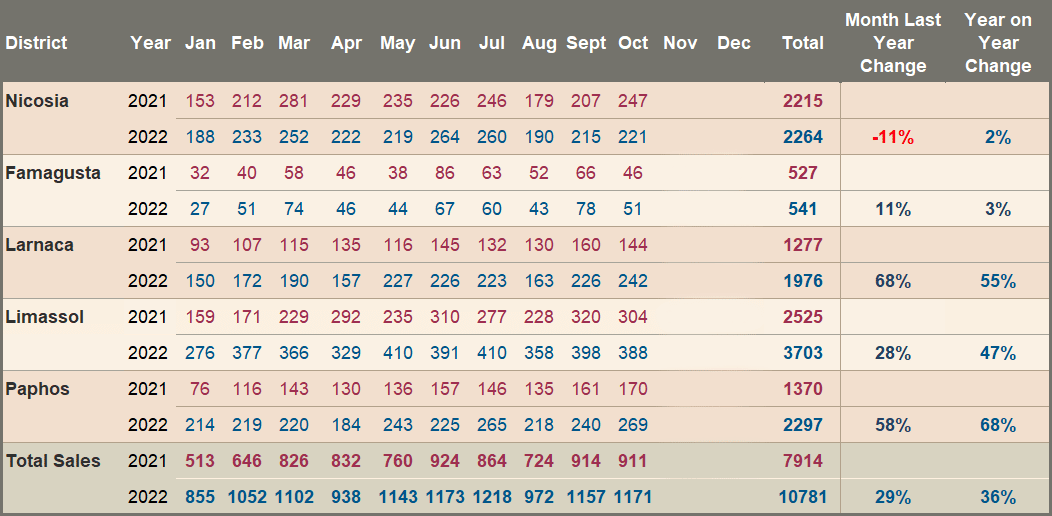
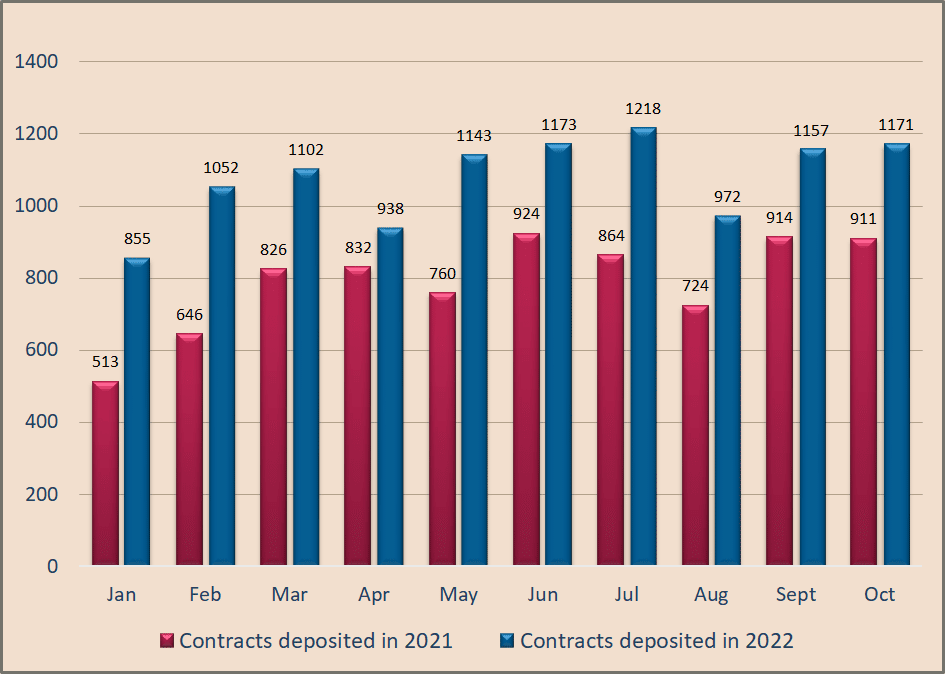
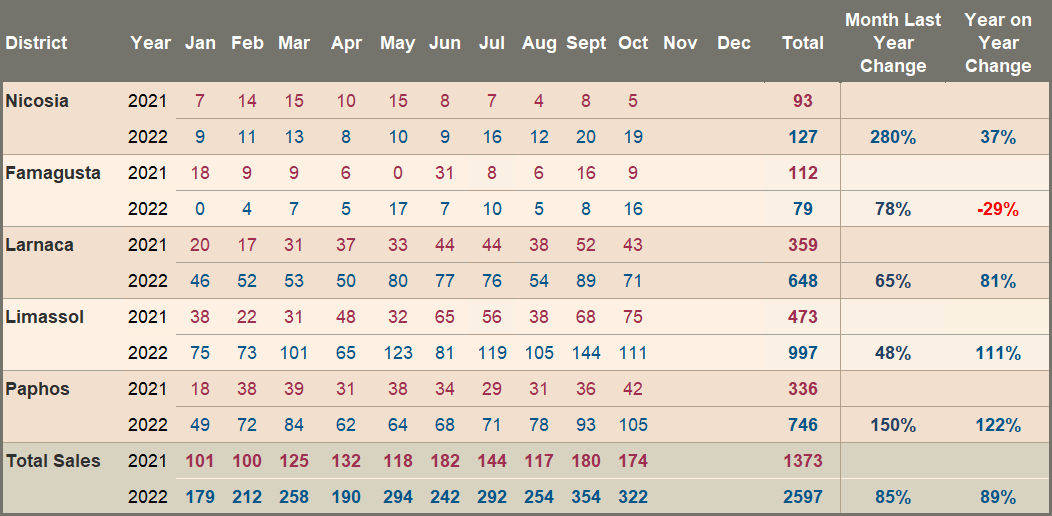
The Department of Lands & Surveys reports that 1,171 property sales contracts were deposited at Land Registry offices across Cyprus in October compared with 911 in the same month last year; a rise of 29 per cent.

Although the number of property sales fell in Nicosia compared to October last year, the rose in the other four districts. In terms of the number of sales, Limassol lead the way with 388, followed by Paphos (269), Larnaca (242), Nicosia (221) and finally Famagusta with 51 sales.

Cyprus Property sales October 2022
Total Property Sale Transactions – 2021/2022 Comparison

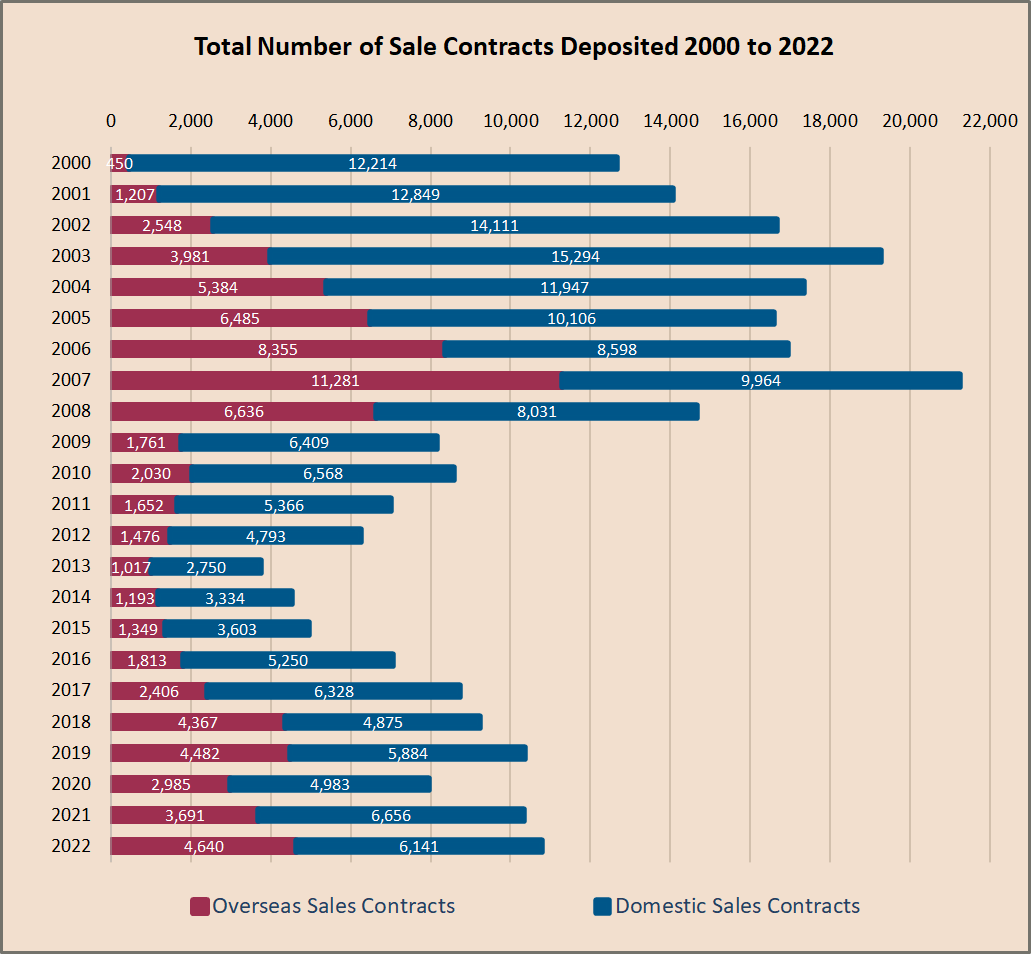
In the first ten months of 2022 a total of 10,781 contracts were deposited at Land Registry offices, a rise of 36 per cent compared to the 7,914 deposited during the same period in 2021, with the number of sales the highest achieved since 2008 once again.

While sales in the capital (Nicosia) and Famagusta have seen a small rise this year, sales have been steaming ahead in the Paphos, Larnaca and Limassol districts where foreign (non-Cypriot) buyers tend to buy property.

Contracts 2021 - 2022 comparison
Total number of sale contracts deposited for years 2021 and 2022 by month

Market segment analyses

Property sales to the domestic market

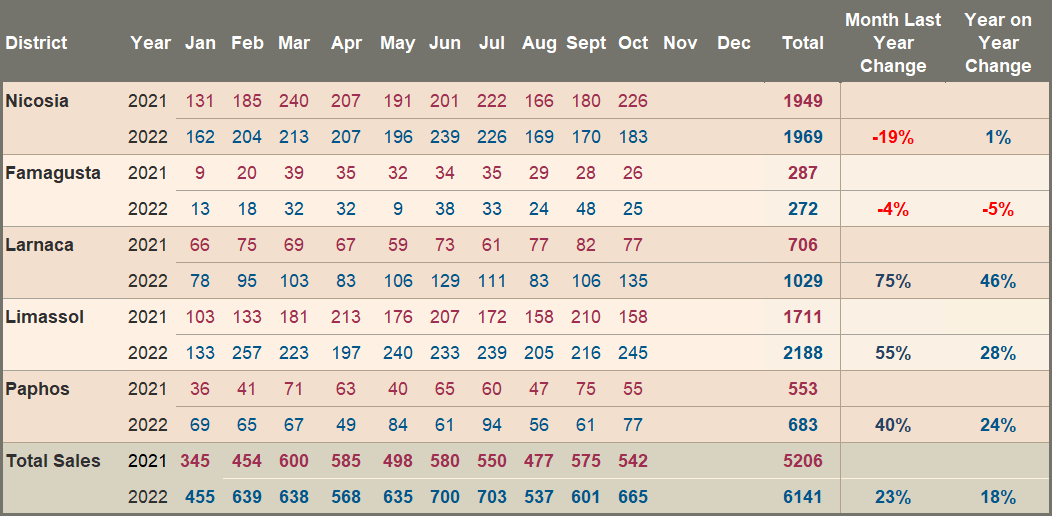
Domestic real estate sales in October, as measured by the number of sale contracts deposited at Land Registry offices, rose 23% compared to October 2021 but with the districts of Nicosia and Famagusta both reporting a drop in sales.

Limassol saw the greatest number of sales followed by Nicosia, Larnaca, Paphos and Famagusta.

Domestic Sale Transactions – 2021/2022 Comparison

Sales to the domestic market during the first nine months of 2022 sales reached 6,141, an 18% increase on the 5,206 achieved during the same period last year.

Property sales to the overseas market

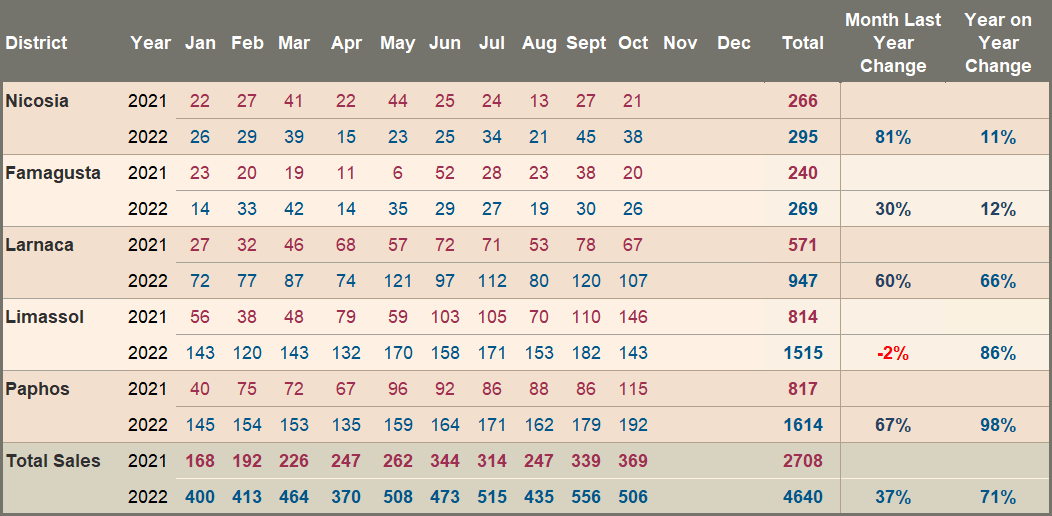
Sales to foreigners (non-Cypriots) were up 37% compared to October 2021 with sales rising in all districts with the exception of Limassol, where they fell by 2%.

Paphos achieved the greatest number of sales, followed by Limassol, Larnaca, Nicosia and Famagusta.

Total Overseas Sale Transactions – 2021/2022 Comparison

Foreign real estate sales during the first nine months of 2022 reached 4,640; a 71% increase on the 2,708 achieved in the same period last year.

Property sales to EU nationals

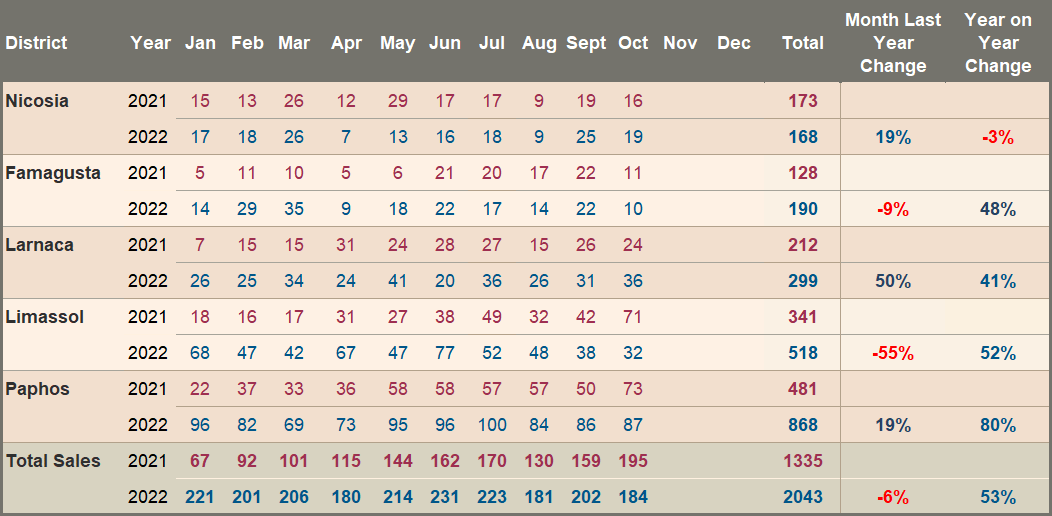
Sales to EU nationals declined 6% compared to October 2021, with sales falling in both Limassol and Famagusta.

Paphos achieved the greatest number of sales, followed by Larnaca, Limassol, Nicosia and Famagusta.

Overseas (EU) Sale Transactions – 2021/2022 Comparison

Foreign real estate sales to EU nationals during the first nine months of 2022 reached 2,043; a 53% increase on the 1,335 achieved in the same period last year.

Property sales to non-EU nationals

Sales to non-EU Nationals rose by 85% compared to October 2021, with sales increasing in all districts.

Limassol recorded the highest number of sales, followed by Paphos, Larnaca, Nicosia and Famagusta.

Overseas (non-EU) Sale Transactions – 2021/2022 Comparison

Overseas sales to non-EU nationals during the first nine months of 2022 reached 2,597; an 89% increase on the 1,373 achieved in the same period last year.

Cyprus real estate contracts deposited between 2000 and 2021


Building permits August 2022

4

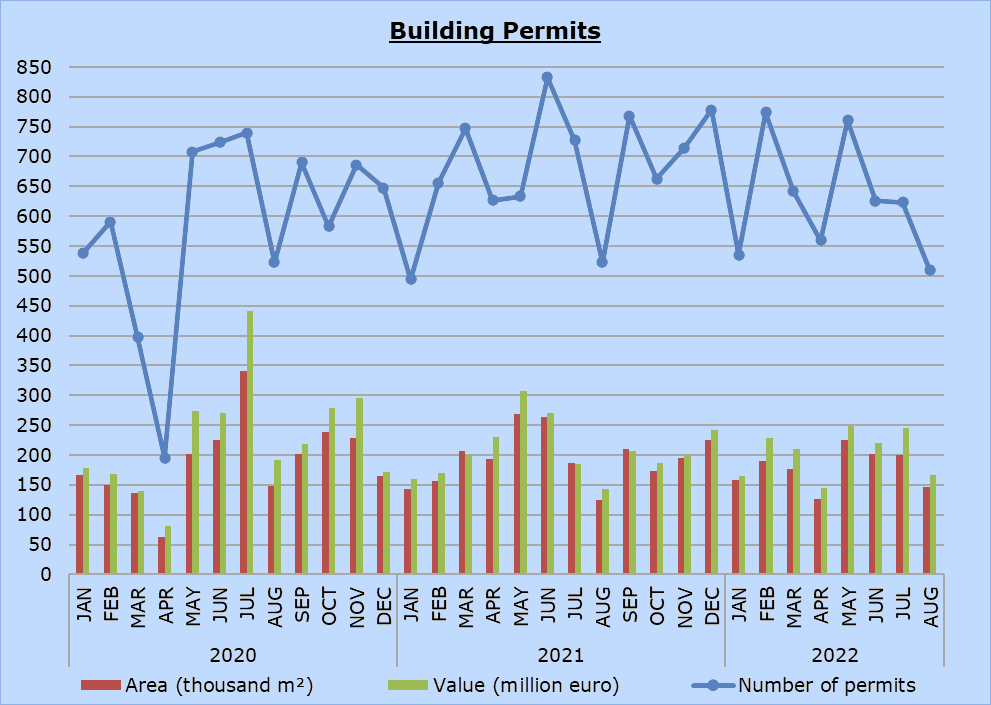
The number of building permits authorized in Cyprus during August 2022 stood at 510. The total value of these permits reached €166.3 million and their total area 146.0 thousand square metres. These permits provide for the construction of 687 dwelling units.

Compared to August 2021, the number of permits issued fell -2.5%, but their total value and area rose by 16.0% and 16.8% respectively.

The 510 permits were authorised for the following:

  • Residential buildings – 354 (up 1.1% from 350 in August 2021)
  • Non-residential buildings – 68 (-20.0% from 85 in August 2021)
  • Civil engineering projects – 42 (up 50.0% from 28 in August 2021)
  • Division of plots of land – 32 (-30.4% from 46 in August 2021)
  • Road construction – 14 (no change from August 2021)

Permits for new homes

The 354 residential permits provided for the construction of 687 new homes (dwellings), comprising:

  • Single houses – 186 (-25.6% from 250 in August 2021)
  • Two housing units – 78 (up 85.7% from 42 in August 2021)
  • Dwellings in residential apartment blocks – 408 (up 56.9% from 260 in August 2021)
  • Dwellings in residential/commercial apartment blocks – 15 (up 650% from 2 in August 2021)

Of those 1,146 new homes, 317 are destined for Nicosia, 537 for Limassol, 170 for Larnaca, 84 for Paphos and 38 for Famagusta.

There’s a significant shift from the construction of single houses to apartments, which may be attributed to the increased costs of building materials, energy and inflation (that stood at 8.90% at the end of August.)

Building Permits Issued for the Construction of New Homes
(Number of Dwelling Units)

Month 2021 (Dwellings) 2022 (Dwellings) Increase/Decrease Change
January 702 640 -62 -8.8%
February 663 901 238 35.9%
March 1033 962 -71 -6.9%
April 955 601 -354 -37.1%
May 1061 893 -168 -15.8%
June 998 1146 148 14.8%
July 874 776 -98 -11.2%
August 554 687 133 24.0%
Totals 5412 5143 -234 -3.4%

Building permits year to date

During the first eight months of 2022, 5,032 permits were issued compared to 5,240 in the same period last year; down -4.0%. The total value of these permits fell -2.3%, their total area fell -7.7%, while the total number of dwelling units fell –3.4%.

Although more new homes are being built is Nicosia and Famagusta; up 10.4% and 3.3% respectively, the numbers are down in the three remaining districts; Limassol -5%, Paphos -12.6% and Larnaca -19.8%.

Cyprus Building Permits issued August 2022

According to the Cyprus Statistical Service “Building permits constitute a leading indicator of future activity in the construction sector.”