2,000 short term stay units register with ministry

The deputy tourism ministry said on Monday that renters operating on platforms such as Airbnb have registered about 2,000 units with the government, ahead of the February deadline to do so.

A source at the deputy ministry told the Cyprus Mail that they are satisfied with the number of short-stay units that have signed up as the government works towards regulating the sector.

“No one will have missed the train, of course anyone who decides to start renting out on such platforms after February will be able to sign up,” the official said.

Deputy tourism minister Savvas Perdios told daily Phileleftheros that it will be illegal to advertise or rent out such properties after February 7 if they have not signed up to the deputy ministry’s registry. The registration fee is €222.

Parliament passed the law to regulate short-term rentals through platforms such as Airbnb and booking.com in early 2020.

Those caught renting out or advertising such stays without having signed up will face fines and penalties.

Perdios explained that it will be very easy to weed out those renting illegally, as any advert for a property will have to include its registration credentials. If those are not clearly visible on the post, any user can then report it to the authorities.

It was further explained that each property signed up to the registry will be assigned a number which will then be provided to the online platforms, ensuring the property advertised is approved by the government.

The platforms also agreed to provide authorities with transaction-related information which will help with taxation.

Governments worldwide have sought to regulate the short-term homestay market – Airbnb was founded in 2008 – amid complaints of rising rents and claims of disruption.

According to KPMG there were 23,120 active listings on AirBnB and HomeAway in 2019. Assuming that number has remained the same, 20,000+ units have yet to register.

From 7th February 2023, owners who rent or advertise properties and who have not obtained a licence face up to one year imprisonment and/or a fine up to a maximum of €5,000.

To obtain a licence, please refer to How to get a license to rent your property.

Home-owning dream turns to nightmare

The dream of owning a home is becoming a nightmare for Cypriot millennial couples as a 20% increase in prices in the past year has made buying a house impossible, with the average sale around €350,000.

Stakeholders are warning that with the rate of house building rising, and if corrective measures are not taken, the fabric of Cypriot society will be shredded.

In comments to the Financial Mirror, Angelos Constantinou, head of BNP Paribas/ Danos Real Estate‘s research department, pinned the estimated 20% increase in the cost of new houses to the rising cost of building materials.

“Following the COVID pandemic, we saw a boom in demand for housing projects, as people were trying to get their lives on track after two years of restrictions and uncertainty.

“This was made worse with the war in Ukraine, which added pressure on trade and transportation of raw materials, pushing the cost further up,” said the real estate expert.

Constantinou said a young couple would need to pay at least €340,000 to buy their own home.

“Buying an average house, nothing fancy, in non-high-end urban areas will put a family out by anything between €340,000 and close to half a million.

“For a smaller home of 170 square metres, for which a reduced 5% VAT applies, a family will definitely need well over €300,000.”

He added that if a family is looking to buy a more comfortable house of 220 square metres, they will need at least €440,000.

“And that is if they are willing to settle for areas that are not so popular, as let’s say Engomi and some areas in Strovolos in the capital.

“In high-end areas in Limassol, that’s a whole different ballgame.”

He said that prices for the same property a year ago would start from something close to €250,000.

“Unfortunately, things are set to get worse for couples looking for a home to start their family as the cost of building materials continues to rise.

“Last week, iron rods saw a 15% increase, going from €115 per tonne to €135. This will have a chain effect on all materials in the coming weeks.”

Rejection

Constantinou said real estate agents had seen a third of clients on the market for a house withdraw their interest in the past year.

“They just can’t afford to buy a house anymore.

“People who had loans approved, following the increase of building costs, had to return to their banks to ask for more money.

“The vast majority of these cases were rejected.”

He added that the drop in demand would inevitably impact the construction industry as developers will be hesitant to move on to their next project without selling all available housing units.

“Going ahead with new projects while demand is in a slump would be playing with fire, bringing a new crisis”.

The Technical Chamber of Cyprus (ETEK) advises the government on building and is particularly concerned over the consequences of increased house prices on society.

“It is now next to impossible for young couples to own their own home.

“Some 20 years ago, couples starting their families were able to obtain housing loans which they could pay off within six to seven years,” said ETEK’s Chair Constantinos Constanti.

He explained it will now take couples more than 20 years to pay off a loan of several hundred thousand euros.

“One-third of the household’s earnings would be going to pay off the loan.

“The difference is that houses are multiple times more expensive than they were a couple of decades ago, while salaries have only increased by 30%.”

He argued that young couples’ incapability to buy a house creates a loss of future wealth.

“It is no secret that Cyprus’ growth in recent years has been backed by business loans taken out by people wanting to start their own business with their home as collateral.

“This will no longer be an option for young people who may want to venture into the business world.

“What is more, people in the past have also been taking out student loans to put their children through university. They will not have that option now,” said Constanti.

Go green

He argued that Cyprus’ future generation is denied potential wealth.

Furthermore, as he noted, owning a home as a family is part of Cypriot culture.

“Families who cannot afford a house are frowned upon by the rest of the society, with complications including tension in their relationship, and their children being taunted at school.”

Constanti said that authorities and stakeholders need to go through affordable housing alternatives while reviewing the culture of building in Cyprus.

“We need to seriously rethink the materials we are using to build our houses, turning to cheaper and greener materials.

“One of the studies we have commissioned and expected to be concluded next week will give us an idea of what and how recyclable materials can be used in housing construction.”


Kitchener’s survey of Cyprus

4

British Field Marshal Horatio Herbert Kitchener (1850-1916), later 1st Earl Kitchener, is probably best known for his WWI recruitment poster. But he was also a surveyor and cartographer and undertook archaeological work in Palestine, Cyprus and Egypt.

In 1878 the British High Commissioner of Cyprus, Sir Garnet Wolseley, requested a rough map of Cyprus from the Foreign Office. Kitchener, a junior officer at the time, was borrowed by the Foreign Office and instructed to make a Survey of Cyprus.

Kitchener reached Cyprus in September with a party of Royal Engineers and equipment – and submitted his proposals to Wolsey for a comprehensive survey of the island. But Wolseley saw no need for a detailed map and ordered Kitchener to map a number of villages that could be pieced together.

Kitchener protested but Wolsey insisted; Kitchener had no option but to appeal to the Foreign Office. The Foreign Minister, Lord Salisbury, wanted a detailed survey to be carried out on the model of the trigonometrical Ordnance Survey in England.

The trigonometric survey was constructed around a baseline proposed by Kitchener to the north of Nicosia. This baseline was accurately surveyed and constructed in October and November 1878. Piles of whitewashed stones were built at each end of the line. Measurement of the baseline was carried out using a 100-foot chain supplied by the Ordnance Survey.

But within a few months Wolsey recommended that the survey should be discontinued due to the dwindling revenue of the island. Kitchener ceased operations on 13 May 1879 and returned to England. He was then seconded as a vice-consul to Anatolia, where he remained until early 1880.

But Cyprus, now under a new High Commissioner, Colonel Biddulph, was pressing for an accurate Survey on which to base a measure of land registration, and the choice of Survey Director again fell on Kitchener.

In March 1880 Kitchener wrote to his friend Walter Besant in Palestine saying:

Here I am back at my old work of surveying. I think I was wrong giving up the diplomatic line, but I could not let another pull my points about here, so when the General offered it me again I could not well refuse, as he put in increased pay and better position. I have now been gazetted Director of the Survey, and hope soon to get my men out again. (He was reportedly paid £672/annum – equivalent to approximately £89,851 today.)

On his return to Cyprus, Kitchener picked up from where he’s left off. From each end of the baseline he’d constructed earlier, observations were made of clearly defined adjacent triangulation points. A network of triangles was constructed outward from the baseline and over time the whole island was covered with a series of 137 linked and angularly measured triangles.

The project faced many difficulties. The mountainous areas of the island and the unexplored areas in Paphos were particularly difficult sections to record. The piles of stones that the crews set to mark trigonometric points were often destroyed so that measurements had to be repeated – and this caused great delays.

The maps, which were completed in 1883, were first full triangulated survey Cyprus. They are very detailed, marking roads, tracks, and telegraph lines, and locating vineyards, monasteries, ruins, sheepfolds, springs, wells and aqueducts. Towns and villages are identified as being Christian or Muslim, and are given both their Greek and Turkish names.

The set of maps consists of a title sheet and 15 map sheets at a scale of one inch to the mile, and are supplemented with a single-sheet index map at a scale of five miles to the inch. The 15 map sheets were engraved on copper plates; when mounted together as one map it measured 12 feet 6 inches by 7 feet. Its accuracy is estimated below 200 metres.

Kitchener’s trigonometric network has been used in subsequent surveying work and formed the basis for the development of the geodetic network still in use today.

Kitchener left Cyprus at the beginning of 1883 and two years later, in a Memorandum, he referred to the conditions of the Island under British rule:

Cyprus was handed over to Great Britain by Turkey in a thoroughly exhausted and ruined condition. The system for centuries had been to take as much as possible out of the Island, giving nothing in return. All public works and every institution in the Island were in the last stage of decay.

Every department of government has been thoroughly reorganised, and it only requires a glance at the map to see that money has been liberally expended on much-needed roads, bridges, piers, etc. Doubtless some result is already being reaped from these increased facilities of communication, and much more may be confidently prophesied for the future.

Justice is now impartially administered by most competent magistrates, and the re-organisation of the Land Registry Department has been a boon to all landed proprietors. The system established in Cyprus might indeed be adopted with advantage as a model for what is much needed in England – a registration of titles and mortgages, and a complete arrangement for the immediate transfer of landed property without the intervention of the conveyancer.

(The Department of Lands and Surveys of Cyprus, which is also known as the Land Registry, started operations in 1858 and is considered to be the oldest governmental department of the public sector in Cyprus.)

An end to trapped buyers in the works

A bill has been placed before a plenary session of parliament that should prevent any more people buying property in Cyprus becoming ‘trapped buyers’.

For readers who have not come across the term ‘trapped buyers’, it refers to those who buy property but are unable to get title (ownership) of the property because its present owner (usually a property developer) had earlier mortgaged the property and failed to repay the debt.

Typically, buyers became trapped because its owner failed to declare the fact that the property was mortgaged or the lawyer acting on behalf of the buyer failed to ensure that his/her client’s interests were protected.

This new bill is intended to prevent contracts for the sale of property being deposited at the land registry in cases where the property in question is encumbered by a mortgage or the present owner of the property has been prohibited from selling it by order of a court. However, sale contracts for properties encumbered by a mortgage may be deposited provided it is accompanied by a written statement from each mortgagor and vendor confirming that the buyer has been advised in writing that the property was mortgaged.

Specifically, the bill amends existing legislation, to ensure the process of purchase and transfer of immovable property and to solve “the serious problem that exists today, with real estate buyers, who, while they have fully fulfilled their contractual obligations towards the seller, are unable to transfer the property in their name due to encumbrances preventing its transfer”.

It’s anticipated that the amendments to the bill will be voted by parliament by the end of this year.

Trapped buyers background

In 2015 a trapped buyers law (Immovable Property Transfer and Mortgage Law (Amendment) (No. 10) was introduced that enabled so-called ‘trapped buyers’ to get title (ownership) of the property providing they had fulfilled their contractual obligations to the vendor. It was introduced by the Government to satisfy the Troika’s requirement to transfer title deeds into the names of the purchasers.

Although the 2015 law was partially successful, district courts in Limassol and Paphos ruled that it was unconstitutional following successful challenges by lawyers representing the banks. The ruling by the was subsequently appealed and we are still waiting for the Supreme Court’s decision.

A step in the right direction

Although this latest development may help prevent ‘trapped buyers’ in the future, a number of significant issues remain that result in buyers becoming trapped through no fault of their own:

  • Property developers fail to complete their developments leaving the buyers trapped until they pay third parties to complete the work. In some cases, developers leave the project unfinished and move on to something else, while in other cases the company fails and goes into administration/receivership.
  • Property developers breach planning regulations or fail to comply with the plans and permits authorised for their development’s construction; some have been known to build illegally without permits. Once again, the buyers trapped until they pay third parties to correct the breaches, etc.

Although Cyprus has made some progress in protecting those buying property on the island, there are many more property related issues that remain to be addressed by the legislators.

Unpaid housing loans cause concern

The finance ministry has expressed alarm and dissatisfaction at the high amount of money owed to public-law organisations that give out loans to people for housing – loans which the state underwrites.

“The greatest risk of loss of moneys for the government presents in the loans granted to individuals through public-law organisations and other financing organisations…and where the monitoring of these loans by the involved organisations has not been as expected,” the finance ministry states in its latest Fiscal Risk report.

In particular, the report flagged three organisations:

At the end of March 2022, 61.67 per cent of loans granted via the Housing Finance Corporation (HFC) were classed as non-performing. Also, the HFC terminated contracts and/or took legal action for 112 loans with a balance of €59.7 million.

At the Central Agency for the Equitable Distribution of Burdens, at the end of March 2022 non-performing loans accounted for 27.9 per cent (€96.5 million) of all loans.

The Cyprus Land Development Corporation was likewise in hot water regarding loans it has granted since the year 2001 to low-income families. At the end of March 2022, the balance on performing loans stood at €7.64 million, while the balance on non-performing loans was €34.17 million.

Moreover, the organisation has gone to court for 139 of its 521 loans classed as non-performing. Title to the properties remains with the entity until loans are repaid in full.

In the report, the finance ministry says that non-performing loans, loans in arrears and the taking of legal action against principal debtors, poses risks of loss of moneys “given that the aforementioned loans have been granted with government capital and their non-recovery will constitute a loss for the state”.

Construction materials prices steadying

0

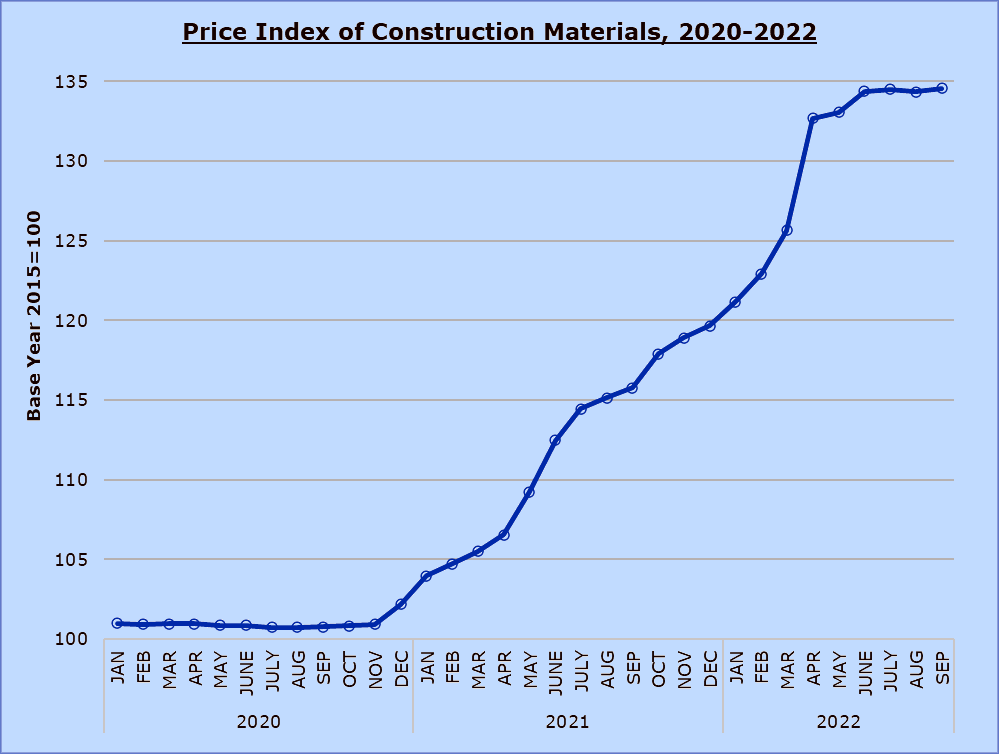
The price index of construction materials rose 16.24 per cent in September on an annual basis compared with August when they rose 16.69 per cent according to the Cyprus Statistical Service.

However, as shown in the graph below prices have steadied in the past four months, albeit at a high level.

The sharp increase in prices is the result of a surge in demand following the Covid pandemic, high energy prices, supply chain problems and Russia’s war in Ukraine.

It is unlikely that construction material prices will fall in the near future.

Compared to September 2021, the Cyprus Statistical Service reports price rises in metallic products of 18.73%, minerals 16.95%, products of wood, insulation materials, chemicals and plastics 14.62%, mineral products 15.51% and electromechanical products 12.23%.

construction materials price index