Real estate safe from EU property bubble

0

Cyprus’ banking and real estate sectors will not be affected by a possible bubble from overheating of the residential market in the European Union, say local stakeholders.

In a recent survey carried out by the European Banking Authority, real estate in the majority of EU states has witnessed double-digit growth between Q1 2021 to Q1 2022, with the fastest in the Czech Republic (25%), Estonia (21%) and Lithuania (21%), while 15 other countries reported at least 10% increase in 2021.

The EBA published a thematic note on residential real estate exposures of EU banks: risks and mitigants.

As the report notes, EU banks reported more than €4.1 trillion of loans and advances collateralised by residential immovable property.

This corresponds to 1/3 of all loans towards households and non-financial corporates.

Demand for housing has been robust in recent years, notes the EBA, adding that strong capital and liquidity positions of EU banks enabled them to fulfil this demand, expanding their exposures towards mortgage loans.

“At the same time, the supply of housing was unable to keep up with the demand due to a lack of housing investments in previous years, construction constraints, and supply-chain disruptions caused by the pandemic.

“As a result, house prices recorded high growth rates in many EU countries, which caused concerns of overheating markets,” said the EBA.

It warned the macroeconomic environment had deteriorated abruptly, and the probability of a recession had increased.

“High inflationary pressures and resulting increases in interest rates have driven up living costs without corresponding increases in income.

“This is a challenge, particularly for lower income and highly indebted households”.

The EBA is mostly concerned that an abrupt drop in prices of housing units coupled with rising default rates could pose a challenge for EU banks.

Almost a third of EU bank loans are mortgages.

In recent years, banks have significantly increased their exposure to this area.

While there are some early signs of deteriorating asset quality in mortgage portfolios, such risks have yet to materialise.

However, in Cyprus, local stakeholders feel the real estate and the banking sector will not feel the heat from a bubble bursting in the EU.

Late recovery in real estate sector

In comments to the Financial Mirror, Pavlos Loizou, CEO of Ask WiRE, said the Cypriot real estate sector has not followed the same recovery course as the rest of the bloc following the 2008 crisis, saving it from overheating.

“We could even say the island’s real estate market has not had the chance even to heat up, as recovery began much later than the rest of the Union,” said Loizou.

He explained that whereas the real estate markets in the Eurozone started recovering around 2011, the banking crisis in Cyprus in 2013 pushed recovery back several years.

“It wasn’t until 2016 that the real estate sector in Cyprus started recovering.”

This late recovery, as he explained, also meant that the island’s banks had started giving housing loans once again much later than the rest of the bloc, saving them from being overexposed.

“Another element is that Cyprus’ developers are no longer venturing into speculative projects, building many housing projects, which they hope to sell to expats or foreign investors.

“The market is mostly oriented towards existing local demand.”

George Mouskides, the Cyprus Property Owners Association chair, agreed that the market is far from overheated like in the rest of Europe.

“Sure, property prices have been pushed up, but this is mostly due to the increase of construction cost rather than the increase in demand,” said Mouskides.

As he argued, demand is at normal levels, with 10,000 to 12,000 annual transactions recorded in recent years.

“We have barely come close to demand recorded in 2009, just before the island’s housing crisis hit.

“The increase in house prices is cost-driven and will not crash if there is an abrupt drop in demand.

“I would go as far as to say that without the increase in the cost of building, the prices of houses in Cyprus could have dropped significantly in the past couple of years.

“I don’t see prices dropping in Cyprus for the next couple of years.”

In comments to the Financial Mirror, Ioannis Tirkides, Chief Economist at the Bank of Cyprus, said increases recorded in the sector have corrected the market than overheat it.

“Recent increases have corrected the market after the abrupt drop with the crisis in 2013,” said Tirkides.

Asked whether the increase in mortgage interests could distort the market, Tirkides said that although interest rates on mortgages could reach 5%, from 2.5% by the end of next year, this will not affect the initial capital needed to buy a house, but the cost to the buyer.

“This will not push prices upwards, blowing hot air into a possible bubble.

“It will definitely be making things harder for people to acquire new loans and to pay off their existing ones, but any fallout will be manageable”.

Tirkides also acknowledged that geopolitical uncertainty and the energy crisis weigh on consumer and business confidence.

Although employment rates remain high, these developments could affect demand for housing and property purchases.

He noted that just like all other crises before, this could lead to difficulties for consumers, “but the situation will definitely not come anywhere near the 2013 crisis”.

Homeowners win Swiss franc loan fight

A number of home buyers in Cyprus have won their legal battle to be released from their crippling Swiss franc loans.

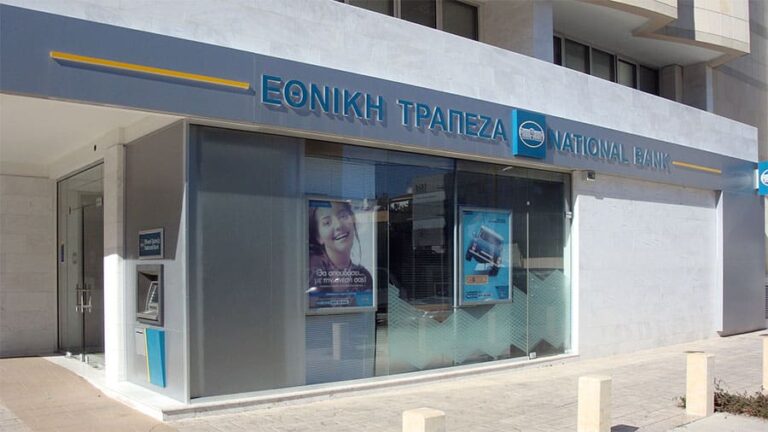
In what could prove be a landmark decision, a judge at the Paphos district court ruled in favour of borrowers whose Swiss franc loans were granted by the National Bank of Greece (Cyprus) Ltd; the borrowers were represented by the Zambartas law firm.

The judge hearing the case ordered the bank to convert their Swiss franc loans into Euros at the exchange rate that applied at the time the loan was granted.

The judge also ruled that bank was not entitled to charge interest on the late payments and rejected the bank’s claim to impose interest at 14% on the loan closure amount.

The judgement follows similar court rulings in favour of Swiss currency borrowers in Poland, Hungary and Croatia.

Swiss franc loans in Cyprus

Many homebuyers in Cyprus were persuaded by the local banks to take out home loans and mortgages denominated in Swiss francs in the years following the island’s accession to the European Union. They were attracted by the promise of low interest rates; the Swiss franc is a ‘stable currency’.

In cases brought to my attention, banks apparently failed to advise borrowers of the risks of fluctuations in exchange rates and interest rates inherent in foreign currency loans.

The value of the Swiss currency has more than doubled since 2008 sending loan repayments skyrocketing. British borrowers have been hit particularly hard as the value of Sterling has been on a downward trajectory since the Brexit referendum was announced in 2015.

The situation was further exacerbated when the Swiss franc abandoned its currency ceiling against the Euro in 2015.

The stress resulting from their crippling loan repayments has caused numerous marriage break-ups and tragically a number of suicides.

Inflation threatens home-owning dreams

Hiking inflation is threatening to halt an upward trend in housing loans from Cypriot banks recorded in the past two years, as interest rates are being pushed up.

Cyprus bank officials say that high inflation is squeezing households having a harder time making ends meet, ultimately putting off buying their own house.

Amid inflationary pressures and an increase in the cost-of-living devouring household incomes, the number of new mortgages is the highest since December 2014, when the Central Bank began recording data.

New net mortgage loans stood at €693.6 million in the first eight months of 2022, up from €520.2 million in the eight months of 2021, €306.3 million in 2020 and €454.3 million in 2019.

News site Stockwatch quoted a Bank of Cyprus official confirming: “There is a slight decline in mortgage take-up, which appears to be driven by inflationary trends, the rising cost of living and recent interest rate hikes.”

A Hellenic Bank official said: “Although the demand for mortgages remains at relatively high levels, we are seeing a slight decrease compared to last year in terms of demand.

“Mainly due to the sharp and serious increase in construction materials, the reduced disposable income and the small increase in interest rates as far as new loans are concerned”.

According to the latest data from the Central Bank, interest rates for mortgages over five years were 2.22% in August, up from 2.04% in August 2021 and 2.33% in 2019.

Banks offer financing up to 80% of the loan’s value for a first home with the possibility of repayment up to 35 years.

It is also possible to suspend the payment of instalments twice a year.

Banks also give loans for home renovations.

Financing up to 80% is offered for first home renovations and 70% for holiday home renovations and plot purchases.

Banks also lend for purchasing land for immediate construction with 50% financing and a duration of up to 15 years. They also offer to finance the acquisition of a second home.

The housing loan can cover 70% of the property’s purchase value for acquiring a second home with a duration of 25 years.

According to Central Bank data, housing loans to Cypriot residents reached €8.66 billion in August, from €8.65 billion in July, €8.21 billion in August 2021 and €8.52 billion in 2019.

Three golden passport cases to go to court

1

Attorney General George Savvides and Assistant Attorney General Savvas Angelides met with police on Friday to discuss court cases of alleged illegal naturalisations under the Cyprus Citizenship by Investment programme.

These meetings have been established for the better coordination of the two bodies and according to information, there soon will be developments in some of these cases, daily Phileleftheros explains.

One case concerns the passport of Egyptian businessman Mohammed Salem and his offspring, for whom the trial date has been set for January 13, 2023.

Salem, his two sons and his daughter seem to have invested €6 million in immovable properties to get Cypriot citizenship. However, it appears that €1.5 million has been returned to them while the relevant apartments in Limassol have not been built. At the same time, the indictment points out that the specific apartments were declared as the Salem family’s main and permanent residences in a bid to pay reduced VAT tax.

In addition to the case of the family of Salem, another two cases will go to court.

One involves Jordanian businessman Almi Hilmi Munib Armoush, Zaineh Ali Himli Armoush, Nikolay Gornovskiy, as well as a Chinese investor with a criminal record.

The third case concerns Iranian Mehdi Ebrahimi Eshratabadi, who became a Cypriot under the name Tony Newman.

The defendants in the first case are former House Speaker Demetris Syllouris, former AKEL MP Christakis Giovani, lawyer Andreas Pittadjis and Giovani’s business associate, Antonis Antoniou. They face charges of conspiracy and corruption.

The case will be tried on October 26 at the Nicosia Assizes Court.

The case of the Iranian has been completed and the verdict is expected on 4 November 4.

© In-Cyprus.com


Mortgage to rent scheme moving forward

The mortgage to rent scheme for distressed borrowers is moving forward as state-owned asset management agency KEPIDES, the finance ministry, banks and the EU are finalising the details, reports said on Monday.

The ‘Mortgage to Rent’ scheme was discussed at the recent visit of EU officials, ECB officials, and IMF officials to Cyprus for the 13th post-bail-out evaluation.

The scheme will cover all non-viable households who have applied for the ‘Estia’ plan but whose income is insufficient to keep up with payments.

Under the envisioned ‘mortgage to rent’ scheme, households will pay a low rent for five years, after which they have the right to buy their residence.

Under a mortgage-to-rent scheme, intended to help homeowners at risk of losing their property due to mortgage arrears, a person voluntarily surrenders ownership of their home for five years to their lender. An entity buys the home from the lender and becomes the landlord. During that time, the borrower no longer owns their home but will continue living in it as a tenant.

According to daily Politis, KEPIDES is set to take under its ownership 1,250 houses with a total value of over €100 million.

The scheme is expected to be announced in coming weeks by the finance ministry, in hopes of being able to start it in early 2023.

Politis reported that the scheme will be made available to 948 cases on non-viable debtors under the ‘Estia’ plan and individuals receiving state aid. The plan will also be available for all non-viable debtors.

The price of the primary home should also not surpass the amount of €250,000 and Kedipes will buy the property at 60 per cent of its value from the banks.

In July, the scheme seemed to be under threat as parliament voted to extend a freeze on property foreclosures.

The bill – amending the laws governing the transfer and mortgage of immovable property – extends to October 31 a moratorium on repossessions.

Despite prior and repeated warnings that a further extension would disrupt banks’ ability to reduce the stock of non-performing loans (NPLs) on their books, the majority of MPs voted in favour – arguing they wanted to protect homeowners amid the ongoing economic slump.

Finance Minister Constantinos Petrides said he could not see the rationale behind MPs’ insistence on the foreclosures freeze, given that the government has rolled out various schemes aimed at affording protection to financially distressed homeowners.

“Suspending foreclosures at this crucial period also endangers the rollout of the much-anticipated ‘Mortgage to Rent’ scheme – a scheme worth €400 million which protects the residence of vulnerable households including the non-viable debtors under the ‘Estia’ programme, since the EU’s approval of it will depend on the effectiveness of the foreclosures framework.”

EU house prices up 48% since 2010

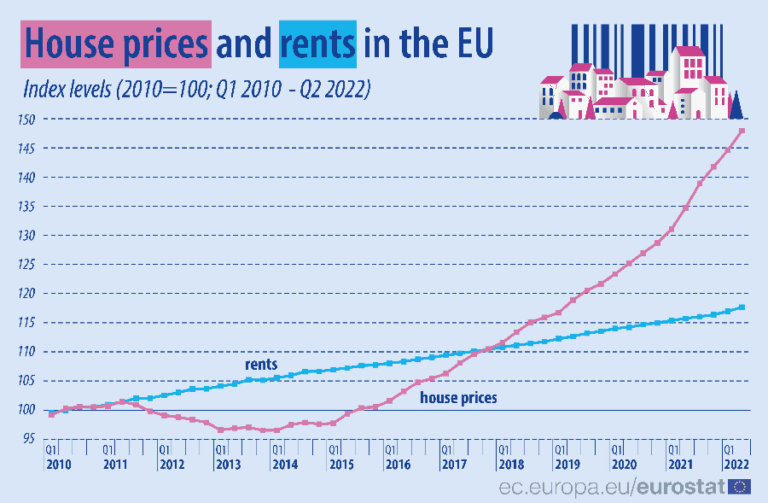
The EU’s statistical service (Eurostat) reports that house prices and rents in the EU followed a similar path between 2010 and the second quarter of 2011.

However, after the second quarter of 2011, house prices and rents have evolved differently. While rents increased steadily throughout this period up to the second quarter of 2022, house prices have fluctuated considerably.

After a sharp decline between the second quarter of 2011 and the first quarter of 2013, the price of houses remained more or less stable between 2013 and 2014, but following a rapid rise in early 2015, they increased faster than rents.

From 2010 until the second quarter of 2022, the price of houses rose 48% in the European Union, while rents increased 18% over the same period

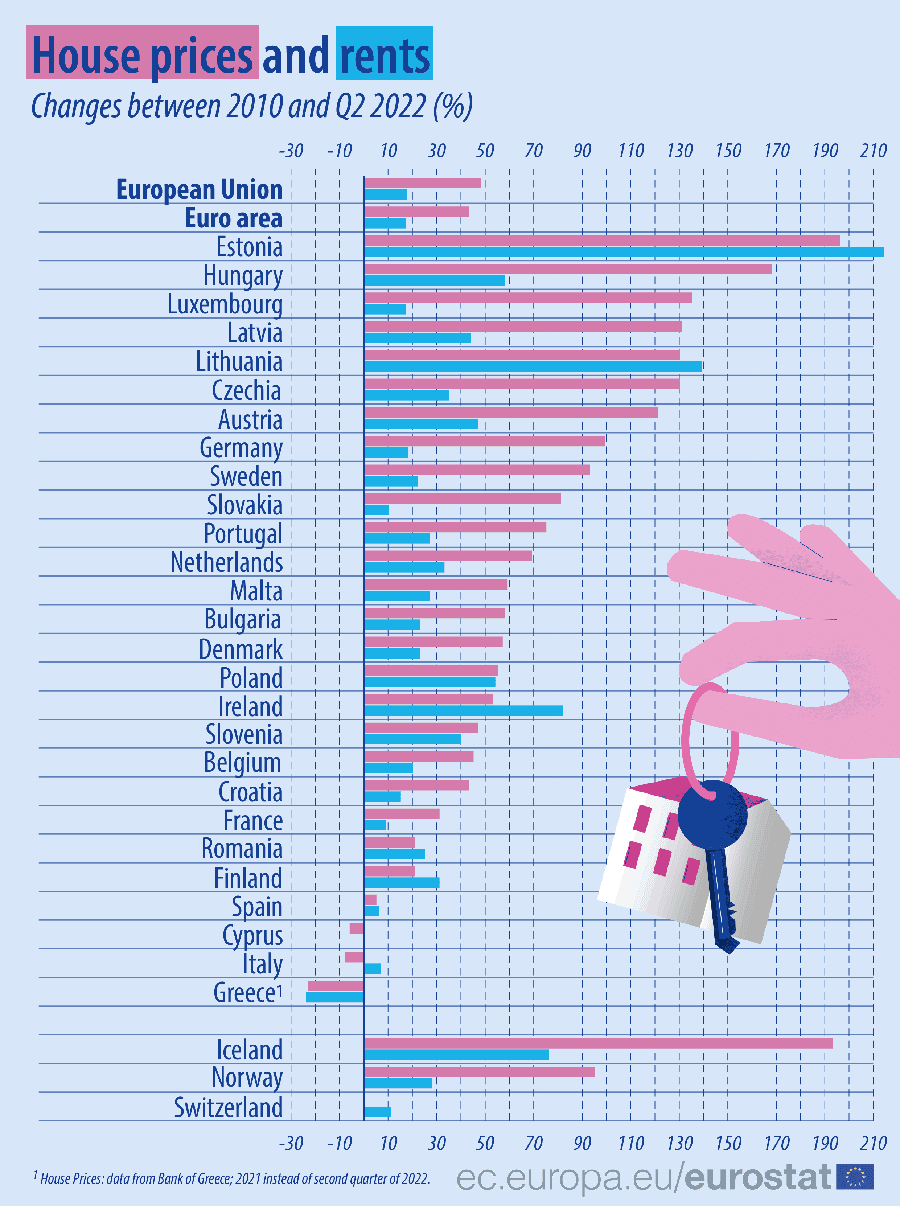
When comparing the second quarter of 2022 with 2010, the price of houses increased more than rents in 19 EU Member States.

House prices

Between 2010 and the second quarter of 2022, the price of houses increased in 24 EU Member States and decreased in three. They more than doubled in Estonia (+196%), Hungary (+168%), Luxembourg (+135%), Latvia (+131%), Lithuania and Czechia (both +130%) and Austria (+121%), while decreases were observed in Greece (-23%), Italy (-8%) and Cyprus (-6%).

Rents

When comparing the second quarter of 2022 with 2010 for rents, prices increased in 25 EU Member States and decreased in two, with the highest rises in Estonia (+214%), Lithuania (+139%) and Ireland (+82%), while decreases were recorded in Greece (-24%) and Cyprus (-0.2%).

House prices and rents between 2010 and Q2 2022