House prices up 4.7% year-on-year

The increase in house prices accelerated in the second quarter of 2022, mainly due to the increased construction costs, reports the Cyprus Central Bank in its quarterly House Price Index (HPI) report.

The bank’s HPI recorded increase in apartment and house prices of 1.7% compared to 1.1% in the previous quarter, while on an annual basis the index increased by 4.7% compared to 3.2% in the previous quarter.

Although increases in apartment prices exceed those of houses in all districts on an annual basis, house prices are now also increasing.

For the first time since the outbreak of the pandemic, all districts are showing year-on-year increases in both apartment and house prices, indicative of the upward trend in prices across the spectrum of the housing market.

Demand in the real estate market during the second quarter of 2022 recorded an upward trend (both domestically and from abroad), while there were signs of a downward trend in supply. The war in Ukraine has intensified inflationary pressures, with a significant impact on construction costs, but currently does not appear to have adversely affected demand.

In the medium term, the increase in the cost of borrowing, due to the rise in interest rates, as well as the erosion of incomes due to inflationary pressures, are expected to reduce demand, but without necessarily reducing prices, which are currently due to rising construction costs.

Warning of unsafe areas to build in Cyprus

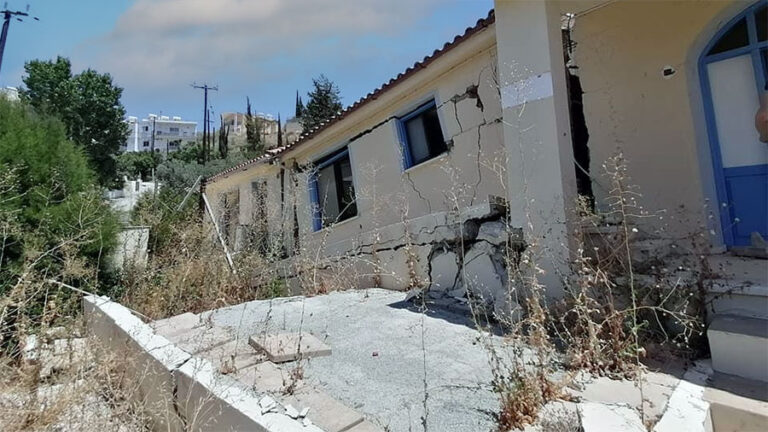
The Cyprus Geological Survey Department is warning citizens regarding the protection of their immovable properties, reviewing the geological suitability zones where investment is not recommended.

The Department has defined 13 areas including parts of Pera Chorio – Nisou, Tochni, Athienou, and Pissouri where no new development/building/construction can occur.

The Department also defined another 113 areas where no new construction or addition to a current construction is recommended.

These zones which were defined followed by detailed research and studies covering 55% of the island or 85% of the area controlled by the Republic of Cyprus.

On the Department’s website, users can navigate into a geographic environment and find additional geological information including fossils, mineral wealth, groundwater, geomorphosites, etc..

The areas that are described according to their level of danger include the following:

Zone 00: The area is threatened by geological risks, and is characterized by instability and increased danger. No new development is permitted in this Zone. T

Zone 00A: The area is threatened by geological risks, and is characterized by instability and increased danger. These geo-dangers have negative and disastrous consequences on the structural environment, which are related to:

  • Active landslides, such as Mathikoloni, Pissouri, Armou, etc.
  • Unstable rock masses, such as Episkopi Pafos, Skali Aglantzias.
  • Large landfills (Vati, Kotsiatis, Agia Marinouda, Kavo Greko) etc.
  • Estuaries of large rivers, such as Kourris, Diarizou, etc.
  • Very high water table, such as lakes / wetlands (Voroklini, Paralimni), salt marshes (Akrotiri, Larnaca) and areas near dams.
  • Sinkholes, such as Pergamos, Maroni, Pera Chorio – Nissou.

Zone 01: This area is offered for development but a preliminary geological study is requested. The site is threatened by geological risks that might have negative and disastrous consequences on the structural environment. These risks vary in degree of danger relate to:

  • Areas where landslides can occur or with areas where there are ancient landslides which are inactive,
  • Unstable slopes and slopes with logs or rock detachment,
  • Areas where landfills were or are operating which must be assessed and remediated prior to development,
  • Areas with underground burrows,
  • Areas where sinkholes may appear, usually around the perimeter of zone 00 or 00A associated with sinkholes but also areas with large streams where gypsum rocks pass,
  • Areas surrounding large bodies of water where there is a large seasonal fluctuation of the water table (lake Paralimni, Voroklinis) or soils with a high salt content (Akrotiri salt flats, Larnaca).

Zone 02: The area is threatened by geological risks that might have negative and disastrous consequences on the structural environment but specifically on big constructions.

Zone 03: No indication of any geological risks, threatening the structural environment.

© In-Cyprus.com


Sales up 18 per cent in first nine months (Update)

0

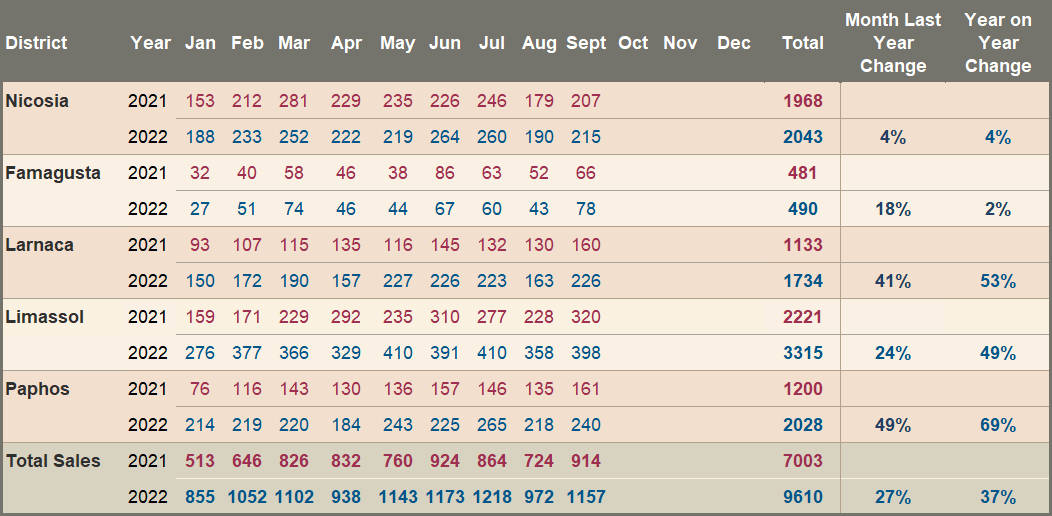
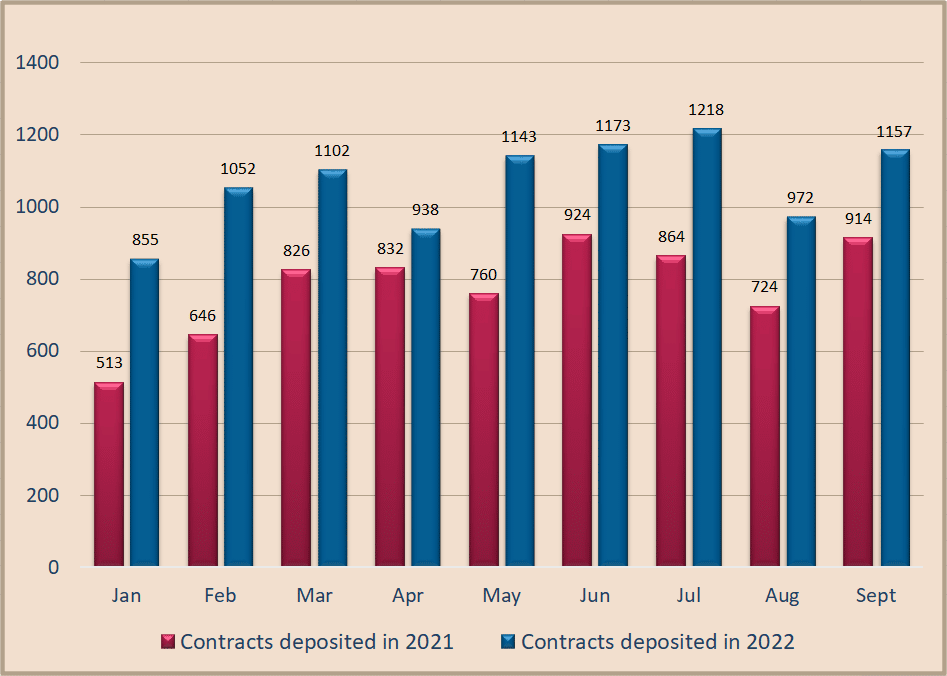
The Department of Lands & Surveys reports that 1,157 property sales contracts were deposited at Land Registry offices across Cyprus in September compared with 914 in September 2021; an increase of 27%.

Sales rose in all districts with Limassol leading the way with 398, followed by Paphos (240), Larnaca (226), Nicosia (215) and Famagusta (78).

Cyprus Property September 2022
Total Property Sale Transactions – 2021/2022 Comparison

In the first nine months of 2022 a total of 9,610 contracts were deposited, an 18% increase compared to the 7,003 deposited during the same period in 2021, with the number of sales the highest achieved since 2008.

Coptracts 2021 - 2022 comparison
Total number of sale contracts deposited for years 2021 and 2022 by month

Comments on sales from the director of Lands and Surveys

Speaking to the Cyprus News Agency (CNA), the Director of the Department of Lands and Surveys Dr. Elikkos Elias said that around 10,000 sales contracts are deposited annually as well as the exchange of some 16,000 to 17,000 properties as a gift.

Dr. Elias pointed out the Department’s significant contribution to the Cypriot economy with the value of some 18,000-19,000 property sales amounting to €3-4 billion.

In 2021, 18,463 property sales valued at €3.19 billion were registered of which 15,406 were sold to Cypriots, 1,987 to EU citizens and 1,070 to third country nationals.

In 2020, 14,663 properties valued at €2.73 billion were sold. In 2019, 17,988 properties valued at €3.55 billion and in 2018, 8,336 properties valued at €3.61 billion were sold.

Market segment analyses

Property sales to the domestic market

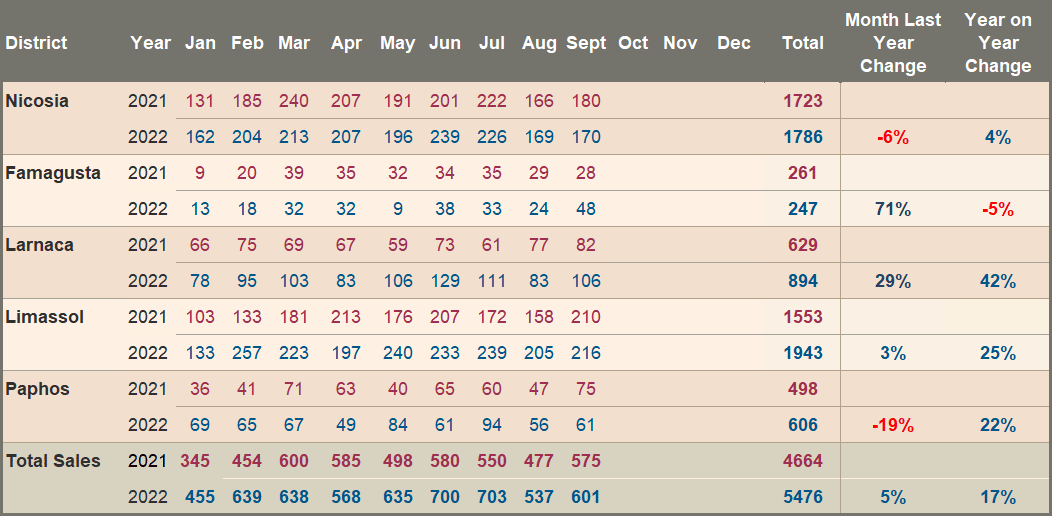
Domestic real estate sales in September, as measured by the number of sale contracts deposited at Land Registry offices, rose 5% compared to September 2021. The districts of Nicosia and Famagusta both reported a drop in sales

Limassol saw the greatest number of sales followed by Nicosia, Larnaca, Paphos and Famagusta.

Domestic property transactions – 2021/2022 Comparison
Domestic Sale Transactions – 2021/2022 Comparison

Sales to the domestic market during the first nine months of 2022 sales reached 4,089, a 19% increase on the 4,089 achieved during the same period last year.

Property sales to the overseas market

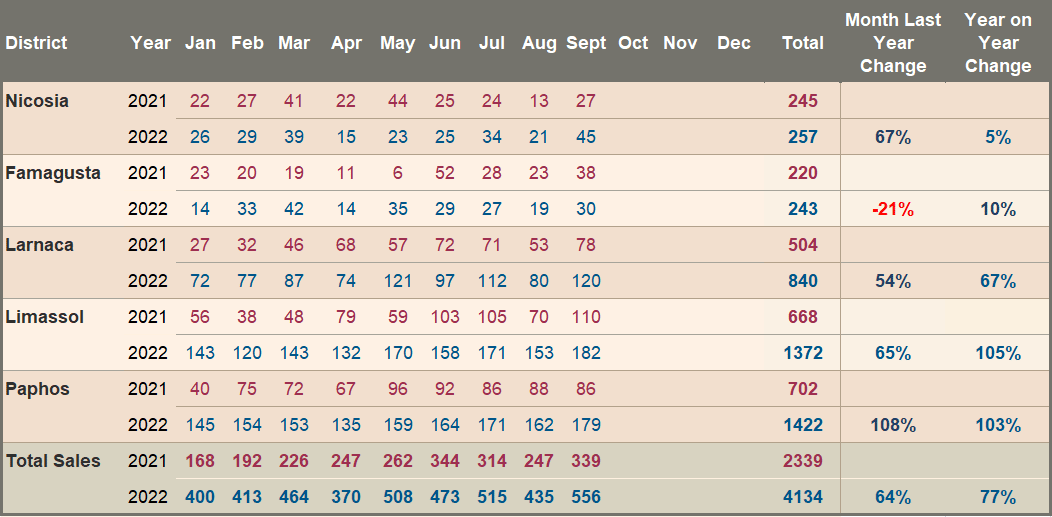
Sales to foreigners (non-Cypriots) were up 64% compared to September 2021 with sales rising in all districts with the exception of Famagusta, where sales fell by 21%.

Limassol achieved the greatest number of sales, followed by Paphos, Larnaca, Nicosia and Famagusta.

Total foreign transactions – 2021/2022 Comparison
Total Overseas Sale Transactions – 2021/2022 Comparison

Foreign real estate sales during the first nine months of 2022 reached 4,134; a 77% increase on the 2,339 achieved in the same period last year.

Property sales to EU nationals

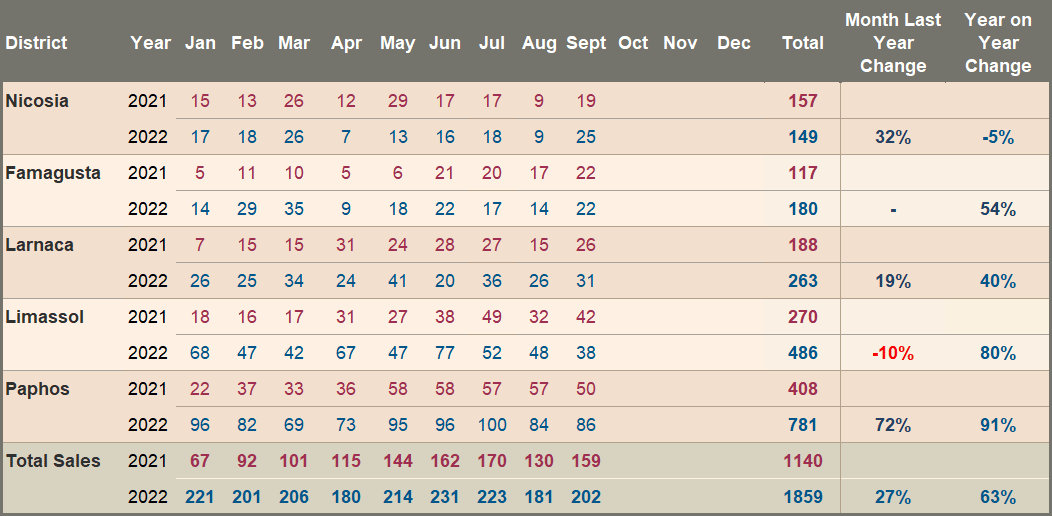
Sales to EU nationals rose 27% compared to September 2021. Although sales in Limassol fell 20% and sales in Famagusta remained steady, these were outweighed by increases in Paphos, Nicosia and Larnaca.

EU Transactions – 2021/2022 Comparison
Overseas (EU) Sale Transactions – 2021/2022 Comparison

Foreign real estate sales to EU nationals during the first nine months of 2022 reached 1,859; an 63% increase on the 1,140 achieved in the same period last year.

Property sales to non-EU nationals

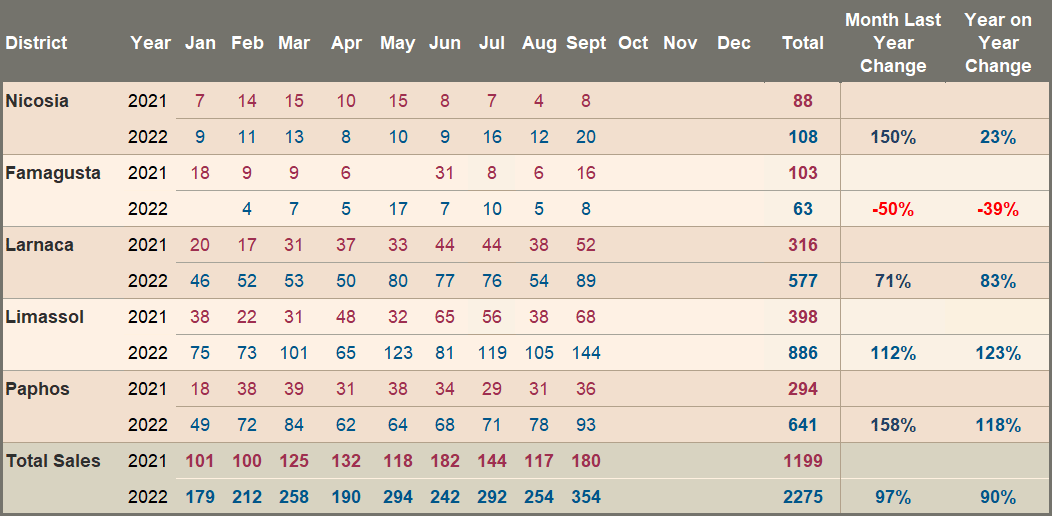
Sales to non-EU Nationals rose by 97% compared to September 2021. Although sales in Famagusta fell, these were outweighed by increases in Limassol, Paphos and Nicosia and Larnaca.

The highest number of sales were recorded in Limassol, followed by Paphos, Larnaca, Nicosia and Famagusta.

Non-EU Transactions – 2021/2022 Comparison
Overseas (non-EU) Sale Transactions – 2021/2022 Comparison

Overseas sales to non-EU nationals during the first nine months of 2022 reached 2,275; a 90% increase on the 1,199 achieved in the same period last year.

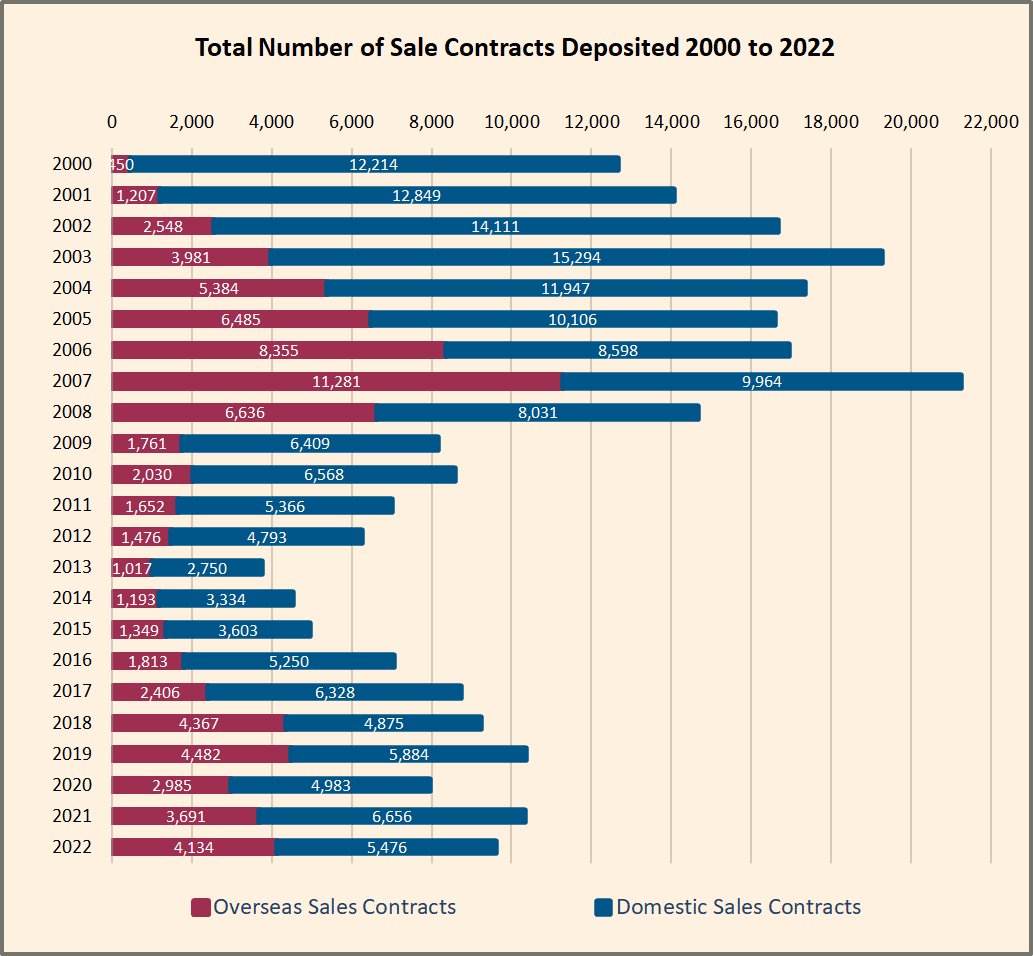
Contracts deposited between 2000 and 2021 Analysis
Cyprus real estate contracts deposited between 2000 and 2021

No quick remedy to spiralling rents

Rents in Cyprus are up by 50 per cent in some areas – and not just in Limassol – with some students in Nicosia now renting cheaper apartments in the north.

The Sunday Mail spoke to experts in the real estate sector who explained the factors which are leading to higher prices – and they argue that they are all heading in one direction: up and up.

The cheapest available place to rent on Bazaraki – a popular site for those seeking accommodation – is for €300, which gets you a 30 square metre prefab container-like room in Lakatamia, Nicosia. Another for €300, also a prefab container home, is available in Kornos.

Yiannos Andreou, 32, told the Sunday Mail that four years ago he was renting a one-bedroom apartment along a busy street in Ayios Dhometios in the capital for €300 but it has since increased to €420.

Experts we spoke to told us that despite the increase the tenant has snagged a bargain.

“Rents have shot up, that’s mainly due to more people moving to Cyprus,” Pavlos Loizou, CEO of Ask Wire – a property technology company, which provides real estate data analytics, told the Sunday Mail.

Indicative rents

Indicative prices for a one-bedroom apartment in Nicosia are at about €500 – €600 while in Limassol they stand at around €800 – €900, according to Marinos Kineyirou, president of the Council for Registration of Real Estate Agents.

For Larnaca the rent for a single bedroom apartment is about €400 – €500 while in Paphos it’s at €350 – €450 – and rising.

And while the focus of the price rises in housing has long been on Limassol, every district is recording a surge.

“Rents have doubled in some cases over the past three years,” head of the real estate agent’s association (Skek) Andreas Kaouris told the Sunday Mail.

He emphasised: “We’re seeing astronomical rents, and I don’t see this changing anytime soon.”

Kaouris told us that the equilibrium in the market has been thrown off, as “the rents are so high in Limassol which pushes more people towards Paphos, Larnaca, and Famagusta where the rents are cheaper in comparison to Limassol”.

According to Paphos Chamber of Commerce president George Mais, the limited number of rental properties in the city is pushing prices higher, with prices up by as much as 30-50 per cent.

Pointing to the surge in demand for accommodation, Loizou cited the most recent census which showed that from 2011 to 2021 the population increased by about 85,000 people.

“And so far in 2022 – there’s no official numbers, yet – but we’re likely at about 20,000 and rising in terms of new arrivals,” he said, explaining that they are mainly on the higher end of the market.

Those involved in the real estate market told the Sunday Mail that there are a multitude of factors which impact the sector – most of which are pointing in the direction of pushing prices higher.

They focused on Russia’s invasion of Ukraine which has had the double effect of pushing up construction costs due to energy price shocks as well as an increase in people seeking refuge – further boosting demand for accommodation.

Indeed, Kaouris sees property as a safe investment as construction costs have also surged – meaning that home prices are unlikely to decrease during a potential upcoming crisis.

He also cited the arrivals in Cyprus because of the Russian invasion, as well as high levels of irregular immigration which has led to a surge in demand for lower end accommodation, pushing up prices there, too.

Loizou explained that many legal foreign workers arriving in the coastal cities are providing much needed skills, mainly in the IT sector.

Many view this as a simply supply and demand issue: there’s just more people seeking accommodation than is available.

Kaouris said that housing is also viewed as a safe investment during a time of low return on interest rates and inflation, rather than saving money in the banks.

“Many Cypriots – not the big-time investors but the smaller ones – have taken their money out of the banks and whoever had enough money has purchased an apartment, not fields, and then rents it out,” he said.

For Loizou, another factor which will keep rents rising is the rising interest rates.

“As interest rates increase, those who are renting and were considering a purchase are now likely to postpone it – so by remaining in the rental pool they are withholding one house or apartment being made available for rent, compounding demand,” he said.

Loizou doesn’t see prices falling any time soon, either, explaining that overseas investors and workers are likely to offset a possible drop in demand from the locals.

 “I don’t see prices coming down, and the reason for that is that even if there’s a softening of demand from locals it will be matched by those from overseas who will move in and buy mainly residential units,” he said.

“Where we may see some rebalancing is mainly where locals buy land to build their houses,” Loizou added.

Other factors are also shifting the equation and increasing demand, such as major projects coming online: the Paphos-Polis highway and the announcement that the Cyprus University of Technology (Tepak) is to establish a school of tourism and hospitality management in Paphos, aimed for completion by 2023. That means many more students will need accommodation in the city.

Loizou said that Larnaca has been gaining momentum for about three years now both because of the nearby Limassol port and marina, while it is also favoured by the Lebanese investors seeking a base for business.

“And then there are those from Israel where prices are high but they do have money and they transact mainly in US dollars which has strengthened against the Euro,” he said.

Paphos is more recent he says – noting that it has been picking up pace in the past six months.

Asked whether factors such as chronic congestion towards the cities for work and higher petrol prices may alter the market, Loizou said that there have already been some changes – but not due to hardship.

“You are seeing more apartments being constructed in central city areas but that’s less due to hardship and more related to lifestyle changes: such as younger people not getting married or not having large families,” he said.

Loizou explained that over the past eight to ten years there has been a shift towards smaller units and progressively towards apartments.

Amid the price surge for those renting, there have been calls for “something to be done”.

For Kineyirou, better regulation of the rental market could lower the costs for both landlords and those leasing.

Weak rental regulation

He argues that weak rental regulation – viewed by landlords as strongly favouring those renting – means that landlords are often hesitant to rent out their properties. They argue that they are insufficiently protected by the law in case of non-payment from the tenants, or tenants simply refuse to agree to a rent increase. Others also raise the rent as they attempt to price-in potentially troublesome tenants who may not pay.

He says that the creation of a register of “bad” tenants who do not honour their rental agreements would soothe the market.

Others, however, have said that such a move is unfeasible and that personal data protection issues may arise.

The situation has led to isolated protests by some student groups, mainly in Limassol, who are warning that they are facing a dire situation: a choice to continue studies or give up and enter the labour market.

The House interior committee also heard this month that some are seeking reprieve from the high rental costs by living in the north. That was confirmed by Dipa MP Alekos Tryfonides who spoke with five Greek Cypriot students who are renting in the north, mainly near the Ayios Dhometios crossing.

The students, mainly from rural communities and other cities, told him that in the north they are able to get a single bedroom apartment for €170 and a two-bedroom apartment for about €200-220.

The House education committee heard this week that a considerable number of students studying in cities away from their home are exiting higher education due to the high rental costs, as well as high fuel costs when commuting.

The Sunday Mail also contacted Elena Kousiou, head of the Cyprus Land Development Organisation (Koag), whose service is tasked with securing affordable housing for low-income and vulnerable groups.

“Certainly, many are struggling now to reorganise their finances to buy a home, so Koag is also looking at affordable rent as well as affordable purchasing,” she told us.

Their focus is on areas near city centres, she told us, so apartment buildings in locations such as Larnaca’s Ayios Nikolaos, in Nicosia’s Kaimakli and Lakatamia, as well as Limassol’s Polemidia.

In July 2020, Limassol municipality and Koag announced that “the largest housing project ever undertaken in Cyprus, worth €100m” would take place in Limassol.

Kousiou told us that the project is facing delays, explaining that: “It is underway but since we’re talking about 600 units you can understand that it’s complicated and we don’t want there to be any mistakes.”

She acknowledged that since that project is stalling, the Koag council has decided to proceed with smaller scale housing works which can be carried out more swiftly.

When the major Limassol housing project was announced, Interior Minister Nicos Nouris said that: “This agreement will help normalise housing prices in Cyprus, as well as help low-income families who are struggling with making ends meet.”

But just months later, the citizenship by investment scheme – whose proceeds were intended to help fund the Koag project – was axed.

A finance ministry official told the House interior committee earlier this month that revenues from the casinos may now instead partially fund the project.

For the interior ministry part of the solution is its fast-tracking of building permits – which it has hailed as a success.

It is hoped that the new process – which sees applications sent through the ‘Ippodamos’ government portal – will see more properties come online faster, by cutting red tape and reducing bureaucracy.

Even so, new housing stock may still take years to enter the market and experts agree that demand will continue to outstrip supply.


Real estate market boosted by demand for offices

0

The Cyprus real estate sector is proving remarkably resilient, shrugging off the effects of hiking inflation as demand for housing units and office space continues to grow.

The property market is backed by a heightened demand for housing projects, but stakeholders report interest in high-end office space has also taken off.

In comments to the Financial Mirror, Loucas Georgiou, Head of Property Studies & Valuations at BNP Paribas/ Danos Real Estate, said the market for office and commercial properties had seen solid demand despite pressures from soaring inflation.

“The war in Ukraine has pushed up the cost of living and businesses’ operational costs; however, at the same time, it is also powering the increase in interest for office and commercial space, as many companies, previously based in Ukraine, are eyeing Cyprus as an alternative base,” said Georgiou.

Despite pressures on the market, demand for offices has been high, keeping prices stable since 2020.

“A number of high-end office buildings will be coming online soon, while work on other projects is at an advanced stage.”

Georgiou said the bulk of demand for offices is still in Limassol, but the capital is picking up as some high-tech companies have landed in Nicosia.

According to a Danos report published by Phileleftheros daily, office rental prices in Nicosia range between €12 and €23 per square metre, while in 2020 and 2021, they were between €12 to €20.

Office rental prices in Larnaca are between €8 and €12 per square metre, compared to between €6 and €10 in 2020.

In Limassol, office rental prices are between €20 and €45 per square metre; in Famagusta, they range between €5 and €12 and in Paphos from €7 to €10.

The sale prices of offices in Nicosia are from €3,000 to €4,500 per sqm, while in 2020 and 2021, they were between €3,000 to €4,000.

In Larnaca, office space prices in 2022 are €2,000 to €3,000, higher than they were in 2021 (€1,500 to €2,000).

The Limassol sales price for offices is €5,000 to €6,000 per sqm; in 2021, it was €4,500 from €6,000.

Famagusta prices range from €1,500 to €2,000, and in Paphos, it’s between €1,500 to €2,500.

For commercial properties, shop rental prices in Nicosia are €15 to €45 per square metre, stable since 2020.

Larnaca rental prices are €6 to €20 — the same levels as 2020.

Limassol shop rental prices are €20 to €45 per sqm, also stable since 2020.

Famagusta shop rental prices are €10 to €25 per sqm, while in 2020 and 2021, they were between €8 and €20.

In Paphos, shop rental prices have remained stable since 2020, ranging from €10 to €25.

Sale prices of shops in Nicosia range from €4,000 to €5,000 per sqm, in Larnaca from €2,000 to €2,500, in Limassol from f€5,500 to €6,500 and Famagusta it €2,000 to €2,500.

Commercial yield

The promising yield encourages investors to enrich their portfolios with office and commercial properties.

For Nicosia, the yield on shop rents is between 6% to 6.5% and ranges from 5% to 6% for offices.

In Limassol, the yield for both offices and shops is between 5% and 5.50%.

In Larnaca, the rental yield for shops is from 5% to 5.50% and for offices, its 5% to 6%.

In Paphos, the rental yield on shops and offices is 5.50% to 6.50%, and in Famagusta, the yield is 5% to 6%.

As noted in the Danos reports, the extent to which the war in Ukraine will affect the domestic real estate market will depend on its duration.

The construction sector is also expected to suffer the consequences of the slowdown, mainly due to the increased cost of building materials and transportation.

“Insecurity leads to freezing major projects and temporary postponement of foreign investment.

“Strong inflationary pressures are increasingly turning investors to real estate markets as a hedge against a possible further burst of inflation,” said the report.

Some large development projects underway in Nicosia and Limassol provide an additional level of security and incentive to investors in real estate to protect their portfolios from high inflation.

Construction material prices up 16.69 per cent

1

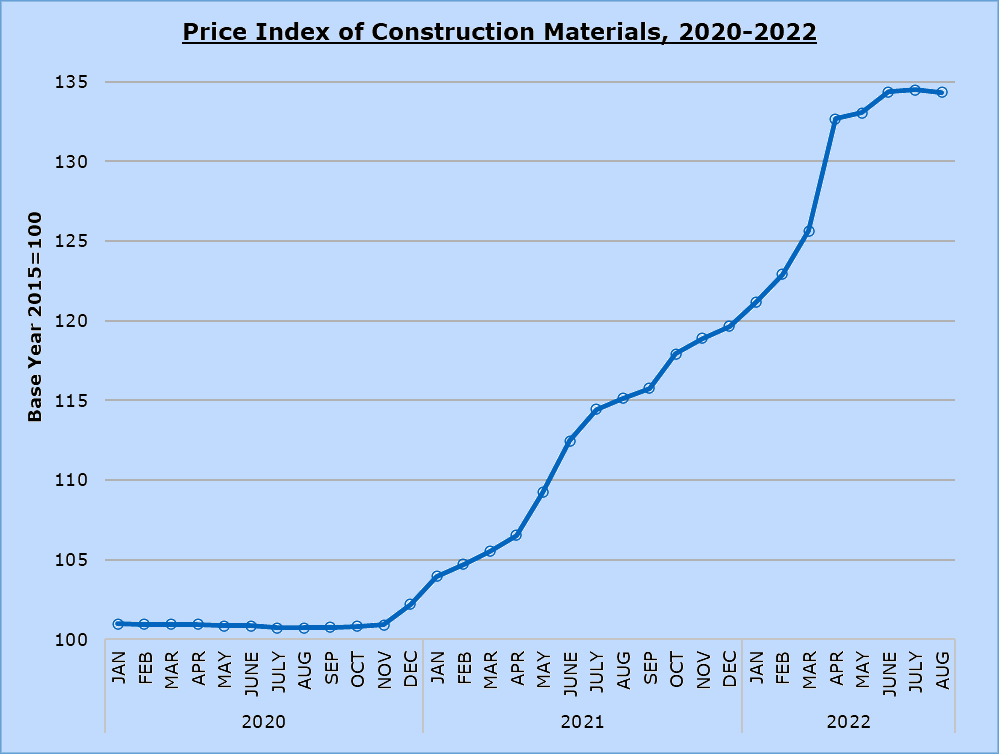
The price index of construction materials rose 16.69 per cent in August on an annual basis compared with July when they rose 17.52 per cent according to the Cyprus Statistical Service.

Compared to August 2021, the Cyprus Statistical Service reports price rises in metallic products of 19.66%, minerals 15.81%, products of wood, insulation materials, chemicals and plastics 15.69%, mineral products 15.62% and electromechanical products 11.91%.

Compared to the annual average construction material price index in 2019, iron and steel prices have risen by an average of 71.04%, with the price of structural steel rising by 88.81%, iron rails by 84.75% and building iron by 77.15%.

Over the same period copper piping has risen 60.81%, PVC doors and windows by 72.66% and bricks by 61.90%.

The only construction materials to have fallen in price since 2019 are lamps -5.02% and air conditioners -2.87%.

construction materials price index