Property sales improve in all market segments

All market segments saw an improved number of property sales in September compared to the same period last year according to figures published by the Department of Lands and Surveys.

Domestic sales

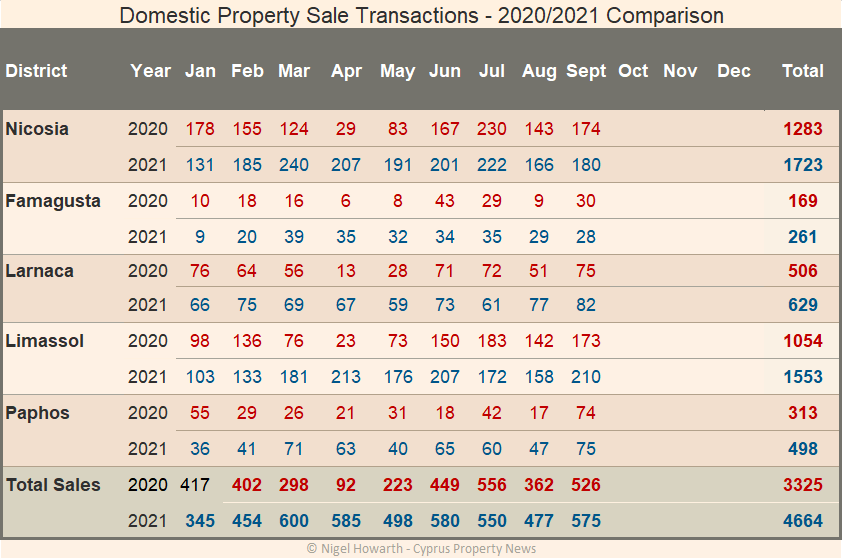
Property sales to the domestic market, which accounted for 63% of all sales in September rose by 9% compared to September 2021 and by 41% compared to September 2019.

With the exception of Famagusta, where sales were down 7% compared to last year, they rose in the remaining four districts.

Sales in Limassol rose 21%, followed by Larnaca (9%), Nicosia (3%) and Paphos (1%)

domestic sale transactions

On an annual basis, sales have risen in all districts. Sales in Paphos (59%), Famagusta (54%), Limassol (47%) and Larnaca (34%).

Sales to the domestic market have been encouraged by the government’s interest rate subsidy scheme, which will continue until the end of 2021. The ceiling for loans for house purchases was raised from €300,000 to €400,000 in February and the scheme provides an interest rate subsidy of 1.5% for a period of four years.

However, bear in mind that the figures include an unreported number of ‘non-sale’ agreements such as loan restructurings, recoveries and debt-to-asset swaps agreed between the banks and defaulting borrowers in efforts by the banks to reduce their non-performing loan portfolios.

Foreign sales

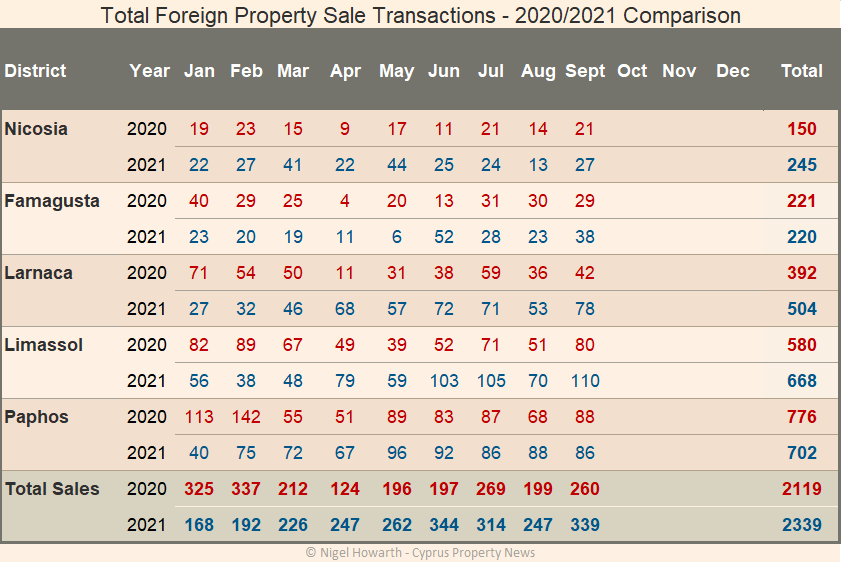
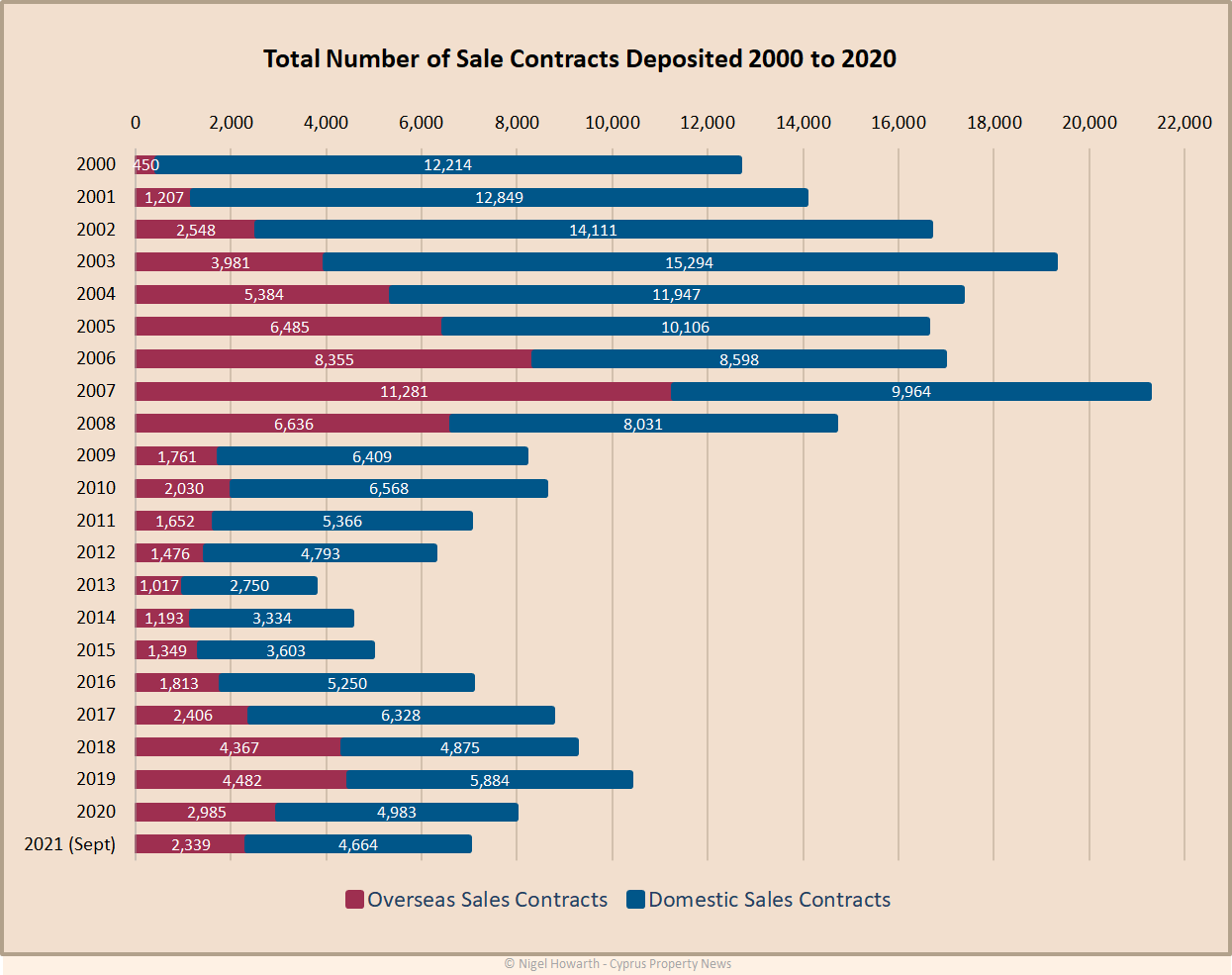
Property sales to the overseas market, which accounted for 37% of all sales in September, rose by 30% compared to September 2021 and by 19% compared to pre-COVID September 2019.

With the exception of Paphos, where sales were down 2%, they rose in the remaining four districts.

Sales in Larnaca rose 86%, followed by Limassol (38%), Famagusta (31%) and Nicosia (29%).

Foreign sale transactions

On an annual basis, although sales in Paphos were down 7% and sales in Famagusta remained almost unchanged, sales in Nicosia rose 63%, followed by Larnaca (29%) and Limassol (15%).

Sales to EU citizens

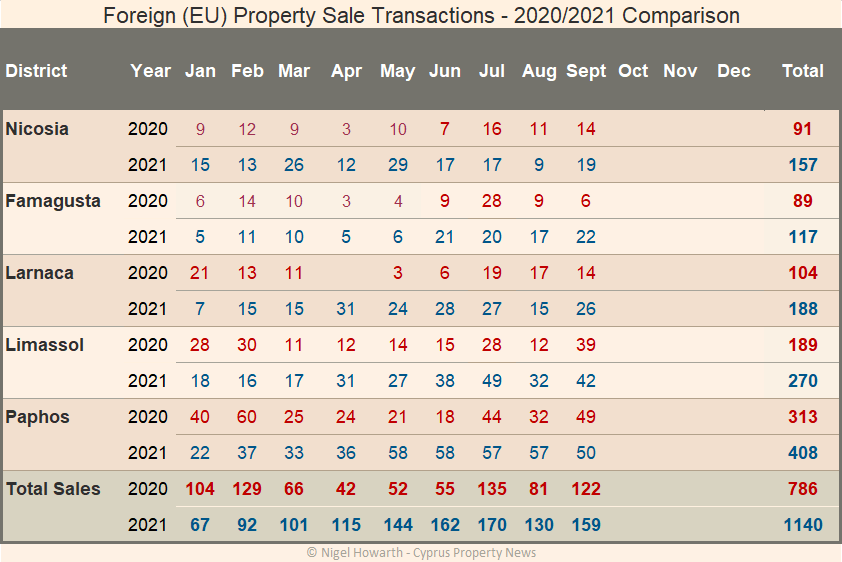
Sales to the EU segment of the overseas market, which accounted for 17% of all sales in September, rose by 30% compared to September 2021 and by 45% compared to pre-COVID September 2019.

Sales rose in all districts. In percentage terms, Famagusta led the way with sales up 267%, followed by Larnaca (86%), Nicosia (36%), Limassol (8%) and Paphos (2%).

EU sales transactions

On an annual basis, the number of properties sold to EU citizens has risen in all districts. Larnaca (81%), Nicosia (73%), Limassol (43%). Famagusta (31%) and Paphos (30%).

Sales to non-EU citizens

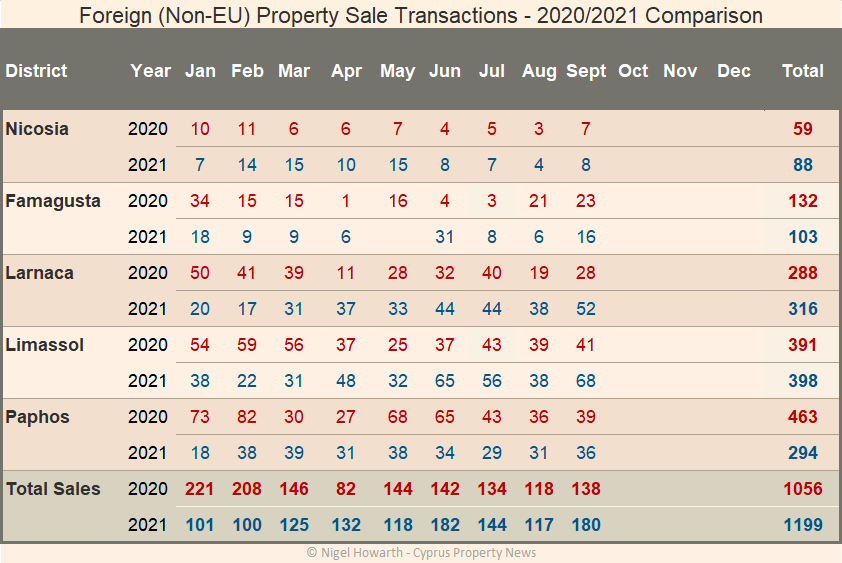
Sales to the non-EU segment of the overseas market, which accounted for 20% of all sales in September, rose by 30% compared to September 2021 and by 3% compared to pre-COVID September 2019.

Although sales in Famagusta and Paphos fell by 30% and 8%, they rose 86% in Larnaca, 66% in Limassol and 14% in Nicosia.

Non-EU sales transactions

On an annual basis, sales in Paphos and Larnaca are down 37% and 22% respectively. However, sales in Nicosia have risen 49% and sales in Larnaca and Limassol have risen 10% and 2% respectively.

Cyprus property sales analysis

Cyprus bucks EU trend for rising rents

0

Cyprus and Greece are the only two EU countries where the cost of renting a flat or a house has decreased over the past decade, according to the latest data released by Eurostat.

Rents decreased in only two countries between 2010 and 2021: Greece (-25%) and Cyprus (-3%).

The highest rises were recorded in Estonia (142%), Lithuania (109%) and Ireland (66%).

Cyprus has also seen the third largest reduction in house values overall compared to 2010, as prices decreased by 8%.

House prices decreased in four countries: Greece (-28%), Italy (-13%), Cyprus (-8%) and Spain (-3%).

The highest rises were recorded in Estonia (133%), Luxembourg (111%) and Hungary (109%).

In its analysis of the data, Eurostat points out that between 2010 and Q2 2011, house prices and rents in the EU followed similar paths, but since Q2 2011, those paths have diverged significantly.

After a sharp decline between Q2 2011 and Q1 2013, house prices remained more or less stable between 2013 and 2014.

Then, there was a rapid rise in early 2015, when house prices have increased faster than rents.

From 2010 to Q2 2021, house prices jumped by 34%, and rents increased by 16%.

Rents and house prices in the EU continued their steady increase in Q2 2021, going up by 1.3% and 7.3%, respectively, compared to Q2 2020.

More specifically, while rents increased steadily throughout the period up to Q2 2021, house prices have fluctuated considerably.

Finally, when comparing Q2 2021 with 2010, house prices increased more than rents in 18 EU Member States.

Further reading

Rent up by 14.2%, house prices by 25.0% since 2010

Nicosia driving slow real estate market

Nicosia is driving the Real Estate market with total property sales in the capital in the first nine months of 2021, exceeding that recorded pre-coronavirus pandemic.

Sales in the capital increased by a whopping 37% in the first nine months compared to the same period in coronavirus stricken 2020, and 38% more than the same period in pre-COVID 2019.

Despite an overall 9% decrease of Cyprus property sales from January to September, compared to 2019, Nicosia pulled in a remarkable increase, being the only district to do so.

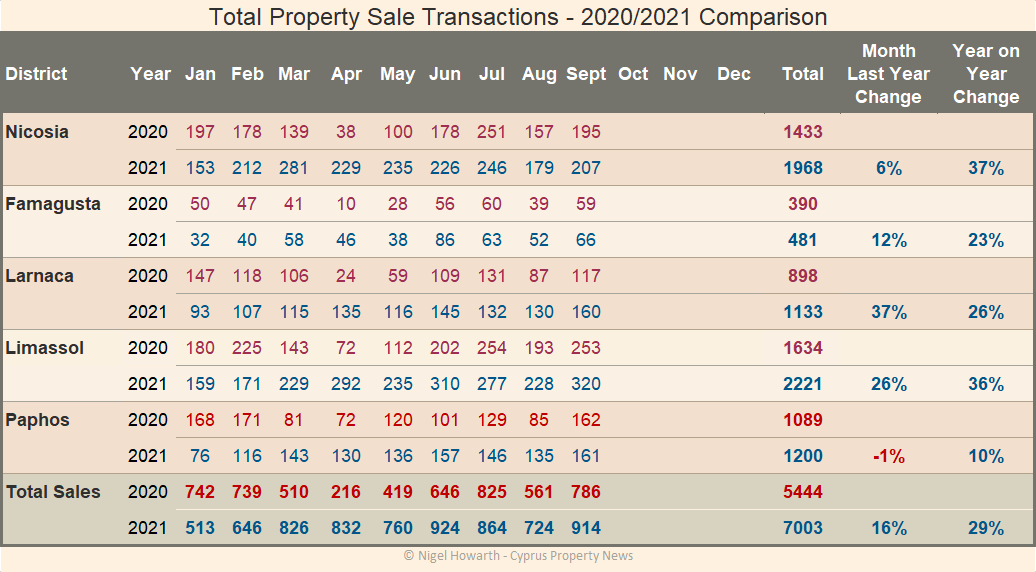
According to Land Registry data, the number of sales documents submitted totalled 7003 from January – September, up from 5444 in the same period last year and down from 7736 in the nine months of 2019.

In the first nine months of 2020, the overall activity in the real estate market increased by 29% from last year.

Part of this increase is attributed to last year’s low base due to lockdowns that significantly reduced economic activity and the operation of the land registry itself.

Real Estate sales rose in all other districts; however, compared to 2019, sales decreased in all districts except Nicosia.

The biggest drop of 40% was in Paphos, while a decrease of 18% was seen in Limassol.

District 2021 2020 2019 Compared
to 2020
Compared
to 2019
Nicosia 1968 1433 1427 37% 38%
Limassol 2221 1634 2709 36% -18%
Larnaca 1133 898 1124 26% 1%
Famagusta 481 390 491 23% -2%
Paphos 1200 1089 1985 10% -40%
Total 7003 5444 7736 29% -9%

As the Central Bank pointed out in its latest real estate price report, the property market has been going through a period of adjustment since the beginning of the pandemic.

It attributed this to a possible shift of buyer and investor preferences to smaller apartments or houses of lesser value than previous years.

According to the Central Bank, there is increased demand for residential property in most districts, mainly for apartments and houses of smaller size and value than in the past.

On an annual basis, there is a stabilisation in house prices with an increase of 0.9% in the first quarter of 2021 from 0.8% in the fourth quarter of 2020.

In 2020, sales documents fell to their lowest point since 2016 at 7,968 units compared to 10,366 in 2019, recording an annual decrease of 23.1%.

Cyprus house price index up 1.2%

The Cyprus House Price Index (HPI) rose by 1.2 per cent in the second quarter of 2021 compared to the previous quarter according to preliminary figures in a press release issued by the island’s Statistical Service (CYSTAT).

However, the HPI also reports that residential property prices in Cyprus fell by 4.9 per cent on an annual basis.

According to CYSTAT, the Cyprus House Price Index (HPI) “is a quarterly index which measures the change in the average prices of residential dwellings. It captures all types of residential properties, both new and existing. The land component of the residential property is included.

“The data source used for both, indices and weights, is the Department of Lands and Surveys, Ministry of Interior. The data cover all areas which are under the control of the government of the Republic of Cyprus.

“Data are marked as provisional and are revised as soon as new information is available.”

Year Quarter House Price Index (2015=100) Quarterly Change (Compared to the previous quarter) (%) Annual Change (Compared to the same quarter of the previous year) (%)
2010 Q1 114.37 -1.6 -6.6
Q2 112.79 -1.4 -6.9
Q3 112.39 -0.4 -5.7
Q4 112.05 -0.3 -3.6
2011 Q1 111.56 -0.4 -2.5
Q2 113.99 2.2 1.1
Q3 111.22 -2.4 -1.0
Q4 107.60 -3.2 -4.0
2012 Q1 106.40 -1.1 -4.6
Q2 106.02 -0.4 -7.0
Q3 110.14 3.9 -1.0
Q4 108.22 -1.7 0.6
2013 Q1 104.54 -3.4 -1.7
Q2 104.77 0.2 -1.2
Q3 103.05 -4.7 -9.3
Q4 100.78 0.9 -6.9
2014 Q1 98.08 -2.7 -6.2
Q2 103.55 5.6 -1.2
Q3 102.70 -0.8 2.8
Q4 101.56 -1.1 0.8
2015 Q1 97.52b
Q2 100.59 3.1
Q3 102.49 1.9
Q4 99.40 -3.0
2016 Q1 97.29 -2.1 -0.2
Q2 99.18 1.9 -1.4
Q3 101.87 2.7 -0.6
Q4 102.72 0.8 3.3
2017 Q1 99.64 -3.0 2.4
Q2 102.74 3.1 3.6
Q3 102.46 -0.3 0.6
Q4 105.24 2.7 2.4
2018 Q1 103.10 -2.0 3.5
Q2 104.01 0.9 1.2
Q3 103.12 -0.9 0.6
Q4 107.04 3.8 1.7
2019 Q1 107.93 0.8 4.7
Q2 112.73 4.5 8.4
Q3 105.64 -6.3 2.4
Q4 106.51 0.8 -0.5
2020 Q1 109.13 2.5 1.1
Q2 109.48 0.3 -2.9
Q3 104.21 -4.8 -1.3
Q4 109.10 4.7 2.4
2021 Q1 102.82 -5.8 -5.8
Q2 104.07 1.2 -4.9

b There is a break in the series in the first quarter of 2015 due to redefinition of the model variables.

Property sales rising steadily

The number of property sales continued to rise in September 2021 compared with the same month last year, according to figures released by the Department of Lands and Surveys earlier today.

During September 2021, a total of 914 contracts for the sale of property were deposited at land registry office across the Republic, an increase of 16% compared with the 768 contracts deposited during August 2020.

Sales have been improving since the COVID restrictions started to ease earlier this year, and the number of sales in September exceeded the pre-COVID number of sales achieved in September 2019 (692).

However, the figures will include an unknown number of ‘non-sale’ agreements such as loan restructurings, recoveries and debt-to-asset swaps agreed between the banks and defaulting borrowers in efforts by the banks to reduce their non-performing loan portfolios. Unfortunately, the Department of Lands and Surveys does not publish these figures separately.

Cyprus property sales contract statistice

Sales have been encouraged by the government’s interest rate subsidy scheme, which will continue until the end of 2021. The ceiling for loans for house purchases was raised from €300,000 to €400,000 in February and the scheme provides an interest rate subsidy of 1.5% for a period of four years.

The Bank Lending Survey, which was published earlier today by the Cyprus Central Bank, reveal that Banks expect that net demand for all types of loans, from businesses and households will increase during the third quarter of the year.

Sales contract numbers 2020 2021 comparisonThe Department of Lands and Surveys has yet to release its analysis of the figures showing domestic and foreign sales. We’ll bring you the figures as soon as they become available.

Rising costs push property prices through the roof

Building material prices in Cyprus soared in the first half of the year, sending the cost of construction to skyrocket to new highs and pushing property prices further up.

This increase has also made it harder for the real estate and construction sectors to recover after the scrapping of the ‘golden passports’ scheme and the coronavirus pandemic fallout.

Increases are recorded across the board, as crucial items such as steel, cement, sand, stone aggregates and wood-based materials have seen a significant price increase in the last seven months, according to the statistical service Cystat.

This has pushed up the overall construction cost by 7.21%, compared to the same period last year.

Real estate experts fear that the upward trend will cause property prices to soar, sending shockwaves throughout the market, causing a temporary, at best, freeze in construction and sales of new development projects.

Supply chain disruptions, due to the Covid-crisis and pre-existing geopolitical antagonism, decreased the supply of building materials just as output remained resilient during the pandemic. This has resulted in shortages and price hikes, said property expert Tasos Bilianides.

Geopolitical reasons and the newly formed alliance between the US, the UK and Australia have cornered China which is feeling the pressure of restrictions imposed, said Bilianides, director at MPA Property agency.

The property advisor said that since 2000, when China’s industrial renaissance began, Australia has been an ally, exporting 85% of its ores to China. This alliance allowed Australia to come up top unscathed from the global crisis of 2008, while China became a leading player in the worldwide production of final product (steel and iron), he explained.

“However, the newly formed alliance has worsened relations between the two countries. As a result of this crisis, there are trade restrictions, reduced production and increased final product prices,” he explained.

Bilianides also said that prices of building materials have been pushed up by inflated transportation costs, fueled partly by COVID-19 and the geopolitical conflicts between the west and China.

And the pandemic has led to a huge increase in the cost of freight shipments, especially from Asia to the West. The average price of a container from €1,500 before the pandemic, has skyrocketed to €10,000.

Increased demand for containers, combined with the need for more port staff, and the industry’s general inability to meet huge demand, has resulted in a sharp rise in transport prices for both raw materials and the final product.

This increase will inevitably be transferred to the final consumer, which is the construction sector. Reports by developers say that the final price of a property could go up by 20%

Delay in construction projects

“What this all means for Cyprus, is that the sector will take another blow, with a number of projects in the pipelines being put on hold, while buying real estate property will become even more inaccessible for some people”.

“Cypriots in the market for a home will temporarily be put off from buying a property, putting off their dream for at least a few months, in the hope of prices going down again,” added Bilianides.

He argued that some young couples looking to buy a home with the help of a bank loan will have a harder time to obtain financing now that prices will inevitably be going up.

Bilianides said that real estate sectors have yet to see deals fall through, but they expect to see a freeze in the market, as buyers will not be sure what to make of the situation.

Panos Danos, CEO of Danos/BNPRE Group told the Financial Mirror that the cost of construction has gone up by 27% since 2020, as increases in transportation and COVID have pushed the cost of construction materials through the roof.

As he explained, ongoing projects will suffer as a result, as many projects will be put on hold.

“When it comes to high-end property housing, constructors of ongoing projects will be faced with a serious problem as the majority of units have already been sold. Constructors will have to shoulder the increased cost”, he said.

“When it comes to newer projects, the cost will probably be rolled down to the final consumer, which is the property buyer”.

However, Danos foresees that the turbulence in the market is temporary, with property prices stabilising by the end of next year.

“Prices have been pushed up mainly from geopolitical events affecting transportation costs. And let’s not forget Brexit, and the coronavirus pandemic” said Danos.

He argued that once the height of these tides is overcome, we will see prices deflate.

Danos stressed that prices are not only being pushed up by the rising costs in building materials, but are also being pushed up by heightened demand, following the coronavirus pandemic, and the crisis.

Increase impacts city properties

“We have been witnessing the increase in prices of mainly city properties, such as building land, offices and new housing projects,” said Danos.

He explained that the crisis comes at an awkward timing for the industry, as demand had started taking off.

“There are a number of people with money in their pockets who are either on the lookout for a new home or an investment opportunity. We have also been on the receiving end of interest from international Real Estate Investment Trusts (REIT) looking to invest in Cyprus properties which have a good profit margin,” he explained.

Asked whether the increase in the cost of building materials will offset the market to an extent that bringing down prices would be a task on its own, Danos said that currently there is some pressure on prices from property already on the market.

“At the moment the market is under pressure from properties already on the market, more so from properties belonging to banks. Housing units, offices acquired by banks mainly through debt to asset swaps, are being sold with generous discounts as banking institutions need to offload these properties,” he said.

However, he said this pressure will be short-lived, as banks currently have a small stock of such properties, while “in any case we are not talking about prime property”.

“Today’s buyers are in the market for new, modern, energy efficient buildings,” said Danos who appeared confident that the market will stabilise in 2022.

“Things are already looking up, with the European Union expecting to see a boom in its GDP and tourism picking up in 2022.

“Property prices might still be higher after the end of next year, but that will be because of heightened demand rather than turbulence caused by geopolitical conflicts and events such as the coronavirus pandemic,” he concluded.