Cyprus ditches ‘golden passport’ scheme

Cyprus has announced it will abolish a controversial passport scheme following an investigation by Al Jazeera that revealed how high-ranking politicians were willing to issue passports to convicted criminals.

The interior and finance ministries said in a statement posted in Greek on Twitter that the citizenship through investment programme in its current form will be abolished from November 1.

“The proposal was based on the long-standing weaknesses but also on the abusive exploitation of the provisions of the programme,” Tuesday’s statement said.

In addition, Cypriot Attorney General George Savvidis announced it would start an investigation into possible criminal offenses.

“What has been published in the last few hours by the Al Jazeera news network is causing outrage, anger and concern among the people,” his statement read.

On Monday, Al Jazeera’s Investigative Unit released The Cyprus Papers Undercover, which showed the willingness of parliament speaker, Demetris Syllouris, and member of parliament, Christakis Giovanis (also known as Giovani in Cyprus), to aid and abet convicted criminals to obtain a passport through the Citizenship Investment Programme (CIP).

Weeks earlier, Al Jazeera also released The Cyprus Papers, a cache of almost 1,400 documents showing Cyprus had granted passports to criminals convicted in their home countries and people wanted by Interpol in the previous years.

Following Tuesday’s announcement by the Cypriot government, Syllouris said he would abstain from duties from October 19 until any government investigations had been completed.

Politicians implicated

Anyone who could afford to invest at least $2.5m in the Cypriot economy, usually through real estate, was able to obtain a Cypriot passport.

The programme has been regularly criticised by the European Union and anti-corruption NGOs, which claim it would increase the risk of money laundering through Europe’s financial institutions.

Posing as Billy Lee and Angie, Al Jazeera’s reporters went undercover, pretending to represent a Chinese businessman interested in acquiring a Cypriot passport. The mystery businessman had been convicted for money laundering, which should have disqualified him as an applicant under Cyprus’ rules.

However, time and again they were told that the sentence would not be a problem as long as enough money was invested.

MP Christakis Giovani, also one of the island’s most prominent real estate developers, told the undercover reporters he would ensure the deal was done.

“It’s not easy. But I can promise, we shall do the best. And I believe we have the experience,” Giovani said.

Parliamentary speaker Demetris Syllouris went even further, saying: “You can tell him that he will have, without mentioning my name or anybody else’s, full support from Cyprus. At any level – political, economic, social, everything – OK.”

These sentiments were echoed by several others, including a lawyer who said that it would even be possible to change the name on the passport, effectively changing the identity of the applicant.

EU criticism of passport scheme

After Monday’s revelations, the European Commission said in a statement it watched the revelations in disbelief.

“President von der Leyen was clear when saying that European values are not for sale,” the Commission said.

“The Commission has frequently raised its serious concerns about investor citizenship schemes, also directly with the Cypriot authorities. The Commission is currently looking at compliance with EU law of the Cypriot scheme in view of possible infringement proceedings,” it added.

“We are aware of the latest declarations of the government and expect the Cypriot competent authorities to thoroughly look into this case.”

Dutch MEP Sophie in ‘t Veld told Al Jazeera the film “fully exposes the ‘citizenship by investment’ schemes for what they really are: a cover operation for bringing criminals and criminal money into the EU.

“Today we have therefore renewed our call on the European Commission to not only take legal action against Cyprus, but submit a legislative proposal banning the practice altogether,” she added.

“If this film is not enough evidence for the need for a legal ban, then what is?”

Her comments were echoed by her colleague Sven Giegold, who said: “It is key that the EU takes over and that this means that the resident programme and the investment programme have to be ended.

“What is so shocking about these pictures is how natural it seems. This was not a one-case accident, it seems structural.

This needs a treaty violation procedure by the European Commission.”

The Cyprus Papers

After The Cyprus Papers, Cyprus defended its programme, saying there had been several mistakes in recent years but tightening laws and checking applicants’ backgrounds were sufficient to stopping criminals obtaining passports.

At least 23 applications had been fast-tracked by the minister of interior, while problematic individuals could apply for a passport with ease through their family members’ citizenship applications.

© 2020 Al Jazeera Media Network

Al Jazeera in Cyprus passports ‘gotcha’ video

Cypriot parliament speaker Demetris Syllouris has lashed out at the Al Jazeera network, saying it tried to snare him in an undercover investigation into ‘golden passports’ under the Cyprus Investments Scheme.

The new 50-minute video, released on Monday, allegedly uses an investor described as ‘Mr X’ who is reportedly a convicted Chinese national, living in Hong Kong.

Syllouris said he met the person socially, a year ago, during an event hosted by property developer and MP Christos Giovanni.

“He did not give details about himself and said he was interested in investing in infrastructure projects, without elaborating further or revealing his source of funds. This raised suspicions,” the House speaker said Monday.

“There is nothing improper about my meeting with Mr Giovanni. We have known each other for years and often meet socially,” Syllouris said.

He argued that Qatar-based broadcaster Al Jazeera did not do investigative journalism, “it does other things.”

Sarah Yeo from Al Jazeera’s Investigative Unit contacted local media saying they would “broadcast an undercover film that reveals in detail how a fugitive from justice might obtain an EU passport through Cyprus, for the right price.

“Posing as representatives of a fictitious criminal character, our undercover reporters were ushered through the application process for the Cyprus Investment Programme by lawyers, property agents, leading eventually to high ranking politicians.”

The evidence reveals a two-track application process where “problematic” applicants pay more money to acquire passports.

“The evidence presented in the film is deeply concerning, particularly when set alongside the findings of our Cyprus Papers investigation which in August, identified high-risk individuals including criminals and politically exposed persons who acquired Cypriot citizenship through the investment scheme.

“The story will lead Al Jazeera’s news bulletins (Monday) and I’m hoping there will be a strong reaction to our findings from across Europe,” Al Jazeera’s announcement said.

Al Jazeera claimed that “among those involved are the speaker of parliament Demetris Syllouris and member of parliament, Christakis Giovani, who is also one of the country’s largest real estate developers”.

“Our path to achieving a passport for our criminal applicant culminates with meeting the president of the Cyprus parliament, who holds the second-highest office of state.”

After being briefed about our applicant’s criminal background, Demetris Syllouris says to our undercover reporters, “You have my full support.”

When asked if the criminal applicant will receive a passport, he replied, “I cannot say 100% but I say 99%.”

The spotlight once again fell on the ‘golden passports’ scheme as a series of unflattering articles and videos were published by Al Jazeera in August which essentially portrayed Cyprus as selling passports to criminals for cash.

The expose was based on the leak of over 1,400 documents related to the investment scheme, obtained by Al Jazeera, which in photos, appear to bear the seal of the Cyprus Parliament.

In an initial response, the Cyprus government refuted Al Jazeera’s claims as propaganda, with Interior Minister Nicos Nouris arguing they only served to damage the island’s economy and reputation through “deception” and “false information”.

The government had accused the Qatar-based broadcaster of engaging in propaganda and seeking to smear the island’s reputation, citing its political ties with Turkey.

It has since launched an independent inquiry to examine all 4,000 applicants since the scheme began in 2007.

Last week, the cabinet said it would revoke seven passports of foreign investors who falsified information on their application.

Twelve other suspect applicants have been referred to the police chief to check if they are wanted overseas.

Copyright © Financial Mirror


Further reading

Cyprus officials implicated in plan to sell passport to criminals (Al Jazeera)

House president denies wrongdoing in latest Al Jazeera revelations (Cyprus Mail)

New storm brewing over ‘golden passports’

Cyprus Citizenship for Investment Scheme is under scrutiny once more following revelations the cabinet approved the naturalisation of 42 relatives of a Saudi businessman with friendly ties to the President.

The case involves relatives of the owner of JetStream Aviation, Abdulrahman Mahfouz whom President Nicos Anastasiades called a friend following a scandal in 2018 when he accepted a ‘lift’ for his family’s vacation in the Seychelles on the Saudi’s jet.

Mahfouz is the same businessman granted a Cyprus passport.

Auditor-General Odysseas Michaelides’ revelations before a House committee on Thursday, has reheated the debate surrounding Cyprus’ investment program and those who fear the passport scheme has brought about more damage than good.

President Anastasiades had said back in 2018 that it was a mistake to accept a free flight on Mahfouz’s jet for a family holiday in the Seychelles but argued the private trip didn’t break any laws or ethical guidelines.

He said in a written statement use of the jet “could’ve been avoided” to prevent what he called a “needless commotion” and “groundless” claims.

According to Michaelides, 42 people benefitted from the naturalisation of the Saudi Arabian businessman resulting from his investment in Cyprus through the CIS program.

An issue arises as no further investment other than the one stated on the initial investor’s application was made.

During a discussion in the parliamentary Audit Committee, Michaelides stated that six relatives were naturalized through the Saudi, as well as 36 dependents of theirs.

Two of the investor’s brothers and a sister, as well as their spouses, acquired Cypriot citizenship.

It is worth mentioning that one of the brothers had two wives.

MPs called on the Ministry of Interior to forward relevant information to Parliament.

The Auditor-General and the House are not the only bodies to revisit the scheme, leading employers came out in support of it but called for investments to be directed towards industry.

The Cyprus Federation of Employers and Industrialists (OEB) argued the investment scheme should be maintained but needs to be improved and its resources redirected from property deals to funding industry as well.

George Petrou, OEB’s chairman, said the Citizenship by Investment Scheme, has contributed up to €9.7 billion in direct and indirect contributions and created about 10,000 jobs since 2013.

In comments to the Financial Mirror, Antonis Loizou, CEO of Antonis Loizou and Associates, defended the scheme arguing it was “not only 10-20 developers who benefit” but a wide range of professionals.

He argued benefits from the scheme have trickled down to other parts of the economy resulting in increased revenue for the state in taxes.

He further argued that Cyprus banks are among the beneficiaries of the scheme as many businesses, including developers were able to restructure their non-performing loans.

Nothing to brag about

Economist and Independent MP Anna Theologou questions the extent to which the CIS has benefited Cyprus’ economy.

She argued the Finance Ministry itself has said that the CIS contribution through investments made in real estate is relatively small compared to the rest of the economy.

Quoting a recent study by the Finance Ministry, she said: “The contribution of investments through the CIS in the construction sector during 2016-2019 amounted to around 1.7% GDP compared to cumulative GDP growth during the same period which was 18.4%”.

She argued the 1.7% cumulative rate over three years compared to the 18.4% GDP growth rate for the rest of the economy, is nothing to brag about.

“If the government had not intentionally turned investors’ focus solely to real estate, returns and benefits would definitely have been higher.”

Theologou said the government turned investors towards real estate in a bid to bail out banks which were overexposed to toxic loans taken out by developers.

“There is currently a bubble in the real estate sector waiting to burst. The government thought that by boosting developers’ liquidity they would be able to pay off their NPLs, helping out banks in the process,” said Theologou.

However, as she argued, developers took to building luxury apartments and houses without planning, creating an oversupply of such property.

“This has brought them back to square one, as despite not having borrowed money from Cyprus banks, they will be unable to repay restructured loans as they will find themselves left with a large number of unsold luxury property on their hands”.

The economist further argued that no serious investment has been made in affordable housing for Cypriots.

“Affordable housing is the last thing on developers’ minds who are concentrating on demand from abroad.

“This means that Cypriots still need to find some €300,000 to buy a house, looking to take out loans from banks.”

She believes these loans are not sustainable, and will eventually become NPLs, adding to the bad debt mountain.

Commenting on the CIS’ contribution to unemployment Theologou said that numbers can be misleading.

The ministry report says some 3,000 people were employed in the industry as a result of these investments.

“We know that a large number of workers from abroad were brought in with part of the income generated from the boom construction industry finding its way out of the island.”

The CIS programme has mostly benefited lawyers and property developers, Theologou said.

For a foreign investor to be eligible for a Cyprus passport, they need to invest at least €2 million and purchase a €500,000 residence plus tax.

Investors also have to pay a €150,000 application fee with the money earmarked for low-cost housing and innovation.

Cyprus is set to revoke Cypriot citizenship from seven foreign investors for violating the terms of its maligned passport-for-investment scheme, officials said Wednesday.

The development followed a storm of criticism created by Qatar-based broadcaster Al Jazeera reporting that dozens of those who applied for so-called “golden passports” were under criminal investigation or international sanctions, or serving prison sentences.

Industry seeks benefit from passports scheme

Leading employers believe the controversial Cyprus passport for investment scheme should be maintained, improved and its resources redirected from property deals to funding industry as well.

George Petrou, chairman of the Employers’ and Industrialists Federation (OEB), said Thursday the ‘Citizenship by Investment Scheme‘, has contributed up to €9.7 billion in direct and indirect contributions and created about 10,000 jobs since 2013.

The so-called ‘golden passport’ scheme has come under fire from international media and the EU after Cyprus granted passports to financial fugitives.

Qatar-based Al Jazeera recently ran a series of reports identifying people wanted in Russia, eastern Europe, the Middle East and Asia as having bought Cypriot passports through the CIS scheme, often providing misleading and false information about their home convictions.

Cyprus was not stringent enough in its vetting process and after heavy criticism at home and abroad, said it was revising the CIS programme.

It appointed a technocratic committee to probe the process for citizenship and earlier this week, the government said it was rescinding seven passports.

The CIS programme, the darling of accountants, lawyers and property developers on the island, requires an investment of at least €2 million and purchase of a €500,000 residence plus tax.

Investors also have to pay a €150,000 application fee with the money earmarked for low-cost housing and innovation.

Petrou said that 20 other European countries also have similar investments-for-passports programmes, some of which date back to the 2007-08 global financial crisis.

He agreed that the CIS programme should be enhanced and made stricter.

“Any mistakes in the past are being identified by an independent commission and will be improved,” Petrou added, referring to the lax inspection of applications.

An ‘economic impact assessment’ of the CIS programme, conducted by advisory firm EY, showed that throughout the programme a mere 6% (about €567 million) of foreign investments in Cyprus ended up in state coffers in fees and taxes, and a further 2% (€211 million) in the national pension fund.

More than two-thirds of the investment funds lined the pockets of property developers, who were on the brink of bankruptcy.

The new money helped them reduce their non-performing loans to banks, which in turn were hit by the exposure to property-secured debt.

As a result, and due to investments in toxic Greek government bonds in 2011-12, Laiki Popular Bank collapsed and was burdened onto Bank of Cyprus which required two rounds of bail-ins by shareholders and new investors, including Wilbur Ross.

“These investments should also be placed in industry that is the productive part of the Cyprus economy,” said Petrou.

He said investments in property was ‘good’, but a diversification of the investment pie was necessary.

EY’s Alexandros Pericleous, an associate partner who headed the study with data for 2018, said there was a steady decline in investments in financial instruments (fixed deposits and government bonds) and from 2014 onwards a steady increase in the sale of properties worth over €500,000.

Pericleous said improvements in the CIS programme and if the current rate of applications is maintained, the investments and state revenues will remain at the same levels.

OEB officials said some 250 investment-for-citizenship applications are pending and awaiting screening to get approval.

The current rate of applications is about 20 a month, far lower than the more than 500 applications a year from 2017 to 2019.

Officially, the Cyprus government has placed a cap at no more than 700 investment-for-citizenship applications a year.

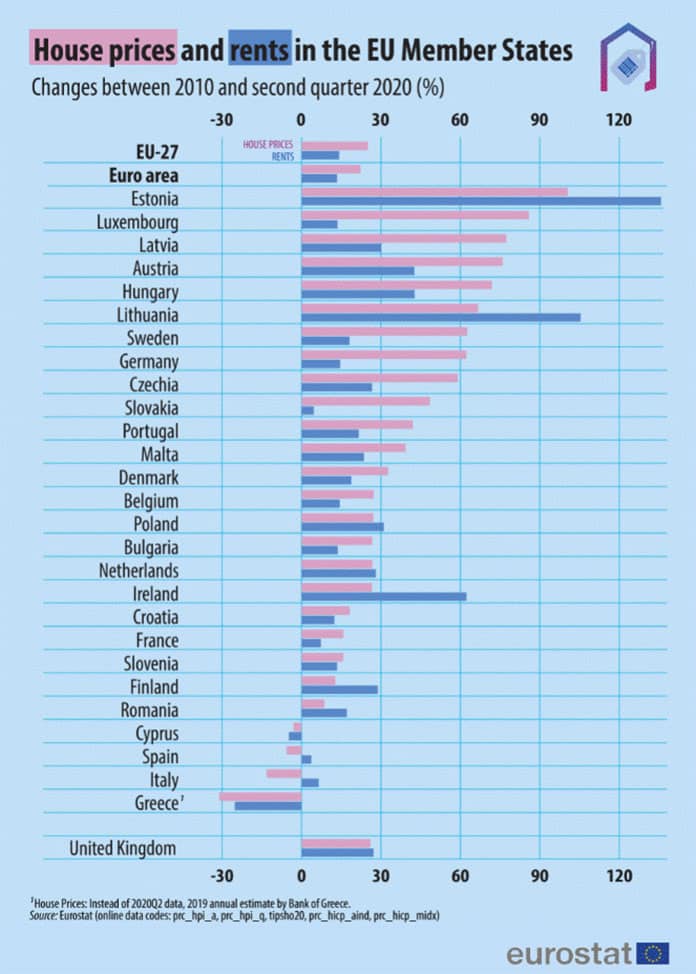
Cyprus house prices and rents yet to recover

House prices and rents in Cyprus have yet to recover to the levels last seen a decade ago reports Eurostat, the statistical office of the European Union.

In a news release, Eurostat reports:

Between 2010 and the second quarter of 2011, house prices and rents in the EU27 followed similar paths. Then, since the third quarter of 2011, they have followed very different paths: while rents increased steadily throughout the period up to the second quarter of 2020, while prices have fluctuated significantly.

After a sharp decline between the second quarter of 2011 and the first quarter of 2013, prices remained more or less stable between 2013 and 2014. Then, there was a rapid rise in early 2015, since when house prices have increased at a much faster pace than rents.

Over the period 2010 until the second quarter of 2020, rents increased by 14.2% and prices by 25.0%.

When comparing the second quarter of 2020 with 2010, house prices increased more than rents in 16 EU Member States. House prices increased in 23 Member States and decreased in four, with the highest rises in Estonia (+100.5%), Luxembourg (+85.8%), Latvia (+77.3%) and Austria (+75.9%). Decreases were observed in Greece* (-31.0%), Italy (-13.2%), Spain (-5.6%) and Cyprus (-3.0%).

For rents, the pattern was different. When comparing the second quarter of 2020 with 2010, prices increased in 25 EU Member States and decreased in two, with the highest rises in Estonia (+135.8%), Lithuania (+105.4%) and Ireland (+62.3%). Decreases were recorded in Greece (-25.2%) and Cyprus (-4.8%).

House prices & rents EU member states

Passport revocation inquiries move forward

Cypriot authorities have identified seven individuals or foreign investors who could potentially be stripped of their Cypriot citizenship, after an internal probe pointed to forged documents or misleading information during the golden passport application process.

The President’s Cabinet this week gave the green light for the initiation of the process for recommending the revocation of golden passports granted to seven persons through the Citizenship by Investment Programme.

According to local media, four case files concerning seven individuals include Malaysian fugitive financier Low Taek Jho, commonly known as Jho Low, whose Cypriot passport came under scrutiny last year.

The probe findings suggested that Low, who was implicated in a huge scandal that landed Malaysia’s former prime minister in prison last summer for 12 years, had obtained his Cypriot passport fraudulently and based on falsified information.

Archbishop Chrysostomos of Cyprus had also accepted a donation for the Church from Low, while the financier is still wanted by Malaysian authorities on theft and embezzlement charges to the tune of 10 billion.

Two other naturalized investors who could lose their Cypriot citizenship are father-son duo Mehdi Ebrahimi Eshratabadi and Maleksabet Ebrahimi from Iran.

Iranian-born Eshratabadi, who is also a Canadian citizen, reportedly applied in Cyprus as Tony Newman, according to the probe, while failing to disclose that he was wanted for money laundering before receiving his passport as well as those for family dependants.

Cambodian businesswoman Sopheap Choeung is also on the list along with her husband Lau Ming Kan and her child, with reports saying the couple’s land development company had been involved in violent evictions.

Last year, Cambodia’s prime minister was involved in a scandal after photos emerged on social media of members of his inner circle who had obtained Cypriot passports in 2017. He had initially denied opposition allegations that they had other passports and lived the high life overseas with assets worth tens of millions of dollars.

New police background checks

The names of twelve others will be provided to police investigators who will be tasked with carrying out background checks to determine whether they were being accused of any serious offences.

Crimes involving moral turpitude as well as offences that carry over 5-year prison sentences could prompt authorities to recommend a passport revocation.

Local media said the investigative committee, chaired by Demetra Kalogerou, who is also Chairwoman of the Cyprus Securities and Exchange Commission, admitted in August that the cases her team had investigated were handpicked by the ministry and did not include all applications mentioned in other reports, including Al Jazeera’s The Cyprus Papers.

Kalogerou is required by a new law to contact the seven naturalized individuals on the list and seek their side of the story before making her recommendations.

Previous reports said some officials pointed to cases where allegations against some foreign investors might have been politically motivated, with some individuals whose names are also on the List of Seven reportedly denying any wrongdoing.

The final word rests with the President’s Cabinet that will have to decide on a case-by-case basis whether a passport revocation would be in order.

In addition to Kalogerou’s committee, a new probe is set to begin after an independent investigative committee was appointed to look into all passports granted through the Cyprus Investment Program from 2008 until July of this year.

(This article was first published in KNEWS, the English edition of Kathimerini Cyprus, on 8 October 2020.)