The long road to justice

CONOR O’Dwyer is nothing if not tenacious. The British man has fought a 15-year battle with Cyprus’ justice system.

“Unfortunately, I don’t think I will ever be able to live in Cyprus, not after what’s happened to me,” Conor O’Dwyer told the Sunday Mail this week.

“It breaks my heart because this country was the one where me and my family chose to build the house of our dreams. How can I see a future here after what I had to go through?”

It is a sad but completely legitimate question posed by the British man who bought a property in the Famagusta district back in 2005. The dream ended in a bitter legal dispute when the developer resold his house to another British family at a higher price.

Into the mix came two assault cases brought against the developers when O’Dwyer fought his corner, insisting the house was his. The ensuing legal battles brought O’Dwyer face to face with Cyprus’ justice system whose wheels grind notoriously slowly. According to O’Dwyer, it is also stacked against foreigners.

Fifteen years after the fight for his house began, O’Dwyer this week appeared before the supreme court in Nicosia, which was finally hearing his appeal into the 2012 verdict of the case filed by developer company Christoforos Karayiannas and Son Ltd, who accused him of breach of contract and of defamation, after O’Dwyer called them “liars” on his blog, called “Beyond Contempt”.

“Before buying the house in 2005, my wife and I were doing really well in life,” O’Dwyer said.

“Cyprus has always been my and my family’s holiday destination, we came to the island many times and I even served time in the military here,”

Cyprus had joined the EU in 2004 and this, combined with the property boom at the time, persuaded the family to buy a house here.

“It was a great opportunity for us. Even if things weren’t going to work out, we could always sell it at a terrific price, considering the property boom at that time,” O’Dwyer says.

“We were cash buyers, we would have lived here with no mortgage and, according to the contract we signed at the time, I would have had my title deeds within three years. It was the ideal situation. I had no doubts that buying a house in a EU country would present no challenges.”

However, shortly after depositing the contract for the house at the land registry, O’Dwyer started to disagree with the developers over some alleged changes they had made to the plans, some of which he claimed breached the contract and others were misrepresentations at the point of sale.

At this stage, the property was midway through construction and he had already paid €113,000 to the developers.

That’s when O’Dwyer decided to start a blog and tell the story behind the problems he was facing. Within a week of starting the blog, he claims he was assaulted for the first time and decided to close it down.

“It was crazy, I never expected such a thing to happen. The website stayed down for a whole year after the incident.”

He pressed charges for the assault.

In February 2007, O’Dwyer then discovered that his house had been sold at a higher price to another British woman, who had already taken up residence in the now-completed house, despite his contract still in the land registry.

The higher price was reflective of the property boom at the time but his money was never returned.

O’Dwyer decided to re-open his blog, which triggered another serious incident in 2008.

“I was assaulted for the second time, and it was even worse than the first time. I had returned to Cyprus in January 2008 for meetings and to take photos of my house for the civil action.

“Christoforos Karayiannas and his son were alerted to my presence in the village and at the busy junction and in front of dozens of witnesses rammed my car and together with an employee, the three men assaulted me again.”

O’Dwyer was hospitalised for five days and pressed charges again.
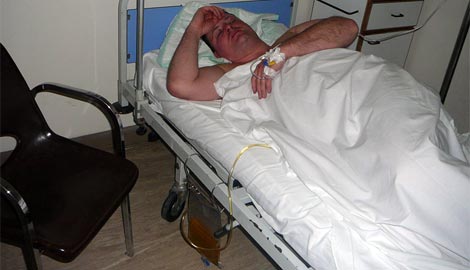
Conor O'Dwyer recovering in hospital after savage beating
Conor O’Dwyer recovering in hospital after savage beating in 2008

After returning to the UK, in August 2008 O’Dwyer decided to camp outside the Cyprus High Commission in London for two months. Thus began his one-man battle to highlight what he came to believe were the perils awaiting foreigners buying property in Cyprus.

“I did that for two reasons. I wanted to get attention after I was assaulted for the second time and I wanted to warn people interested in buying property in Cyprus of the potential risks they might have faced.”

O’Dwyer eventually ended his protest in October 2008 on the promise that his court case would be heard in January 2009.
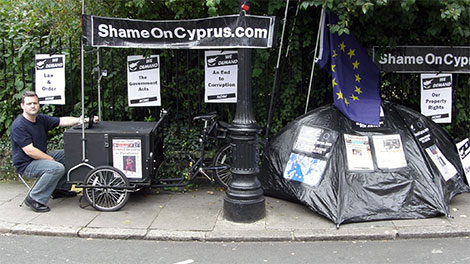
Conor O’Dwyer sleeping rough for justice outside the Cyprus High Commission in London

The developers walked free for the first assault after the prosecutor failed to call O’Dwyer to court and the case was discontinued in his absence.

The developers and their employee were then found guilty for the second assault, but were given a suspended sentence, after a two-year court battle.

The developers then sued O’Dwyer for breach of contract and defamation for what he had written on his blog.

O’Dwyer and his lawyers made a counterclaim for breach of contract.

In 2012, the Larnaca district court ruled that O’Dwyer had not breached any contract and that Karayiannas had unlawfully cancelled it and retained his money. It was also ruled that the house was sold again without his knowledge. However, the court failed to award him any damages.

Instead the court went on to fine O’Dwyer a national record for defamation of €50,000.

“I made 64 flights back and forth from UK to Cyprus to attend lower courts, an absurdity! I spent an absolute fortune. On top of that, it took two years to process my second assault case.”

O’Dwyer said there are striking similarities in the way his case was handled with false rape claim trial of the British woman in Ayia Napa at the end of 2019 which has received such criticism in the British press.

Conor & Michaela O'Dwyer with ITV film crew outside the Cyprus High Commission in London today
Conor & Michaela O’Dwyer with ITV film crew outside the Cyprus High Commission in London

“Firstly, the length of both trials was excruciating. Neither of the two cases needed that much time to be processed, it’s unacceptable.

“Secondly, I can see that in both cases there was a clear victimisation of foreigners, I think it’s a sadly common practice in Cyprus.

“I was the victim of a crime and, somehow, I ended up having to appeal to the supreme court and defend myself. At the same time, the people who assaulted me were found guilty, but were both handed suspended sentences. How is this justice?”

O’Dwyer’s lawyer Giannos Georgiades claims his client’s case could eventually prove to be useful for the Cypriot justice system.

“I am firmly convinced Conor is doing a favour to our country,” he told the Sunday Mail.

“It motivates us to stand up to those people who give a bad name to our country. It makes us fight for what’s right.

“Conor came here to pursue his dreams, because he loves this country. He did not come here to fight. It’s not him who is making Cyprus look bad.

“Every person who comes here should be treated with respect and have the utmost trust in our justice system. We have the right to protect those who come and invest in our country, just like Conor was planning to do.”

So does O’Dwyer feel he will finally receive justice at the Supreme Court?

“I hope that they will rule in a way that will allow me to close this horrible chapter of my life. If not, I am fully prepared to take the matter to the European Court of Human Rights.”

He insisted his battle is not just for the benefit of foreigners.

“I want to make things better for everyone in Cyprus, a country that I love, but where, unfortunately, I will never be able to live.”

Banks to offload €4 billion NPLs

The island’s two largest lenders, the Bank of Cyprus and the Hellenic Bank, will sell bad loans worth €4 billion in total as the banking system tries to purge itself of toxic debt, Central Bank of Cyprus governor Constantinos Herodotou said.

Herodotou has briefed the House Financial and Budgetary Affairs Committee, noting that the amount of non-performing loans (NPLs) have not changed much during the last few months.

He pointed to two major milestones, by the island’s two largest banks to sell loans from their portfolio.

The sale is expected by the end of February for the Bank of Cyprus, while Herodotou said he was unaware about the date for Hellenic Bank.

He said both banks are expected to sell NPLs worth €4 billion in total, allowing them to dispose more than 10% of their problematic loans and concentrate on operational matters.

Latest data shows that bad loans in the banking system are 29.3% of the total.

Moreover, the final position of the European Central Bank (ECB) regarding a complaint handling mechanism on foreclosures, prepared by the CBC, is expected in late February.

Herodotou told the House Committee that deliberations with the ECB started on December 6, with the CBC sending a detailed description of the mechanism.

After receiving the relevant draft bill, the ECB sent an unofficial document with its initial thoughts.

The CBC governor said the ECB agrees in general with the mechanism’s modus operandi. Consultation on two issues is pending between the CBC and the Finance Ministry, which is scheduled to take place next week.

After the consultation is complete, the draft bill will be sent back to the ECB at around February 6-7, and a reply is expected by February 20-21.

Herodotou said that the plan aims to help banks avoid being adversely hit, while people will be able to seek redress.

Citizenship applicants are high-risk

THE INSTITUTE of Certified Public Accountants of Cyprus has sent a circular to its members calling for high scrutiny of citizenship via investment applicants. And it also notes that passport applicants should be considered as high-risk clients.

In addition, ICPAC wants auditors to check the framework behind a potential investment stressing that this should also assist the overall economy of Cyprus.

It then underlines that citizenship by investment programmes carry the risk of legalising money coming from laundering, corruption and tax evasion mainly because of the nature of the target group they attract, that is, high-income individuals.

Therefore, the circular points out, particular attention should be paid to addressing all risks of possible money laundering and the reputation associated with the island’s investment programme.

The goal of the circular’s guidelines is the application of uniform due diligence checks when services are provided to new or existing clients associated with the Cyprus Investment Programme.

The guidelines are there to also assist auditors with ensuring that the implementation of anti-money laundering legislation is not circumvented within the context of providing services to applicants of this programme.

The circular also notes that the source of a client’s wealth and funds must be verified during the audit, and in the event that citizenship is refused, the reasons should be substantiated and taken into account.

It then notes that a potential investment should contribute towards further strengthening the Cyprus economy.

At the same time, auditors have to determine whether existing or potential clients have participated in other citizenship investment plans.

© In-Cyprus.com

Further Reading

IPAC Guidance Note on the provision of services related to the Cyprus Investment Program.

O’Dwyer hopes quest for justice is finally over

A TORTUOUS 15-year fight over a dodgy property sale and defamation case may finally be coming to an end this Friday when the Supreme Court is due to hear a British man’s appeal.

The appeal alone has taken nearly eight years to be heard.

In 2005, Conor O’Dwyer bought a property in the Famagusta district which ended in a bitter legal dispute when the developer resold his house to another British family at a higher price.

He has arrived nearly a week early in anticipation of the case and is protesting outside the Supreme Court in Nicosia. Pictures O’Dwyer posted on Twitter show he has turned up well prepared with posters, toothpaste and a toothbrush, a tent with placards criticising Cypriot justice and other gear to see him through until Friday.

According to O’Dwyer not only was the original sale to him registered with the land registry department, but the developer also kept the money he had paid.

In 2012 courts ruled in favour of O’Dwyer on the grounds of the resale of his home, but also found him guilty of defamation of the developer and he was fined €60,000.

“What we are fighting against is twofold. First is the issue that O’Dwyer won the case but was not awarded all the damages and legal fees he should have got,” his lawyer Giannos Georgiades told the Cyprus Mail on Monday. “And also that his freedom of speech was not respected when the judge found him guilty of defamation.”

Georgiades also says that O’Dwyer is a family man who was dragged into a drawn-out legal battle and went up against property developers at the height of their powers during the building boom of the early 2000s.

Since 2005 O’Dwyer has become active in various groups advising Britons not to buy properties in Cyprus. In March 2019 he organised a protest outside a major property exhibition in London and warned about purchasing houses on the island.

In November the British government upheld its advice of exercising “extreme caution” when buying a property if the title deeds are not readily available.

People buying property in Cyprus in some cases have become “trapped buyers”.

The British High Commission’s advice page still warns that developers take out mortgages on land or property and that signing a contract under these conditions makes the buyer ultimately liable for the loan.

Lawyers are not required to check for mortgages automatically.

While a law in 2015 attempted to solve the incredibly complex issue, as of 2018 there were still as many as 70,000 trapped property buyers without title deeds.

However, member of the House interior committee Andreas Kyprianou told the Cyprus Mail last month that “the 2015 law is working very well and many people have had their title deeds restored, the bill is being enforced.”

“The British government has been warning of this issue for a while, and perhaps there are some people with outstanding issues – but to my knowledge the bill is working well,” Kyprianou concluded.

Law regulating Airbnb rentals passed

THE OWNERS of self-catering accommodation with services such as Airbnb will now have to register with the state under a new law passed by the House of Representatives on Friday.

The bill, which covers both new and existing accommodation, was passed by 52 MPs for and two MPs against.

The bill was proposed by ruling DISY party head Averof Neophytou and EDEK MP Elias Myrianthous. The proposal was amended ahead of voting to include a clause on extending the time period for existing Airbnb owners to streamline themselves with the bill. The time period was increased from one year to two years.

New landlords will have to register immediately.

An amendment put forward by AKEL, EDEK, and ALLILEGGI (Solidarity) was also passed. The amendment removed the condition which did not allow for accommodation in communal units to register.

During the discussion preceding the vote, Neophytou said an issue that was uncontrolled was being regulated so that a household can have an additional legal income.

Tourism minister Savvas Perdios told MPs last October that after talks with platforms like Airbnb and Booking.com, the latter agreed they would obligate users to enter a serial number – provided by the Cyprus government – before allowing home-owners to use their services.

The bill aims to create a dedicated registry for short-term self-catering accommodation, where each property rented will be assigned a number. According to Perdios, that number would then be provided to online platforms, ensuring the property advertised is approved by the government.

The platforms also agreed to provide authorities with transaction-related information that might help for the purposes of taxation.

House prices not recovered from 2007 crash

AN ANALYSIS by Eurostat reveals that Cyprus and Greece are the only two countries in the European where house prices and rents are lower than they were thirteen years ago in 2007.

The price of houses and rents in the EU have followed very different paths since the financial crisis. While rents increased steadily throughout the period up to the third quarter of 2019, house prices have fluctuated significantly.

After an initial sharp decline following the financial crisis, prices remained more or less stable between 2009 and 2014. Then there was a rapid rise in early 2015, since when house prices have increased at a much faster pace than rents.

Over the period 2007 until the third quarter of 2019 rents increased by 21.0% and prices of houses by 19.1%.

Click the image to enlarge

Between 2007 and the third quarter of 2019, there were increases in house prices in 22 EU Member States and decreases in 6, with the highest rises in Austria (+85.5%), Luxembourg (+80.6%) and Sweden (+80.3%). The largest decreases were observed in Greece (-40.0%), Romania (-27.2%) and Ireland (-16.7%).

Click the image to enlarge

For rents, the pattern was different with increases in all Member States, except Greece1 (-17.5%) and Cyprus (-0.3%). The largest increases were observed in Lithuania (+101.1%), Czechia (+78.6%) and Hungary (+67.8%).

1 Annual estimate 2018 instead of third quarter of 2019.

(In a separate Eurostat news release, Cyprus recorded the largest quarterly drop in house prices of all the European Union member states in the third quarter of 2019.)