Rise in property sales attributed to local & EU buyers

FIGURES released by the Department of Lands & Surveys earlier today show that the 12% year-on-year rise in Cyprus property sales can be attributed almost solely to the domestic (Cypriot) and the overseas EU market.

Domestic sales

Property sales to the domestic market, which accounted for 57% of all sales, rose 21% on an annual basis, with increased numbers recorded in all districts.

In percentage terms, Paphos led the way with sales up 55% on an annual basis, followed by Larnaca, where sales increased by 26%. Meanwhile, sales in Nicosia rose by 23% and sales in Famagusta and Limassol rose by 18% and 10% respectively.

But Limassol recorded the highest number of sales (2,321) followed by Nicosia (1,693), Larnaca (829), Paphos (743) and finally Famagusta (298).

Domestic Property Sale Contracts – 2018/2019 Comparison

District Year Jan Feb Mar Apr May Jun Jul Aug Sep Oct Nov Dec
Nicosia 2018 126 84 104 93 135 123 155 84 97 126 141 108
2019 127 164 115 137 168 121 153 90 114 163 187 154
Famagusta 2018 -3 18 18 12 34 27 18 29 21 36 14 29
2019 32 19 16 58 45 25 2 13 16 33 13 26
Larnaca 2018 60 44 67 41 55 61 41 47 60 46 82 52
2019 54 82 47 73 83 42 90 53 67 81 69 88
Limassol 2018 107 152 199 162 169 207 194 174 175 176 196 201
2019 166 152 192 291 329 138 177 134 176 144 210 212
Paphos 2018 18 8 43 21 43 55 62 48 32 24 64 60
2019 30 31 28 69 175 69 54 54 34 66 64 69
Totals 2018 308 306 431 329 436 473 470 382 385 408 497 450
2019 409 448 398 628 800 395 476 344 407 487 543 549

(Note that some of these domestic sales may have resulted from properties acquired by banks as part of loan restructuring agreements, etc.)

EU sales

Property sales to the overseas EU market, which accounted for 15% of all sales, rose 7% on an annual basis. Increased numbers were recorded in all districts with the exception of Famagusta, where sales fell 6% and Paphos, where they remained steady.

In percentage terms, Nicosia (the capital) led the way with year-on-year sales up 43%, followed by Larnaca (+29%) and Limassol (+7%).

But Paphos recorded the highest number of sales (755) followed by Limassol (286), Larnaca (189), Nicosia (157) and finally Famagusta (142).

Foreign (EU) Property Sale Contracts – 2018/2019 Comparison

District Year Jan Feb Mar Apr May Jun Jul Aug Sep Oct Nov Dec
Nicosia 2018 10 8 8 10 9 8 11 5 10 8 7 15
2019 14 14 9 19 20 16 13 5 8 10 15 14
Famagusta 2018 15 24 8 12 19 16 20 9 0 7 13 8
2019 9 6 14 17 10 8 17 14 10 5 9 23
Larnaca 2018 9 9 9 6 9 20 15 11 15 13 11 19
2019 12 12 21 18 20 11 16 13 6 23 14 23
Limassol 2018 15 17 32 17 19 22 25 24 11 27 38 20
2019 16 25 20 21 28 26 27 17 25 30 26 25
Paphos 2018 41 58 55 49 70 60 79 55 49 91 74 73
2019 56 72 61 48 69 59 73 58 61 95 61 72
Totals 2018 90 116 113 94 126 126 150 104 85 146 143 135
2019 107 129 125 123 147 120 146 107 110 133 125 157

However, sales to EU nationals during the final 7 months of 2019 rose a mere 1%; probably as a result of the introduction of more stringent criteria for foreigners seeking a Cypriot passport and citizenship under the government’s “Cyprus Investment Programme“.

(In December, Reuters reported that a number of UK Conservative donors had “quietly took steps to stay inside the European Union”. They included billionaire Alan Howard, one of Britain’s best-known hedge fund managers, and Jeremy Isaacs CBE, the former head of Lehman Brothers for Europe, the Middle East and Asia.)

Non-EU sales

Property sales to the non-EU citizens, which accounted for 28% of all sales during 2019, rose by just 0.48% on an annual basis. Although sales in Limassol and Paphos, recorded falls of 12% and 9% respectively, sales rose in the remaining 3 districts.

Sales in Nicosia rose 23%, while sales in Paphos and Larnaca rose 12% and 1% respectively.

Paphos recorded the largest number of sales (1,132), followed by Limassol (910). Meanwhile, the number of sales in Larnaca, Famagusta and Nicosia were 550, 213 and 148 respectively.

Foreign (Non-EU) Property Sale Contracts – 2018/2019 Comparison

District Year Jan Feb Mar Apr May Jun Jul Aug Sep Oct Nov Dec
Nicosia 2018 10 4 13 14 9 15 10 2 11 11 13 8
2019 20 17 7 13 25 8 8 8 15 10 6 12
Famagusta 2018 36 10 14 28 26 18 23 12 24 14 20 9
2019 12 23 15 21 32 10 30 3 14 12 26 15
Larnaca 2018 43 46 40 36 49 52 56 36 46 57 50 32
2019 48 31 50 49 70 49 51 27 29 56 39 51
Limassol 2018 103 87 83 67 94 109 95 64 65 87 110 69
2019 69 79 75 116 189 55 82 45 39 54 60 47
Paphos 2018 105 97 74 87 88 65 92 53 71 89 92 97
2019 101 108 96 107 160 77 103 54 78 61 108 79
Totals 2018 297 244 224 232 266 259 276 167 217 257 285 215
2019 250 257 243 306 476 199 274 137 175 193 239 204

However, sales to non-EU nationals during the final 7 months of 2019 fell by 15%; probably as a result of the introduction of more stringent criteria for foreigners seeking a Cypriot passport and citizenship under the government’s “Cyprus Investment Programme”.

Over this 7-month period, sales declined in all districts with the exception of Paphos where 560 properties were sold compared with 559 in the same period of 2018; an increase of just 0.18%.

Cyprus property sales 2000-2019
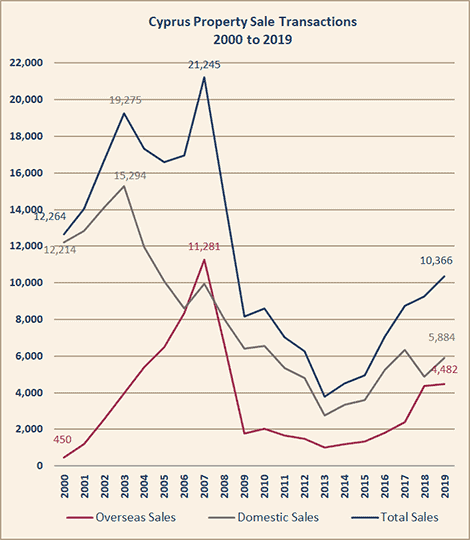
Cyprus property sales chart 2000 - 2019
The Department of Lands & Surveys has advised that overseas sales in 2018 and subsequent years should not be compared to sales in previous years due to changes in the methodology used to classify ‘Aliens’ (foreigners).

Annual property sales hit eleven year high

DECEMBER saw rise of 14 percent in the number of property sale contracts deposited at Land Registry offices across Cyprus compared to December 2018 with the annual total reaching 10,366; the highest number recorded since 2008 according to official figures published by the Department of Lands and Surveys.

Property sales – December 2019

During December a total of 910 contracts deposited compared to 800 in December 2018. Although the numbers in Paphos and Limassol fell by 4% and 2% respectively, they rose in the remaining three districts.

Property ales in Larnaca rose by 57%, while those in Famagusta and Nicosia (the capital) rose by 39% and 37% respectively.

Total Property Sale Contracts – 2018/2019 Comparison

District Year Jan Feb Mar Apr May Jun Jul Aug Sep Oct Nov Dec
Nicosia 2018 146 96 126 117 153 146 176 91 118 145 161 131
2019 161 194 131 169 213 145 174 103 137 183 208 180
Famagusta 2018 48 52 40 52 79 61 61 50 45 57 47 48
2019 53 48 45 96 87 43 49 30 40 50 48 64
Larnaca 2018 112 99 116 83 113 133 112 94 121 116 143 103
2019 114 125 118 140 173 102 157 93 102 160 122 162
Limassol 2018 225 256 314 246 282 338 314 262 251 289 344 290
2019 251 256 287 428 546 219 286 196 240 228 296 284
Paphos 2018 164 163 172 157 201 180 233 156 152 204 230 230
2019 187 211 185 224 404 205 230 166 173 192 233 220
Totals 2018 695 666 768 655 828 858 896 653 687 811 925 800
2019 766 834 766 1057 1423 714 896 588 662 813 907 910

Annual sales

The total number of property sales during 2019 was the highest on record since 2008 (when 14,667 properties were sold) with sales rising in all districts.

In percentage terms, Nicosia saw the largest increase with sales up 44%. In equal second place were Larnaca and Paphos, where annual sales rose by 17%. Meanwhile sales in Limassol and Famagusta rose by 3% and 2% respectively.

Looking at the actual number of properties sold in each district, Limassol came in first place with the total number of properties sold reaching 3,517. Paphos came in second with 2,630 sales, with Nicosia in third place with 1,998 sales, Larnaca in fourth with 1,568 sales and finally Famagusta with 653 sales.

Swiss Franc loan nullified following ECJ ruling

THE WARSAW District Court on Friday announced a verdict in a test case regarding Swiss Franc mortgage of Mr and Mrs Dziubak. The loan agreement has been nullified.

According to the judge, it was questionable whether or not the Dziubaks had been informed by the bank about the currency exchange risk. The court said that they hadn’t been properly informed about the unpredictability of long-term currency fluctuation.

The Dziubaks borrowed 400,000 zlotys in 2008 but before the case owed about 500,000 zlotys, despite making 10 years of repayments because of the rise in the value of the Swiss franc.

The verdict is likely to encourage more lawsuits.

The European Union’s (EU) top court ruled in October, 2019, in favour of Polish consumers who took out mortgages in Swiss Francs, allowing them to ask Polish courts to convert the loans into the local zloty currency in a blow for lenders.

The verdict was not an outright victory for borrowers, however, because it is up to Polish courts to decide on a case-by-case basis how the contracts are altered.

Attracted by lower interest rates some 700,000 Poles took out mortgages in foreign currencies, mainly in Swiss francs, nearly a decade ago. They are now paying far bigger instalments than they expected after the Swiss franc soared 92 percent against the zloty since the start of the global financial crisis in 2008.

Foreign currency loans total 124 billion zloty ($31 billion), almost one third of all Polish mortgages, and the ECJ verdict encouraged more borrowers to sue for refunds. Currently there are more than 11,000 cases running in the courts.

[youtube=https://www.youtube.com/watch?v=IEt07snaH-E&w=470&rel=0]

© TVN S.A. 2020 Wszelkie prawa zastrzezoneProgram

What next for the Cyprus real estate market?

THE CONCLUSION of 2019 is that the Cyprus real estate market is changing faster than ever and requires constant innovation, updating and transformation.

The positive trend will continue in the coming period, as the Cypriot real estate market is constantly developing and becoming more and more attractive for global investors, as well as the banks that follow their projects with various types of financing.

Investments are also extremely visible in the retail sector, which, in 2020, will gain several new shopping destinations such as the Neo Plaza in Nicosia and the Metropolis Centre in Larnaca. Following the construction of these facilities, Cyprus will have 450,000 square meters of modern retail space, which will facilitate the entry of many new brands to the market.

The residential market is not lagging as a significant number of large residential complexes are currently under construction such as, 360 in Nicosia, Kition in Larnaca and Limassol Del Mare (phase II), which will add to the appeal of the Cyprus market and supply new luxury residential space.

In the office space segment, an important change happened, as many companies are increasingly interested in downtown locations for business.

By the end of 2020, Cyprus will, with the finalisation of the office development schemes currently under construction, reach a staggering 260,000 square meters of office space in its market.

Among the major office projects that are planned to be delivered on the market next year in Nicosia are the Nicosia City Centre, the Capital Gate and the Asteroid Tower, as well as upcoming projects such as the Cymiva Office Tower.

The focus is also on the industrial and land sector, which will experience expansion in the future. This year more than 10,000 square meters of modern industrial and logistics facilities have been completed, with the current total supply in Cyprus of over 340,000 square meters. More such facilities are to be constructed in 2020, from companies such as Lamar.

Hotels and Tourism finally are sustainable and a very promising market as well, with additions such as a new Radisson and a Sofitel, plus Ayia Napa Marina to join the market, soon.

It is important to note that the availability of financing is a major component in the growth of the investment market in Cyprus.

The banks are generally willing to finance yielding assets with sustainable income at attractive rates, allowing for attractive gaps to investors looking for leverage.

Nicosia, Limassol, Paphos and Larnaca are finally becoming important locations on the world investment map, and we must safeguard growth and outperform the competition.

What to have in mind

To provide investors with the information as to what to invest in and whether they’ve picked the right moment to invest at all, we first need to analyse the idea of the project and the location where the facility would be built. Not every moment is the right one and not every project is profitable, regardless of the price.

Since 2001, there has been an overall expansion of the real estate market and the arrival of large global companies and of private investors-residents, which have changed the image of Cyprus and its cities in the construction sector.

The Cypriot market follows world trends, needs and balances accordingly, trying not to become oversaturated in any sense.

The aim is to make a product which is easily sustainable in the market, that is, to help the investor make the planned income in the easiest way possible.

The great news is that it is obvious that all market segments are developing, as we have been in an expansion phase for some time now.

When it comes to the construction of business premises, the demand is great, and the lack of modern office space which meets the standards of large companies is one of the reasons why many investors are currently working on expanding their business complexes, and new business facilities are being built as well.

Also, along with the residential market, which is developing intensively, good planning and analysis are becoming increasingly important, so that a project is fully adapted to the needs of the market, that is, a certain location, in terms of structure, quality, price and available features meeting with the expectations of the target group of clients, can be carried out.

Judging by the research and analyses from the past few years and the data we get every day, Cyprus is a desirable investment.

About the author

Panos Danos is the CEO of Danos/BNP Paribas Real Estate and has a Bachelors in Land Management and Development and is a Fellow of the Royal Institution of Chartered Surveyors. He is a registered valuer of RICS (VRS), member of Investment Property Forum (IPF) and a Chartered member of the Society for the Environment.

Cyprus passports really are ‘golden’

CYPRUS topped the list of countries offering Citizenship by Investment Programmes (CBI) whose passport power increased during 2019, according to the latest Passports Index.

The index ranks passports of the world based on their total mobility score which concerns the number of countries their holders can visit visa-free (VF), with visa on arrival (VOA) an Electronic Travel Authorisation (eTA) or an eVisa if issued within three days.

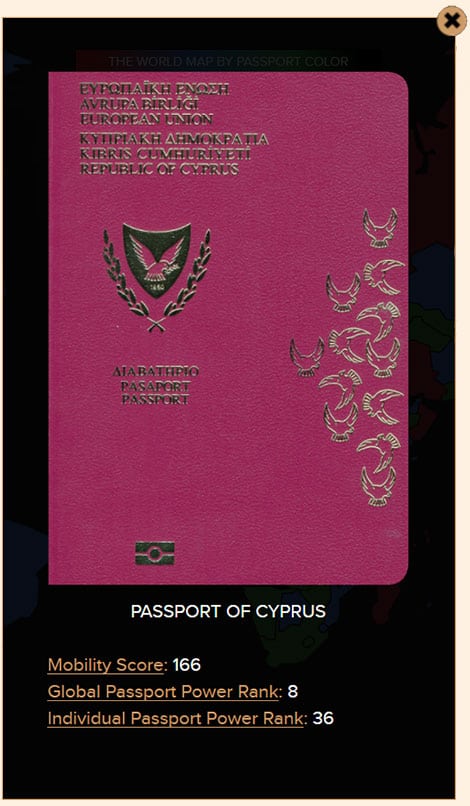
Overall, the Republic of Cyprus’ passport’s power ranks is 8 since its holders can visit 166 countries including 122 visa-free and 44 by obtaining visa on arrival. Holders of Cyprus’ passports can also visit another 32 countries after obtaining visa before their trip there.

Globally, the United Arab Emirates passport is considered as the most powerful as regards mobility with its holders being able to visit 179 countries visa-free or with visa on arrival, with those of Germany, Finland, Luxembourg and Spain following suit with 172 countries.

The average rank among the 193 UN member countries and six territories (ROC Taiwan, Macao (SAR China), Hong Kong (SAR China), Kosovo, Palestinian Territory and the Vatican) screened is 47 and the average mobility score is 107.

According to the index, this year also displayed an increase of passport power with nations offering CBI.

“Cyprus and St. Kitts and Nevis are amongst the ones who made the biggest leap forward, gaining +9 visa waivers in 2019,” the survey said.

The boost in passport power has also benefited Malta (+8), Antigua & Barbuda, Bulgaria, Montenegro and Portugal (+7), as well as Dominica and Saint Lucia (+6). Grenada came last but nevertheless showed improvement with (+4), said the survey.

Cyprus is also number seven in the top 10 of the Fastest-Growing Passports of 2019 after adding another nine countries this year to its mobility score, raising the number to 166. In 2017, the Cyprus passport ranked 13th among the strongest in the world, as its holders were able to travel to 146 countries without a visa or VOA.

Last November, the Cypriot government announced it would start procedures to strip the citizenship of 26 individuals following revelations that passports had been granted to a now-wanted Malaysian businessman, persons tied to Cambodia’s authoritarian government and a Kenyan billionaire who is under investigation for tax evasion by the authorities in Kenya.

The interior ministry has said it would review all passports granted before 2018 when stricter criteria and vetting instruments were put in place.

In January, the European Commission had warned that programmes of EU states, including Cyprus, to sell passports and visas to wealthy foreigners could help organised crime groups infiltrate the bloc and raise the risk of money laundering, corruption and tax evasion.

A month later the government introduced a series of changes to the citizenship-by-investment scheme, in a stated bid to make it more credible.

The Passport Index by Arton Capital is considered by its creators as the world’s most popular online interactive tool, which collects, displays and ranks the passports of the world.
To determine the individual rank of each passport, its mobility is score is taken into account, as well as their Visa-free portion of their score compared to the VOA. The UN Development Programme Human Development Index 2018 (UNDP HDI) is used as a tie breaker. The latter is used since UNDP HDI is a significant measure on the country’s perception abroad, the creators argue.

Passports: the barometer for real estate

Cyprus real estate salesDESPITE a sharp increase in demand of real estate over the first months of 2019, a slight decline was recorded after the recent strengthening of criteria on the island’s Citizenship by Investment programme.

Sales increased 13.7% year-on-year for the period January-October 2019. During the same period, the number of property sales to local buyers and foreign buyers also saw an annual increase of 22% and 4.7%, respectively, indicating that demand for real estate comes from both locals and foreigners.

However, the Central Bank of Cyprus report noted that if this period was divided into before the implementation of the programme’s stricter criteria (January-May 2019) and post-implementation (June-October 2019), there is a 48% increase in demand by locals and a decrease of 5.1%, respectively, and by foreigners an increase of 20.2% and a decrease of 8.5%, respectively.

At the same time, even though there is a continued significant recovery of the sector as well as of the GDP of Cyprus, residential property prices show moderate increases with the exception of areas affected by specific factors – such as the Limassol and Larnaca coastal front.

There is also fear that the recorded price increases in these two areas will potentially spillover to others. “Areas with high price increases need close monitoring, as well as monitoring for potential spillovers to other areas,” the report said.

In the meantime, the European Systemic Risk Board (ESRB) has ranked the residential real estate sector in Cyprus at a recovery stage, also assessing that the probability of risks have been limited.

Based on latest statistics, the CBC report indicates that in the first half of 2019 investment in houses reached a total of €760 million (7.1% of GDP), while investment in other buildings and constructions were at €473 million (4.4% of GDP).

© 2019 In-Cyprus.com