Home Blog Page 653

Immovable Property Tax scam warning

Scam IconTHERE have been many reported scams where property developers demand ‘Immovable Property Tax’ from property buyers.

But rather than being based on the assessed 1980 value of the property as prescribed by law, these property developers base their illegal calculations on the price the buyer has paid for a property (the contract sum) as shown in their Contract of Sale.

Typically, the annual charge demanded is 0.4% of 50% of the contract sum. (E.g. For a property costing £200,000 the annual amount demand is calculated at: £200,000 ÷ 2 x 0.4% = £400).

Some developers demand even higher annual payments and some even add interest to their bill!

Other developers do nothing until the Title Deeds are issued. They then demand all the ‘unpaid’ taxes (plus interest) dating back to the time that the buyer purchased the property, often extorting money from buyers by using the threat of withholding Title Deeds to elicit payment.

In one case in which I was recently involved, these ‘unpaid’ taxes amounted to 50% of the property’s purchase price. Imagine buying a property for € 350,000 and then, some years later, receiving a demand from the developer for a further € 175,000 for ‘Immovable Property Tax’ before he’ll transfer Title!

Immovable property tax – an overview

Under Cyprus’ Immovable Property Tax laws 1980-2004 all property owners, regardless of whether they’re resident in Cyprus or not, are liable to pay an annual tax on the total value of all the immovable property (a term that relates to land and buildings) registered in their name.

Immovable Property Tax is calculated on the market value of the property as at 1st January 1980 and is paid annually the Inland Revenue Department.

Individual owners are exempt from this tax if the 1980 value of their property is less than CYP 100,000. As a result, you are extremely unlikely to pay (unless you have bought property valued in millions at today’s prices).

Every registered owner whose immovable property exceeds CYP 100,000 is required to submit a Declaration of Immovable Property (IR 301 and IR 302) and pay the respective tax every year before 30 September.

At the date of writing this article, Immovable Property Tax rates are as follows:
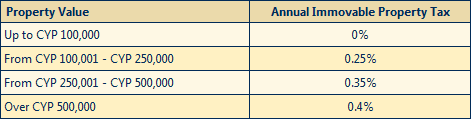
Immovable Property Tax Table

It should be noted that the nil rate Immovable Property Tax on property valued up to 100,001 only applies to natural persons. If you have set up a company (a legal entity) to own a number of properties, the nil rate does not apply.

Property buyers’ contractual obligations

Due to the delay in issuing Title Deeds, some developers are the registered owners of land banks whose value runs into many millions of pounds. It is the developer who is legally obliged to pay the Immovable Property Tax on these land banks, plus any interest due to late payment. But in their Contracts of Sale, some developers include a clause making buyers liable for Immovable Property Tax when they take delivery of a property rather than at completion (i.e. transfer of ownership).

Buyers in this situation must ask the developer to provide them with written evidence of the amount of Immovable Property Tax that has been paid to the Inland Revenue for the land on which the development has been constructed and the buyers share of that land.

E.g. If the development has been constructed on 100,000 m2 of land, and the buyer’s plot measures 500 m2, then the buyer should only pay 1/200 or 0.5% of the tax bill. So if the developer receives an Immovable Property Tax demand for € 10,000 the buyer should contribute € 50.

Buyers are warned not to pay a developer any Immovable Property Tax unless that developer:

  • Supplies you with written evidence of the amount of Immovable Property Tax he has paid to the Inland Revenue for the land on which your development has been constructed.
  • Provides you a written statement identifying your share of that land (see above).
  • Provides a written invoice on the company’s letterhead for the agreed amount to be paid.
  • Provides a written company receipt for the amount paid.

Reclaiming Immovable Property Tax from the Inland Revenue

Once buyers receive their Title Deed they may apply to the Inland Revenue, using Form IR 314, to reclaim any overpayment of Immovable Property Tax paid by the developer on their behalf. Buyers should take the completed Form IR 314, together with:

  • Copy of the Title Deed of the property.
  • Receipt issued by the Land Registry when the Contract of Sale/Sale Agreement was deposited for Specific Performance.
  • Copy of the Contract of Sale/Sale Agreement.
  • Receipt(s) issued by the property developer confirming the Immovable Property Tax paid.

to their local Inland Revenue Office.

Buyers should note that:

  • Tax refunds resulting from overpayments exclude any interest charges that may have added for late payment.
  • The 1980 value of their property (the value on which Immovable Property Tax is calculated, which will include the value of the land plus the value of the dwelling) will be assessed by the ‘Valuations Desk’ at the Land Registry at the time their Title Deeds are issued.

Try before you buy

IF YOU PLAN on living in Cyprus but are uncertain about where exactly you want to live or have some lingering doubts as to whether you really want to live here permanently, start off by renting somewhere to live. You should rent for at least six months, ideally a year, and get to know the island before committing yourself.

Some people soon discover that living in Cyprus is not for them. They often find that family ties are too great or find it too difficult to settle in a foreign country.

Tourists visiting Cyprus often fall love with the island and immediately go on a property buying spree; failing to appreciate that holidaying in Cyprus and living in Cyprus two completely different things. Many regret their decision and sell up after a year or two and return to the UK, while others move to somewhere on the island more to their liking.

Others often make the mistake of making their permanent home in a tourist area rather than a residential area. They find out too late that their neighbours are noisy & constantly changing, or see adjacent properties standing empty and poorly maintained for many months in the year. Often they have no facilities nearby and, having no permanent neighbours, they find it difficult to make permanent friends.

To avoid making the same mistakes yourself, try before you buy!

Finding rental property

There are many properties available for rent in Cyprus; the longer the rental term the better deal you’ll be able to get. But don’t rush into renting the first property you see. Stay in a hotel or rent a holiday apartment for a few weeks to allow yourself enough time to have a good look around and find something that you really like.

Renting gives you ample time to:

  • Decide whether you’ll be happy living in Cyprus.
  • Familiarise yourself with the island, the climate, the amenities and the local people.
  • Meet other expatriates living in Cyprus and talk with them about their experiences.
  • Discover the real cost of living for yourself.

House Hunting Advice

If you decide to make your home in Cyprus, start looking around for somewhere to live permanently:

  • Visit areas you like at different times of the year to see them in summer and winter and decide where to make your permanent home.
  • Think about the longer term. You may be fit and active now but may not be able to manage a large or steep garden, lots of steps, the drive to the shops/doctor/hospital, etc. as the years go by.
  • Look at the various types of properties available, compare prices and assess their relative values.

If you decide that you want to live permanently in Cyprus, then renting gives you plenty of time to seek out your new property at your leisure.

Renting greatly reduces your chances of making a purchase that you may later regret.
Try before you buy.

Cyprus president ousted

The closest-ever election in the Republic of Cyprus has ended President Tassos Papadopoulos’s five years in power.

The MEP Ioannis Kasoulides won the knife-edge poll by just 980 votes, after a turnout of around 90%.

The former foreign minister will face Demetris Christofias, who came second, in a run-off vote next Sunday.

The election is being seen as a crucial step towards reunification with the break-away Turkish-controlled northern Cyprus after decades of division.

Mr Kasoulides won 33.51% of votes compared to 33.29% for Mr Christofias and 31.79% for Mr Papadopoulos.

Open-minded

A member of the right-wing DISY party, Mr Kasoulides is the candidate most favoured by the international community to push ahead with reunification talks, says the BBC’s Tabitha Morgan in Nicosia.

She says the result shows that most Cypriots have clearly rejected Mr Papadopoulos’s uncompromising approach to solving the Cyprus problem in favour of a more open-minded candidate.

Ahead of Sunday’s vote, both Mr Kasoulides and Mr Christofias, the communist party leader, had claimed to be best qualified to head negotiations with the Turkish north. Last month the International Crisis Group, a think tank, warned that if talks after the election failed, the likely outcome would be partition.

Cypriots living in Greece and Britain have been flown back to Cyprus on planes chartered by the main parties, so that they can vote.

Cyprus was partitioned after a Turkish invasion in 1974, which came shortly after a Greek Cypriot coup backed by the military junta ruling Greece at the time.

Shortly before joining the European Union in 2004 the Greek Cypriots rejected a United Nations plan to reunify the island.

Turkey recognises only the Turkish Cypriot authorities and keeps about 30,000 troops in the north of the island.

Story from BBC NEWS

Building permits top 20,000

Earlier today, the Cyprus Statistical Service (CySTAT) announced that during 2007, the number of dwelling units for which building permits had been authorised topped 20,000 for the first time ever, reaching a staggering 20,486.

Although the numbers were slightly down for Nicosia and Paphos, they were up for Limassol, Larnaca – and most notably Famagusta, where they jumped from 1,693 in 2006 to 2,473 in 2007.

During the past five years, building permits have been issued for the construction of nearly 86,000 dwellings.

I’ve produced the five-year chart below, from the figures provided by CySTAT.

Permits issued for the construction of property in Cyprus

Cyprus rejects coastal building ban

SIGNATORIES to the Barcelona Convention, an international agreement to protect the sea, have agreed to ban development within 100 meters of the coastline.

A total of 14 Mediterranean countries signed a protocol of agreement in Madrid, under which they undertake to stop all building less than 100 metres (about 328 feet) from the coast.

However several countries refused to sign, including: Cyprus, Bosnia, Turkey, Lebanon, Libya, Bosnia, and Egypt, but said they may sign later this year.

Those who have agreed to ban building 100m from the high water line include: Algeria, Croatia, France, Greece, Israel, Italy, Malta, Slovenia, Spain, and Tunisia.

Mr. Fernández Pérez told a press conference that the new protocol would require administrations to create “a new way of looking at the sea.” His boss was similarly pleased with the agreement. “This is a historic protocol,” said Cristina Narbona, Spain’s environment minister, “and it gives us a very powerful structure with which to combat the negative effects of overdevelopment.

Participants also issued the Almería Declaration, which requires all member states to develop a list of threatened marine species by 2011, to establish a “broad and coherent network” of protected coastal areas by 2012, and to promote renewable energies in the region.

But it is the shoreline construction ban that will have the most impact. Nearly 40% of the Mediterranean coast already is cluttered with highways and buildings, and experts believe that figure could climb to 50% in the next 20 years.

The initiative comes at an important moment, as experts warn that the rising sea levels caused by global warming will soon threaten human habitats. “This is the first time that the Barcelona Convention has responded to climate change,” says Banu Dokmecibasi, Greenpeace Mediterranean’s oceans campaign director. “Governments have tried to ignore the issue for years, but more public and media awareness have pressured them to respond.

Spain has already begun efforts to clear the outermost 100 meters of its coastline – both Mediterranean and Atlantic – of human-made elements. In 2007, the government razed some 655 illegal structures near the water, and its newly debuted “Strategy for Coastal Sustainability” calls for the removal of thousands more.

The most difficult steps are still to come, however. “I know from our experience in Spain that compliance is the problem,” warns the environment minister, Ms. Narbona. “Every single one of the provisions agreed to in Almería already exists in Spanish law. There just hasn’t been sufficient will or awareness to enforce them.” To address that challenge, the Almería protocol creates a committee to ensure that the convention’s provisions are carried out.

From her office in Istanbul, Ms. Dokmecibasi still worries that even that step won’t be enough. “This kind of regional agreement is important because it helps create more binding instruments,” she says. “But it’s up to the national governments to convert these agreements into national law and enforce them. We have the same 100-meter law in Turkey, but people are still building on our coastline.

Property scams turning Brits away?

Scam IconACCORDING TO one local pundit, the number of Brits buying property in Cyprus will drop by 20%. It seems that media revelations about the many ‘property scams’ are having a negative impact on the islands property sales.

Although some drop in sales may be attributable to the worldwide credit-crunch, the current weakness of Sterling against the Euro and increasing house prices in Cyprus, I have no doubt that the bad publicity and property scams are turning Brits away.

Consider the evidence

  • The savage beating of British buyer Conor O’Dwyer, allegedly at the hands of Cyprus property developers Christoforos & Marios Karayiannas with whom he is in dispute.

Thousands of people have watched Conor’s struggle for justice on YouTube. And I suspect that many more will have visited his lyingbuilder.com website.

The Cyprus Mail, which has carried several articles covering the O’Dwyer property scam, has a daily circulation of around 4,000 and the many visitors to its website will also have read of Conor’s problems and his battle for justice.

  • Channel 4’s damning revelations about the Cyprus Title Deed scams and legal system. Their audience research figures indicate that it’s was seen by more than 4,000,000 British viewers.

[youtube=http://www.youtube.com/watch?v=eLUDlI6CSCM&w=470]

  • The Marathounta Heights property scam. Thousands of people have viewed the collection of the conmen’s YouTube videos concerning the alleged £ 3.5 million scam involving J&I Estates Ltd and Peter Stephenson Properties (a registered estate agent in Paphos).
  • The book Cyprus Things the Estate Agents Don’t Tell You, which is available worldwide through Amazon. It paints a graphic picture of the frauds, cons and problems associated with buying property in Cuprus.
  • CyBC TV English language news programs have reported on the many problems, issues and scams. Watch, listen and learn.

[youtube=http://www.youtube.com/watch?v=dvewIPNRgJA&w=470]

  • The establishment of the Cyprus Property Action Group. It has been inundated several thousand messages of support and complaints from people with property problems – both Cypriot and expatriate.

Maybe the Cyprus Government is happy to bury its head in the sand and let the scams and bad publicity continue. If it is, I envisage dire consequences for its property market, its tourism industry and its economy.