

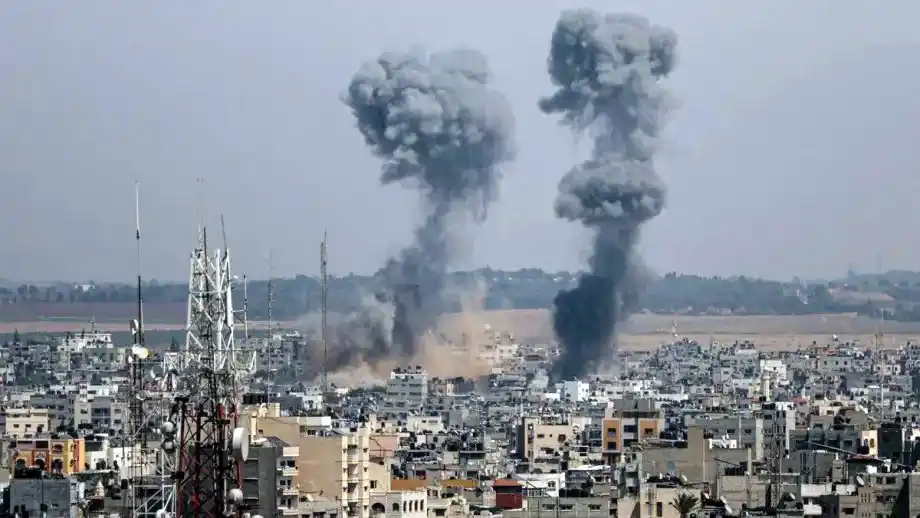
Escalating tensions in the Middle East, particularly the conflict involving the United States, Israel and Iran, have inevitably raised questions about potential ripple effects across the Eastern Mediterranean.
For Cyprus, a country whose property market has historically been sensitive to geopolitical shifts in the region, the key question is whether the current crisis could once again reshape demand and pricing dynamics.
Real estate professionals say the market is watching developments carefully, but without signs of panic.
Andreas Christoforides, Chief Executive of the Landbank Group, says property transactions in Cyprus are continuing largely uninterrupted despite the heightened geopolitical climate.
“The market is following recent events calmly,” he notes. “At present we do not see any impact that would justify concern or alarm. In fact, much of what is reported abroad about Cyprus often bears little resemblance to the reality on the ground.”
According to Christoforides, while there has been a modest dip in property purchases in recent days, such hesitation is typical during periods of uncertainty and is likely to prove temporary.
“Similar patterns emerged in 2022 following Russia’s invasion of Ukraine and during previous tensions in Lebanon,” he adds. “Experience shows that Cyprus, and particularly its real estate sector, tends to demonstrate remarkable resilience.”
Indeed, past crises have sometimes strengthened the island’s appeal. Last year, heightened instability in neighbouring countries led to increased interest from investors in Lebanon and Israel seeking a stable European base.
Demand currently remains strongest for residential properties, particularly apartments and family homes, both for owner occupation and rental investment. Limited housing supply combined with sustained international demand is helping maintain price levels.
“I would not say prices are being squeezed,” Christoforides says. “If anything, they are being reinforced as Cyprus continues to mature as a quality investment destination.”
A property market with a ‘memory’
Pavlos Loizou, Chief Executive of property data firm Ask Wire, argues that the Cypriot real estate market has developed a clear “memory” of how it responds to geopolitical shocks.
Following the Beirut port explosion in 2020, interest from Lebanese buyers surged, particularly for homes in Larnaca and Limassol. Two years later, the war in Ukraine triggered a relocation wave of businesses and residents to Cyprus, again pushing demand higher, especially in Limassol.
Foreign buyers now represent a major pillar of the market. Roughly four out of every ten property purchases in Cyprus involve overseas buyers, while in districts such as Paphos and Larnaca the share frequently exceeds 50%.
Currently, Loizou notes, the strongest interest is coming from Israeli buyers, with smaller but notable demand from Lebanese nationals.
“These purchases are not necessarily luxury investments,” he explains. “In many cases they involve ready-to-move-in two- or three-bedroom apartments or family homes near international schools, infrastructure and good flight connections.”
For many buyers, Cyprus effectively serves as a “Plan B residence”, a secure second base within the European Union but still close to their home countries.
In the short term, geopolitical uncertainty often leads to a temporary pause as investors adopt a wait-and-see approach. However, if instability persists, historical patterns suggest the opposite effect may emerge: increased demand from individuals and companies seeking stability in safer jurisdictions.
Cyprus as a regional ‘Plan B’
Leonidas Hadjinicolaou, Director of Research and Negotiations at Danos Cyprus, says recent developments have already begun to influence buyer behaviour.
“In times of uncertainty, investors and families look for safe and stable destinations within the European Union to diversify investments and protect their assets,” he explains. “For many in the region, Cyprus effectively becomes a Plan B while remaining close to home.”
According to market estimates cited by Danos, interest from Israeli, Lebanese and Iranian buyers has surged since the latest escalation, with some property platforms reporting demand increases of up to 300% compared with previous periods.
However, there are potential downside risks. Cyprus’ investment property sector is closely tied to tourism, with around 16,000 short-term rental properties currently operating across the island.
Should prolonged geopolitical tensions disrupt tourist flows, occupancy levels – and therefore investment yields – could come under pressure.
More broadly, the duration of the conflict may prove decisive. Rising construction material costs, possible tourism volatility and shifting international demand could all influence the trajectory of Cyprus’ property market in the months ahead.
For now, though, the island appears to remain what it has often been during times of regional uncertainty: a safe harbour for investors seeking stability.
(Translated and summarised from an article in philenews)
