Investigation into abusive clauses in mortgage contracts

The Consumer Protection Service has launched an independent investigation into potentially abusive clauses in standard mortgage agreements used by all banking institutions in Cyprus.

This inquiry is conducted under the provisions of the Consumer Protection Law (Law 112(1)/2021) with findings expected in the coming months.

The Service has also filed court injunctions against around 50 property development companies and six banks, in line with earlier administrative rulings. These applications resulted from complaints alleging the use of abusive contract terms. This was confirmed in a letter from Consumer Protection Service Director Konstantinos Karagiogis, in response to a question from MP Stavros Papadouris of the Green Movement, during a Parliamentary Commerce Committee session on October 22, 2024, focused on inflation and government policy.

Mr. Papadouris requested an update on the progress of the Service’s administrative decisions – some dating back a decade – within its legal authority over abusive clauses in consumer contracts.

Mr. Karagiogis highlighted that three injunction applications remain pending in the Nicosia District Court, with decisions on two anticipated soon, as proceedings have concluded. He also noted that, as of June 16, 2020, a court order mandated Societe Generale Bank – Cyprus Limited to immediately cease and refrain from using specific terms in its mortgage contracts, though this is currently under appeal in the Supreme Court.

Delays in resolving cases

Speaking to StockWatch, Mr. Papadouris expressed concern over delays in case resolutions and indicated plans to request a committee review of this issue. Many cases handled by the Consumer Protection Service have been pending since 2014. He added that these delays cannot fully account for the extended time since the Service issued its rulings, with the judicial process yet to conclude. He pointed out that these decisions are available on the Service’s website, dating back to mid-2014.

History of abusive clauses legislation & decisions

Legislation addressing abusive clauses was enacted in 1997, with the Consumer Protection Service’s first decision on banking contracts in 2016, impacting thousands of borrowers.

This decision followed an EU Commission action against Cyprus for failing to enforce the abusive clauses legislation effectively. The first court ruling was issued on February 25, 2021, ordering the immediate cessation of thirteen clauses in a Societe Generale mortgage agreement. That same year, the framework for abusive clauses was reinforced and supplemented by further consumer protection legislation.

Addressing gaps in abusive clauses legislation

Despite these efforts, gaps remain in the current legislation. To address this, Mr. Papadouris submitted a bill to the House of Representatives in early September, seeking additional protections for consumers against abusive clauses in loan agreements.

The proposed bill aims to protect borrowers who signed contracts before 2021. The 1996 Abusive Clauses Law was repealed by the new 2021 Consumer Protection Law, which aligns with the relevant EU Directive. However, the applicable law depends on when the loan agreement was signed: agreements made before May 12, 2021, are subject to the repealed 1996 law, while those signed after fall under the current Consumer Protection Law.

The bill aims to amend the Consumer Protection Law to ensure that contracts established before the new law took effect – and still active – are reviewed under the provisions of the current law, which includes safeguards against abusive clauses.

Land in Limassol sold for €5 million

The 50 highest-value property transactions in Cyprus totalled €57.5 million in September 2024, with the priciest sale being a €5 million plot of land in Germasogeia, according to research by Ask Wire.

Limassol accounted for six of the top ten most expensive sales in the month, which sold for a total of €18.56 million. Paphos had two properties in the top ten, which sold for €6.5 million. Nicosia and Larnaca each had one, which sold for €2.96 million and €1.8 million respectively.

Across Cyprus, the 50 most expensive sales in September, representing the top ten transactions in each district, amounted to €57.5 million. Limassol contributed 43 percent of this total (€24.7 million), confirming its central role in the high-end property market.

Top Ten Property Type Location Price
1 Land Germasogeia (Limassol) €5m
2 House Agios Tychonas (Limassol) €4.2m
3 House Kouklia (Paphos) €4.15m
4 Apartment building Dali (Nicosia) €2.96m
5 Apartment Agios Nektarios (Limassol) €2.5m
6 House Kato Paphos €2.35m
7 Apartment Agios Nektarios (Limassol) €2.33m
8 Apartment Agios Nektarios (Limassol) €2.33m
9 House Parekklisia (Limassol) €2.2m
10 Land Voroklini (Larnaca) €1.8m

“September’s most expensive sales in three of the five districts were land transactions, including the month’s highest in Limassol,” noted Pavlos Loizou, CEO of Ask Wire. He highlighted that land sales were prominent in some areas, yet high-value residential properties continue to anchor the market.

Loizou added, “In the ten most expensive sales, residential properties dominate, as they do within the top 50, where 31 high-value residential transactions are recorded.” He concluded that “Limassol and Paphos are the districts with the highest-value residential sales, while Nicosia and Larnaca remain on par.”

Ban construction within 100 metres of coastline

The Environment Commissioner Antonia Theodosiou has proposed a ban on construction within 100 metres of the coastline.

Speaking at a conference organized by the environment department, Theodosiou argued that this restriction would align Cyprus with the Barcelona Convention’s standards for coastal zone management across the Mediterranean.

The convention mandates a minimum 100-metre buffer from the highest winter waterline, within which construction is prohibited. Current Cyprus legislation, however, only restricts construction within 100 yards (91.44 metres) from the high tide mark, allowing exceptions for projects deemed in the public interest and approved by the cabinet.

Theodosiou expressed concerns that the existing regulations lack the necessary rigor, emphasizing that “intensive construction and disruptive interventions near the coast have degraded coastal ecosystems and landscapes.” She noted that these pressures, combined with climate change impacts, are exacerbating environmental degradation.

Cyprus is already experiencing climate-related challenges such as rising sea levels, coastal erosion, extreme weather, and ecosystem damage, she said. To address this, a study is underway to assess the “environmental sensitivity” of Cyprus’ coastlines. Early indications suggest that more than the 100-metre buffer recommended by the Barcelona Convention may be required.

Enforcement is also crucial, Theodosiou noted, highlighting ongoing inspections of coastal areas to monitor compliance with protective laws. Her goal is to strengthen the legal framework to safeguard coastal zones, ensuring that unlawful projects cease to harm the environment, compromising coastal resilience and ecosystem sustainability.

Property market warning as demand outstrips supply

0

A recent announcement by the Ministry of Interior shows a strong rise in property sales, which indicates high demand. However, the report also raises a note of caution for the future of the property market, particularly in 2025.

Industry experts warn that this high demand, coupled with limited supply and delays in new properties entering the market is paving the way for price increases. The Ministry’s announcement highlights a steady growth in new property sales, with sales of apartments significantly outpacing those of houses.

According to the Department of Lands and Surveys, property sales in the first nine months of 2024 rose by 19.2% compared to the same period last year. Between January to September, 5,253 sales contracts for residential properties were deposited; 4,335 for apartments and 918 for houses. This trend spans all districts, with the highest increases in areas with minimal foreign investor interest.

Apartments in high demand

Apartment sales have surged by 30% nationwide, in contrast to a 9.2% drop in house sales compared to the same period in 2023. This shift, which is very popular with young people and families, is driven by housing costs and challenges in securing financing for larger down payments on homes.

Additionally, the geographic distribution of new purchases and the Ministry’s announcement indicate that many people in Nicosia have used housing assistance programs to buy apartments, especially in efforts to revitalize the mountain, remote, and disadvantaged rural areas.

The table below, from the Interior Ministry’s website, shows the number of sales and their total values in each district in the first nine months of 2024 – and the percentage increase and decrease in the number of sales and values compared to the first nine months of 2023.

District Apartments Houses
Volume % Value (€) % Volume % Value (€) %
Nicosia 1,194 29 236.9 mln. 25.2 161 3.2 49.8 mln. 2.6
Limassol 1,469 17 820 mln. 41 237 -18.5 165 mln. 6
Larnaca 1,113 35.4 218.8 mln. 39.5 191 14.4 64.3 mln. 6.2
Paphos 416 42 138.4 mln. 31.4 243 -23.1 149.6 mln. -16.8
Famagusta 143 46 249.1 mln. 62.1 86 6.2 28.8 mln. 10.3
Cyprus Total 4,335 27.7 1.45 bln. 38.1 918 -9.2 457.2 mln. -2.8

High demand outpacing supply

Speaking to Phileleftheros, the chairman of the Property Valuers Association Polys Kourousidis said that these figures clearly reflect a high demand for housing and emphasized this trend should serve as a warning for the future.

The strong demand is expected to continue next year, but supply has not kept pace. With delays in new properties entering the market – largely due to bureaucracy in new District Administration Organizations, which began issuing permits in June 2024 – the situation could lead to further price increases if demand continues to grow at its present rate.

Property buyer demographics

Mr Kourousidis also provided insights on the buyer demographics:

  • Nationwide, about half of the buyers are Cypriots and half are foreigners.
  • In Nicosia, Cypriots make up 90% of buyers.
  • Foreign buyers are particularly active in Larnaca and Paphos, where many Israeli buyers are involved, and to a lesser extent in Limassol.
  • In Famagusta, transactions are fewer and mainly involve holiday homes.

Discussing the large increase in apartment purchases, Kourousidis said that these are mostly for owner-occupation, especially in Nicosia, where the typical two-bedroom apartment is priced between €220,000 and €230,000.

Analysing the Department of Lands and Surveys data, Kourosidis concluded that 5,253 sales contracts were submitted in the first nine months of this year. This averages to 583 new property sales per month or about 145/district. Given an average of 22 working days per month, six properties were sold/day/district, which is a manageable level for the market. He added that if the volume of sales was higher, the market may face difficulties meeting the increased demand.

Acquisition of Cyprus property by foreigners

The Interior Ministry recently published guidance outlining the ins and outs of granting a license to foreigners to acquire immovable property in Cyprus, which I have reproduced below:

In general

Foreigners, citizens of other States outside the European Union, including foreign companies, as well as companies controlled by foreigners, as these terms are interpreted in the law, who wish to acquire immovable property in Cyprus must first obtain the necessary permission from the relevant Provincial Administration.

In order to grant the permit, the COMM 145 form/application is completed and submitted together with all the necessary supporting documents to the Provincial [District] Administration of the Province [District] in which the property they wish to acquire is located.

No fees are paid for the granting of the permit, while the processing time of the request is between 2 – 3 weeks.

Conditions

A foreigner or a couple of foreigners can be granted a permit to acquire:

  1. A plot of land or land that has not been divided into plots with an area of up to 4000 sq.m., for the construction of a house for owner-occupation.
    In the case of a couple, only one license is granted as above.

or

  1. Up to two units which may be in different development. These units can be either two residential units or one residential unit and a shop up to 100 sq.m. or a residential and office unit with an area of up to 250 sq.m.
    In the case of a couple, the above limitation applies to the couple as a whole.

Certificates (If not done electronically)

The COMM 145 form/application must be accompanied by the following documents:

  • Spatial Plan
  • Copy of the Title Deed
  • Copy of the Building Permit (required only if no separate title deeds have been issued for the apartment or residence being purchased). For plots that are under subdivision, a copy of the Subdivision Permit must be submitted.
  • Copy of the duly stamped bill of sale.
  • Floor plan of the house or apartment.
  • Evidence of the applicants’ financial situation.
  • Copies of passport pages of applicants and their spouses.
  • Applicants’ marriage certificate with an official translation if it is not in Greek or English (required only if the spouses do not have the same surname and the spouse’s passport does not include the husband’s name).
  • Copy of the applicant’s residence and work permit in Cyprus.
  • In cases where the applicant is a company or the applicant is a shareholder of a company, in addition to the above, certificates of registration, shareholders, directors and registered offices of the company, a copy of the company’s articles of association and information on its activities and the staff it employs, must be submitted, with their Social Security numbers as well as the first pages of the passports of the company’s shareholders and their spouses.

Legislation

The Acquisition of Real Estate (Foreigners) Law, Chapter 109, and its Regulations.

(Further details and contacts may be found on the Interior Ministry’s website.)

Check your Title Deed for problems!

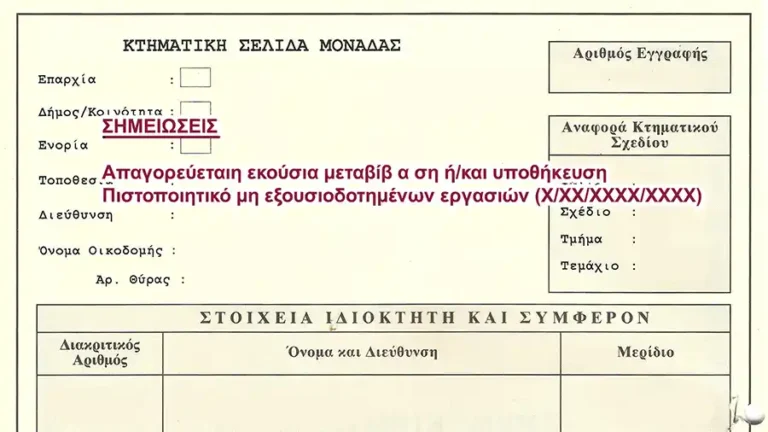
The Immovable Property Law, CAP. 224, prohibits the registered owner of a property (i.e. the name of the owner recorded on the Title Deed) from transferring or mortgaging that property if it has been issued with a ‘Certificate of Unauthorised Works‘.

A note to this effect was added on the property’s Title Deed, thereby making the property effectively worthless on the open market.

A Certificate of Unauthorised Works indicates that a property suffers from serious planning infringements which, in the main, have been caused by shoddy or incomplete building work. When the serious planning infringements have been corrected, the owner can apply to have the prohibition removed and thereby have a ‘clean’ Title Deed issued.

Some infringements, such as a balcony’s balustrade/guardrail/railing being too low, failing to comply with fire regulations, etc. have serious health and safety implications. Others, such as a lack of a green area, are less significant and generally pose no danger.

Although a ‘blighted’ property could not be transferred or mortgaged, it could be left to someone in a Will (transferred by inheritance) or donated to a close family relative.

In my opinion, this change in the law was a positive move as it prevented unscrupulous vendors dumping their worthless and possibly dangerous properties onto their unsuspecting buyers while retaining responsibility for sorting out the mess they created.

(The recently announced ‘Building Amnesty‘ may help those with a ‘blighted’ property overcome a small number of minor planning infringements.)

Government’s temporary Title Deed ‘amnesty’

Earlier today I learnt that the Government introduced a law (Law 54(I)/2021) that provided a temporary amnesty permitting registered owners of properties (in most cases the developer who built it) to transfer and/or mortgage properties despite the fact that they had been issued with Certificates of Unauthorised Works.

This temporary amnesty came into force on 14th April 2021 and ended on 31st December 2021. During the amnesty period nearly 13,000 transfers took place.

The government’s motive for introducing this temporary amnesty is open to speculation.

I have evidence confirming that one unscrupulous property developer managed to offload a ‘blighted’ property onto an unsuspecting buyer during the amnesty period – and I suspect there are many more!

If you have the Title Deed for the property you purchased, it’s easy to check if your property’s ‘blighted’ with a ‘Certificate of Unauthorised Works’.

How to check your Title Deed

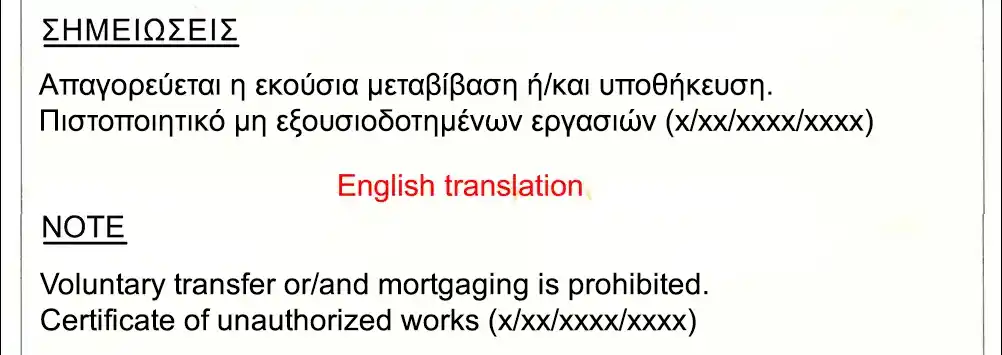
Your Title Deed will be in the Greek language. Look though your deed to see if it contains the Greek text shown in the image below, where you’ll also find an English translation. (The x/xx/xxxx/xxxx is the Certificate of Unauthorised Works’ reference.)

Cyprus Title Deed showing unauthorised works

What to do next

If your property has been issued with a Certificate of Unauthorised Works, you can visit the local Planning Authority to discover the scope and severity of the infringements.

If you bought an apartment or a property on a development, it’s extremely likely that others on the development have the same problem (although some of them may not have a Title Deed as the law protected them when the Deed became available for transfer.)

I know people who have clubbed together and paid for the work needed to resolve the planning infringements; understandably, others are reluctant to do so.

A second option is to club together and investigate the possibility of suing the vendor.

There is a third option if a bank has foreclosed one or more of the properties on your development.