Encroachment: should I have boundaries surveyed?

0

Encroachment occurs when an owner of a property extends a structure or some other feature beyond the boundaries of his land onto land belonging to a neighbour.

Encroachment can involve fences, buildings, driveways, landscaping, or even utilities that cross over a property’s boundaries. Encroachments in Cyprus usually arise from outdated boundary surveys, most often due to builders failing to survey the land before they start construction work.

How do boundaries become outdated?

If we turn back the clock to the 19th century, a British surveyor and cartographer by the name of Horatio Herbert Kitchener surveyed Cyprus. Kitchener, a junior officer at the time, went on to become 1st Earl Kitchener who is probably best known for his WWI recruitment poster, surveyed Cyprus.

Although his survey was considered to be very accurate at the time, it’s accuracy was limited to the equipment available to him at the time. E.g. Kitchener used a 100-foot chain supplied by the Ordnance Survey.

Surveying equipment has become more accurate since Kitchener’s time. Today Cyprus uses sophisticated surveying equipment that measures distances that are accurate to within 1-2 millimetres over typical distances and employs global navigation satellite systems (GNSS).

This increased accuracy means that plots of land may appear to have ‘moved’, with their boundaries now encroaching onto their neighbours land.

Resolving disputed boundaries

Land encroachment in Cyprus is a serious issue, especially given the island’s limited land area and growth of the real estate market since the start of the century.

Resolving encroachment and boundary disputes typically involve legal, administrative, and sometimes technical approaches, depending on the severity of the encroachment and the parties involved.

Avoiding the problems

I have three friends whose properties encroach on their neighbours land and there’s no easy solution to the problem. Their properties are located on the edge or outside the built up areas. Two bought land and built individual houses and one bought a detached house that was built some years earlier.

To avoid the problems experienced by my friends, I recommend that anyone buying land to have the plot surveyed to confirm its boundaries. Similarly if someone plans to buy an older resale property on the edge or outside the built up area I recommend they have it surveyed.

The Department of Lands & Surveys (DLS) publishes a list of licenced private surveyors, or people may chose to have a DLS surveyor undertake the work.

Fees for private and DLS surveyors may be found at the Land Registry’s leaflet of Fees & Charges.

Small increase in October property sales

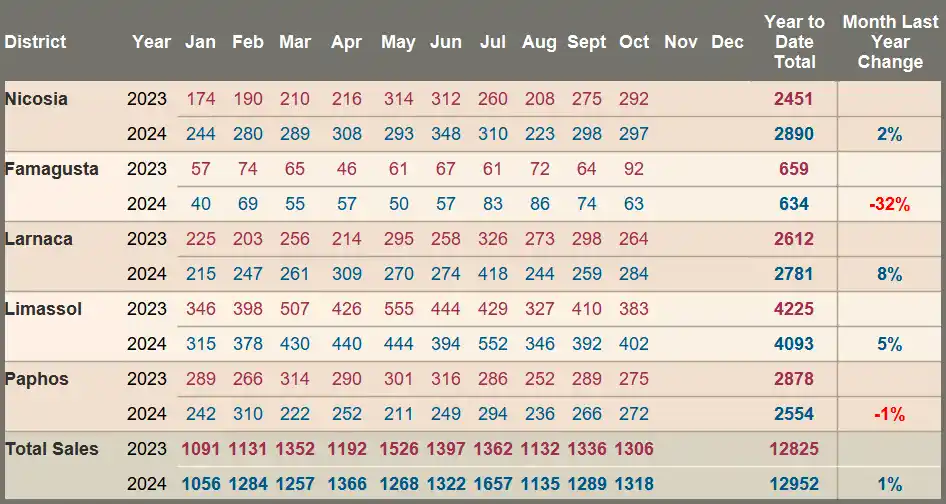
The number of Cyprus property sales achieved in October rose by 12 compared with the numbers sold in the same month last year according to official statistics published by the Department of Lands and Surveys.

The total number of Cyprus property sales (as measured by the number of sales contracts deposited in Land Registry offices in the free areas of the island) stood at 1,318; an increase of 1% on the 1,306 sold in October last year.

Although sales Famagusta and Paphos fell by 32% and 1% respectively, they increased by 8% in Larnaca, 5% in Limassol and 2% in the capital Nicosia.

Total Cyprus Property Sales to October 2024
Total Sale Transactions – 2023/2024 Comparison

Property sales in the first ten months of 2024 have risen 1% compared with the same period last year with only the capital Nicosia and Larnaca gaining ground.

Total contracts of sale deposited – 2023/2024 Comparison (Jan-Oct)

Cyprus property sales – market segment analysis

Sales to the domestic (Cypriot) market

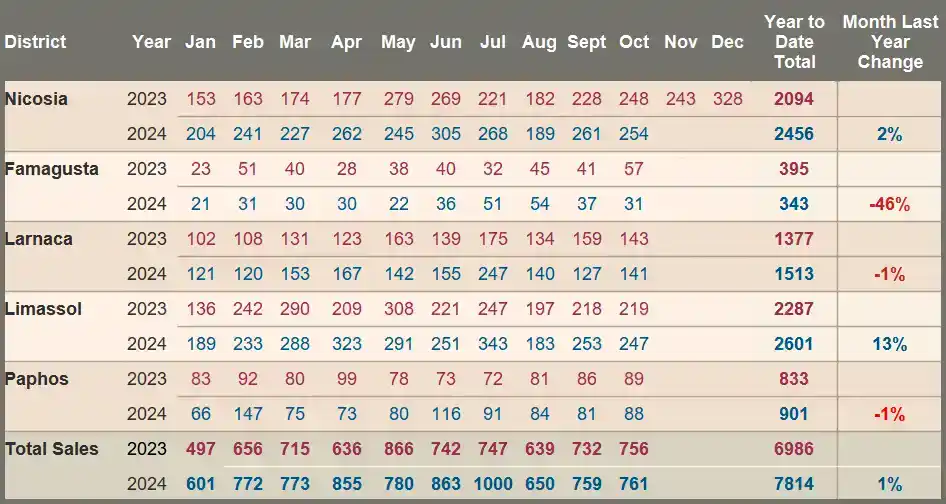
The total number of sales to the domestic market in October rose 1% compared with October last year and accounted for 58% of the total number of sales in the month.

While sales in Limassol and Nicosia rose by 13% and 3% respectively, they fell 46% in Larnaca and 1% in both Famagusta and Paphos.

Cyprus property sales to Cypriot citizens September 2024
Domestic Sale Transactions – 2023/2024 Comparison

Sales to the domestic market in the first ten months of 2024 reached 7,814; an increase of 1% on the 6,986 achieved in the same period of last year. With the exception of Famagusta, where sales fell by 13%, all districts recorded gains.

Domestic contracts of sale deposited – 2023/2024 Comparison (Jan-Oct)

Property sales to the overseas market

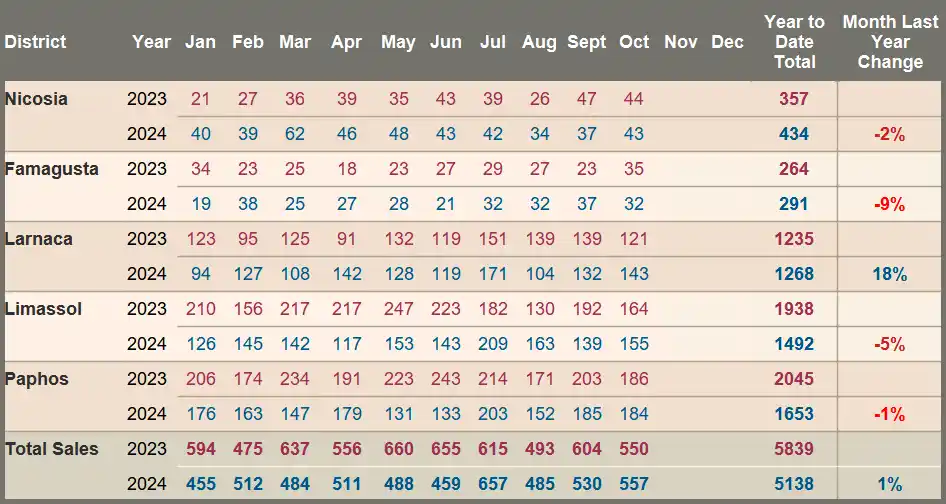
The total number of Cyprus property sales to the overseas market (both EU and non-EU citizens) in October reached 557; an increase of 1% on the 550 achieved in October last year.

Sales fell in all districts with the exception of Famagusta, which recorded a double-digit increase of 18%.

Cyprus property sales to EU and non-EU citizens October 2024
Overseas Sale Transactions – 2023/2024 Comparison

On an annual basis, overseas sales have fallen 12%. Although sales in Nicosia, Famagusta, and Larnaca have risen 22%, 10% and 3% respectively, they’ve fallen 25% in Limassol and 29% in Paphos as foreign buyers focus their attention on the lower priced areas of the island.

Overseas contracts of sale deposited – 2023/2024 Comparison (Jan-Oct)

Property sales to EU citizens

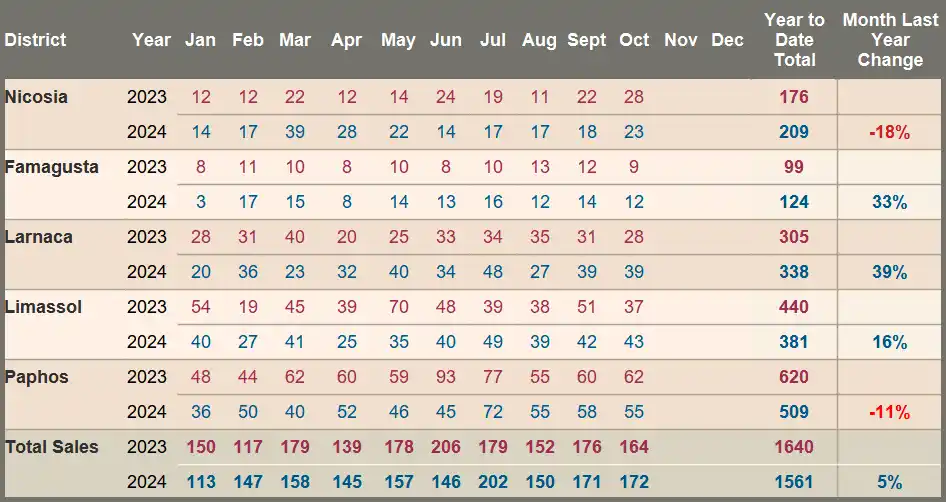
In October, sales to EU citizens rose 5% compared to the same month last year, with falls of 18% in Nicosia and 11% in Paphos outweighed by increases in Larnaca (39%), Famagusta (33%) and Limassol (16%)

Cyprus property sales to EU citizens October 2024
Overseas (EU) Sale Transactions – 2023/2024 Comparison

Sales to EU citizens in the first ten months of 2024 reached 1,561; a fall of 5% compared to the 1,640 sold in the same period last year, as a consequence of sales in Paphos and Limassol falling 18% and 13% respectively.

Contracts deposited by EU Nationals – 2023/2024 Comparison (Jan-Sept)

Property sales to non-EU citizens

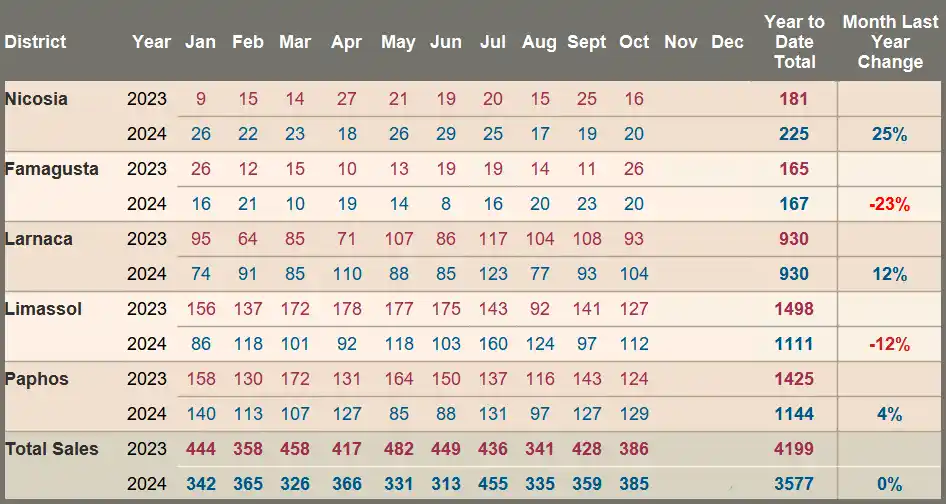
Sales to non-EU citizens rose 5% in October compared to October last year. While sales in Larnaca, Famagusta and Limassol rose by 39%, 33% and 16% respectively, they fell 18% in Nicosia and 11% in Paphos.

Cyprus property sales to non-EU citizens October 2024
Overseas (Non-EU) Sale Transactions – 2024/2024 Comparison

Sales to Non-EU citizens in the first ten months of 2024 reached 1,561, falling 5% compared to the 1,640 compared to the same period last year.

Contracts deposited by non-EU Nationals – 2023/2024 Comparison (Jan-Sept)

Cyprus property sales market segment summary analysis

The chart below shows each of the district’s popularity with each of the market segments. Sales to the overseas market segments (EU nationals + non-EU nationals) exceed domestic sales in Paphos.

In Paphos, the most popular with those looking for a holiday home in the sun, sales to non-EU nationals alone exceed sales to the domestic market (Cypriots.)

Market Segment Summary Analysis 2024 (Jan-Oct)

Contracts Deposited 2008 to 2024 in the First Ten Months of Each Year

RICS/KPMG property price & rental index Q3 2024

The 59th quarterly publication of the RICS Cyprus Property Index with KPMG in Cyprus records the property price and rental index, tracking property and rental prices across all Cyprus districts and main property types.

On behalf of KPMG in Cyprus, Christophoros Anayiotos, Board member and Head of the Real Estate Industry Group, stated:

“In this third quarter of 2024, the index shows increasing signs of stabilization, recording only minor changes in most asset categories. Once again, apartments remain the leading category, whilst retail and warehouses are at the lower end.

“At the district level, Nicosia continues to show strength in residential apartments, joined by Paphos and Famagusta, which also demonstrate strong performance. In contrast, Limassol is experiencing a minor decline across all categories.

“Rental values continue to rise, particularly in residential assets, while retail shows almost no increase. Overall, the index reflects increases in rental values compared to previous years, although property yields show very marginal movements.”

On behalf of RICS, Simon Rubinsohn, RICS Chief Economist, commented:

“Despite signs of a more stable trend in values as highlighted in the RICS Cyprus Property Price Index with KPMG in Cyprus, sentiment captured through the RICS Global Commercial Property Monitor still remains on balance positive. Occupier demand metrics are proving to be relatively resilient according to the feedback from respondents to the survey while investment enquiries actually appear to be picking up.

“Critically, there is a sense that credit conditions are improving which should help support the real estate market going forward.”

Extracts from the Q3 2024 RICS/KPMG price and rental index

Market values year-on-year

Looking at the data on a year-on-year comparison, the Q3 numbers show a strong increase in Apartments, with Houses and Offices some way behind. Warehouses recorded a marginal increase, whilst Retail once again stands out showing a decline compared with a year earlier.

  • Apartments +4.93%
  • Houses +1.38%
  • Retail premises -0.72%
  • Warehouses +0.57%
  • Offices +1.35%

Holiday home prices

Over the past year both Holiday Apartments and Holiday Houses are still showing price increases, with Apartments leading the way..

  • Holiday apartments +1.75%
  • Holiday houses +1.00%

Rental values year-on-year

Year-on-year, rental values showed increases in most asset categories, the highest being in apartments, followed closely by apartments. Warehouse and retail assets are at the lower end of the scale, whilst Retail recorded slight decreases.

  • Apartments +10.57%
  • Houses +9.55%
  • Retail premises -0.98%
  • Warehouses +1.82%
  • Offices +5.53%
  • Holiday apartments +7.44%
  • Holiday houses +6.45%

Rental yields

Yields have generally recorded marginal movements over the past year, with apartments posting the biggest fall.

  • Apartments -0.15%
  • Houses +0.07%
  • Retail -0.07%
  • Warehouse +0.03%
  • Office +0.19%
  • Holiday Apartments -0.11%
  • Holiday Houses +0.04%

RICS notional buildings

The RICS Cyprus Property Price Index with KPMG in Cyprus monitors hypothetical or notional buildings, each having specific characteristics. The methodology underpinning Index was developed by the University of Reading.

The price per sqm is based on the Gross External Area of the property (as defined in the RICS’ Code of Measurement Practice 8th Edition), which includes the living area and covered verandas but excludes common areas.

The estimation of price levels is carried out by accredited RICS property professionals who are active in the relevant markets.

Further reading

The full publication can be found on the RICS website at The RICS Cyprus Property Index with KPMG in Cyprus.

A mere 50 applications for the urban planning amnesty so far

Launched on September 13 2024, the Urban Planning Amnesty, which was expected to allow thousands of ‘trapped buyers’ to obtain a Title Deed, has to date received a mere 50 applications according to media reports.

An Interior Ministry official advised the Parliamentary Committee on Internal Affairs about the scheme’s current progress, highlighting that over 300 inquiries have been made for more information.

The official said that the ministry is currently focusing on replying to those enquiries, with answers also available on the ministry’s website (view the Planning Amnesty FAQs in English). The official added that the Interior Ministry anticipates that the bulk of applications will be submitted by March. This would be in line with previous amnesty programs where applications start low begin with, but increase steadily before reaching their peak near the deadline.

This scheme will remain active for six months, allowing Planning Amnesty applications for unauthorized extensions in residential and other developments to be reviewed, with the aim of issuing Approval Certificates and eventually, Title Deeds. The amnesty scheme also aims to improve surrounding environments and support the Affordable Housing Fund.

Applications for the Urban Planning Amnesty can be submitted online via the Ippodamos system at the five main planning authorities (District Administrations of Nicosia, Limassol, Larnaca, Paphos, and Famagusta). Interested citizens are encouraged to consult registered planners associated with the Cyprus Scientific and Technical Chamber (ETEK).

Following Planning Authority approval, and before receiving a planning permit, applicants must first pay 10% of the required compensation to the District Administration’s fund, with the remainder going to the Affordable Housing Fund, managed by the Cyprus Land Development Corporation (KOAG). The applicant then provides KOAG’s receipt to the Planning Authority to secure the permit.

Urban planning amnesty comments

Readers should appreciate that:

  • This is not an ‘amnesty’ in the true sense of the word, i.e. “the act of an authority (such as a government) by which pardon is granted to a large group of individuals.” This is a scheme whereby individuals may apply to have a limited number of planning infringements removed on payment of compensation, which is based on the extent of the infringement. Unfortunately, this so-called amnesty has been reported as helping ‘trapped buyers’ to get their Title Deed, leading many real trapped buyers (who cannot get Title Deeds because the vendor mortgaged the land on which he was building) to believe this is a viable alternative. In fact, people may be ‘trapped’ by both planning infringements and vendors’ mortgages.
  • Here are some of the infringements that the urban planning amnesty fails to address:
    • The most glaring omission is that only foreigners who are legally registered as resident in Cyprus can apply as the online application system (Ippodamos) requires foreign applicants to enter their ARC number.
    • Unfinished/lack of roads and/or pavements
    • Unfinished/lack of green area
    • Unfinished/lack of surface water drainage
    • Parking spaces configured incorrectly
    • Insufficient parking spaces
    • Lack of disabled parking spaces
    • Lifts not installed according to the permit
    • Balcony railing heights built less than 1.1m from the parapet
    • Electricity sub station built in wrong place
    • Boundary walls too high
    • Access in wrong place
    • Lack of sewage green card
    • Final approval certificate not issued
    • Communal facilities not inspected
    • Nowhere to keep rubbish bins and/or not enough bins
    • Swimming pool changing rooms and facilities not built according to permit
    • Properties built facing wrong direction
    • Street lighting not installed
    • Parking areas blocked in and covered
    • Biological sewerage systems not installed as required by permit
    • Buildings failing to meet fire regulations
    • Buildings encroach on land belonging to someone else
  • Given the limited scope of this urban planning amnesty, I wonder if the lawmakers investigated the scope, extent and multitude of planning infringements blighting properties with the Planning Authorities?

Renovate – rent scheme aims to increase affordable rentals

With the price of rentals surging across Cyprus, affecting both high-end and budget-friendly areas, the Interior Ministry has announced measures to address rising housing costs.

Interior Minister Constantinos Ioannou has unveiled a new housing initiative, “Renovate – Rent“, which is designed to increase affordable rentals by bringing vacant properties back into the market.

The scheme offers property owners grants up to €35,000 to renovate vacant residential units, which will then be leased at affordable rates to low and middle-income tenants. Property owners can apply for grants from 15 November 2024 to 31 December 2025, while tenant applications will be open from 15 January to 31 December 2025.

Eligible properties must have been vacant for at least 12 months prior to 24 October 2023 or between then and 15 November 2024. Vacancies are defined by annual electricity usage below 200 kilowatt-hours. Additionally, properties must have been connected to the Cyprus Electricity Authority grid for at least 15 years as of 24 October 2023.

To qualify, tenants must meet specific income requirements, with income thresholds set from €25,000 for single individuals to €65,000 for families of five or more.

Participating property owners will receive tax incentives, including exemptions from income tax on rental income and defence contributions, along with enhanced capital allowances for equipment purchases. They must commit to renting their units for at least four years at 70 per cent of the market rate.

Grant amounts are based on the size of the unit:

  • One-bedroom units: up to €15,000
  • Two-bedroom units: up to €25,000
  • Three-bedroom units: up to €35,000

Following a four-year affordable rentals period, landlords may extend their participation by at least two more years, becoming eligible for maintenance grants ranging from €3,000 to €5,000, depending on the size of the rental unit

The Cyprus Land Development Corporation will oversee compliance. In cases of non-compliance, sanctions include temporary suspension and grant recovery.

Landlords must also provide a structural safety certificate from a registered civil engineer following renovations.

Residential renewable energy grants reissued

The Ministry of Energy has reopened its residential renewable energy grant program, now accommodating an additional 3,000 applications from households across Cyprus.

Following the launch of the popular “Photovoltaics for All” program in March, which resulted in more that 6,000 applications in just four months, leading to numerous completed installations. This scheme supports non-vulnerable households by offering funding to install photovoltaic (PV) systems, reducing electricity bills and promoting environmental sustainability. Eligible households can repay the investment through instalments added to their electricity bills, covered by the Renewable Energy Sources (RES) and Energy Efficiency Fund.

In this revised phase, the ministry has made adjustments to enhance accessibility and impact. The updated Category A3 scheme has removed the 6,000 kWh/year consumption limit, reduced the grant from €1,000 to €500, and raised the repayable amount from €4,000 to €4,500, targeting applicants with greater financial need. Additionally, eligibility now extends to applicants with a filed purchase agreement at the Department of Lands and Surveys, even if they aren’t the official property owners.

The grant program also offers ongoing support across several categories:

  • Category A1: General population can receive €375 per kilowatt (kW) for PV systems, up to €1,500, with a 50% increase for installations in mountainous areas.
  • Category A2: Vulnerable households are eligible for €1,250 per kW, up to a maximum of €6,250.
  • Category B1: For roof insulation, general population can receive 50% of costs up to €2,500 (€25/m2), with a 50% boost in mountainous areas.
  • Category B2: Targeting vulnerable households, this provides 75% of insulation costs, up to €3,750 (€37.50/m2).

Residents are encouraged to explore these grants to lower energy costs and contribute to a greener future. Details on eligibility and application procedures are available at www.ref.org.cy, with applicants advised to review the requirements carefully before applying.