Cyprus’ antediluvian swimming pool laws set to change

New legislation will end the need for a swimming pool lifeguard on complexes of less than five residential units will be met with huge relief from smaller development complexes.

Following years of complaints and concerns regarding the outdated and unworkable regulations on public and some private swimming pools in Cyprus, the obsolete laws are on the brink of change.

So tough have the regulations been that many complexes rented to tourists or sold to individuals were forced to close their pools in recent years.

At the end of 2023, the interior ministry presented a bill aimed at upgrading legislation regarding the characteristics and inspections of public and private swimming pools during a House interior committee meeting.

The revised bill, which is currently before the Legal Service, proposes three categories of swimming pools:

  • The first category concerns swimming pools in water parks.
  • The second category covers hotel and tourist accommodation pools including those catering for more than five residential units.
  • The third category encompasses all others, smaller than five units which are rented to tourists or sold.

Depending on the category, construction permits will be issued, and periodic inspections will be carried out. Specifically, the bill specified that swimming pools included in the first two categories will undergo systematic health and safety checks, while those in the third category will only undergo sampling.

Additionally, lifeguards will now be required for supervision only in pools falling under the first two categories.

“The new legislation for swimming pools is now at the final stages of legal audit from the Legal Service,” a source at the interior ministry said.

“It will be approved by the Legal Service and then it will have to be approved by the cabinet.”

This development was confirmed to the Cyprus Mail by the Legal Service as well.

In particular, the problem arises from the fact that Cyprus has for years categorised communal pools found at private complexes as public ones, subjecting them to strict laws designed for public facilities.

This has led to extensive requirements for obtaining a licence for a communal pool, including specific construction standards, the presence of a qualified lifeguard on duty at all times, and professional pool maintenance supervision.

“I own an apartment in Emba where the pool is currently closed due to the fear of prosecution of not adhering to the swimming pool laws,” Pam Simcox told the Cyprus Mail.

“One of the stipulations being that we need toilets, changing rooms and a lifeguard on duty. If things don’t change, this will be our third summer without use of the pool.”

She explained that, in order not to risk breaking the law, some of her family members preferred booking a hotel in the area, so that they could use the swimming pool.

“However, they noticed that there has been no lifeguard on duty since they arrived last week. Some friends of theirs are staying in holiday apartments nearby with no lifeguard there either.

“So, the irony is that we cannot use our apartment pool because the other residents and I cannot afford a lifeguard, yet they are actually paying to stay in a hotel operating without lifeguards!”

Peyia councillor Linda Leblanc has been advocating for legislative differentiation between private communal pools and public ones since 2007.

Over the years, she repeatedly stressed that Cyprus could easily implement EU standards, which classify complexes with shared pools for property owners, their guests, and families as ‘Type 3’ swimming pools, subject to different standards from public pools.

Leblanc highlighted the detrimental impact of the current laws on Cyprus tourism and property markets, urging for a swift resolution.

She often underlined the need for a proposal to change the law and for the interior ministry to take action, suggesting that solutions could be implemented quickly with a few adjustments to EU standards.

At present, privately owned holiday villas offered for rentals on platforms like Airbnb are also under scrutiny. Complex owners are being informed that their pools require operating licences due to being regarded as public ones, leading to closures and financial losses for property owners.

Russell Flick, a communal property specialist living in Limassol, started an online petition to change the law. The petition garnered over 8,000 signatures, enough to bring it before parliament. However, despite the widespread support for reform, progress has been slow.

Flick echoed Leblanc’s sentiments, stressing the urgent need for a review of the law and the application of common sense.

Speaking to the Cyprus Mail, he said that the strict enforcement of swimming pool laws, particularly in the Paphos district, has left many complex owners frustrated and facing financial hardships.

The situation has also raised concerns among prospective property buyers and investors, who may be deterred by the uncertainties surrounding swimming pool regulations. This could have long-term implications for Cyprus’ tourism and property sectors, which rely heavily on attracting foreign investment and visitors.

As discussions continue regarding the proposed bill from the interior ministry, stakeholders remain hopeful for meaningful reforms that will address the concerns raised by both property owners and industry experts. However, there is a pressing need for swift action to modernise swimming pool regulations and ensure the sustainability of Cyprus’ tourism and property markets in the future.

The proposal is a step in the right direction, but stakeholders are still calling for comprehensive reforms that take into account the complexities of the tourism and property sectors.

CM

5% VAT rate on new homes extended

Parliament has passed a law, with 34 votes in favour and one against, granting beneficiaries to request a reduced 5% VAT rate within a year of acquiring a main residence.

Proposed by the AKEL parliamentary group, the bill aims to modify the Value Added Tax Law, enabling the Tax Commissioner to accept submissions from eligible individuals that will allow them to enjoy the reduced rate of 5% when buying or building a new home within twelve months of its acquisition.

AKEL MP Andreas Pasiourtidis clarified that some beneficiaries, due to various reasons like health issues or residing abroad, might submit their applications late. The new law will enable them a twelve-month timeframe to apply for and benefit from the reduced rate.

Diko MP Chrysis Pantelidis praised the legislation, expressing their support and observing that despite concerns, the market has continued to operate smoothly since the VAT rate adjustment six months ago.

Stavros Papadouris, MP for the Movement for Ecologists – Citizens’ Cooperation, welcomed AKEL’s amendment and endorsed it, recognizing that despite the law, there will always be unique cases requiring the Tax Commissioner’s sensitivity and flexibility for adjustments.

Larnaca port & marina developer renewing financial guarantee

Kition Ocean Holdings, the consortium responsible for the development of Larnaca’s port & marina, has agreed to renew its financial guarantee after a meeting chaired by President Nikos Christodoulides on Monday at the Presidential Palace. The amount of the financial guarantee under the contract amounts to €10 million.

However, the amount placed by the consortium at the moment stands at €4.2 million.

“Following a productive dialogue, an agreement was reached for Kition Ocean Holdings to place the guarantee of €4.2 million,” a statement released by the consortium said.

“This step will enable further discussions on the details concerning the specifics of this guarantee amount. Once the guarantee is submitted, the government has committed to promptly engage in discussions about the company’s varied requests as outlined in the concession agreement,” the statement said.

The meeting was attended by several relevant officials in Cyprus, namely Larnaca mayor Andreas Vyras, undersecretary to the President Irene Piki, Chamber of Commerce (Keve) president Stavros Stavrou and Deputy Attorney General Savvas Angelides.

Transport ministry officials also attended, along with representatives of Kition Ocean Holdings and the real estate company Aroundtown.

During the meeting, Kition Ocean Holdings committed to deposit the amount of the financial guarantee in the coming days, allowing the project to continue according to the provisions of the contract.

Following the meeting, Vyras called the President’s intervention “very positive”.

“We expect the implementation of the terms of the contract as discussed,” he said.

Vyras also added that if the contract is to be implemented at all, the guarantee will have to be renewed.

“Once the guarantee is renewed, the rest will proceed according to the terms of the agreement.”

He reiterated that the agreement states the works will begin in June.

He added that the conditions are in place already, as the license will be issued on April 26, explaining that tenders have been submitted and both the company and the transport ministry – which oversees the contract – are awaiting the implementation of the agreement.

Asked about the amount of the guarantee to be deposited, he said that he cannot comment on the lump sum, adding that the agreement provides for a dispute resolution process.

“The most important thing is for there to be a financial guarantee, as without it, there is no agreement,” Vyras explained, noting, however, that the amount of the guarantee was not the subject of the meeting, but the issue was that for there to be an agreement, there must be a financial guarantee.

During the meeting Christodoulides underscored Vyras’ statements, telling the port & marina managing company that for the contract to be considered valid, the financial guarantee must first be deposited.

The company committed to depositing the financial guarantee. The President did not reportedly enter into discussions regarding other demands made by the company, with this to occur after the deposit is made.

CM

Property sales fall in Paphos, Limassol, and Famagusta

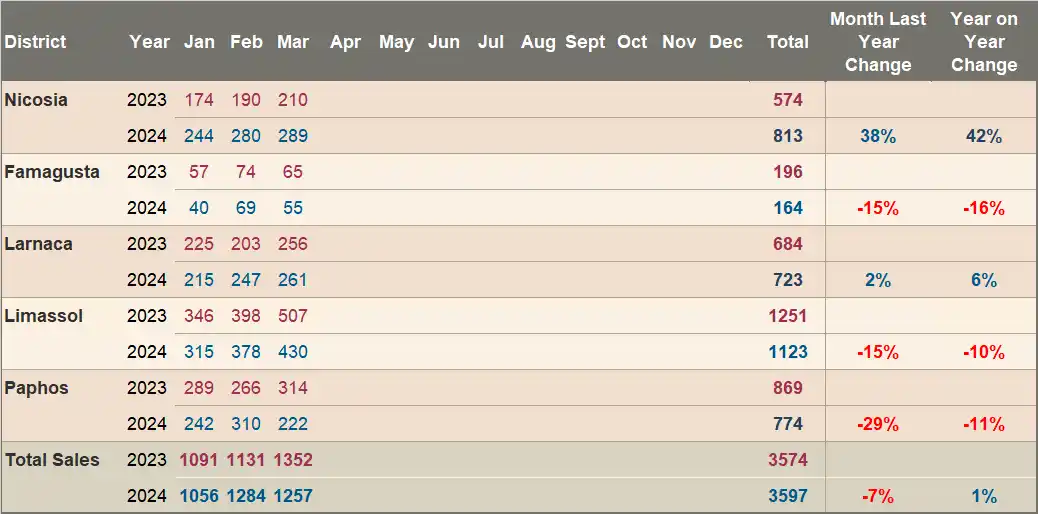
In March 2024, the total number of property sales contract deposited at Land Registry offices across Cyprus reached 1,257, falling 7% compared to the 1,352 deposited in March 2023, according to official sales statistics published by the Department of Lands and Surveys.

Although sales in Nicosia and Larnaca rose by 38% and 2% respectively, they fell 29% in Paphos, 15% in Limassol and 15% in Famagusta.

Total Property Sale Transactions – 2023/2024 Comparison (Jan-Mar)


Total real estate sales for March 2024Sales in the first quarter of 2024 reached 3,597, recording a small increase of 1% compared to the first quarter of 2023 – and the highest number on record since 2008 when 4,522 properties were sold in January and March.

Market segment analysis

Property sales to the domestic (Cypriot) market

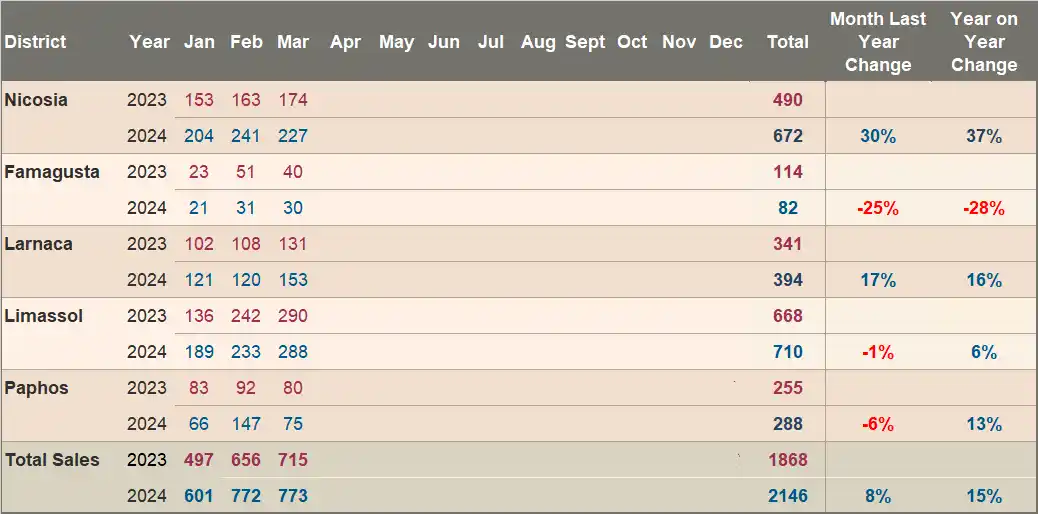
The total number of sales to the domestic (Cypriot) market March 2024 reached 773, a rise of 8% compared to the 715 achieved in the same month last year accounting for 61% of the total number of sales in the month.

Although the number of sales in Famagusta, Paphos, and Limassol fell by 25%, 6%, and 1% respectively, these falls were outweighed by rises of 38% in Nicosia and 17% in Larnaca.

Domestic Property Sale Transactions – 2023/2024 Comparison (Jan-Mar)

Sales to domestic market (Cypriot citizens) March 2024

In the first quarter of this year sales to the domestic market rose by 8% compared to the same period last year. With the exception of Famagusta, which recorded a fall of 28%, sales in the remaining four districts have risen.

Property sales to the overseas market

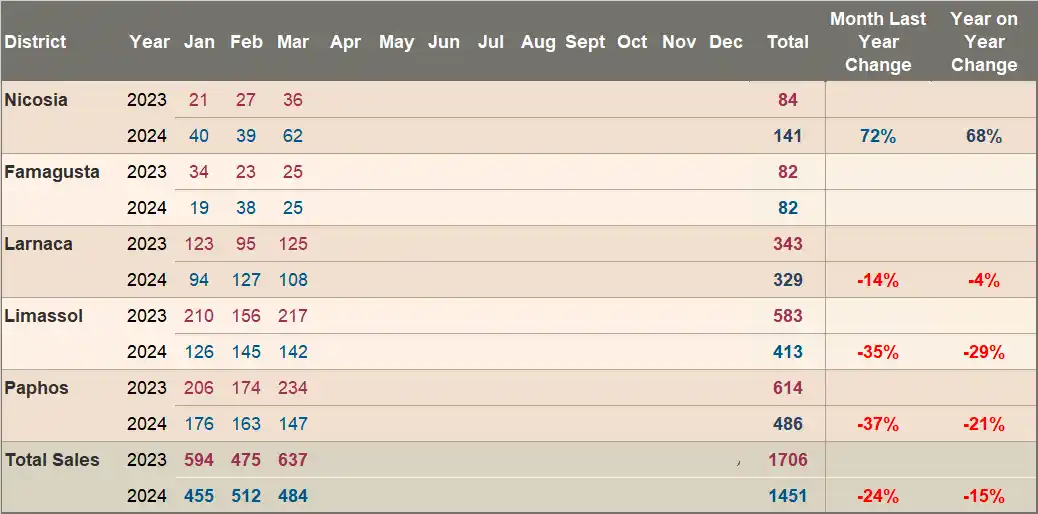
The total number of property sales to the overseas market (both EU and non-EU citizens) in March 2024 fell 24% compared to March 2023. The only district recording an increase was the capital Nicosia, where sales rose by 72%.

Overseas Property Sale Transactions – 2023/2024 Comparison (Jan-Mar)

Total sales to foreigners (EU citizens and non-EU citizens) March 2024In the first quarter of this year sales to the overseas market have fallen by 15% compared to the same period last year.

Sales to EU nationals

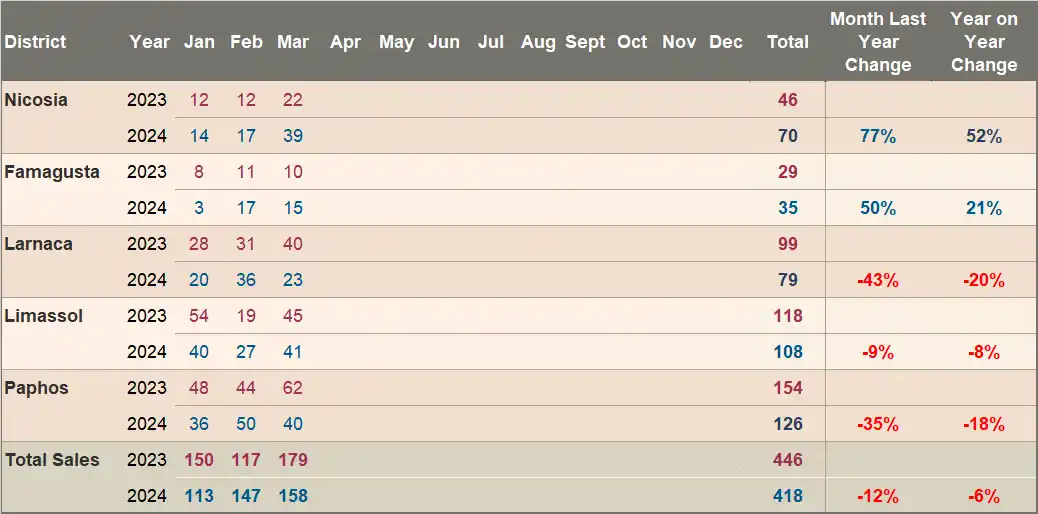
Sales to EU nationals fell 12% compared to March 2023. Although sales in Nicosia and Famagusta rose by 77% and 50% respectively, sales in Larnaca, Paphos and Limassol fell by 43%, 35%, and 9% respectively.

Property Sale Transactions EU Nationals – 2023/2024 Comparison (Jan-Mar)

Property sales to EU citizens (excluding Cypriots) March 2024
In the first quarter of this year sales to EU nationals have fallen by 6% compared to the same period last year.

Sales to non-EU nationals

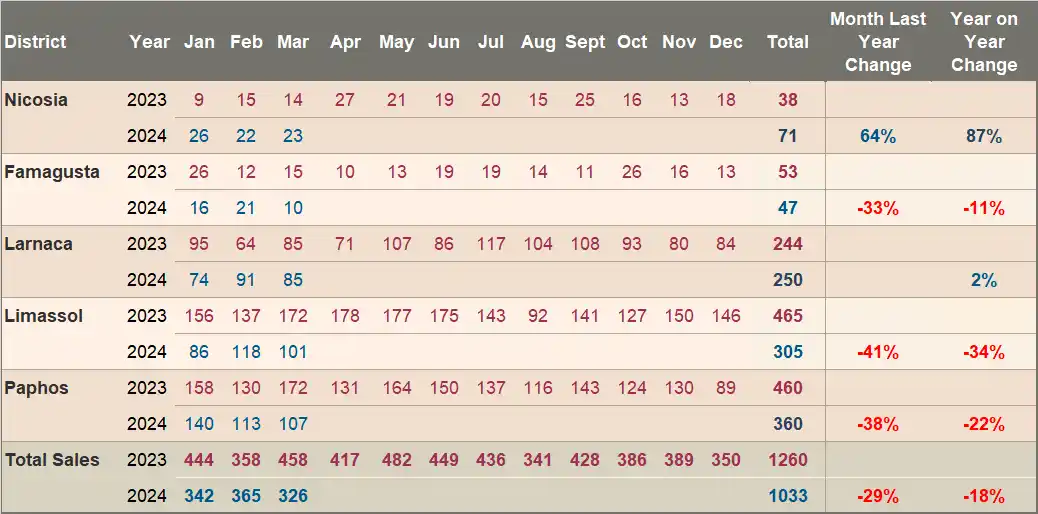
Sales to non-EU citizens in March 2024 fell 29% compared to March 2023. The only district recording an increase was the capital Nicosia, where sales rose by 64%.

Property Sale Transactions Non-EU Nationals – 2023/2024 Comparison (Jan-Mar)


Property sales to Non- EU citizens March 2024

In the first quarter of this year sales to non-EU nationals have declined by 18% compared to the same period last year, with only Nicosia and Larnaca recording increases in property sales.

Property Sales Market Segment Analysis Jan-Mar 2024

Total Number of Sale Contracts Deposited 2008 to 2024 in the First Three Months of Each Year

Cypriots squeezed out of the property market

Cypriots are being squeezed out of the property market as they can’t afford climbing rents. Hiking construction costs and interest rates are making homes unaffordable, with the need for the government to step in, more than ever.

While the island’s real estate sector is showing a significant recovery despite the uncertainty triggered by the energy crisis, the market is tough for the locals.

The market is grappling to come to terms with a 30%-plus increase in construction costs and the hike in mortgage rates, pushing up prices.

The Cypriot economy did not remain completely unscathed from the war in Ukraine and the conflict in the Middle East, with inflation skyrocketing, particularly affecting the more vulnerable groups.

Unfortunately, this has prompted Cypriot households to think twice about borrowing to buy their dream home, as demand for mortgages dipped.

Cypriots are being further marginalised, as renting a flat or a house has become a nightmare, especially in Limassol and the capital Nicosia, where they have been outpriced.

The ever-increasing number of high-tech and fintech firms moving to Cyprus, while boosting the economy, has made things difficult for locals looking for a flat to rent.

These companies bring along their employees, who have higher salaries and can afford higher rents.

Employees of these companies usually prefer newer properties, taking them off the market for Cypriots with lower income.

In all towns in Cyprus, it seems that demand supersedes supply.

Especially in Nicosia and Limassol, any new residential project is sold on plan and during the construction period, while apartments to rent at a price that could accommodate Cypriots are scarce.

Limassol out of reach

According to Danos International Property Consultants and Valuers’ data, renting a one-bedroom flat in Limassol costs a minimum of €850 a month, while a two-bedroom flat would set back the family budget by at least €1,300.

Renting a three-bedroom flat in the district is next to impossible on a Cypriot wage, as rents are around €1,700 monthly.

According to recent CyStat data, Cypriots’ average gross monthly earnings rose to €2,693 for the fourth quarter of 2023, from €2,535 in the preceding year, reflecting a noteworthy 6.2% increase.

Seasonally adjusted figures for the same period reveal that the average gross monthly earnings stood at €2,402, a 1.6% increase compared to the third quarter of 2023.

However, CyStat data also points out that more than half of the island’s employees take home an average of €1,500. The minimum monthly wage in Cyprus is set at €1,000.

In Nicosia, the rent for a one-bedroom flat is between €550 and €650, while a two-bedroom flat would set a family back a minimum of €750.

However, renting an 85 square metre flat in an uptown area in the capital, like Engomi, costs €900 monthly.

The rent for a three-bedroom flat in the capital is between €950 and €1500.

Nicosia residents looking for cheaper alternatives must move to the suburbs, such as Lakatamia, where rents are lower.

Rents in Larnaca and Paphos are lower, for the moment, as the interest of foreign investors and high-tech companies on the lookout for a Cyprus base in the coastal towns, is on the rise.

The rent for a one-bedroom is between €450 and €550. Two-bedroom flats are €550 to €650, while the rent for a three-bedroom is €750 to €850.

Prices mentioned are indicative, and subject to the property’s location, age and other characteristics.

At this point we cannot avoid highlighting the imbalance between demand and supply.

As an agency, we have been looking for new flats to add to our inventory, but the earliest new developments will come online, is in ten months from now. This has largely to do with the fact that, projects get tangled up in red tape procedures.

What needs to be done

The government will have to speed up its housing strategy, aimed at stimulating affordable housing development.

Earlier in the year, the council of ministers gave the green light to new construction incentives proposed by the Interior Ministry.

The objective is to make approximately 800 residential units available in the market at an affordable price for both purchase and rental within the next three years.

As part of a strategic initiative, the government has introduced a ground-breaking housing policy.

Landowners with a building block exceeding 1,000 sq.m. and a building coefficient above 100% now have access to a lucrative 45% additional building coefficient. In contrast, plots below 1,000 sq.m. will see a 25% increase in property development.

These incentives are specifically tailored for developers, with the scheme aiming to promote affordable housing through additional building coefficient.

Out of the 45% boost, 25% is earmarked for affordable home construction, while the remaining 20% is left to the discretion of the developer.

However, the government will have to take into consideration the concerns of developers and real estate agents, as the current plan poses liquidity challenges.

Developers will need to find investors with cash and willing to play the long game before seeing any return on their investment from the additional housing units.

It does not help that banks, in their own right, remain hesitant in providing loans to developers, who in turn must rely on self-financing or find affluent investors.

Most projects are self-financed, as developers turn to investors for funding, making the implementation of the plan a challenge on its own.

About the author

Kyriacos Kiliaris is Danos International Property Consultants and Valuers’ Chief Marketing Officer.

It’s time to abolish the rent control law

Rent control in Cyprus has turned into a cumbersome obstacle, casting a shadow over the local property market and stifling both development and investment opportunities, according to the Cyprus Real Estate Agents Registration Council.

Specifically, the council referred to the Rent Control Law of 1983. This law intervenes in the relationship between landlord and tenant, imposing certain obligations on them.

The main purpose of the law was to protect the tenant from abuses by the landlord, especially during the period following the Turkish invasion, when refugees needed to be shielded from any exploitative practices.

“Rent control has evolved over the years into a painful saga, now plaguing those involved in Cyprus’ property market as it poses numerous issues,” Cyprus Real Estate Agents Registration Council president Marinos Kineyirou said.

“Unfortunately, it continues to apply in our country despite its initial purpose – established in 1974 to protect refugees from exploitation – becoming obsolete years ago,” he added.

Moreover, he stressed that “it’s time to abolish this outdated measure, which burdens the real estate sector”.

Understanding the ramifications of rent control, Kineyirou explained, necessitates delving into the foundational principles and parameters of the legislation.

Firstly, he noted that not all properties are affected, as areas covered by rent control are determined by a Cabinet decree.

Moreover, he stated that when a property falls under the purview of rent control, it triggers specific outcomes.

A tenant meeting certain criteria becomes a statutory tenant, entailing limited circumstances under which they can be compelled to vacate the premises as per the law.

In addition, determining statutory tenancy hinges on several conditions. These include the property’s location within a rent-controlled area, and its construction date predating December 31, 1999.

The property must also have been leased or offered for lease on or before December 31, 1999.

“The existence of rent control automatically creates both tenants and landlords of two different classes,” Kineyriou said.

“This occurs because the legislative regime differs in rent-controlled areas compared to non-rent-controlled areas,” he added.

He noted that in rent-controlled areas, tenants are considered statutory if rental payments are up to date, meaning that it is nearly impossible for the property owner to reclaim their property.

In simple terms, he continued, they cannot unilaterally decide that their rental agreement is complete and should no longer apply, after the original contract period is over.

“One might reasonably ask, why would a property owner want to lose a tenant who pays rent regularly? The answer comes from the things we observed in the property market. A property owner may want their property to pass on to their children, need to sell it to repay a loan, or simply want to stop renting it out to utilise it as they see fit,” Kineyirou stated.

“It is worth noting that the owner of such a property cannot renegotiate the rental fee unless there is a decree of the Cabinet authorising it and specifying the adjustment of the rental fee upwards,” he added.

He also noted that “it is indicative that from 2013, this adjustment percentage stood at 0 per cent until May 2023”, essentially freezing the rental price up until that point, before a decree by the Cabinet set the increase rate at 6 per cent for the 2023-2025 period.

“All of the above is enough to deter anyone from investing in the real estate market in areas subject to rent control,” Kineyirou said.

“These properties are colloquially referred to as ‘difficult to sell’ as investors do not want to be subject to the provisions of an outdated legislation that affects the utilisation and ultimately the return on their investment,” he added.

Furthermore, he said this is why “property owners subject to rent control are often self-identified as trapped property owners”.

“Unfortunately, the problems concerning owners of rent-controlled properties are not limited to them alone,” Kineyirou stated.

He noted that “under the fear of rent control, investors generally avoid properties that were built before December 31, 1999, resulting in a broader impact on the market”.

“Therefore, it is necessary for the state to provide a solution, recognising that the institution of rent control and the country’s development model are not aligned,” the council president concluded.

CM