Expats bristle at unfair taxation in Paphos village

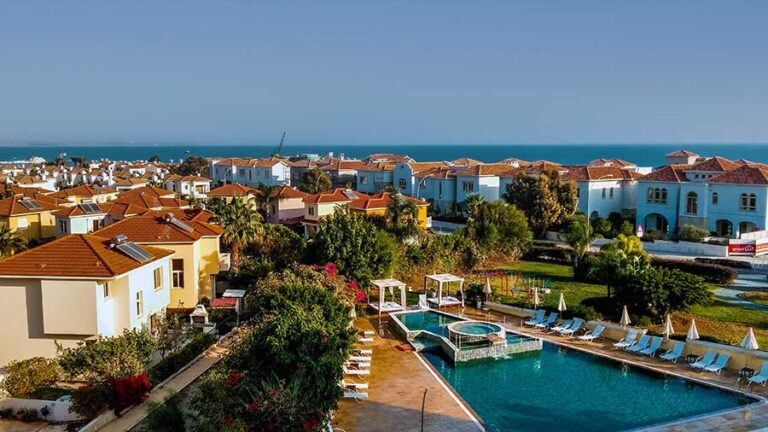
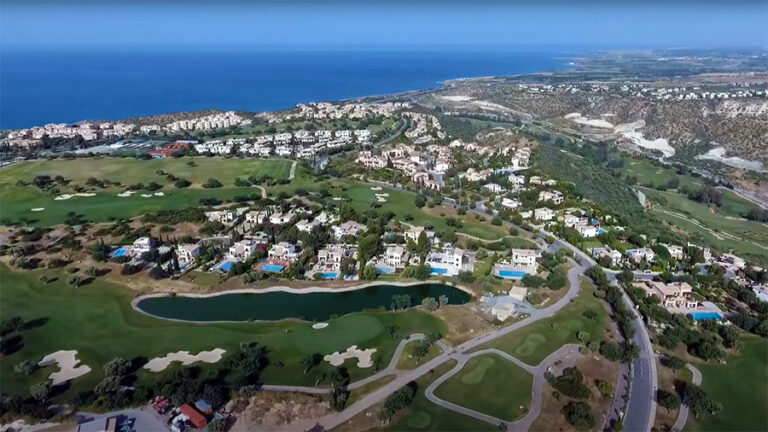
Residents of Aphrodite Hills and Ha Potami, nestled within the scenic Kouklia village in the Paphos district, find themselves entangled in a longstanding dispute with the local village community council over alleged taxation discrepancies.

The heart of the contention lies in what residents perceive as unequal tax burdens between these expatriate-heavy areas and the native Kouklia village.

Member of the Aphrodite Hills Residents Association Ray Smith brought to light a decade-long struggle, referencing a legal battle initiated in 2013 by representative residents of Aphrodite Hills and Ha Potami.

Smith highlighted a 2017 court ruling that deemed the taxation policy of the Kouklia community council, and by extension the Paphos district office, unfair and unlawful, emphasising the need for rectification.

“The levy of taxation is an administrative decision,” Smith noted, echoing sentiments shared by the expatriate communities.

“Kouklia is effectively three separate areas, and both Ha Potami and Aphrodite Hills are described by the council as ‘tourist areas’.”

The heart of the residents’ grievances lies in the stark contrast of tax levies. According to Smith, while Kouklia village residents reportedly pay approximately €68,000 yearly, those in Ha Potami and Aphrodite Hills contend with taxes reaching approximately €700,000 per year. Smith alleged that despite several meetings and legal intervention, there has been a lack of progress in rectifying the taxation inequity.

Additionally, he highlighted the exorbitant water bills faced by the expatriate communities, which total around €300,000 annually, significantly higher than those incurred by Kouklia village residents.

community leader of Kouklia Michalakis Nicolaou defended the council’s stance, asserting that the discrepancy in taxes was due to property valuation differences.

“Properties in Aphrodite Hills and Ha Potami are notably larger with various amenities, thus necessitating higher taxes to sustain services,” Nicolaou said.

He also stressed what he deemed “substantial disparities in property sizes”, claiming that most residences in the expatriate areas measure over 250 square metres with amenities like swimming pools, which incur higher maintenance costs.

Moreover, Nicolaou highlighted the classification of these areas as ‘tourist zones’, reinforcing the argument for higher taxation to support the necessary infrastructure and services. He maintained that the council’s tax imposition was in alignment with the properties’ value and the services provided.

Smith rebuffed Nicolaou’s assertion, challenging the perception of property values between the areas.

“There are owners of mansions worth up to €3 million in Kouklia that pay less taxes than people owning two and three-bedroom properties in Aphrodite Hills and Ha Potami,” Smith countered.

Paphos district officer Mary Lambrou acknowledged the dispute, affirming the district office’s awareness of the 2017 court ruling favouring the expatriate communities.

Lambrou revealed that numerous complaints had been received regarding the taxation issue, stressing the district office’s directive to the Kouklia council to review the tax levies, albeit without tangible outcomes.

“We are doing everything in our power to make it right,” Lambrou asserted. “However, our efforts necessitate the cooperation of the Kouklia community council.

“The responsibility of collecting all the taxes falls on the local council,” she added. “We have been in communication with them about it, but we cannot collect the taxes for them, despite the court ruling.”

Lambrou also revealed that the district office has faced numerous challenges in dealing with the Kouklia council, describing it as among the most difficult entities among the over 100 villages and communities in the Paphos district.

Despite the district office’s efforts to address the issue, Lambrou emphasised the imperative need for cooperation from the Kouklia council to resolve the long-standing taxation disparities.

The stalemate, spanning a decade, encapsulates the complexities of taxation policies vis-à-vis property valuations and the provision of services.

While the residents of Aphrodite Hills and Ha Potami persist in their pursuit of equity, backed by a court ruling in their favour, the Kouklia community council’s stance on the necessity of differentiated taxation highlights the intricate challenges faced in reconciling these differing perspectives.

For now, the impasse between the expatriate communities and the Kouklia village council continues, emblematic of a nuanced tussle over perceived inequities in taxation affecting the lives of expats and locals alike.


Foreclosure bills passed into law

President Nikos Christodoulides heralded the bundle of bills voted into law in parliament tackling foreclosures on Friday, saying it marked “a milestone for the fiscal stability and financial outlook of the country.”

During a marathon plenum session, the majority of deputies voted to instil into law measures aimed at fast-tracking foreclosure proceedings and grant more powers to the financial ombudsman.

Amendments submitted by Akel, Edek and the Green Party did not garner enough votes to pass into law.

“This issue has been pending for years, posing a risk to the country’s fiscal stability and financial credibility. After several months of persistent efforts, it has now come to a successful end,” Christodoulides said in a written statement after the vote.

“The comprehensive approach of the package promoted by the government completes the legislative framework that will provide effective protection for vulnerable and prudent borrowers.”

A day earlier, he said if some of the amendments were voted through, he would veto the law.

One of the new laws authorises the Supreme Court to appoint judges that can fast-track cases where mortgagors challenge foreclosure proceedings against their property. It relates to primary residences with a value of up to €350,000, as well as small business premises.

The law was passed by 35 votes in favour, three against from Edek and 15 abstentions from Akel.

A separate law was also voted through, broadening the scope of the financial ombudsman’s powers to appoint a mediator who can work towards restructuring loans.

The ombudsman will mediate for cases concerning primary residences up to €350,000 and commercial properties up to €750,000. There were 38 MPs who voted in favour, three opposing it from Edek and Akel’s 15 abstentions.

Asked if he knew who he was going to appoint to the role, Christodoulides said he had two or three candidates in mind.

Another two bills from Diko, Edek and Depa were voted into law which regulate a debtor’s right to lodge a complaint against banks for their primary residence to the financial ombudsman.

If the financial ombudsman rules in favour of an individuals, the foreclosure process is suspended, until the case goes to court.

Meanwhile, six laws were unanimously adopted which broaden the definition of the term “restructuring” to include the disposal and transfer of immovable property to the Cyprus Asset Management Company in the context of the implementation of the ‘mortgage to rent’ scheme.

Christodoulides heralded the “responsible political forces of the country” for their cooperation.

“Today’s development demonstrates the prospects and potential of our country when prudence and responsibility prevail. I am optimistic that the implementation of prudent policies will shield our economy and bring further growth and progress for our country.”

Nonetheless, some deputies slammed the developments, with Akel’s MP Giorgos Loucaides saying those who supported the bills “want to protect the banks and abandon poor borrowers.”

Former finance minister and Disy MP Harris Georgiades said what was before the MPs was an improvement but not the perfect solution. He highlighted the existing problems will not disappear but neither will this mean mass foreclosures.

Diko MP Nicholas Papadopoulos said the day’s votes implemented seven out of eight of the government’s measures, apart from the Estia plan which is still pending approval.

The choice deputies had in plenum was whether they would stand with honest borrowers or protect the dishonest ones, he added.

Exorbitant property prices pushing foreign investors north

Recent developments in the Cyprus property market have highlighted a significant shift in buyer interest toward the occupied territories, with pricing identified as a key driver, rather than the ongoing conflict in Israel, according to the Cyprus Real Estate Agents Council.

Council president Marinos Kineyirou explained that foreign buyer interest has notably influenced the Cypriot property market over the past few years.

In this context, he noted that following the Covid-19 pandemic, the interest from foreign buyers had played a substantial role in revitalising the market after a period of profound crisis.

“Interest from foreign buyers has supported the Cypriot real estate market in recent years,” Kineyriou said.

“It wouldn’t be an exaggeration to say that after the Covid-19 pandemic, the interest of foreign buyers provided a significant boost to the market and contributed significantly to its recovery after the strong shock it had suffered,” he added.

Analysing comparative property sales data on a quarterly basis, as presented by the Real Estate Agents Council, Kineiyrou pointed out that property sales in Cyprus had seen a consistent upward trend over the nine-month period of 2023.

However, he highlighted a significant recent shift, indicating signs of stagnation across all cities and districts in the areas controlled by the Republic of Cyprus.

Despite widespread speculation linking market stagnation to the conflict in neighbouring Israel, Kineiyrou argued that while the war had impacted Israeli and Lebanese interest, it was not the primary cause.

He emphasised that exorbitant property prices had equally dampened the interest of both domestic and foreign buyers.

“Many, experts and non-experts alike, argue that the stagnation in the market is due to the war that has erupted in neighbouring Israel, as it has slowed down the interest of Israelis and even Lebanese buyers,” he said.

“Our experience in the Cypriot real estate market leads us to conclude that the war in Israel is not the main cause of stagnation but rather an easy excuse,” he added.

Moreover, Kineyirou said that “the reality is that excessively high property selling prices have dampened the interest of both domestic and foreign buyers”.

Moreover, Kineiyrou highlighted a notable trend where foreign buyer interest had redirected beyond the Green Line to the occupied territories.

He argued that Israeli and Lebanese buyers were now investing in properties there, even amidst ongoing conflict.

This shift has been evident in the Turkish Cypriot press and social media, where tailored advertising campaigns aimed at Israeli and Lebanese markets were observed.

“Apart from the Russians, who, after the outbreak of the war in Ukraine and the resulting sanctions, have flooded occupied Cyprus, both Israelis and Lebanese choose to buy houses in the Turkish-ruled areas of our homeland,” he stated.

In response to this market shift, Kineiyrou said that there are two perspectives to this phenomenon, one of deliberate ignorance, and one of pragmatism.

“We, who live and make a living from the real estate sector in the free areas of the Republic of Cyprus, in our opinion have two choices,” he said, noting that the first option is “to continue sweeping the problem under the rug and finding excuses for reducing demand.

“The second option is to admit that we have gone too far with prices to the point where we are driving away foreign buyers,” he added.

Concluding his observations, Kineiyrou highlighted the role of the government in curbing this trend, urging property owners to confront the issue rather than evade reality, to avoid potential repercussions on the market.

“The country has a government and mechanisms that can do everything they can to stop this flow of foreign property buyers to the occupied territories,” Kineyirou stressed.

“Property owners need to quickly understand that if they sweep this problem under the rug, refuse to face the truth head-on, and refuse to rationalise property selling prices, then I am afraid we will again be mourning a catastrophe after the fact,” he concluded.

Voting this week on foreclosure legislation

Government legislation affording extra protections to distressed borrowers with their homes on the line will go the plenum for a vote later this week, it emerged on Monday.

The first of the bills concerns authorising the supreme court to appoint judges to fast-track cases where mortgagors challenge foreclosure proceedings against their property. The second bill gives expanded jurisdictions to the Financial Ombudsman.

Mortgaged properties eligible for such judicial fast-tracking are those valued at under €350,000.

In parliament on Monday, the finance ministry came with a last-minute amendment of its own – where for such cases already filed in court, the litigant may apply for his or her case to qualify for the fast-track process provided that the case has yet to reach the hearing stage.

For their part, MPs proposed that the first bill include a clause explicitly defining the maximum number of days for such trials to be completed. But their idea got the thumbs-down from Giorgos Panteli, permanent secretary at the finance ministry.

Lawmakers could still insert this clause in their own amendments, a number of which have been drafted by the parties.

Chair of the House finance committee Christiana Erotokritou (DIKO) welcomed the new government legislation despite its flaws. On the bill regarding the expanded powers of the Financial Ombudsman, she noted that the official would now be able to consider cases involving business premises (not just residential properties) as well as cases involving terminated loans.

Akel MP Andreas Kafkalias asserted that the two government bills essentially change nothing. He said legislation governing foreclosures “is still tailor-made for the banks”.

Another idea that MPs are toying with is to allow mortgaged properties whose value may have exceeded €350,000 due to re-zoning, to qualify for the fast-track judicial process.

But government officials again voiced scepticism.

The Greens’ Stavros Papadouris proposed that the €350,000 limit for taking recourse to the Financial Ombudsman be upped to €500,000.

He also revealed that one of the party amendments that will be put to a vote at the upcoming House plenary will call for a moratorium on repossessions until January 31 of 2024.

Cyprus property sales show signs of cooling

Although the number of Cyprus property sales continued to rise in November, there are signs that the market is cooling.

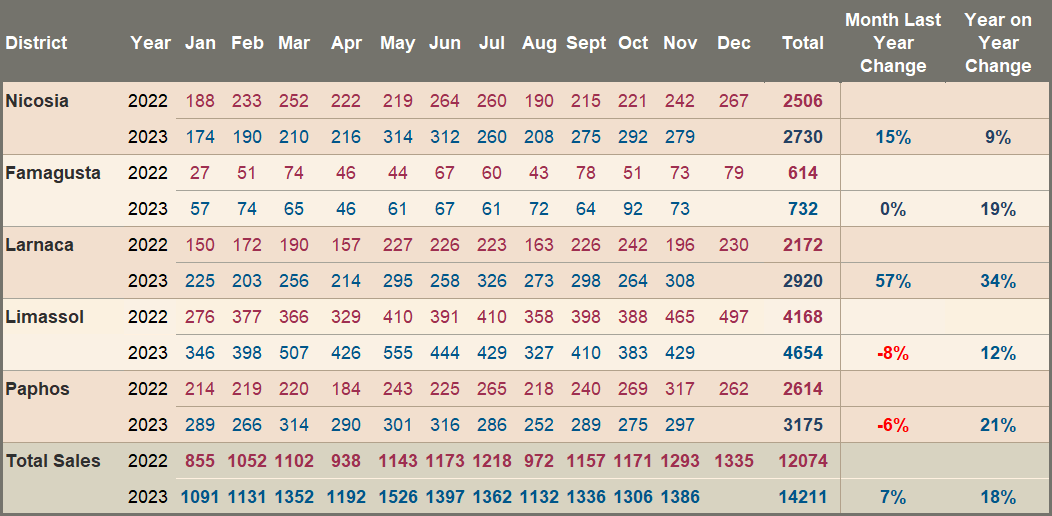
Sales in November, as measured by the number of contracts deposited at Land Registry offices, rose 7 per cent compared to November 2022 according to official figures from the Department of Lands and Surveys. But while sales in Larnaca rose 57%, which has been reported as a result of strong interest by Israelis, sales in both Limassol and Paphos have fallen by 8% and 6% respectively compared to November last year.

However, despite the slowdown, it is certain that 2023 will be the best year for property sales since 2008.

Total Property Sales Transactions
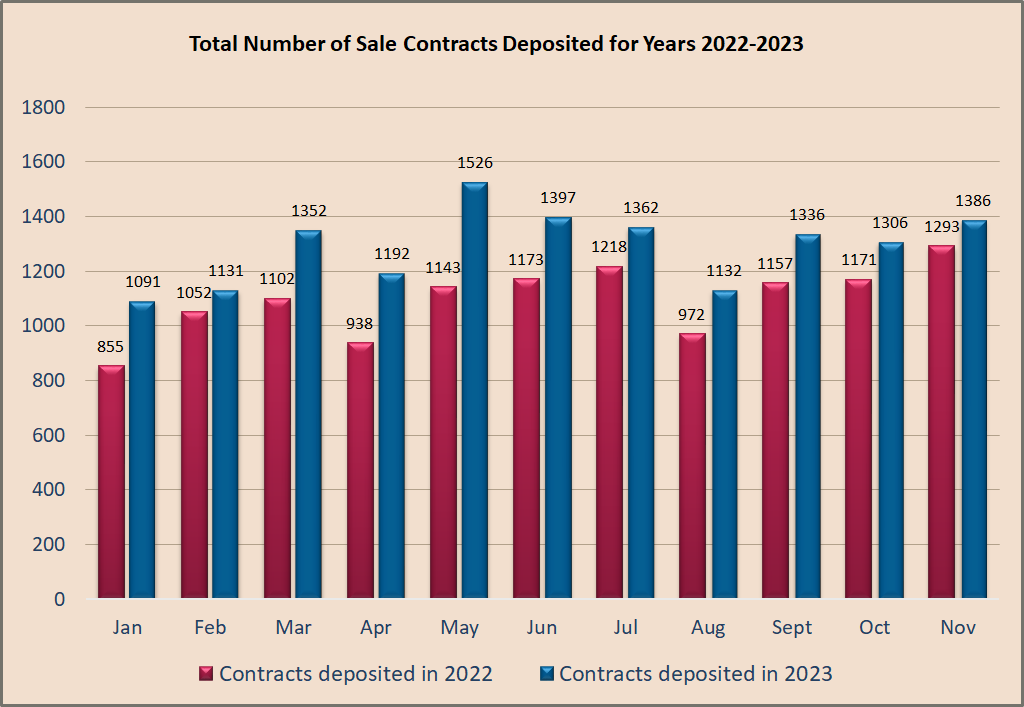
Total Property Sale Transactions – 2022/2023 Comparison

Year to date property sales

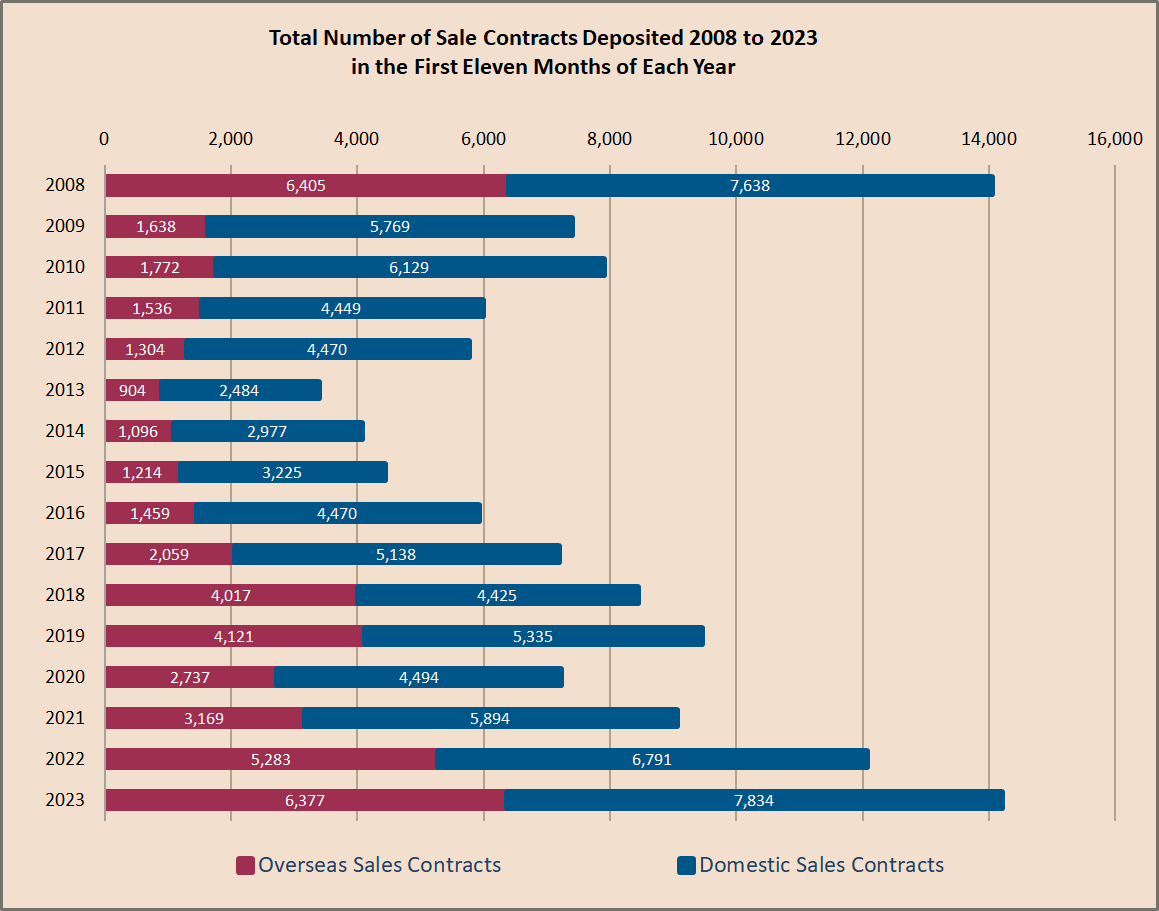
Sales during the first eleven months of 2023 sales reached 14,211 an increase of 18% compared to the 12,704 achieved in same period last year with sales rising in all districts.

Property sales 2022 - 2023 comparison
Property sales 2022 – 2023 comparison

Market segment analysis

Property sales to the overseas market

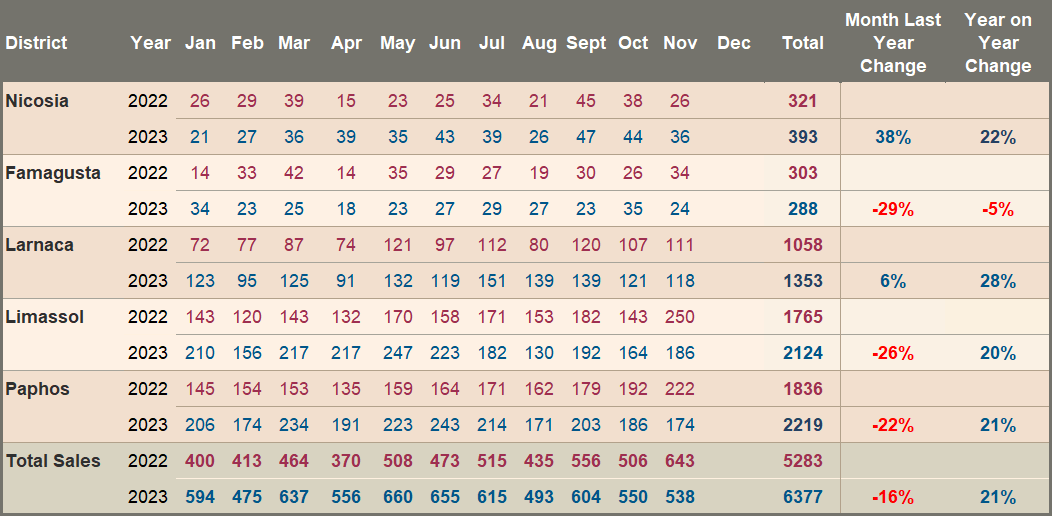
The total number of property sales to the overseas market (both EU and non-EU citizens) in November fell 16% compared to November 2022.

Although sales in Nicosia and Larnaca rose by 38% and 6% respectively, these were wiped out by falls of 29% in Famagusta, 26% in Limassol and 22% in Paphos.

Foreign sales
Property sales to the overseas market – 2022/2023 Comparison

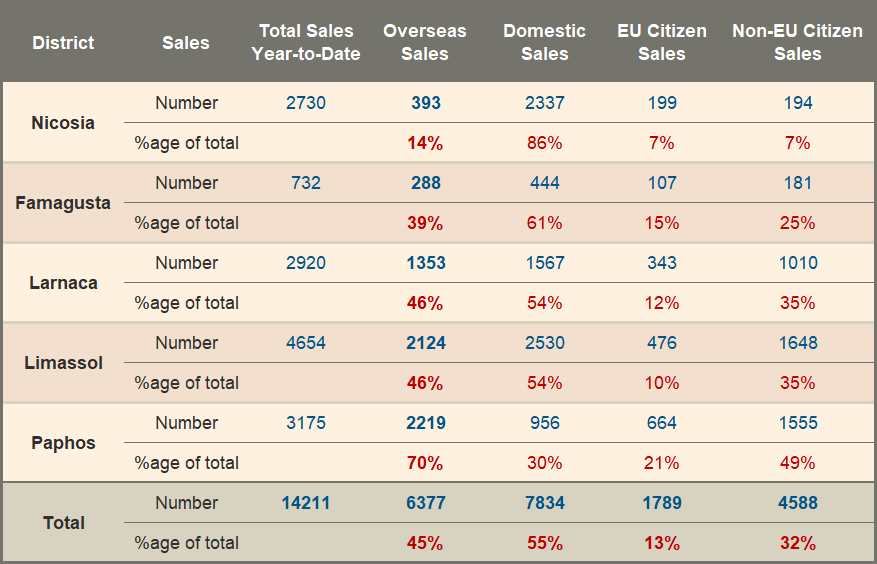
Sales to the overseas market during the first eleven months of 2023 reached 6,377; a 21% rise on the 5,283 achieved in the same period last year.

Property sales to non-EU citizens

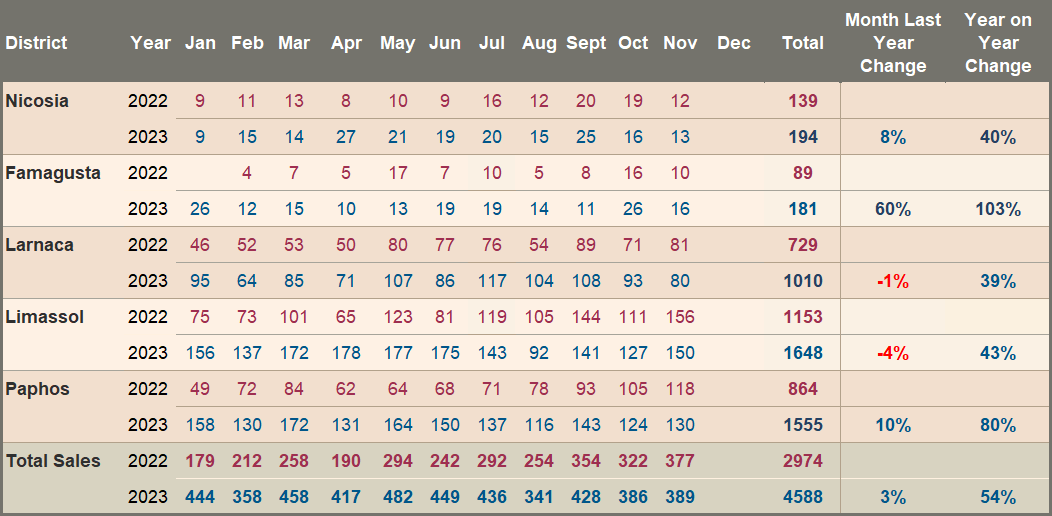
Sales to non-EU citizens rose 3% compared to November 2022 and accounted for 32% of the total number of sales (1,386) achieved during the month.

Although sales in Limassol and Larnaca fell by 4% and 1% respectively, these falls were outweighed by increased sales of 80% in Famagusta, 10% in Paphos and 8% in Nicosia.

Sales to non-EU citizens
Overseas (non-EU) Sale Transactions – 2022/2023 Comparison

Sales to non-EU nationals during the first eleven months of 2023 reached 4,588; a 54% increase on the 2,974 achieved in the same period last year.

Property sales to EU citizens

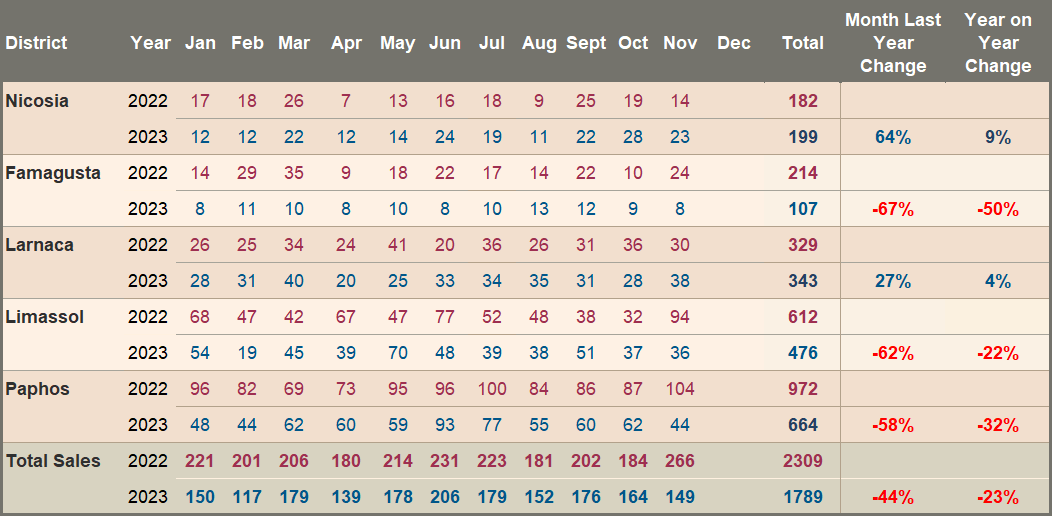
Sales to EU nationals slumped 44% compared to November 2022. The only two districts to buck the trend were Nicosia, where sales rose by 64%, and Larnaca, where sales rose by 27%.

Sales to EU citizens
Overseas (EU) Sale Transactions – 2022/2023 Comparison

Sales to EU nationals during the first eleven months of 2023 reached 1,789; a fall of 23% compared to the 2,309 achieved in the same period last year.

Overseas market preferences

An analysis of property sales to the overseas market over the first eleven months of 2023 reveals that foreign buyers prefer to buy in the coastal areas of the island.

Paphos is by far the most popular destination, with overseas sales accounting for 70% of total sales in the district. Paphos is followed by Limassol and Larnaca (47%), Famagusta (39%) and finally Nicosia with overseas buyers accounting for just 14% of sales in the district.

Overseas market location preferences

Property sales to the domestic market

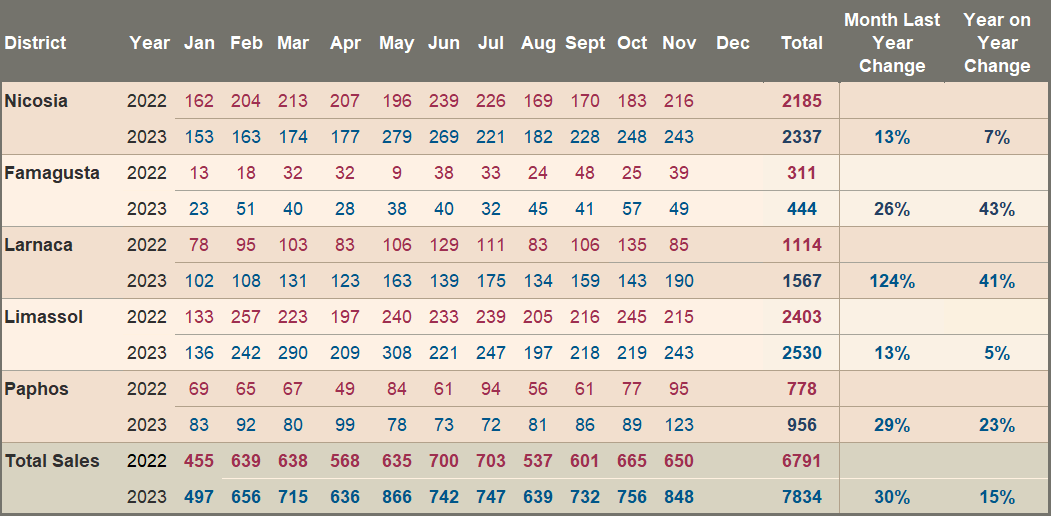
Real estate sales to the domestic market continued to perform strongly in November, with sales rising by 30% compared to November 2022, with sales rising in all districts with Larnaca, in particular, recording a massive 124% increase in sales.

Domestic Property Sales Transactions – 2022/2023 Comparison
Domestic Sale Transactions – 2022/2023 Comparison

Sales to the domestic market during the first eleven months of 2023 reached 7,834; an increase of 15% on the 6,791 achieved during the same period last year.

Total Number of Sale Contracts Deposited 2000 to 2023


Demand for Cyprus real estate remains high

According to data from the Comparative Sales Department of the Land Registry and Cartography, processed and presented on a quarterly basis by the Real Estate Registration Council, the real estate market continues to be resilient to challenges.

In particular, the nine-month period of the year saw a total of 8,681 property transfers nationwide with a total value of €1.4 billion and 9,374 sales documents with a total value of €3.3 billion.

Marinos Kineyirou, the President of the Real Estate Registration Council, stated, “It is with great satisfaction that we observe the Cypriot real estate market achieving remarkable performances despite the prevailing negative environment. External demand combined with the maintenance of domestic demand at good levels create expectations for another positive year in the real estate sector.”

Limassol leads

Limassol district confirms its status as the driver of the Cypriot real estate market, registering the highest number of sales documents (3,435) and ranking just behind Nicosia in the number of property transfers (2,334). In terms of values, it is the strongest district, having transferred properties worth €462 million and sales documents worth €1.85 billion in the nine-month period.

The two faces of Nicosia

Nicosia district records the highest number of property transfers (2,937) in the nine-month period and follows Limassol in terms of values, amounting to €409 million.

However, the analysis of sales documents during the nine months reveals a significant decline for Nicosia, both in transaction volume (1,673) and values (€382 million), placing it in the fourth position, behind Limassol, Paphos, and Larnaca.

Paphos maintains momentum

The Paphos district continues to maintain its momentum in the real estate market for over a year, recording 1,063 property transfers worth €165.3 million and 2,027 sales documents worth €632 million in the nine months of 2023.

In terms of transfer values, Paphos ranks fourth, but in sales document values, it stands second, comfortably ahead of Larnaca and Nicosia.

Larnaca on the rise

Larnaca district demonstrates significant achievements in the real estate market in recent months, reflected in the comparative sales for the nine-month period.

With 1,850 property transfers worth €266 million and 1,892 sales documents worth €383 million, it secures the third position in the reported period.

Steady performance in Famagusta

Despite its small size, the real estate market in the free district of Famagusta demonstrates stability during the January to September 2023 period, with a total of 497 property transfers worth €93 million and 347 sales documents worth €82 million.

© 2023 In-Cyprus.com