Ban golden passports & regulate golden visas

‘Golden passports’ are “objectionable from an ethical, legal and economic point of view and pose several serious security risks”

MEPs want common EU rules on ‘golden visas’ to fight money laundering and corruption

A levy on ‘golden visas’ collected at EU level

Concerned that EU citizenship is for sale, Parliament proposes new common rules to address the many problems linked to ‘citizenship/residence by investment’ schemes.

On Wednesday, MEPs adopted a legislative initiative report calling on the Commission to table a proposal by the end of its mandate. The commitment by the Commission, France, Germany, Italy, the UK, Canada, and the US to limit wealthy Russians with ties to the government from accessing ‘golden passports’ was raised during Monday’s debate in plenary. The text passed with 595 to 12 and 74 abstentions.

Ban ‘golden passports’…

Parliament stresses that ‘citizenship by investment’ (CBI) schemes, under which third country nationals obtain citizenship rights in exchange for a sum of money, undermine the essence of EU citizenship.

Parliament describes the practice – in place in Malta, Bulgaria and Cyprus – as “free riding”, as member states sell what was never intended to become a commodity.

Applications have been accepted even when requirements were not met, MEPs say, and demand that these schemes be phased out due to the risks they pose.

…and regulate ‘golden visas’

Noting the less severe risks posed by ‘residence by investment’ (RBI) schemes, Parliament asks for EU rules to help tackle money laundering, corruption, and tax evasion, including:

stringent background checks (also on applicants’ family members and on sources of funds), mandatory checks against EU databases, and vetting procedures in third countries;

reporting obligations for member states, including a “notification and consultation” scheme to allow other member states to object; and

requirements for minimum physical residence (for applicants) and active involvement, quality, added value, and contribution to the economy (for their investments).

No passports, nor visas for Russian oligarchs

Parliament welcomes the commitment by the relevant member states to limit the sale of citizenship to Russians with ties to the Russian government, and calls for all CBI and RBI schemes in the EU to exclude Russian applicants with immediate effect. MEPs urge EU governments to reassess all approved applications from the past few years and ensure that “no Russian individual with financial, business or other links to the Putin regime retains his or her citizenship and residency rights”. In addition, they call on the Commission to ban Russian nationals who are subject to EU sanctions from all RBI schemes.

A fragmented system and the role of intermediaries

MEPs deplore the lack of comprehensive security checks and vetting procedures in both types of schemes, adding that it should not be possible to file successive applications in different member states. Member states should not rely on checks carried out by non-state actors. Parliament calls for an EU levy of a meaningful percentage on the investments made – until ‘golden passports’ are phased out, and indefinitely for ‘golden visas’. It also asks the Commission to put pressure on third countries that benefit from visa-free travel to the EU to follow suit.

Noting that intermediaries in these schemes are neither transparent nor held accountable, Parliament calls for a ban on their involvement in CBIs and a “strict and binding regulation” for their role in RBIs, which should include sanctions.

Quote

Rapporteur Sophia in ‘t Veld (Renew, NL) commented: “These schemes only serve to provide a back door into the EU for shady individuals who cannot enter in broad daylight. It is time we closed that door, so that Russian oligarchs and other persons with dirty money stay out. Member state governments have refused to address the problem, claiming it was not an EU matter. Given what is currently happening, they cannot duck this issue anymore.”

Next steps

The Commission has to prepare a legislative proposal or justify its decision not to do so.

Background to golden passports and visas

At least 130,000 persons benefitted from CBI/RBI schemes in the EU from 2011 to 2019, generating revenues of over €21.8 billion for the countries concerned.

CBI schemes exist in Malta, Bulgaria (where the government has tabled a draft law to end the scheme) and Cyprus (which is only processing applications submitted prior to November 2020, all of which have already been examined, according to the Cypriot government).

Twelve member states have RBI schemes based on diverging amounts and options of investment.

Further reading

MEPs press for EU-wide ‘Golden Passports’ ban

The European Commission will very soon present a recommendation to all Member States addressing residence permits and citizenship under investor schemes, Commissioner for Home Affairs Ylva Johansson said on Monday evening during a debate at the European Parliament plenary session on an EU-wide ban on ‘golden passports’, and common rules for ‘golden visas’.

During the debate on the report calling for a ban on “citizenship through investment” programmes and for joint EU rules on residence permit schemes, MEPs and European Commissioners said the “sale of EU passports” must end.

The acquisition of “golden passports” by Russian oligarchs was mentioned by most speakers.

Johansson said that the Commission has already taken measures, but will very soon present a recommendation to all Member States addressing residence permits and citizenship under investor schemes in particular.

She also said that the Commission exercises constant pressure on all visa free countries running citizenship by investment schemes which has brought results, as several visa-free countries have decided to terminate their schemes or have put on hold plans for new ones.

She said the Commission will do more and reassured the European Parliament they can count on the Commission to follow up on the report.

“I am considering strengthening checks on continuous residents as part of our current revision of the long-term residents Directive,” she also said.  Johannsson noted that people using these schemes to falsify their tax residence must be stopped, by ensuring the implementation of the Directive on administrative cooperation, with infringements procedures if necessary.

“You ask for many measures, we will analyse all these requests and where necessary, we will propose legislation,” she added.

In his intervention, Cypriot MEP, George Georgiou, said that the investment schemes that could boost the development of society were eventually transformed into a “factory for the production and issuance of passports”.

Unfortunately, he added, as a Cypriot, he knows this very well. “My government may have stopped assessing pending applications, but the damage done to Cyprus is great,” he said.

The Akel MEP said that they demand transparency and measures against corruption at every level, and the closure of tax havens.

He added that Russians, Ukrainians, and other oligarchs were not only present in Cyprus and Malta but were scattered throughout Europe.

Georgiou said the uncollected taxes from the issuing of “golden passports” belong to society and called for the collection of these funds in order to be given to the states that need them.

The draft legislative initiative on which MEPs will vote on Tuesday and the result to be announced on Wednesday morning, says ‘citizenship by investment’ schemes, under which third country nationals can get so-called ‘golden passports’, are objectionable ethically, legally, and economically.

According to the draft text, third countries with visa-free access to the EU should also end their ‘golden passports’ schemes.

It calls for proposals for a strict EU regulation, including a levy on investments (with contributions going to the EU budget), stringent background checks and requirements for physical presence, and a comprehensive set of rules for the activities of intermediaries.

Value that tree house!

Most people will simply calculate the total amount they paid for their house (i.e. cost of buying the vacant parcel/plot plus their total construction cost) and assume that’s the Market Value of their property. Well, I’m sorry to be the one to say that that’s not true! I’m sure many will argue that it should be true since that’s the cost. Unfortunately, cost is not value.

Simply explained with an example, the cost of building anything up in the mountains is relatively more than the cost of building that same unit down in a city centre…… Why? Because that ‘minor’ essential product called concrete needs to be carried miles further, meaning more costs; because the bricks also need to be carried that same distance; and because the construction company needs to travel all those miles every day for a couple of years to build that unit (unless the construction company, the concrete company, the brick company etc. are all based up in the mountains).

That was a very simple explanation of cost compared to value. Now let’s assume I manage to get a building license to build a beautiful house in an agricultural area or in an area where there are farms around my property compared to a similar house being built only a few miles further, in a residential area. Let’s also assume same cost for building the two units. Well, some may argue that the house next to the farm has an advantage since it’ll have that great “piggy smell” from the farm next door when enjoying your evening drink on the veranda, or the fact that the owner will need to drive through a dirt road for a couple of miles before they can find an asphalted main road, or even the fact that the farmer next door will provide with fresh eggs for breakfast every morning.

That said, the value of the two properties is not based on the construction cost, but simply put, on how much the market is willing to pay for them!

Similarly, when developing a vacant parcel/plot, the investor should analyse the Highest and Best Use of that property/parcel. This would be considered as the legal use of a property that yields the highest present value. A feasibility study of all permissible uses of the property can be processed and the financially feasible use that produces the highest financial return can be considered as the highest and best use. Based on the above, if I decide to build a two-storey house upon a plot located on a commercial avenue, with a permissible use for a potential six-storey commercial building, won’t make me look as a very good investor. This automatically changes the use of the property, from a commercial to a residential use, since I had the ‘fantastic idea’ of building a two-storey house on a commercial plot which could be developed into a six-storey commercial building. I have therefore affected the value of the plot and generally the property.

The same applies when investing in a property where there are buildings already upon the parcel. There are two main factors to look at here; Current Use vs Development Potential. Whichever is higher is the best investment option to proceed with. If, for example, there is a single-storey 30-year-old house on a commercial plot, the investor will look at his options. Current Use (keep as is) Vs Development Potential (demolition of current buildings and development of vacant parcel). Let’s give some inside info here….’go for the second option’! The investor will therefore give no value to the current buildings upon the plot as these will simply be costs for demolition.

What if that same parcel is already fully developed into six storeys, with the building being relatively new but the ‘use’ of the buildings not considered as the highest and best use of the parcel? Remember Janice from the Friends series?? “Ohh Myyyy Goddd”

Well unfortunately, whatever the construction costs may have been for developing that parcel (with the wrong use), it will affect its total value! This is where the importance of market analysis comes in the equation; only before the actual development.

About the author

Angelos Georgiou FRICS, FCIArb
Managing Director – KTESION | Real Estate & Asset Advisory
Chartered Valuation Surveyor
Fellow of the Royal Institution of Chartered Surveyors (RICS)
Fellow of the Chartered Institute of Arbitrators (CIArb)

Banks want loan payments on Pissouri homes

Even though homes in Pissouri that have either been destroyed or seriously damaged by an ongoing landslide are still crumbling, some owners that took out loans to purchase their stricken homes have been asked by their lenders to restart payments.

“It’s like rubbing salt on an open, weeping wound,” an affected resident told the Sunday Mail this week.

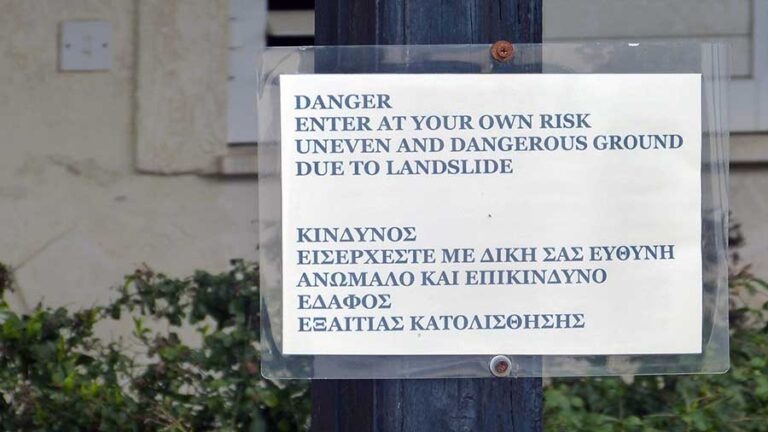
The request for payments to restart is an added pressure for owners of the homes in the development to the south west of Pissouri village proper. Some homes have virtually collapsed, the result of a continuous and accelerating landslide and have been deemed unfit for habitation. Homes, gardens and swimming pools are ripped apart, walls and driveways are collapsing, roads split, buckled and impassable.

A couple that bought their ‘dream’ home in 2014 were unaware of any problems in the area and poured all of their money into their property which they cannot live in and yet are now expected to repay their mortgage.

“We have been paying the interest only on our mortgage for the last two years and now the bank wants us to start to repay the loan. We are trying to negotiate with them now,” said the couple who did not wish to be named.

They were forced out of their home in and into rented accommodation after their home was deemed unfit for habitation as the landslide caused broken pipes to spew waste into the ground, as well as other problems.

“I have had to go back to work full time so that we can afford to rent somewhere, and we are still having to pay building insurance for the property in case there are any injuries,” the wife said.

The pair can no longer live in their three-bedroom home with its 180 degree panoramic view of the sea and mountains. It is now twisted by three metres and partially sunk due to the landslide, with a fissure in the ground behind which has forked either side of the house and affected their garden and pool.

The house itself was built on a concrete plinth which is the reason it has not broken apart, unlike older houses in the area, they said.

“We were given an eviction order, even though we spent thousands on repairs to fix problems as they arose as we wanted to stay in our home. This is our only property, and we are devastated.”

The heavy rainfall this winter has increased concerns over how the area will be further affected.

“We would like compensation to go and buy somewhere else in Cyprus where the land is safe. But we would consider staying in our home if they could stabilise everything.”

The reason for the destabilisation is the accumulation of water in the subsoil. The 2012 landslide started immediately after an extremely rainy winter of 2011-2012.

Since then, a long process of engineering studies and battles over who bore responsibility for building on the site has ensued with various vague promises of compensation. At least three interior ministers have become embroiled in the dispute which has also been discussed in the House of Representatives.

In 2015, several property owners came together to form the Pissouri Housing Initiative Group (PHIG) with lawyer Georgia-Elina Zoi representing some of the owners.

She wrote to Interior Minister Nicos Nouris in January, and one point raised noted that since the borrowers cannot pay both the monthly loan instalment and the monthly rent which they were forced to pay, due to their inability to stay in their homes, loans have been suspended.

She pointed out that it may be possible, with the stabilisation of the ground and the restoration of the area, that some residents may be able to return to their homes and repay their loans normally.

Only some of the 22 buildings have irreparable damage, she said. Most buildings are unsuitable because they have been disconnected from utilities (water, electricity, telecommunications) and the destruction of the surrounding area, not the building itself. The owners will be able to return and repair properties after the completion of stabilisation work, so they will not lose their property. This would dramatically reduce their financial losses.

“However, banks are interested in knowing the work schedule so that they know when their customers will be able to start repaying their loans again,” she said.

In addition, immediate measures need to be taken to pump out the water that accumulates due to heavy rainfall, so as to protect the infrastructure and properties that have not been damaged so far and can be repaired, she said.

The ongoing works started on January 27 and will take seven months to complete, and include the construction of a long pile wall at the top of the landslide area. It aims to protect the area outside the landslide but she said it would do nothing for stabilizing the affected area.

“It seems that the government is just trying to prevent the expansion of the problem on the hill at the north and west of the landslide area,” she said.

This winter, part of the village proper has also been affected and two houses have received an evacuation order, she said.

In his reply to Zoi, the minister said that work was underway in the area and, “at the same time, the preparation of tender documents from the Department of Public Works for the construction of an embankment, which will be the counterweight for holding the instability at the foot of the landslide. The announcement of the tender by the Department of Public Works is expected to be done after the summer season and the duration of the project is expected to be two years.”

He added that 22 private buildings in Pissouri were deemed unsuitable for habitation and therefore the state, for humanitarian reasons, decided to fund relocating them to a safe place. Finding another home for relocation is the responsibility of the residents, to whom one-time financial assistance has been granted, by decision of the Council of Ministers.

However, the lawyer noted that she has asked for clarification over this reference to a ‘one-off payment’, which she described as confusing, as no such financial assistance has been forthcoming. Instead, the Council of Ministers decided to grant an annual ‘favour’ payment in December towards rent of around €1,800 a year.

“I’m afraid the banks will not agree to a loan suspension if their borrowers receive compensation from the state to relocate and will never return to the home for which they took the loan, so this needs clarification.”

Some Pissouri residents are sceptical at the government’s plans to stabilise the area anyway, noting that the land slide has been ongoing for around 10 years, and that it would take at least that amount of time again to stabilise it, and that the necessary pumping of water has not even begun yet.

“Nothing has been fixed yet and it is short sighted to think it has. It will take a good few years to see if the area can be stabilised and the ground will continue to move for some time after water has been pumped from the area,” said resident Simon Carroll, who also has engineering experience.

Along with his wife, the home owner has yet to receive an order to vacate and would refuse to do so anyway.

The couple’s four-bedroom home complete with a ‘granny flat’ was once a million euro property, he said, but now patios are lifting and dropping and one corner of the house has a tilt of around three percent, which means a ball, if dropped, will roll to that side of the house. The driveway is collapsing, and the first crack has appeared inside the property, in an unused spare room where daylight is now visible.

He will repair it and complained about the lack of information that is being passed on to residents by the authorities.

“I am not convinced that this ‘stabilisation’ plan will work, however we want to stay until they make an offer, but there has been no mention of compensation yet,” he said.

Record property sales for a second month

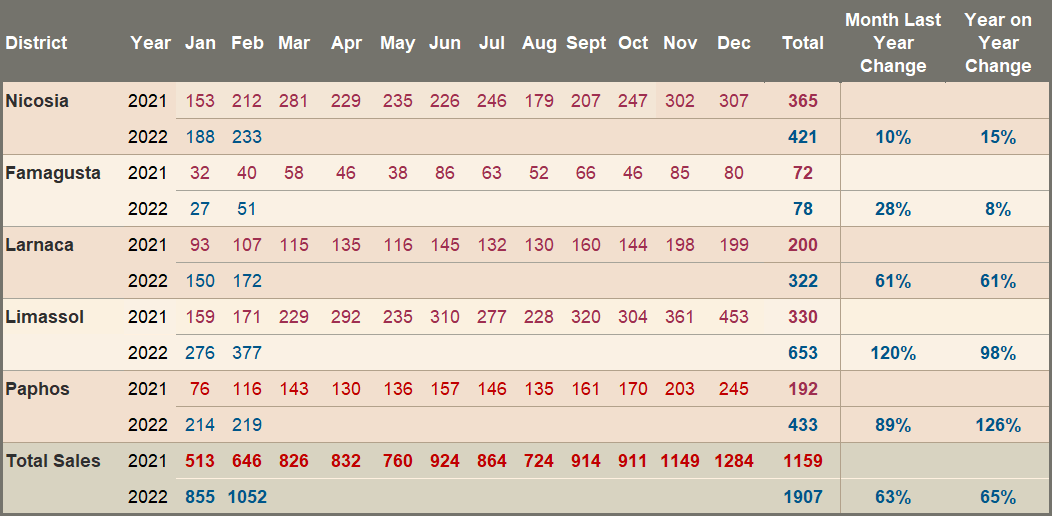
February saw Cyprus achieving a record number of property sales since 2008 for a second consecutive month according to official statistics from the Department of Lands and Surveys.

The total number of property sales (as measured by the number of contracts deposited at Land Registry offices) in February 2022 rose 62% compared to February 2021. This is the highest February figure since 2008.

These contracts will have included houses, apartments, commercial buildings and land.

Limassol led the way in percentage terms with sales up 120% compared to February 2021. Limassol was followed by Paphos, Larnaca, Famagusta and Nicosia.

Total property Sale Transactions – 2021/2022 Comparison
Total Property Sale Transactions – 2021/2022 Comparison

Sales during the first two months of 2022 reached 422, an increase of 65% compared to the same period last year.

Looking at each market segment:

Domestic property sales

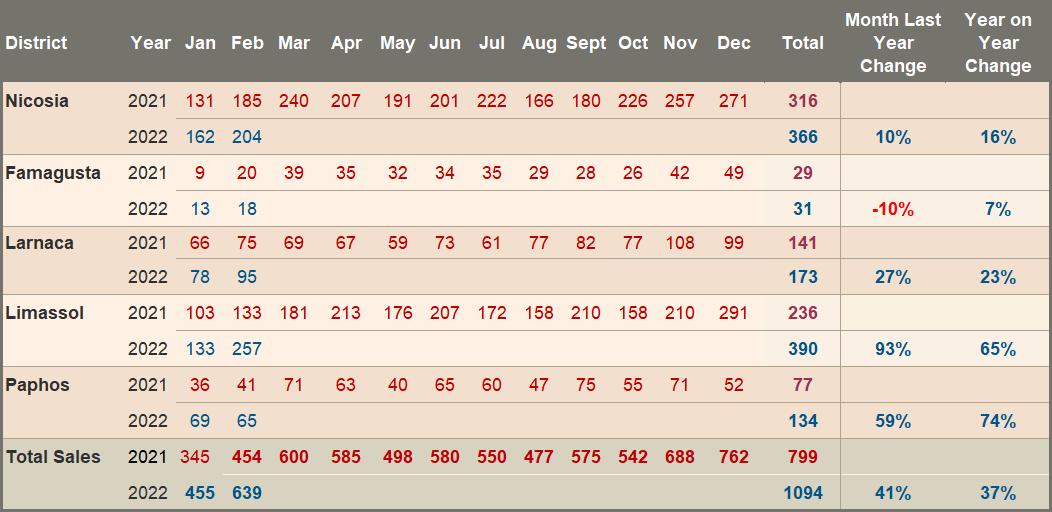
Domestic sales rose by 41% compared to February 2021, with sales rising in all districts with the exception of Famagusta.

Once again, Limassol led the way in percentage terms with sales up 59% compared to February 2021. Limassol was followed by Paphos, Larnaca and Nicosia.

Domestic property Sale Transactions – 2021/2022 Comparison
Domestic Property Sale Transactions – 2021/2022 Comparison

Sales to the domestic market in the first two months of 2022 reached 1,094, an increase of 37% compared to the same period last year.

Note that the figures include an unreported number of ‘non-sale’ agreements such as loan restructurings, recoveries and debt-to-asset swaps agreed between the banks and defaulting borrowers in efforts by the banks to reduce their non-performing loan portfolios. Unfortunately, the Department of Lands & Surveys doesn’t record these separately.

As it may take 2 or 3 months to process applications, the numbers are likely to include a number of subsidised purchases through the government scheme that concluded at the end of 2021. The scheme provided an interest subsidy of 1.5% for a period of four years for loans not exceeding €400,000 for house purchases.

Foreign property sales

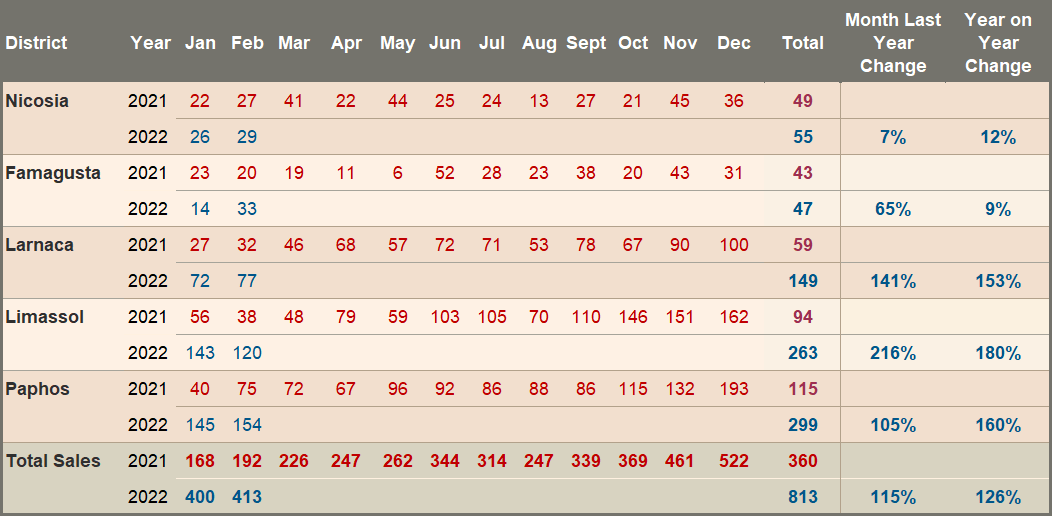
Property sales to foreigners (non-Cypriots) also performed well with sales up 115% compared to February 2021 with sales rising in all districts and the highest number of February sales since 2008.

In percentage terms, Limassol led the way with sales up 216% compared to February 2021. Limassol was followed by Larnaca, Paphos, Famagusta and Nicosia. However, the largest number of properties were sold in Paphos.

The interest shown by foreigners in buying property is Cyprus has improved following the relaxation of many COVID restrictions as more are now able to visit the island. Cyprus recently announced that travel restrictions will be further relaxed for travellers who have been fully vaccinated against the COVID-19 disease. In a statement the authorities said:

“Travellers who can prove that they have received all necessary doses of an authorised vaccine or they have recently recovered from COVID-19 will not be required to undergo any tests to visit Cyprus, irrespective of colour-categorisation of their country of departure.”

Foreign Sale Transactions – 2021/2022 Comparison
Foreign Property Sale Transactions – 2021/2022 Comparison

Sales to foreigners in the first two months of 2022 reached 813, an increase of 126% compared to the same period last year.

Foreign sales (EU nationals)

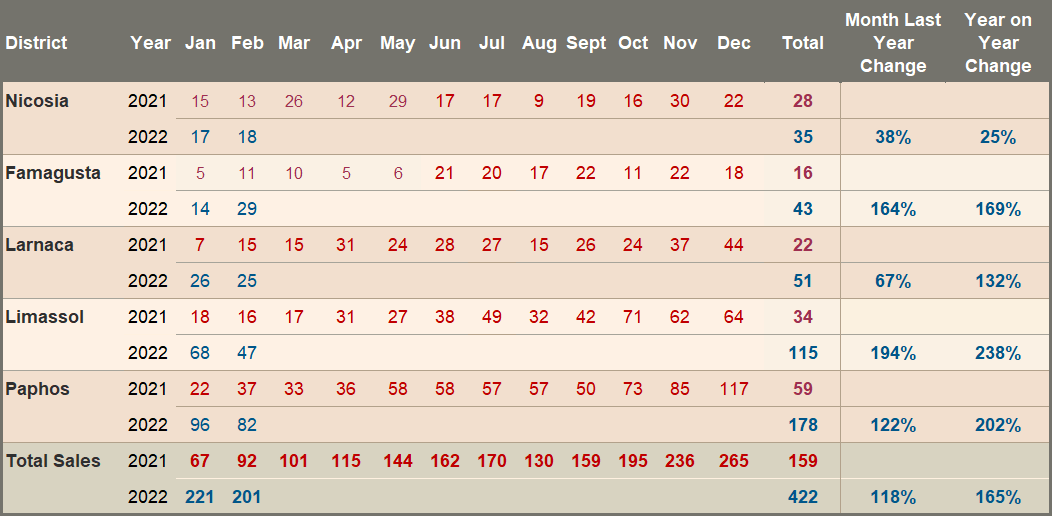
Foreign sales to EU nationals performed well with sales up 118% compared to February 2021 with sales rising in all districts. Once again Limassol lead the way with sales up 194% compared to February 2020. Limassol was followed by Famagusta, Paphos, Larnaca and Nicosia. Once again, the largest number of sales were in Paphos.

Foreign (EU) Sale Transactions – 2021/2022 Comparison
Foreign (EU) Property Sale Transactions – 2021/2022 Comparison

Foreign sales to EU nationals in the first two months of 2022 reached 422, an increase of 165% compared to the same period last year.

Foreign sales (non-EU nationals)

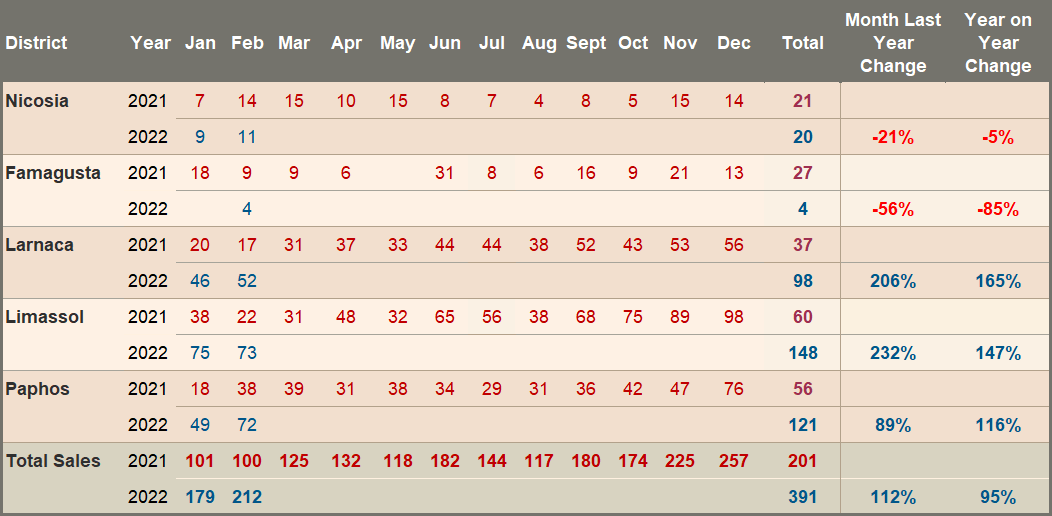
Although sales to non-EU nationals were up 112% in February 2022 compared to the same month last year, it was a mixed picture with sales falling in both Famagusta and Nicosia.

However, sales in the three remaining districts (Limassol, Larnaca and Paphos) more than compensated for the drop in sales in the other two.

Foreign (non-EU) Sale Transactions – 2021/2022 Comparison
Foreign (non-EU) Property Sale Transactions – 2021/2022 Comparison

Sales to non-EU nationals in the first two months of 2022 reached 391, an increase of 95% compared to the same period last year. With the exception of Famagusta and Nicosia, all districts saw a rise in sales.

The future of sales to non-EU nationals is likely to waiver in light of the EU shutting down EU airspace for Russian-owned, Russian registered or Russian-controlled aircraft as a consequence of Vladimir Putin’s invasion of Ukraine.

Cyprus agreed to follow EU policy and imposed the shutdown. However, as Turkey has refused to follow the EU’s lead, Cyprus may review its decision to follow the EU’s policy according to local media reports.

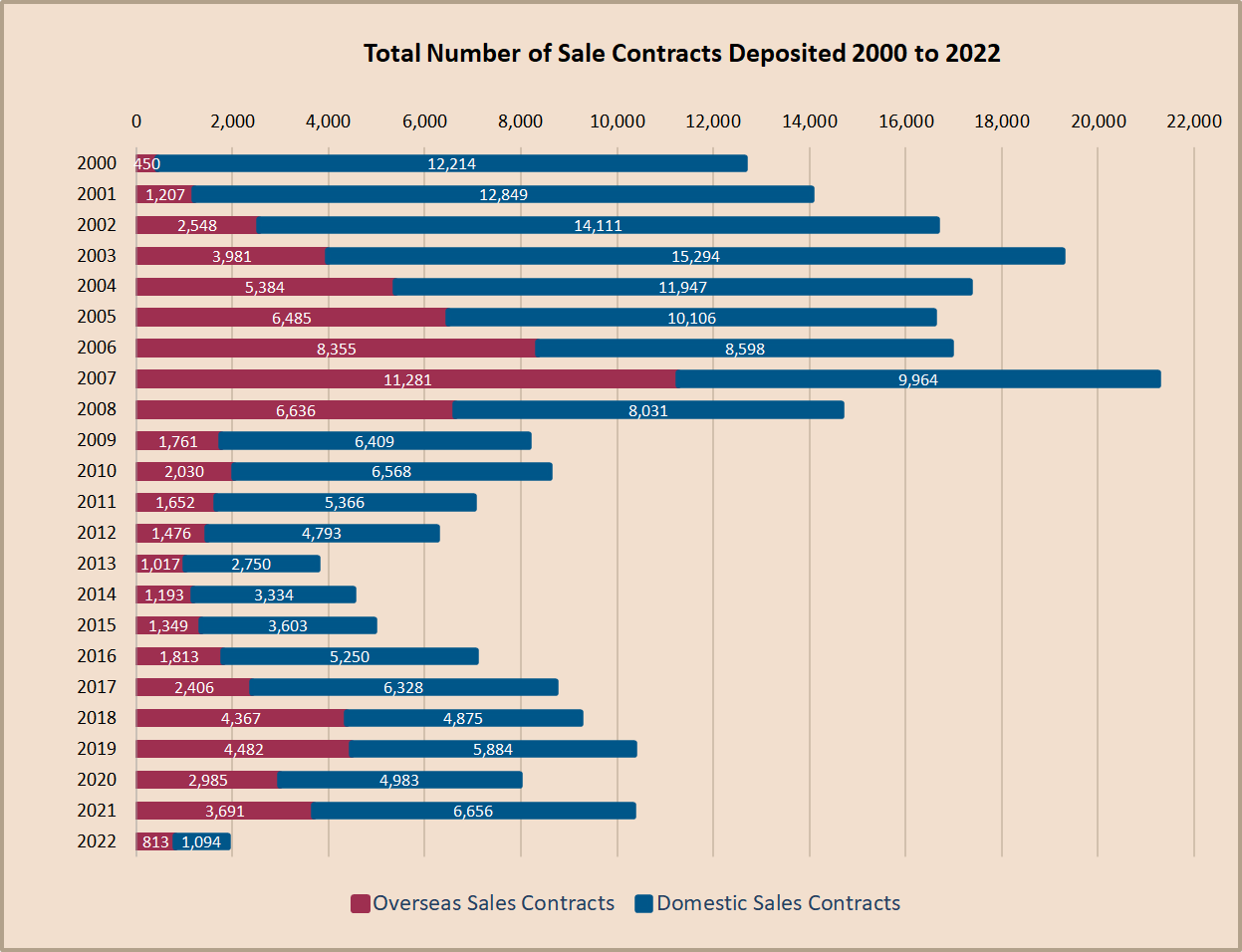
Cyprus property sale transactions 2000 - 2022


Rising prices are a challenge for everyone

1

The steady increase in property prices is a serious challenge that has not been adequately addressed by the state, Founding Director of Limassol property developer Imperio and Deputy Chairman of the Land and Building Developers Association, Yiannis Misirlis said.

At least four to five years are needed to stabilise both property prices and rent levels, he added. This is why it is imperative that the government offers a few incentives to reverse the continuing trend of low supply. In this way, Misirlis stressed, the current increased demand will be adequately covered, leading to a stabilisation in property prices.

Based on official government statistics, apartment prices have been increasing over the past few months. Why are apartment prices rising at a higher rate than houses?

The increase in the prices of apartments is a major challenge, especially for young couples. To find solutions, we need to explore this issue in depth, focusing on the real reasons behind the sharp increase in prices.

The recent report of the Central Bank of Cyprus (CBC) on the house price index, as well as articles that attempt to analyse some aspects of the problem, identify only a few of the ways in which it could be addressed, such as monitoring the continuously increasing prices of construction materials globally.

However, perhaps the most important, yet often neglected, factor that contributes to the increase of prices is the reduced supply of suitable properties. For years, the supply of apartments has been lower than demand, and this situation is not expected to improve any time soon. On the contrary, it is safe to say that supply will drop even more over the next three to four years, as developers are putting off new projects.

How can we solve the issue of rising prices?

In the long run, the market tends to correct itself. This however, requires the existence of favourable conditions. And this is where a low level of state intervention could come in to correct any distortions.

Take Limassol for example, where rent prices have skyrocketed in recent years. And since the CBC likes to compare price growth rates with the average GDP growth rate of the Cyprus economy, it is worth pointing out that rent prices outpaced the country’s GDP growth rate in the last five years.

The market will correct this distortion in the long run. However, given the small size of the market, it may take another four to five years to achieve the desired level of rental prices. Until then, tenants will continue to be victimised by paying high rents. That is why the state must intervene, until rents are stablised by the market.

What initiatives should be taken by the state in this direction?

It is extremely important that the private and public sectors work together to create the proper conditions for the consolidation of the real estate, and ensure there are enough affordable properties on the market, as well as the right financing conditions, so that home ownership does not become the privilege of the few.

The state should start offering incentives that will encourage and allow the private sector to deliver more properties that are now in high demand, such as apartments. Increasing the supply of apartments will also help solve the problem of high rents.

The proper conditions must also be created for the rental market, to favour the penetration of institutional real estate investors – something that is missing from the Cypriot rental market, compared to other countries.

Institutional investors should be incentivised to invest in a large number of apartments, with the obligation to subsequently make them available to the rental market, thereby solving the problem of high rents.

Supporting new buyers

Misirlis also stressed that Cyprus’ home ownership rate is quite low compared to other European countries.

He pointed out that new buyers should be supported with the right initiatives, such as creating the required supply that will make homes and apartments affordable, so that acquiring a home is not out of reach for them. “For these reasons,” he added, “at the Land and Building Developers Association of Cyprus, we have already repeatedly said that the real estate sector is one of the most highly taxed of the economy.

“Today’s real-estate market, amid an environment of high prices of construction materials and limited supply of homes, cannot handle the introduction of any new taxation. On the contrary, Millennials and young buyer-occupiers should be given special tax breaks to be able to jump on the home-ownership ladder. We must find ways to create more home-owners and less tenants”.