Property sales bounced back in November

0

Property sales bounced back in November following a fall of 14% in October compared to the same period last year, with the number of sales rising in all market segments.

According to the statistics published by the Department of Lands and Surveys, sales in November rose 59% compared to November 2020, while sales during the first 11 months of 2021 are up 25% compared to the same period last year.

Domestic property sales

Sales to domestic market, which accounted for 60% of sales in November, rose 49% compared to November 2020. In percentage terms, Paphos led the way followed by Limassol, Famagusta, Larnaca and Nicosia.

Sales during the first 11 months of 2021 are up 31% compared with the same period last year, with the number of sales rising in all districts

Sales to the domestic market have been encouraged by the government’s interest rate subsidy scheme, which will continue until the end of 2021. The ceiling for loans for house purchases was raised from €300,000 to €400,000 in February and the scheme provides an interest rate subsidy of 1.5% for a period of four years.

However, bear in mind that the figures include an unreported number of ‘non-sale’ agreements such as loan restructurings, recoveries and debt-to-asset swaps agreed between the banks and defaulting borrowers in efforts by the banks to reduce their non-performing loan portfolios.
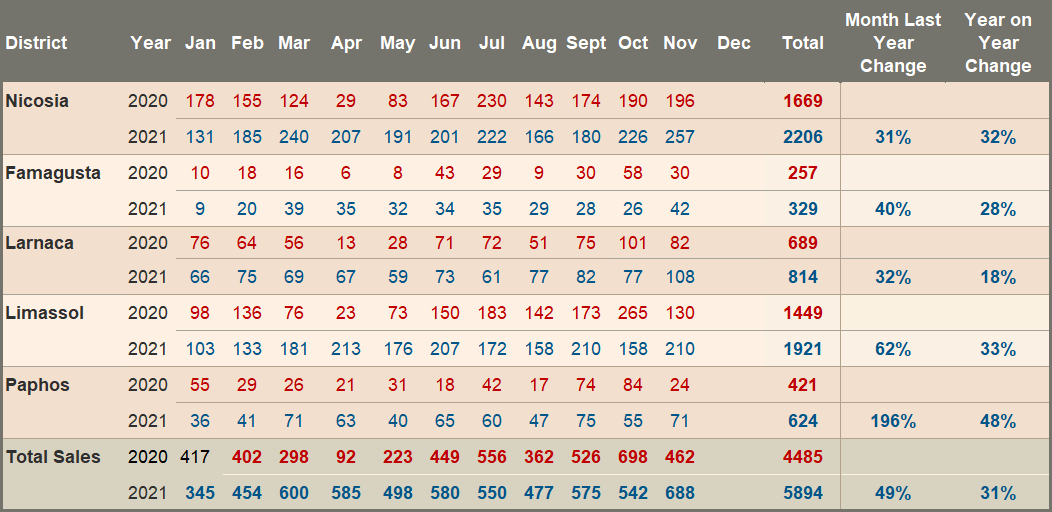
Domestic Property Sale Transactions - 2020/2021 Comparison
Domestic Property Sale Transactions – 2020/2021 Comparison

Overseas property sales

The total number of sales to non-Cypriots, which accounted for 40% of all sales in November, rose by 77% compared to November 2020. In percentage terms, Larnaca led the way followed by Nicosia, Famagusta, Limassol and Paphos.

Sales during the first 11 months of 2021 are up 15% compared to the same period as last year. Although sales in Paphos have fallen 4%, they have risen in the remaining four districts.

Total Foreign Property Sale Transactions - 2020/2021 Comparison
Total Foreign Property Sale Transactions – 2020/2021 Comparison

Sales to EU citizens

Sales to the EU segment of the overseas market, which accounted for 21% of all sales in November, rose 90% compared to November 2021 and by 89% compared to the pre-COVID November 2019.

In percentage terms, Larnaca led the way followed by Limassol, Nicosia, Famagusta and Paphos.

On an annual basis, sales to EU citizens have risen 53%, with the number of sales rising in all districts.
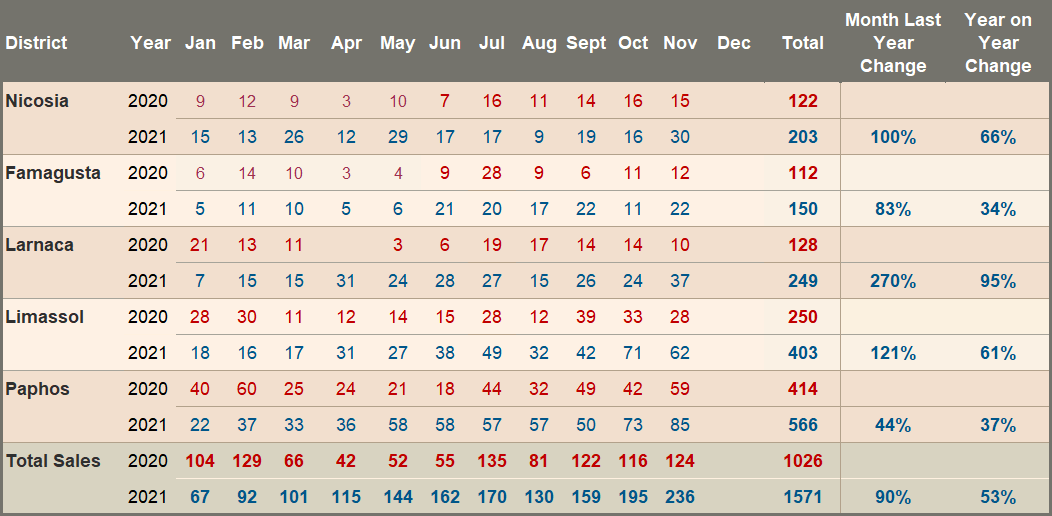
Foreign (EU) Property Sale Transactions - 2020/2021 Comparison
Foreign (EU) Property Sale Transactions – 2020/2021 Comparison

Sales to non-EU citizens

Sales to the non-EU segment of the overseas market, which accounted for 20% of all sales in November, rose by 76% compared to November 2020.

In percentage terms, Larnaca led the way followed by Nicosia, Famagusta, Paphos and Limassol.

On an annual basis and despite the abrupt termination of the Golden Passport scheme, sales to non-EU citizens have risen 51%. However, while sales have risen in Nicosia and Larnaca – and remained steady in Limassol, Sales in Paphos and Famagusta have fallen.

Foreign (Non-EU) Property Sale Transactions - 2020/2021 Comparison
Foreign (Non-EU) Property Sale Transactions – 2020/2021 Comparison

Year-end projection

Statistics published by the Land Registry Department reveal that the number of property sales contracts deposited reached 9,063 during the first 11 months of the year, compared with 7,231 in the same period last year and 9,456 in 2019.

Compared to the first 11 months of pre-COVID-19 2019, sales this year are down 4%, and it seems likely that the total number of sales by the end of this year may be very close to the 10,366 achieved in 2019.

Total Number of Sale Contracts Deposited 2000 to 2021

Two Limassol towers post-golden passports

0

Limassol is still seeing high-rise projects preparing to take off the ground, despite Cyprus’ golden passport scheme’s demise that put some luxury towers on ice.

The island’s environmental body has given the all-clear to two high risers reaching 81 metres and 75 metres added to the coastal city’s skyline.

One of the projects by CYAGAMA LTD concerns the construction and operation of a residential development named “Westminster Residences” in Yermasoyia.

The main building includes 17 floors with apartments, a roof garden with a swimming pool, a semi-basement area with a gym, a hammam facility, changing rooms, and 44 parking spaces.

The two other buildings will be 18 metres high, including four floors with apartments and two outdoor swimming pools on the third and fourth floors.

Developers are targeting locals and foreign investors, arguing that the project will add value to the area.

The environmental department noted that no Special Protection Zone or Site of Community Importance is located near the plot.

The nearest corridor – passage for migratory wild birds is located 475m west of the project area, while the nearest protected area is the Limassol Forest at 4.5 km north.

The second project, called “Clelia“, is located in the municipality of Agios Tychonas and includes a modern and luxurious, purely residential building of 19 floors, with underground private parking.

The development will be about 75.3 metres in height and include a private pool and gym.

It will consist of 26 residential units and 41 parking spaces.

However, as noted by the environmental department, this project may run into unexpected difficulties, as it notes that the location could contain artefacts, as the ancient site of Amathus is not far away.

Therefore, a condition was added that the department of antiquities would be monitoring the construction of the project to avoid altering the possible discovery of cultural and archaeological heritage elements.

Limassol was the darling of foreign investors eyeing a Cypriot passport through the citizenship for investment scheme.

But since the scheme’s demise in November 2020 due to corruption claims, some high-rise projects have been suspended or shortened.

License to rent your property Q & A

2

The article I published on 24 November ‘How to get a license to rent your property‘ raised a number of questions from readers regarding the law for those wishing to rent their property as self-catering accommodation and short-term holiday rentals to obtain a license.

Once again, I’m grateful to Lyn Hill (who has obtained a license to rent his apartment in Paphos) and his legal team for answering the following questions:

Q. Does the legislation draw a distinction between short and long-term rentals? If it does where is the line drawn? To me this would be difficult, if the answer is that there is no distinction then so be it.

A. There is no clarification as to the amount of time that a property can be rented. However, the legislation for self-catering accommodation refers to short term stay and anything other than that, for example permanent residence, does not fall within the scope of the Law N.34(I)/2019. If the intention of the tenant is to use the property as their residence until they find another property, then different provisions of another Law apply.

Q. Does the legislation apply to owners of Self-Catering accommodation in Cyprus regardless of their nationality?

A. Yes, that is correct. The Law applies irrespective the nationality of the owner of the property.

Q. The legislation is intended to regulate accommodation occupied by tens of thousands of foreign holiday tourists who visit Cyprus each year. But was it intended to apply to the likes of:

  • A Cypriot couple staying in Self-Catering accommodation whilst the save to buy their first home?
  • Individuals staying at student lets whilst studying for their degree?

It seems to me that the answer may depend on the nature of the letting/the reason for occupation but we are not sure.

A. Yes, that is correct. The intention of the tenant is important here. For example, if a couple rents a property on an annual basis to use it as their permanent residence, then a different law applies.

Q. Take the situation where a person has eleven properties that are all rented long term. The answer to the first two points above will influence the answer to this question. But from a legal point of view all eleven would be classified as a unit so would need to be registered rather than a block registration for all properties?

A. If they are rented for touristic purposes then yes, the license for self-catering accommodation is required.

Q. There is also ‘spitaki’ to consider – the small house people build within the boundaries of their property for their children and newly-weds. Once the children leave, can the ‘spitaki’ be rented without the need for a license?

A. The answer it that the Law for Self-catering accommodation does not apply here since it needs to be independent premises for the provisions to apply. For example, a different electricity supply etc.

Q. Can I apply for a license on the Internet or do I have to apply by post?

A. Yes, you can apply for a license to rent your property online. You will find details of the application process, the information required and the application form at Grant of Special Label and Registration Number for Self-Service (Sharing Economy) Accommodation Establishments.

Is now the right time to sell your property?

0

We frequently get asked this question around this time of year: Is now the right time to sell?

An optimal time to sell a property is when there is an increase in demand, record sale prices, interest rates are low and there is a shortage of properties available for sale on the market. Right now, we are experiencing all of those conditions. However, those conditions might be starting to change.

Here, are 3 aspects that sellers in 2022 should strongly consider.

Supply is lower than ever but this trend is temporary

This means buyers have less options to choose from, which creates more competition among them, resulting in a higher price for your home. Currently, the lack of supply has been a major driver of the stable price growth we’ve seen this year across the European and Cyprus real estate market. However, this trend won’t last for long for three reasons.

Firstly, When COVID-19 hit, the Cyprus government issued and extended a moratorium on foreclosures up to 31/10/2021. For this reason, very few foreclosures have been taken place, even less than usual. As this comes to an end, both covid and pre-covid pending foreclosures will take place. This will cause higher number of available properties for sale, lower asking prices – lower values, or at least a downwards pressure.

Secondly, the Cyprus average monthly earnings are expected to show muted increases whilst coincide with considerable higher cost of living. Apparently, a downwards pressure on the real purchasing power is anticipated in the coming years. By following this trend, property owners will have a higher motivation than otherwise to liquid their assets.

Thirdly, new construction has been declined and stalled in 2020 for many reasons. However, in 2021 and despite the unprecedented rise of construction materials it is expected that the permits for the number of new homes are about to increase by the end of the year, on a year-over-year basis, at around 10% – 15%. This means that by early to mid-2022 we are most likely going to experience an increase in the supply of new properties compared to the last year, at least.

Finally, baby boomers (ages of 58-75) is a big share of existing home owners. Hence, over this decade many of those will be passing away, moving with relatives or will actively need to downsize to other smaller and more suitable retirement homes. Progressively, the result will be more homes than usual will be entering the market each year. However, it is worth to highlight that this will create an over-demand for smaller properties as millennials opting for smaller homes.

Rising interest rates and worsening of affordability will push some buyers out of the market

The ultra-low interest rates make the cost of mortgage payment to ‘‘look’’ relatively low and the house prices to feel more affordable than otherwise. However, once the mortgage rates increase – and it’s not a matter of if, it’s a matter of when; the number of potential buyers will be reduced significantly since the cost of mortgage will increase progressively.

In the meantime, considering real estate prices are slow to react to new market conditions, the prices will continue to increase and thus cause a further deterioration on housing affordability. Nevertheless, the rising house prices require bigger down-payments; which means that even some of those who might be able to afford the mortgage payments are unable to qualify for a mortgage in the first place. This, in combination with the anticipated increase in the cost of borrowing (via the higher interest rates) will result to a considerable reduction of the mortgage applications.

Slowdown in property sales for 2022

The total number of property sales during 2019 was the highest on record since 2008 with sales rising in all districts. By the end of 2021, sales are expected to reach and nearly exceed the level of 10,000. This amount is nearly equivalent with the sales of 2019 which were 10,366 in total. It needs to be highlighted that the year of 2019 was the last active year for the citizenship by investment programme. Therefore, the number of sales at the moment are already quite high considering the adversity and restrictions of the global pandemic. Within 2022, the number of sales is expected to cool down; as affordability is worsening, interest rates are about to increase and supply is expected to grow.

The decision to sell a property is always personal and complicated. Coronavirus has only added another layer of complexity. Yet, for making better decisions one needs to always consider the prevailing and projected market conditions.

About the author

Charalambos Pitros holds a PhD in Real Estate Economics and is a Member of the Royal Institution of Chartered Surveyors (MRICS) and of the European Real Estate Society (ERES). He is a Lecturer in Real Estate at AUCY and a Chartered Surveyor Valuer at Zyprus Property Group – Property Valuers & Estate Agents.

Property prices still at pre-2008 levels

0

Property prices in Cyprus have bounced back by 87% compared to the first quarter of 2008, according to a recent report by the rating agency DBRS.

Real estate values have been climbing slowly, after declining since the 2008 global property crisis.

DBRS assessed the property markets in Cyprus and another five countries, Spain, Ireland, Italy, Greece, and Portugal, in a recent report.

After the first quarter of 2008, all six countries experienced a decline in property prices, with Ireland recording a sharper drop at around 46.0% in 2013, compared to the value of properties in Q1 2008.

However, Ireland has recorded a significant recovery since then, reaching 87% of 2008 price levels.

Property prices in Spain have gradually recovered to around 85% after dropping to 63.4% in 2014.

The drop in property prices in Italy slowed from 2011 onwards, reaching its lowest ebb in 2019 at 82%.

Since then, it has gradually improved to about 86% of 2008 Q1 prices.

Greece and Cyprus followed a similar trajectory with a continuous and gradual decline, reaching 58.0% and 70.7% compared to the value of Q1 2008, respectively, by the end of 2016 beginning of 2017.

The property market in Greece has recovered 69% of the lost ground over the 13 years, and Cyprus has done better with 87% compared to Q1 2008, according to DBRS.

Portugal has recorded the highest rebound, as prices are actually higher now than in 2008, reaching 148.8% of what they were in 2008.

DBRS also touched on banks’ exposure to Non-Performing Loans (NPLs) against toxic real estate assets in these six countries.

The majority of the non-performing loans in Cyprus, Greece and Ireland are backed by real estate, unlike Italy and Portugal.

Businesses took out the majority of NPLs in Italy and Portugal.

Trapped property buyers protection extended

By unanimous vote, parliament on Thursday passed a law extending to the end of 2022 the protection afforded to ‘trapped’ property buyers.

It means the protection now applies to buyers who filed a sales contract to the land registry pursuant to a court order issued after December 31, 2019, based on an application filed with a court prior to December 31, 2022.

The legislative proposal was tabled by Disy MP Nicos Tornaritis.

In a bid to sort out the so-called trapped property buyers mess, back in 2015 parliament passed a government bill granting the head of the land registry the authority to exempt, eliminate, transfer and cancel mortgages and or other encumbrances, depending on the case and under certain conditions.

The law sought to resolve the problems created by the failure to issue title deeds to people who had paid for their property, either because the property was mortgaged by the developer, or the state could not go ahead with the transfer because of outstanding taxes.

Since developers’ land and buildings were counted as assets that need to be offset against their debt to banks, this gave lenders a claim on people’s properties that had been mortgaged by developers.

But following a string of court decisions in cases where banks objected to the law, the land registry suspended procedures, as authorities contemplated their next move.

In July 2018 banks and the legislature struck a gentlemen’s agreement aiming to resolve the matter. In exchange for MPs approving legislation making it easier for banks to collect their dues, the banks association agreed not to raise any objections over the issue of buyers trapped without title deeds as long as the transaction was done in good faith.

Speaking in parliament on Thursday, Akel deputy Aristos Damianou called on banks and “their bigshot lawyers” to stop hindering the legal rights of trapped property buyers.