How to get a license to rent your property

8

Renting your property in Cyprus is a good way to earn money while you’re not using it, but a law that came into force in January 2020 requires those wishing to rent their property as self-catering accommodation and short-term holiday rentals to obtain a license.

The new law 9(I)/2020 amended the current ‘Law on the Regulation of Establishment and Operation of Hotels and Tourist Accommodations of 2019 (N. 34(I)/2019)’ and is designed regulate the operation and licensing of Self-Catering Accommodation in Cyprus.

The process of obtaining a license is relatively straightforward and I am grateful to Lyn Hill, who has obtained a license to rent his apartment in Paphos, for the following article in which describes the process:

Dear Property Owner

There is a new Law for renting property in Cyprus. It comes into force soon and at the moment it may seem all a bit overwhelming but I have just registered and obtained a license. With assistance from reliable professionals, it all went Okay and didn’t take long.

I want to share my experience with you.

Concerned or frustrated by the need to register your villa or apartment?

I would like to draw your attention to a very important development that will shortly affect you if you rent your property in Cyprus; but firstly, a brief introduction about me.

I purchased my property in 2006, I am the Chairperson of our development and over the years have dealt with numerous disputes with our developer.

I was instrumental in the highly successful Swiss Franc Campaign against the banks that resulted in substantial compensation being awarded to many owners who were encouraged to take out CHF loans to purchase their properties.

Apart from this I have devoted a huge amount of my time on the thorny issue of Title Deeds.

My personal experience of renting & how the new Law affects us all

I have rented my property in Cyprus for a good number of years and a while ago discovered that in January 2020 the Cypriot Government passed a new Law; ‘The Regulation of the Establishment and Operations of Hotels and Tourist Accommodation Law 34(1) 2019‘.

This new law is aimed, inter alia, at regulating Self-Catering property rentals. I understand that there are tens of thousands of properties in Cyprus that are currently unlicensed and not subject to any form of regulation.

A new authority, the Tourist Establishment Licensing Directorate, has therefore been set up to regulate the Self-Catering holiday market.

How to & why you must register

To be able to rent your self-catering accommodation you must complete and submit an application to register your property with the new Directorate.

For owners operating self-catering accommodation prior to the enactment of the new Law in January 2020, there is a period of grace of 2 years to register and obtain a license in order to continue renting their property.

On making a successful application you will receive a registration number along with a license. To advertise your property for rent either through one of the larger tourist companies or your property management company your unique registration number must be displayed.

For more recently acquired properties owners are required to register their properties immediately and obtain a license under the new law.

This new Law WILL be policed and fines levied

Please note that failure to comply with the new law is an offence consequently renting self-catering accommodation post January 2022 without a registration license is illegal and can result in a substantial fine being imposed.

Post COVID and getting back to normal

I was determined to continue to make best use of my property, particularly after the dreadful year we have just had as a result of COVID, so I researched the new law and its regulations but more importantly I sought advice from Christodoulos G Vassiliades & Co. LLC (CGV), the same law firm that achieved the excellent outcome in the Swiss Franc campaign.

CGV provided advice and introduced me to InterTaxAudit (ITA), a prominent firm of Cyprus accountants, together they guided me through the registration process. The application was made ‘online’, it is quite involved requiring a number of documents to be provided, the first step is to register with the Cyprus Tax Authorities and obtain a unique identity number which ITA arranged.

Once registered a submission to the Tax Authorities needs to be made each year. The application was made and in less than 3 weeks was approved. I am now in possession of a license and registration number.

The fee charged by the Ministry of Tourism was €222 and lasts for 3 years.

Reliable professionals who will help you

If your intention is to continue renting your apartment registering your property and obtaining a license is mandatory. If you want professional assistance to do this successfully, please contact Kyriakos Hadjikyriakou at ITA quoting the reference ‘LCH’.

ITA will take care of the first step which will involve registering with the Cyprus Tax Authorities, dealing with other financial issues and will work with CGV in taking you through the application process and dealing with legal issues. ITA will also provide details of the costs involved.

And don’t worry; it’s not as bad as it seems in terms of taxes & VAT!

A final word on tax issues, I am a specialist on this subject. Registering with the Cyprus Tax Authorities is mandatory, their position is that as rental income arises from immovable property in Cyprus they have taxing rights.

There is no legal argument against this but the starting point for paying income tax in Cyprus is when profits exceed €19,500 pa and the VAT threshold starts at €15,600 turnover. Should your rental income exceed these figures and you pay Cypriot tax it can be off set against UK tax liability under HMRC’s double taxation rules.

I make this point only to demonstrate registering with the Cyprus Tax Authorities is not a big issue and should not stand in the way of registering your property.

Lyn Clifford Hill
Chair Marina Hilltop Owners Association

Larnaca marina landmark for Cyprus

0

The much-awaited Larnaca marina and port €1.2 billion redevelopment will be a landmark for Cyprus, says Kition Ocean Holdings, the consortium awarded the project, calling on stakeholders to pull together.

Panos Alexandrou, the consortium’s CEO, called on all stakeholders, from boat owners to professionals in marine tourism, to join together in a spirit of cooperation to benefit the country.

Cyprus’ largest investment project will provide boat owners with upgraded services, infrastructure and increased security.

Alexandrou said the upgrade of services would result in a small increase in berthing costs “which have not been revised since 2009”.

Kition Ocean Holdings CEO pointed out the fees will be the same for all boat owners, existing and new, docking at the Larnaca Marina, explaining that the increase will be minimal.

Alexandrou said the consortium would set up berths at another location within the marina during reconstruction works regarding the mooring of boats.

It will apply to all boats, even leisure ships, which are moored on the protected dock, which will be upgraded.

Making special reference to the owners of tourist ferry boats, he indicated that they would be given a specific space for passengers to pass through the new Larnaca marina for boarding and disembarking.

“Our goal is to deliver a milestone project, which will lead to a new era of development with benefits for the economy and the society,” said Alexandrou.

It is estimated the project will generate revenues of around €12 billion for the government.

The project will create about 4,000 new jobs, calculating those directly tied to the marina operations and businesses that will open outlets in the commercial areas.

The work will be carried out in four phases over 15 years, with construction starting in 2022.

The BOT project will see the government receiving fixed rent and a percentage of the revenue through a concession agreement with the port/marina operated on a 40-year lease and the real estate acquired on a 125-year lease.

After 40 years, the port and marina can be handed back to the government.

Also, the works include the expansion and reconstruction of the existing marina to accommodate 650 boats from 5 to 150 metres long and offer facilities such as boat repair and services.

The upgraded marina will also accommodate mega yachts up to 150m.

Works include constructing the Larnaca Marina Yacht Club with offices, cafes, event venues, sailing and diving schools.

An upgraded Larnaca port will accommodate ships up to 450 metres in length, such as luxury cruise ships, energy exploration vessels, military, and other merchant ships.

Construction material prices continue to skyrocket

0

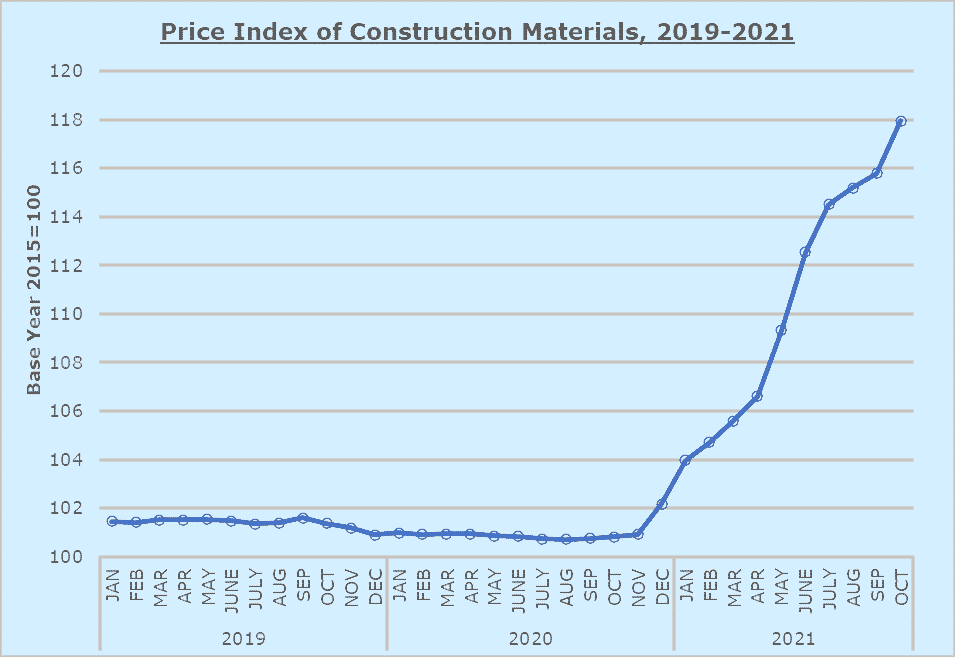
Construction material prices continued to skyrocket in October as the global economy continues to pick up in the wake of the COVID-19 pandemic causing global demand to increase.

The Cyprus Statistical Service reports that, compared to October 2020, the Construction material price index recorded an increase of 16.99%.

Compared to October 2020, increases were recorded in:

  • Metallic products (32.35%) including iron and steel (44.70%)
  • Wood, insulation materials, chemicals and plastics (17.51%)
  • Electromechanical products (11.68%)
  • Minerals (5.61%) including Cements (10.62%)
  • Mineral products (4.31%)

The Cyprus Statistical Service notes that prices of materials used in construction are collected on a monthly basis based on a sample of products and suppliers. The reference date for the prices collected is the 15th each month. Prices are valued excluding VAT. The data collection is carried out by telephone, fax or e-mail.

Prices of materials are based on actual prices rather than list prices.

Price index construction materials chartChina’s imposition of emissions-reducing limits on metal production, factory closures throughout Asia, increasing electricity and gas costs, container shortages, escalating fuel costs have all contributed to skyrocketing costs.

Construction material costs – further reading

Press release: Price Index of Construction Materials: October 2021

Inspecting resale properties – part 4

0

In the previous article I gave some advice on how to carry out an external inspection of resale properties. In this article you’ll find advice on inspecting their interior.

When inspecting the interior of resale properties, look at every room in the building. Ignore the decoration and furnishings and concentrate your attention on the fabric of the property.

  • Does the property look clean, tidy and well-cared for?
  • Check that the internal walls are flat, smooth and not cracked.
  • Check that the floor and ceiling are level.
  • Look at the wall/ceiling junctions and make sure they’re straight.
  • Check that the paintwork in the corners of the room is not discoloured or flaking (a sure sign of damp).
  • Look at the junctions between the windows and the walls; are they properly sealed? Are there any cracks at the corners? Are there any signs of dampness or water penetration?
  • Do the windows and doors fit and open properly? Have the door hinges and handles been fitted correctly? Sticking doors can be symptomatic of a cracked or deformed slab.
  • Are the windows double-glazed? Do they have insect screens? Do they have adjustable shutters?
  • Is there sufficient storage space in wardrobes, etc?
  • Check that the wall and floor tiles are level and properly grouted. Look at the way they’ve drilled the wall tiles to accept the plumbing; are the holes neat and tidy? Have they been finished off properly?
  • Check that the wall and floor tiles are not cracked. Cracks can be caused simply by dropping something heavy on the tile or can be symptomatic of movements or a cracked or deformed floor slab.
  • Do the central heating radiators have leaking taps?
  • Are there any damp or musty smells?

Inspecting water supply and plumbing

You can check some of the elements of the water supply and plumbing during your visit to the smallest room in the property. Some of the more salient aspects of the inspection are listed below:

  • Do they use copper, grey plastic or pipe-in-pipe plumbing?
  • Check the water tanks (on the roof or in the attic) and associated plumbing.
  • Are the tanks, solar panels, etc. securely fitted?
  • Do the solar panels face in a southerly direction?
  • Are there any signs of corrosion, lime scale deposits or leakage?
  • Are the hot water tank and pipes insulated?
  • Is there an immersion heater? Does it have a thermostat and/or timer?
  • Is there any protection in the event of a major leak in the roof space such as a large water proofed tray under the storage tank and run-off gullies for the water?
  • Is there a water meter on the incoming main (required by law)?
  • Is there a water filter on the incoming main (stops debris getting into the plumbing)?
  • Has a water softener been fitted (recommended to prevent pipes furring and eventually blocking, prolong life of appliances, and reducing heating costs)?
  • If there is no water softener, has a magnetic scale reducer been fitted? Although this will reduce the amount of calcium deposited in the plumbing system, it is not as effective or as long lasting as a good quality water softener.

Electrical works Inspection

Take a few minutes inspecting the electrical system and fittings. It’s quite easy to spot bodged or sub-standard work. Don’t be tempted to put your fingers into places they’re not supposed to be. You might get a bigger shock than you expected!

  • Does the property have a single or three-phase electricity supply? A single phase is perfectly adequate for apartments and smaller properties. But if it has three or four air conditioners, a single-phase supply may prove inadequate. To see which type of supply the property has, count the number of electricity supply cables running to the building. If there are two, the property is on a single phase; if there are four it’s on a three-phase supply.
  • Look inside the internal distribution and circuit breaker boxes for signs of damage and bodges. Are the electrical cables neat and tidy?
  • Are there enough switches and sockets? Do they work? Do they spark when used?
  • Are the switches and sockets square on the wall? Do you recognise the brand name or are they of the low cost unbranded variety?
  • Are there shaver points in the bathrooms?
  • Are the light fittings neat and tidy?
  • Do all the lights work?
  • Are there any light fittings in impossible to reach places?
  • Is there a telephone?
  • Is there a TV aerial and TV point(s)?
  • Is there air conditioning, does it work properly?
  • Is there a satellite TV/Internet TV?
  • Are there other items such as: a security system, electric gates, electric garage doors, etc? If so, do they all work properly?

The lists above are illustrative but not exhaustive.

I always recommend that potential purchasers should have resale properties inspected professionally by a qualified independent surveyor.


Property sales to EU nationals bucks trend

0

Further analysis of the property sales statistics (as measured by the number of sale contracts deposited at Land Registry offices) provided by the Cyprus Department of Lands and Surveys reveal that the 14% fall in sales in October was caused by a weakening demand in the domestic and non-EU segments of the market.

Of the 2,708 sales contracts involving overseas buyers in the first ten months of 2020, 1,335 were from EU buyers and the remaining 1,373 from non-EU buyers. Non-Cypriot buyers accounted for approximately 34% of total sales.

Property sales to EU Nationals

During October, sales to the EU segment of the market rose 68% compared to the same month last year.

While the number of sales in Nicosia and Famagusta remained unchanged from October 2020, they rose in the remaining three districts; Larnaca 71%, Limassol 115% and Paphos 74%.

EU property sales October 2021
Foreign (EU) Property Sale Transactions – 2020/2021 Comparison

On an annual basis, sales have risen in all districts. Sales in Paphos (35%), Famagusta (28%), Limassol (54%) and Larnaca (80%).

Sales to non-EU nationals

Property sales to the non-EU segment of the market in October fell 30% compared to the same month last year.

With the exception of Larnaca, where sales rose 13%, they fell in the other four districts; Nicosia -76%, Famagusta -18%, Limassol -28% and Paphos -45%.

Non-EU property sales October 2021
Foreign (Non-EU) Property Sale Transactions – 2020/2021 Comparison

On an annual basis, sales in Nicosia are up 16% and in Larnaca they’re up 10%. However, sales in Paphos, Famagusta and Limassol are down 38%, 22% and 4% respectively.

Domestic sales

During October, property sales to the domestic market fell 22% compared to the same month last year.

With the exception of Nicosia, where sales were up 19% compared to October 2020, the total number the number of properties sold fell in the remaining four districts; Famagusta -55%, Larnaca -24%, Limassol -40% and Paphos -35%.

Domestic sales October 2021
Domestic Property Sale Transactions – 2020/2021 Comparison

Despite the fall in during October, year-to-date sales in Paphos are up 35% followed by Nicosia where they’re up 32%. Meanwhile annual sales in Limassol, Famagusta and Larnaca are up 30%, 26% and 16% respectively compared to the first ten months of 2020.

Cyprus approves 390 extra golden passports

1

Cyprus approved another 390 golden passports applicants after the Citizenship-by-Investment scheme was scrapped in November 2020, while Brussels’ infringement procedure into the scheme continues.

Presenting his ministry’s budget before the House Finance Committee, Interior Minister Nicos Nouris said the government had approved 390 applications by foreign investors submitted before it ended on 1 November 2020.

Nouris said that until 31 July 2021, he had forwarded 1413 applications to the Cabinet, submitted through the country’s disgraced citizenship-by-investment program that stopped taking new applicants on 31 October 2020.

Nouris told MPs the 390 were approved, while some 1023 were rejected.

He said 691 were petitions by investors and 722 were from their dependants, adding that 1023 were rejected.

Asked about the EU’s infringement procedure into golden passports, Nouris said: “We have given all the explanations that needed to be given, and we expect to hear back in the coming weeks”.

In June, the European Commission sent a reasoned opinion to Cyprus for failing to address earlier concerns.

It gave Nicosia two months to explain what measures it had taken to comply with EU laws or face legal ramifications.

The European Commission stated: “While Cyprus has repealed its scheme and stopped receiving new applications on 1 November 2020, it continues processing pending applications”.

In October, the EU confirmed it had received a reply from Nicosia in the ongoing infringement procedure into the Cyprus Investment Programme and is currently assessing it.

Brussels considers that Cyprus and Malta failed to fulfil their obligations by establishing and operating investor citizenship schemes that offer citizenship in exchange for pre-determined payments and investments.

Last year, the Mediterranean island dropped the golden passports scheme after Al Jazeera aired a documentary showing reporters posing as fixers for a Chinese businessman seeking a Cypriot passport despite having a criminal record.

Parliament speaker Demetris Syllouris and an opposition MP were secretly filmed allegedly trying to facilitate a passport for the fugitive investor.

They later resigned, although both insisted they were innocent of any wrongdoing.

Al Jazeera reported that dozens of those who applied were under criminal investigation, international sanctions or even serving prison sentences.

A public inquiry found the government broke the law countless times to grant citizenship to over 6,700 people from 2007 to 2020.

The damning report said that over half (53%) of the 6,779 passports granted were done so illegally, encouraged by a due diligence vacuum or insufficient background checks.

Cyprus’ passport scheme generated over €7 billion during its lifespan from 2007.