The number of building permits authorised in Cyprus by the municipal authorities and the district administration offices during August of this year remained steady.
The August 2021 figures show that a total of 523 building permits were authorised during the month; the same number as authorised in August 2020. Their value fell 25.3% to €143.4 million and their area fell 15.3% to 124.9 thousand square metres.
The August permits provided for the construction of 554 new homes (dwelling units), a fall of 29.9% from the 790 new homes authorised in the same month last year.
The 523 building permits were authorised for the following:
Residential buildings – 350
Non-residential buildings – 85
Civil engineering projects – 28
Division of plots of land – 46
Road construction – 14
New home construction
The 350 permits for residential buildings provided for the construction of 554 new homes, comprising:
Single houses – 250
Buildings comprising 2 units – 42
Residential apartment blocks – 260
Residential/commercial apartment blocks – 2
Of those 554 new homes, 225 are destined for Nicosia, 171 for Limassol, 86 for Paphos, 56 for Larnaca and 16 for Famagusta.
Building Permits Issued for the Construction of New Homes
(Number of Dwellings)
Month
2020 (Dwellings)
2021 (Dwellings)
Increase/Decrease
%age Change
January
696
702
6
0.9%
February
680
663
-17
-2.5%
March
524
1,033
509
97.1%
April
339
955
616
181.7%
May
956
1,061
105
11.0%
June
976
998
22
2.3%
July
1,141
874
-267
-23.4%
August
790
554
-236
-29.9%
Totals
6,102
6,840
738
12.1%
Building permits: year to date
During the first eight months of 2021, 5,240 permits were authorised compared with 4,416 in the same period last year; an increase of 18.7%. The value of these permits fell 4.5% to €143.4 million, but their total area rose by 8.1% to reach 124.9 thousand square metres.
These permits provided for the construction of 6,840 new homes, an increase of 12.1% compared to the 6,102 new homes authorised in the same period last year.
According to the Cyprus Statistical Service “Building permits constitute a leading indicator of future activity in the construction sector.”
Today, I’ll move on to look at how to carry out an external inspection.
When inspecting the outside of resale properties, take time to look over any outbuildings, the boundary walls and the general site conditions:
Look at boundary walls. Check for leaning, bowing, cracking and signs of movement indicating poor construction or maintenance.
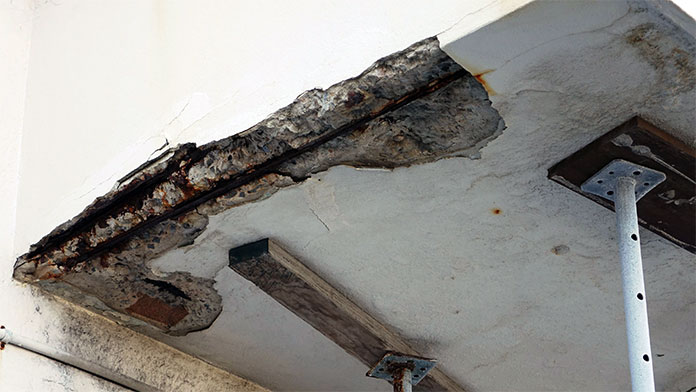
Check for exposed steel reinforcing, particularly on the roof. Exposed steel rusts, allowing water to penetrate the superstructure. As it rusts it expands, causing the concrete to crack and eventually fall away. Thoroughly examine the area around any exposed steel for cracks. (This problem, as shown in the photo above, is expensive to rectify. It requires the damaged concrete to be removed, the steel reinforcing cleaned and protected, and the surface re-rendered and decorated both inside and outside the property.)
Check external walls for any signs of dampness, such as discoloured or flaking paint, powdery deposits and mould growth. Pay particular attention to the base of the walls. (Moisture causes the majority of problems with masonry. It affects the adhesion of paint and spritz, causing blistering, flaking and mould growth. As well as being unsightly, damage to the structure of the building can occur. In extreme cases salts in the building fabric are brought forward with the moisture as the surface dries out. Although the fluffy type can be brushed off easily, it is symptomatic of more serious underlying problems that can be difficult and expensive to rectify.)
Check the finish of the walls to see if there are any large cracks.
Make sure walls and corners are straight.
Are there any disturbing smells from drains?
Check that drainage is away from the property. Low areas around properties may collect water.
Where fitted, check that gutter down-pipes have extensions or splash-blocks to direct the water away from the property and its foundations.
Check that patios, porches, balconies and driveways slant away from the property to carry away water.
Surface gradient should be highest next to the property so that water is carried away. If the plot is graded correctly, there should be no standing water in the garden or patio areas 24 hours after it rains.
Are the junctions between the walls and the windows and doors properly sealed?
If you are able, check that the foundation, ground beams and columns are free of major cracks, crumbling and signs of dampness.
Check that the visible parts of the concrete slab are free of major cracks, crumbling and signs of dampness.
Does it have a concrete roof? If so, has it been sealed?
Check the roof tiles are level and evenly laid and that the roof is not sagging. Are there any missing or broken tiles?
Check that any wood has not cracked, decayed, warped or been attacked by insects.
Check the swimming pool to make sure that the pumping and filtration equipment is in good order and that the pool is not cracked or damaged.
Check any metalwork for rust and flaking or loose paint.
Check that the external doors and gates open and close properly.
Check the electricity supply box, which is usually on one of the external walls. Is it in good condition and are its internal electrics in good order?
Check that there are no leaks from the septic tank.
Check that the garden is neat and tidy and that no trees are overhanging the roof. Note that some trees have very invasive roots and can get inside water pipes and drains causing blockages and breakages.
The list above is illustrative but not exhaustive.
I always recommend that potential purchasers should have resale properties inspected professionally by a qualified independent surveyor.
Cyprus’ golden passport scheme’s demise has put some high-rise projects on ice, while other towers have been shortened, delivering a body blow to the construction industry.
According to the news website Stockwatch, several high-rise projects in Limassol have been cancelled, or developers have altered plans, knocking off a few floors.
Limassol district municipalities are no longer seeing applications for skyscrapers once the darling of developers eyeing to sell luxurious flats to prospective golden passport investors.
The tallest project for which an application has been submitted to the Limassol Municipality is no taller than 17 floors.
All developers who have pending applications for higher rise projects along the coastline of Limassol have withdrawn their applications.
Stockwatch cited a Limassol municipality official who confirmed that no new application for a tower had been submitted in recent months.
Reportedly, developers are rethinking their projects in Limassol, once buzzing with high rise constructions.
Developers Cybarco is reviewing its large “Trilogy” project in the heart of Limassol, consisting of three towers of 36, 37 and 39 floors.
Two of the three towers are in an advanced stage, while the company has submitted a new urban planning permit, according to which the third tower will be shorter.
Pafilia Property Developers are also reportedly rethinking their plans for their Limassol Neo project, which consists of four towers, 43, 38, 31 and 25 floors.
It has temporarily been put on ice until the company decides whether it will be redesigning the project.
Reports say the developers are thinking of including a hotel and offices.
However, some projects have been completed.
According to information gathered by Stockwatch, the Olympic Residence, a complex of twin towers of 20 floors each has been recently completed after two years.
A DTA Group residential development, High Rise Apartments, with a height of 130 meters and 25 floors, launched in 2017, was completed before the demise of the investment program.
Meanwhile, in Yermasogia, developers Leptos and D. Zavos are adding the final touches on the Limassol Del Mar, covering 40,000 square metres, consisting of two towers of 17 and 27 floors.
Imperio’s The Icon project of a 21-floor tower is also in the final stages.
Prime Property Group’s Sky Tower, which consists of 23 floors at the height of 98 metres, is also close to completion.
The nearby 23-story tower of the company DTA Group, named High Life i100, is also completed, while two residential towers of the company Chr. Athanasiou are finished; one was sold to a foreign investor.
A new application was submitted to the Mouttagiaka community council by a foreign company for a 17-story building, according to Stockwatch.
Cyfield has also completed the 17-story The ARC-Ship in the community.
Meanwhile, the Four Seasons Hotel in Ayios Tychonas obtained a permit and built a 12-story building on the site.
Owners of the Mediterranean Hotel have also added a 10-floor tower to the hotel.
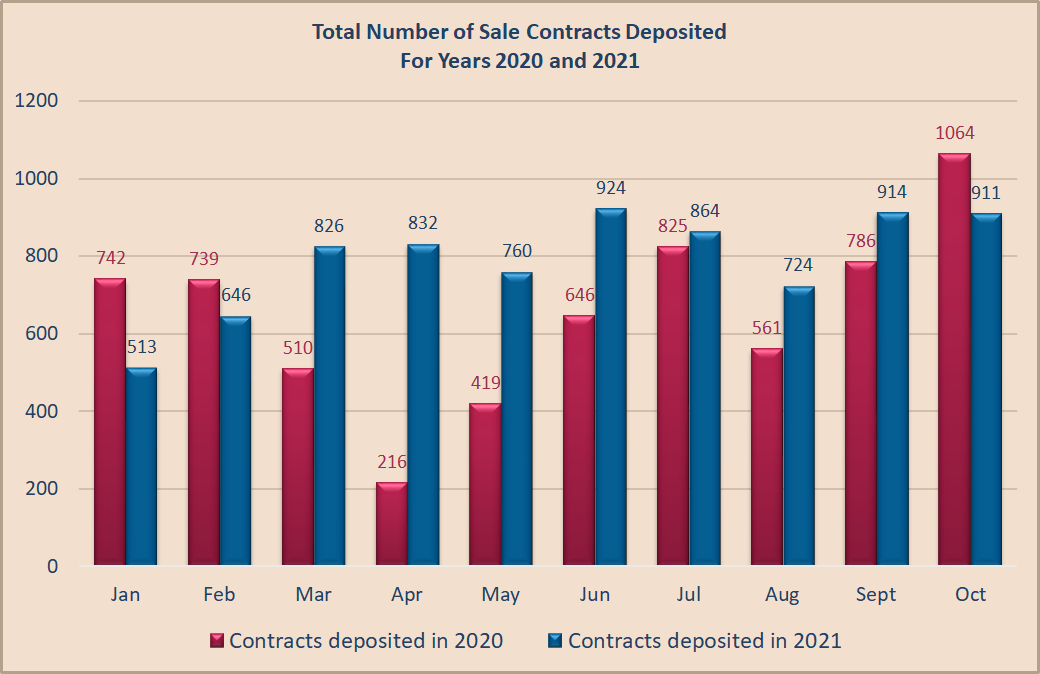
Property sales (as measured by the number of sale contracts deposited at Land Registry offices) fell in October compared to October 2020 following seven months of positive growth.
The only district that reported a rise in sales was Nicosia, the capital; up 9% compared to October last year.
Property sales in Famagusta were down 43% and in Limassol they fell by 24%. Meanwhile, sales in Paphos and Larnaca recorded falls of 16% and 6% respectively.
Overall, sales were down 14% compared to October 2020.
Total Property Sales Transactions – 2020/2021 Comparison
However, it’s not all doom and gloom. Despite the overall 14%, property sales in Nicosia during the first ten months of 2021 have increased beyond the numbers sold in pre-COVID 2019 during the same period.
As the Cyprus Central Bank noted in its Residential Property Price Index (RPPI) report for Q1, which it published last month, “Since the beginning of the pandemic, the real estate market goes through a period of adjustment, which is due, inter-alia, to the shift in the preferences of buyers and investors towards apartments or smaller and cheaper houses.”
“This mismatch is causing a significant increase in prices for specific properties, while for other types of property prices are decreasing as there is a lack of demand.”
According to WiRE FS findings, prices and transaction volume of real estate at city centres in Nicosia and Limassol remain stable, as locals, taking advantage of government subsidies, continue to acquire residential property.
Their focus is mainly apartments, mostly for homeownership but also to generate rental income.
Businesses are upgrading their office space requirements, resulting in an increase in demand for Grade A office space and a contraction across lower quality premises.
However, the other districts, specifically Paphos and Famagusta, are continuing to experience low demand levels, as they are more reliant on overseas markets and have a higher dependency on tourism.
The situation in Larnaca is notably positive, as recent changes such as the signing of the Larnaca Marina Development Project contract, removal of the oil refineries, and the attraction of Lebanese and Israelis to the city have boosted demand across all asset classes.
Commenting on the state of the real estate market, WiREs’ CEO, Pavlos Loizou, said: “There is a significant mismatch between supply and demand, which is resulting in imbalances across asset classes.
“There is significant supply of land, (dated) industrial buildings, and large houses available for sale, while demand is mainly for housing (apartments) in the city centre and good quality offices.
“This mismatch is causing a significant increase in prices for specific properties, while for other types of property prices are decreasing as there is a lack of demand.”
In a country like in Cyprus where the actual private debt is over three times the country’s GDP, it is hard for households and firms to make ends meet, let alone being able to service their existing loans.
With that as a given, the only attainable objective for banks is to seek to maximise their return by employing the recourse available to them. This translates into using all means possible to capture the collateral and guarantees of existing bad loans. In addition, they seek tax payer support with special schemes through the Government and push to promote legislation that facilitates this process of wealth extraction. This is the definition of a zombie bank.
What is zombie banking
The term “Zombie Bank” was first used by Edward Kane (Kane 1989) to explain the dangers of tolerating a large number of insolvent savings and loan associations. A zombie bank is one that cannot give productive loans and needs the support of the tax-payer to survive while engaging in asset stripping by selling the loans on its balance sheet. For this reason, the Iceland Government took control of all existing banks in 2008.
In Cyprus, the Government has taken the stance that we need to “save the banks at all costs as there is no economy without the banks”. Iceland was out of recession in 3-4 years while Cyprus is struggling and going from bad to worse.
Cyprus economy in dire straits
The reasons for resorting to zombie banking practices are many, but in Cyprus following the financial crisis in 2013 Cyprus a bank found itself between a rock and a hard place as it could not grant a sufficient amount of new viable loans with adequate repayment capability in an over- indebted economy. In particular:
there are only a few remaining potential borrowers that can be deemed credit worthy and
there is only feeble domestic demand to allow for new investment opportunities to take place.
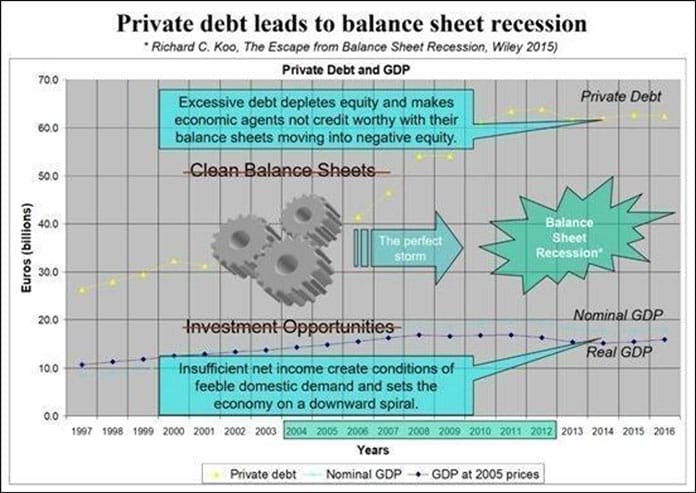
In conditions of excessive private debt, such as those that exist in Cyprus, there are very few potential borrowers who remain credit worthy so that new loans can be extended to them. Moreover, because a large part of income has to be channelled towards repayments, domestic demand suffers which, in turn, makes investment opportunities scarce and far between. This in a nutshell is the problem at the very core of the Cyprus economy. As a consequence, a bank is unable to channel back into the economy in the form of new viable loans the savings collected from repayments and which inevitably end up as excess liquidity which kept as cash balances earning mostly negative interests in Central Banks.
The problem with excessive liquidity
The excessive and dubious foreign deposits amassed by banks during the happy years for some in Cyprus (such as lawyers, accountants, developers and politicians) resulted through collateral lending in mostly unproductive debt, as illustrated in Figure 1 below.
Figure 1: Excess Deposits Translate into Unproductive Loans or costly unused liquidity
Sadly, this situation and the debt demise of the economic agents of the country, also inevitably brings about a recession. Sustained development results from the productive use of financial and other resources to create real wealth. In Cyprus, the very rapid growth of private debt and the increasingly wasteful use of financial resources has contributed importantly to calamitous events, such as the financial crisis which culminated in the infamous bail-in of 2013 and the associated recession that followed.
Many studies for advanced economies provide evidence that the fast growth of private debt leads eventually to a marked slowdown in economic growth as diminishing returns set in from the use of abundant finance (see, for example, Mian and Sufi (2014), Hudson (2012) and Vague, Richard (2014)). Most notably, Richard Koo coined the term ‘balance sheet recession’ to describe the recession that inevitably comes about from ignoring, as we now do in Cyprus, the problem of excessive private debt in an economy.
Private debt leads to balance sheet recession
As illustrated Figure 2, private debt weakens the two essential requirements necessary for an economy to grow and develop on a sustainable basis. The need for its economic agents to enjoy clean balance sheets and for having conditions that are conducive to viable investment opportunities in the real economy. This can create a perfect storm which Koo argues, results in a long and possibly deep balance sheet recession like the one Japan has experienced in the last few decades.
Figure 2: Private Debt Leads to Balance Sheet Recession
The consequence of ignoring private debt and facilitating the narrowly perceived needs of predatory investors is to create zombie banks like the ones that Cyprus ended up having. Given that these financial institutions are condemned to operate in an economy that is overwhelmed with debt, their main, and practically only, remaining purpose for existence becomes one of extracting as much as possible from the collaterals and guarantees they hold on their books. They have, therefore, transformed themselves from being providers of productive finance to quasi asset management companies or, at best, intermediaries for such companies. It should therefore come as no surprise that this process eventually leads to a huge transfer of wealth from the people at large to those who eventually buy the loans of these failing banks.
Wealth transfer rather than wealth creation
The object of the wealth transfer are the collaterals and guarantees that were acquired during the uncontrolled process of collateral lending, mainly in the years before the financial crisis of 2013 when Cypriot banks were using the billions of “imported” deposits to extend mostly wasteful loans. The measure of success for the CEOs of these banks has thus become how efficiently the banks’ balance sheets are employed for the special and possibly crony benefit of the sponsors and current major shareholders, rather than what it is the long term good for the lenders and the economy at large. They are now even charging negative interests on deposits which they have the audacity to call “parking fees”. As if a computer entry is a piece of real estate space that is used to “park” one’s money!
With the projected banner and motto put forward by the Government that “without banks there is no economy” politicians accommodate the bankers by any means at their disposal. Of course, the truth is exactly the opposite. Without viable economic conditions (one where the net worth of the people’s balance sheets is not diminished by debt) there is no role for private banks other than ripping the bank’s balance sheet. This is why in such circumstances the Government should step in to put things in order and safeguard public interest against such predator banking practices (for example in Iceland in 2008 and in England with the Royal Bank of Scotland).
Instead, in Cyprus the Government directs legislation to suit the bankers and their collaborators needs and even subjects the tax-payer to guarantee further loans and hence pick up the bill for even more wasteful debt which the banks would not have approved without the Government provided pledges. Therefore, rather than support wealth creation by funding productive projects in the real economy and with the help of the country’s elected government, these “vulture investors” have taken full control of this parasitic endeavour to extract wealth at the expense of the people and the economic agents of the country. And the government is happy to oblige.
Bibliography
Kane, Edward J. (1989). The S&L Insurance Mess: How Did It Happen?. Washington, D.C.: Urban Institute Press. ISBN 978-0-87766-468-0.
Mian, Atif. and Sufi, Arif (2014), House of Debt: How They (and You) Caused the Great Recession, and How We Can Prevent It from Happening Again. University of Chicago Press. Kindle Edition.
Koo, Richard C (2015) The Escape from Balance Sheet Recession and the Q.E. Trap, Wiley.
Manison, Leslie and Savvides, Savvakis (2017) “Neglect private debt at the economy’s peril”, World Economics Journal, Vol. 18, No. 1, January–March 2017.
Hudson, Michael (2012) “The Road to Debt Deflation, Debt Peonage, and Neo-feudalism”, Working Paper No. 708, Levy Economics Institute of Bard College.
Vague, Richard (2014) The Next Economic Crisis: Why It’s Coming and How to Avoid It, University of Pennsylvania Press.
Savvakis C. Savvides is an economist, specialising in economic development and project financing. He is a former senior manager at the Cyprus Development Bank and has been a regular visiting lecturer at Harvard University and currently at Queen’s University. Author page: http://ssrn.com/author=262460.