Home Blog Page 17

DLGOs face dealing with dangerous buildings without funding

0

The deaths of two people following the collapse of a two-storey dangerous building in Germasogeia have once again laid bare a crisis that Cyprus’ central government can no longer ignore.

What should have been prevented through proper oversight has instead become another tragic example of institutional failure. Dangerous buildings are no longer simply a matter of structural decay – they have become a symbol of state paralysis, weak enforcement and political reluctance to confront a growing public safety threat.

Two people are dead, yet the response from central government has been to distance itself from responsibility.

Government hands poisoned chalice to local authorities

In the aftermath of the collapse, the Ministry of Interior Cyprus has pointed to existing legislation, claiming it does not have the authority to intervene directly in dangerous building cases.

Instead, responsibility has been pushed onto District Local Government Organisations (DLGOs), many of which say they were handed enormous responsibilities without the funding, staffing or legal powers needed to carry them out.

The arrangement has sparked outrage among local officials, who argue they are being forced to act as the government’s frontline emergency service while being denied the resources to do so.

Under current rules, DLGOs are expected to pay upfront for emergency demolitions or structural repairs and then attempt to recover the costs from property owners later, often through lengthy and expensive legal battles with no guarantee of success.

For many local authorities, that is financially impossible.

They warn that diverting already stretched budgets to emergency building work risks undermining essential public services, while central government continues to stand on the sidelines.

A system designed to fail

The current framework is riddled with fragmentation and bureaucracy.

Licensed engineers inspect buildings. DLGOs determine whether they are officially dangerous. Municipalities issue separate suitability certificates for buildings used by the public.

The result is a slow-moving bureaucratic maze where responsibility is spread across multiple agencies, but accountability remains elusive.

When systems are this fragmented, dangerous delays become inevitable – and in some cases, deadly.

ETEK has repeatedly warned that Cyprus needs structural reform, not reactive damage control after lives have already been lost.

Its president, Constanti Constantinos has called for mandatory building inspections to identify structural risks before they escalate into disasters.

The organisation has also proposed tougher enforcement measures, including legal claims against negligent owners, court-led cost recovery, utility disconnections and bans on renting unsafe buildings.

Yet despite years of warnings, meaningful reform has remained painfully slow.

Ministers ignore warnings as buildings continue to decay

Property experts have long warned that Cyprus lacks a centralised system for tracking unsafe buildings.

ETEK has proposed an electronic building identity register that would create standardised safety records for properties across the country, helping authorities identify risks earlier.

  • The technology exists. The recommendations exist.
  • What has been missing is political urgency.

Instead of creating a modern oversight system, successive governments have allowed outdated processes, incomplete records and weak enforcement mechanisms to persist.

The consequences are now impossible to ignore.

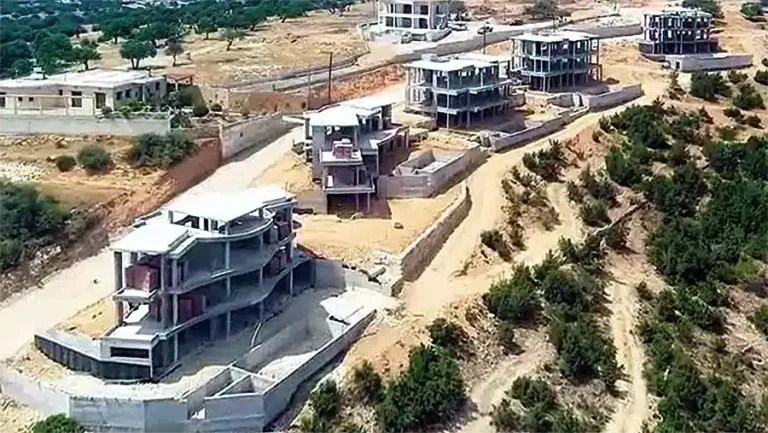
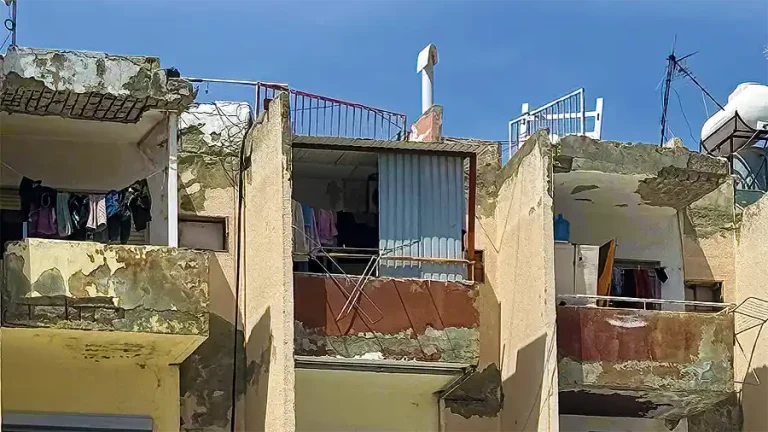
Dangerous building in urgent need of repair

Residents left to pay the price

Kyriacos Xydias, mayor of Amathounta, has stressed that property owners must take responsibility for maintaining their buildings.

But enforcement remains inconsistent, particularly in jointly-owned buildings where disputes between owners frequently drag on for years while buildings continue to deteriorate.

Officials have suggested mandatory sinking funds to ensure repairs can be carried out before buildings become hazardous.

  • Again, the idea has merit.
  • Again, action has been slow.

Families face eviction with nowhere to go

Even when authorities identify dangerous buildings, enforcement is fraught with obstacles.

DLGOs are operating with limited staff and increasingly relying on private contractors to handle inspections.

  • Evacuation orders are often ignored.
  • Court orders take time.
  • And when residents are forced out, many have nowhere to go.

Local authorities currently lack emergency housing mechanisms for displaced residents, particularly vulnerable families, pensioners and low-income tenants.

That responsibility, too, has been left hanging in a policy vacuum.

Larnaca reveals the scale of the failure

Angelos Hadjicharalambous, chairman of the Larnaca DGLO, has described a deeply flawed handover process in which local authorities inherited major responsibilities without proper preparation.

  • Hundreds of unresolved cases remain open.
  • Many files are incomplete.
  • Some must be reassessed entirely from scratch.

Meanwhile, dangerous buildings continue to age — and risks continue to grow.

A preventable crisis

This crisis was not unforeseeable.

  • Experts warned about deteriorating buildings.
  • Local authorities warned they lacked resources.
  • Industry professionals proposed reforms.

And still, central government moved too slowly.

Now two people are dead.

The longer ministers delay decisive action, the more unsafe buildings will fall through the cracks –  and the greater the risk that this tragedy will happen again.

Developers urge immediate reform of jointly-owned buildings law

Two weeks after a building collapsed in Limassol, claiming the lives of two residents, Cyprus’ property sector is renewing calls for urgent legislative reform to tackle the growing issue of unsafe buildings.

As discussions continue over how authorities should address dangerous buildings, the Cyprus Property Developers Association has once again stressed the need to modernise the legal framework governing jointly-owned buildings.

In a statement, the Association warned that the lack of an updated regulatory framework is creating serious loopholes that put lives at immediate risk. It said further delays in decision-making were no longer acceptable given the severity of the issue.

Outdated jointly-owned buildings law leave residents at risk

According to the Association, the immediate advancement and approval of new legislation is essential to protect public safety, ensure proper maintenance of existing buildings and prevent similar tragedies in the future.

It said it had repeatedly raised concerns over the risks created by the absence of a modern and effective legal framework. Recent events, alongside the growing public debate, have highlighted both the scale of the problem and the urgent need for decisive action.

The organisation argues that ageing apartment blocks and poorly maintained jointly-owned buildings are becoming an increasing concern across Cyprus, particularly in urban areas where older developments require substantial upkeep.

New parliament urged to fast-track jointly-owned buildings legislation

The Association said the newly elected House of Representatives of Cyprus should make the immediate approval of the Management of Jointly-Owned Buildings and Related Matters Law of 2023 a top priority.

It said significant weaknesses remain in the way building management committees currently operate, leaving many unable to carry out essential maintenance work efficiently.

Calls for stronger oversight and accountability

Among the reforms proposed by the Association are the creation of a supervisory authority to improve transparency, compliance and oversight.

The Association is also calling for standard operating regulations and stronger powers for management committees, allowing them to carry out necessary maintenance works without unnecessary delays and recover associated costs more effectively.

Industry leaders say these measures are critical if Cyprus is to avoid further building failures and restore confidence in the safety of its ageing property stock.

(A machine translation of the initial draft of the Management of Jointly-Owned Buildings and Related Matters Law of 2023 may be downloaded by clicking here.)

Cyprus parliament approves four foreclosure law referrals

Cyprus’ Parliament has approved four revised foreclosure related law referrals from President Nikos Christodoulides, while rejecting one, in a move likely to have significant implications for homeowners, lenders and the wider property market.

The House of Representatives voted to accept four of the President’s referrals after amendments were made by the Finance Committee, while rejecting a fifth referral tied to legal access for borrowers challenging debt claims and unfair contract terms.

The decisions come amid growing political pressure over property foreclosure, non-performing loans and the protection of vulnerable homeowners facing financial hardship.

New legal powers for district judges

Lawmakers unanimously approved changes to legislation originally proposed by Christiana Erotokritou (DIKO), allowing district court judges to hear financial disputes.

Supporters say the measure will help speed up legal proceedings involving debt-related property cases and improve access to justice for borrowers.

Parliament also unanimously approved amendments to interest rate legislation that will prevent banks from charging additional interest once a borrower’s outstanding debt, including accrued interest, reaches double the original loan amount.

The measure is expected to offer relief to borrowers whose debts have escalated significantly over time.

Stronger protection for borrowers

MPs also backed amendments to insolvency legislation covering personal repayment plans and debt relief orders for individuals.

In addition, Parliament approved legislation preventing licensed credit institutions, vulture funds and loan servicers from demanding extra collateral when a property mortgage already exceeds the value of the outstanding loan.

The reforms are widely seen as an attempt to strengthen protections for borrowers who are struggling financially but acting in good faith.

Christiana Erotokritou emphasised that the revised legislation includes a 12-month period designed to give borrowers additional time to secure workable financial solutions.

She said the measures are intended to protect responsible borrowers who are making genuine efforts to meet their obligations.

Parliament rejects one presidential referral

The only referral rejected by Parliament concerned legislation proposed by AKEL and the Greens, which aimed to give borrowers greater legal recourse over unfair contractual clauses and disputed debt amounts.

MPs voted against the referral by 38 votes to 13, with one abstention.

Aristos Damianou (AKEL) argued the referral was unnecessary and maintained that the proposal was fully constitutional, citing both Cypriot and European legal protections guaranteeing access to justice.

Meanwhile, Averof Neofytou (DISY) broke ranks with his party and said he would support the law, expressing surprise that the President had referred legislation he described as constitutionally sound.

Political tensions over property foreclosures

The debate exposed growing divisions between the government and political parties over how Cyprus should tackle non-performing loans and home repossessions.

Marinos Sizopoulos (EDEK) criticised successive governments for prioritising banks over homeowners, while Alekos Tryfonides (DIPA) called for the immediate rollout of the “Mortgage to Rent” scheme to prevent vulnerable residents from losing their homes.

Stavros Papadouris also questioned the government’s legal arguments, claiming that issues previously described as political disagreements are now being framed as constitutional concerns.

For Cyprus’ real estate sector, the latest reforms signal continued political intervention in the foreclosure market – and a clear effort to balance financial stability with greater protections for property owners.

Limassol warns building owners over safety risks after collapse

The Limassol District Local Government Organisation (DLGO) has issued a fresh public warning to building owners and property management committees, urging them to carry out urgent safety checks on their properties – and warning that legal action will follow if they fail to comply.

The renewed appeal comes in the wake of the recent building collapse in Germasogeia, which has raised fresh concerns over ageing buildings and structural safety across the district.

In a statement released today, the DLGO called on all building owners, as well as management committees of apartment blocks and other jointly-owned buildings, to take proper responsibility for their condition, maintenance and structural stability.

It stressed that monitoring a building’s condition and taking timely action to repair damage, protect occupants and eliminate potential risks is not optional.

According to the DLGO, this is a serious legal responsibility for anyone who owns, manages or oversees the operation of a building, including management committees responsible for jointly-owned buildings.

Older buildings in Limassol face greater scrutiny

The DLGO said particular attention should be given to older buildings or properties showing visible signs of deterioration.

Warning signs include:

  • cracks in walls or structural elements
  • falling plaster
  • exposed concrete rebar
  • damp and corrosion
  • structural deformation
  • subsidence
  • any other signs that may indicate worsening structural conditions

Officials said these warning signs should not be ignored, particularly in older residential developments where maintenance has been delayed.

Owners urged to hire qualified inspectors

Property owners and management committees have been urged to arrange inspections without delay through qualified professionals registered with ETEK.

Where necessary, inspections should also be carried out by engineering firms listed on ETEK’s official register.

Authorities said that if a building is found to pose a danger, owners must act immediately to remove risks, protect residents, visitors and passers-by, and comply fully with official notices.

Fines, court action and evacuations possible

The Limassol DLGO made clear that it will intervene where owners fail to act.

Potential enforcement measures include:

  • banning the use of a building
  • ordering evacuations
  • restricting access or sealing off properties
  • pursuing court orders
  • issuing administrative fines
  • launching criminal proceedings against those who ignore public safety risks

Officials said these powers would be used where required under Cyprus law to protect public safety.

“The prevention of accidents, responsible ownership and early intervention are crucial in avoiding serious, and potentially tragic, consequences,” the statement concluded.

Paphos leads Cyprus property market surge in 2025

PwC has identified Paphos as one of the biggest success stories in Cyprus’ property market in 2025, with the coastal district emerging as the leading destination for overseas buyers amid rising international demand.

According to PwC’s Cyprus Real Estate Market – Year in Review 2025 report, foreign demand accelerated significantly throughout the year, reinforcing Cyprus’ reputation as a prime destination for international property investment.

A total of 7,255 properties were bought by overseas buyers in 2025, up from 6,228 in 2024, marking a 16% year-on-year increase. Foreign investors accounted for roughly 28% of all property transactions across Cyprus, highlighting the market’s growing international reach.

Paphos top choice for overseas buyers

At the heart of this growth story is Paphos, which secured its position as the most active market for foreign buyers in 2025.

The district accounted for 32% of all international property transactions, making it the top-performing location for overseas buyers. PwC’s report also found that Paphos contributed the largest share of the overall rise in foreign activity, underlining its importance in driving market growth.

Its combination of coastal living, tourism appeal and investment potential continues to attract buyers seeking both lifestyle benefits and long-term returns.

Coastal property continues to attract investors

Limassol ranked second, accounting for 28% of foreign property transactions.

Together, Paphos and Limassol represented nearly 60% of all international property deals completed in Cyprus during 2025. The figures highlight the continued demand for coastal property, where buyers are drawn by strong rental prospects, lifestyle appeal and long-term capital growth opportunities.

Non-EU buyers dominate Cyprus property market

The report also revealed that non-EU buyers remained the dominant force in Cyprus’ international property market.

They accounted for approximately 66% of all foreign buyers in 2025. While this figure was slightly lower than the previous year, it confirms Cyprus remains highly attractive to investors from outside the European Union.

Alongside Paphos and Limassol, Larnaca continued to attract strong interest from international buyers.

The latest figures point to a resilient and increasingly global property market, with Paphos firmly established as the driving force behind Cyprus’ foreign real estate demand in 2025.

Five foreclosure laws challenged, four sent to Supreme Court

Cyprus President Nikos Christodoulides has referred five of the 12 foreclosure-related laws recently approved by the House of Representatives back to Parliament, while sending four others to the Supreme Court of Cyprus for constitutional review.

The move highlights growing tensions over how Cyprus balances borrower protection with financial stability in its property market.

According to Presidential Press Office Director Viktoras Papadopoulos, the president approved two government-backed bills and one proposal submitted by the Greens. The law keeps in place a rule preventing repossessed properties from being sold at auction for less than 50% of their market value.

The two government bills strengthen protections for borrowers. One makes decisions by the Financial Ombudsman binding for disputes involving up to €20,000, although financial institutions can still challenge rulings in court. The second gives homeowners the right to seek earlier verification of their debt through the Ombudsman when facing foreclosure proceedings, offering greater protection for primary residences.

Five foreclosure laws referred back to parliament

The five laws referred to parliament raised concerns over constitutional conflicts, retrospective application and legislative overlaps.

One proposal from DIKO would require district courts to hear foreclosure-related cases within 12 months. President Christodoulides argued this interferes with judicial independence.

Another proposal from AKEL and the Greens would allow borrowers to challenge unfair loan terms and debt calculations in court. Officials warned this could overload the legal system and delay repossessions.

A separate bill aimed to stop banks charging additional interest once debt reaches twice the original loan amount. The president said lawmakers must clarify whether this applies to existing or future contracts.

Two additional laws covering extra collateral requirements and personal insolvency arrangements were also returned for amendments.

Four laws sent to Supreme Court

Four other measures were sent directly to the Supreme Court over concerns they may breach the constitution.

These include a proposal from Democratic Alignment to suspend foreclosures on primary homes worth up to €350,000 until year-end.

Other measures would limit guarantors’ liabilities, require lenders to exhaust all recovery options before pursuing guarantors and write off remaining debt after repossessed properties are sold.

The laws will now return to Parliament for further debate, with the outcome expected to have major implications for Cyprus’ housing market, lenders and homeowners.