No signs of compromise over foreclosures

Authorities and financial regulators on Monday poured cold water on a parliamentary bill seeking to further extend a moratorium on home repossessions, warning of the dangers it could pose to the banking system – but opposition MPs are determined to press on regardless.

Lawmakers invited officials from the finance ministry, the Central Bank of Cyprus (CBC) and the Association of Cyprus Banks, to get their feedback on a bill proposing to extend to October 31 a current freeze on home foreclosures.

The current freeze is set to expire at the end of this month. The moratorium was initially instated in early 2020 – to protect debtors amid the coronavirus-related economic fallout -and has been renewed several times since.

As it stands, the law prohibits foreclosures up to July 31 of primary residences valued at no more than €500,000, business premises (small enterprises employing less than 10 people and with a turnover not exceeding €2 million), and agricultural land plots with a value up to €250,000.

A finance ministry representative told MPs the government would need to seek the opinion of the European Central Bank, as the matter appears to fall within the ECB’s jurisdiction.

If guidance is not sought, it might be considered a breach of EU law.

A CBC rep said MPs’ concerns over repossessions are overblown in any case. Since 2015 only six residences have been repossessed and auctioned off, at an average market value of €523,000 – higher even than the residences currently protected by law.

He warned that granting yet another extension to the foreclosure’s moratorium would effectively make the freeze a permanent fixture, rather than the temporary measure it was supposed to be.

Foreclosures are a tool and an incentive encouraging delinquent debtors to restructure their loans.

“Otherwise the risk looms of adverse impacts on financial stability and the economy in general,” the official cautioned.

He cited data showing that Cyprus is currently ranked second worst in the EU in terms of the ratio of non-performing loans (NPLs) to total loans. This is an index, he said, that ratings agencies take seriously into account.

The official also noted that 64 per cent of NPLs concern loans in arrears for over two years.

“The data tells us that the measure before us [the foreclosures freeze] does not in fact concern the timeframe of the pandemic.”

Speaking to reporters after the session of the House finance committee, Akel MP Aristos Damianou excoriated the government for its failure to protect home owners, for example citing the low uptake for ‘Estia‘ – a government-backed relief scheme.

“We have a duty to strike a balance between banks’ privileges and debtors’ rights…we have no other option but to forward this legislative proposal onto the plenum…”

In other business on Monday, the finance committee discussed passing an amendment making a bank that’s under liquidation, liable for compensating insured depositors (up to €100,000), rather than the compensation being made through the Deposit Guarantee Scheme (DGS) which is currently the case.

The thinking behind the proposed change is that the fund created by the DGS does not contain enough cash to compensate depositors in the event an individual bank defaults.

Cyprus property market recovering steadily

The Cyprus property market continues its recovery with sales to the domestic and EU market leading the way, but sales to non-EU citizens are not performing so well following the termination of Cyprus’ disgraced ‘Citizenship by Investment Scheme’ (a.k.a. Golden Passport.)

During June a total of 924 contracts for the purchase of real estate comprising residential, commercial, retail and land were deposited at Land Registry offices across the Republic; an increase of 43% on the June 2020 figure of 646.

If the trend continues during the second half of the year, we expect that annual sales will recover to their 2018 levels.

Total Real Estate Sale Transactions
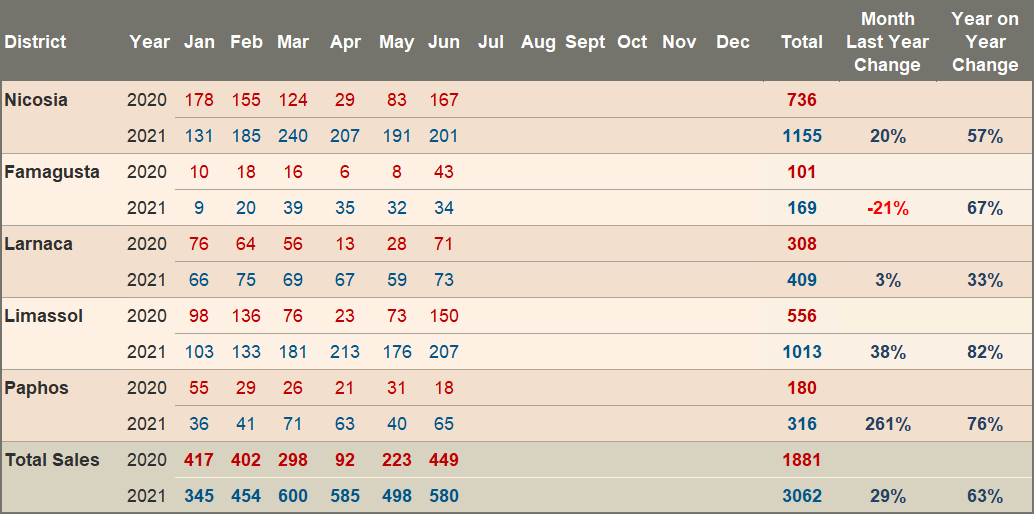
Total Cyprus Property Sale Transactions – 2020/2021 Comparison

Domestic property sales

Property sales to the domestic market in June rose by 29% compared to the same month last year, encouraged by the government’s interest subsidy scheme and low interest rates.

However, the figures will include an unknown number of ‘non-sale’ agreements such as loan restructurings, recoveries and debt-to-asset swaps agreed between the banks and defaulting borrowers in efforts by the banks to reduce their non-performing loan portfolios. Unfortunately, the Department of Lands and Surveys does not publish these figures separately.

Domestic Sale Transactions
Domestic Property Sale Transactions – 2020/2021 Comparison

Foreign sales

Foreign sales also rose in June, up 75% compared to June 2020. But as Cyprus will be placed on the ECDC’s ‘Red List’ due to its escalating number of COVID-19 cases and the cancellation of the island’s ‘Golden Passport’ scheme, it’s going to take some time for the numbers to recover.

Foreign Property Sale Transactions
Foreign Property Sale Transactions – 2020/2021 Comparison

Cyprus property sales to EU citizens

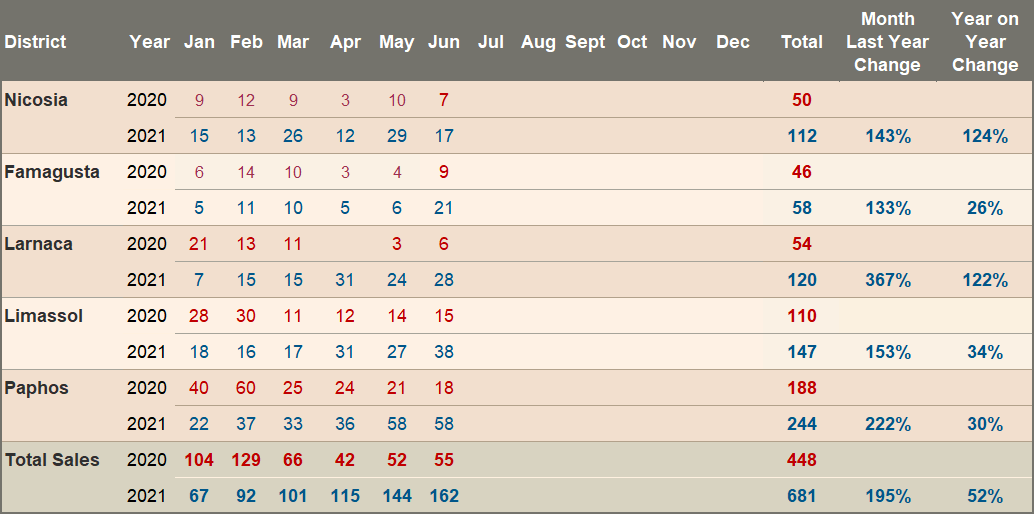
Sales to EU nationals jumped 195% in June compared to June 2020 and are up 52% year-on-year. However, as mentioned above, as Cyprus is about to be placed on the ECDC’s ‘Red List’ it’s likely that potential foreign buyers will be dissuaded from visiting the island.

Foreign (EU) Property Sale Transactions
Foreign (EU) Property Sale Transactions – 2020/2021 Comparison

Cyprus property sales to non-EU citizens

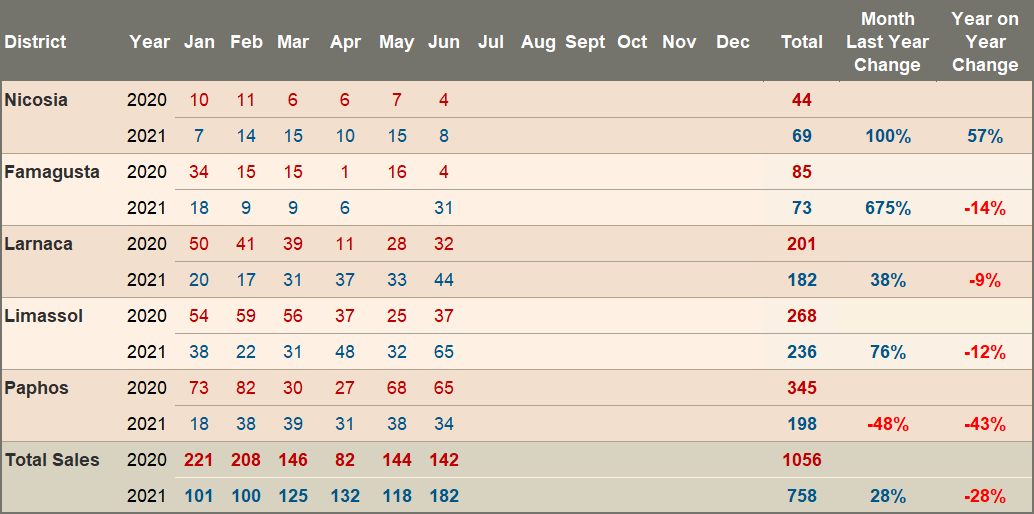
Sales to non-EU citizens rose 28% in June compared to June 2020 but are down 28% year-on-year.

In terms of the number of property sales, Limassol is performing better than the other districts although year-on-year sales are down 12%.

Foreign (Non-EU) Property Sale Transactions
Foreign (Non-EU) Property Sale Transactions – 2020/2021 Comparison

Analysis of property sales since 2000

Cyprus Property Sale Contracts 2000 – 2021

Year Overseas Sales Domestic Sales Percentage
Overseas Sales
Total Sales
2000 450 12,214 3.6% 12,664
2001 1,207 12,849 8.6% 14,056
2002 2,548 14,111 15.3% 16,659
2003 3,981 15,294 20.7% 19,275
2004 5,384 11,947 31.1% 17,331
2005 6,485 10,106 39.1% 16,591
2006 8,355 8,598 49.3% 16,953
2007 11,281 9,964 53.1% 21,245
2008 6,636 8,031 45.2% 14,667
2009 1,761 6,409 21.6% 8,170
2010 2,030 6,568 23.6% 8,598
2011 1,652 5,366 23.5% 7,018
2012 1,476 4,793 23.5% 6,269
2013 1,017 2,750 27.0% 3,767
2014 1,193 3,334 26.4% 4,527
2015 1,349 3,603 27.2% 4,952
2016 1,813 5,250 25.7% 7,063
2017 2,406 6,328 27.5% 8,734
20181 4,367 4,875 47.3% 9,242
2019 4,482 5,884 43.2% 10,366
2020 2,985 4,983 37.5% 7,968
2021 (June) 1,439 3,062 32.0% 4,501
Totals 74,927 166,319 30.9% 240,616

1 The Department of Lands & Surveys has advised that overseas sales in 2018 and subsequent year should not be compared to sales in previous years due to changes in the methodology used to classify ‘Aliens’ (foreigners).

Cyprus property market to continue to recover

Cyprus has long been a popular holiday destination. Many of us have relied on this fact for our financial stability, making money off tourism and foreign investment.

Because of the island’s centrality, people from Europe, Africa, and the Middle East are regular visitors. This is why the property market is so dependent on borders being open.

Unfortunately, over the past year we have seen how easily the economy can be brought to its knees without international travel. The property market in particular has struggled, with thousands of international investors putting their purchases on hold. Even in Cyprus, potential property buyers have had to postpone their plans due to their economic troubles.

With the light at the end of the tunnel, the property market in Cyprus has begun to recover as lockdown restrictions around the world are being gradually lifted.

Economic recovery

The fact that the Cyprus property market is recovering is unsurprising. The pandemic hit economies around the world hard, but most economies were able to rebound with the easing of restrictions. Tens of millions of people who had been left unemployed found new jobs fairly quickly.

This is not to say that there was no permanent damage done to businesses and individual finances.

However, the truth is that economies no longer represent the reality on the ground in most countries. The economy can be booming while individuals and small businesses struggle, simply because the big corporations and publicly-listed companies are raking it in.

The global economic recovery has benefited people on a micro level, but it is the big businesses and wealthy investors that are truly winning.

The Cyprus property market

The Cyprus tourism industry may take some time to rebound. While people will want to travel as soon as they are able to, and there will definitely be a bounce, many nomads no longer have the funds to travel. Even those who do make it to Cyprus may have less money to spend than they would have had a year and a half ago.

But the Cyprus property market is not bound to tourism. It is not your run-of-the-mill tourists who are buying property in Cyprus. Rather, wealthy investors buy properties to rent out to travellers, or as holiday and retirement homes.

This explains why the property market has already reached 2018 levels, despite the fact that travel restrictions are still in place in many countries.

Most international property purchases are, at the moment, coming from EU countries. Non-EU investors are likely to take a little bit longer. This is also the case for British property buyers, who have not yet returned in significant numbers.

It is not just international investors who are helping the property market rebound. Domestic property purchases more than doubled in May 2021 compared to May 2020. This is in part due to government incentives including an interest subsidy scheme. The interest rate is in any case incredibly low at about 2.5%.

The end of British lockdowns?

The UK was set to ease lockdown restrictions at the end of June, but it is looking likely that this will only happen at the end of July. The infection numbers there are still high, and scientists are calling for a delay so that more people can get fully vaccinated before the country opens up.

This might prove to be an unexpected blip in the recovery of the Cyprus property market. After all, a lot of property in Cyprus is bought by British individuals and investors. While they can buy without having to come over to Cyprus, buyers are nonetheless wary of spending huge sums of money in still uncertain times.

Nonetheless, an extra month of lockdowns is unlikely to make a big difference in the long run. Potential property buyers will come through at the end of July. August will be the big month for Cyprus property.

One industry that is being impacted by the increase in property purchases is the international money transfer industry. Cyprus is the home to a number of these companies, or at least their head offices.

Non-bank international money transfer companies

When it comes to transferring big sums of money abroad, banks are not the best choice. They charge huge fees and commissions, and provide interest rates that benefit themselves, thus adding a type of hidden fee. For this reason, investors turn to international money transfer companies.

Over the coming months, we can expect to see non-bank international money transfers happening at a massive scale. These companies are gearing up for this, knowing that their systems need to be performing reliably if they are to take full advantage of these transfers.

Money transfer companies have been hit by the pandemic. This is not because people have stopped doing business overseas or living as digital nomads. On the contrary, in many industries this type of work has picked up. However, with international property markets struggling, the number of transfers of major sums of money has decreased.

The recovery of the Cyprus property market is great news for these companies, and many of them are likely to offer benefits and incentives to use their services.

This has already started to happen, and it will only increase over the next few months. We can expect August to be a huge month for these companies, as Britons start buying up Cyprus property once again.

What’s next for the Cyprus property market ?

The good news is that it is unlikely that the Cyprus property market will crash once the boom ends. While its growth will slow, it is unlikely to go below pre-pandemic levels. More people are struggling than before the pandemic, and formerly-thriving small businesses have ceased to exist. But those individuals and businesses are not the main source of international Cyprus property investment.

It is possible that we’ll even see an increase in these types of buyers. There will be people who decide to expedite their retirements, finding a way to buy their dream homes so that they don’t have to wait through potential future roadblocks. In the case of further shutdowns, they can see out the crisis from their beautiful Cyprus home.

Many wonder if property investors will hold off based on what has happened to tourism over the past year. However, what we are already seeing around the world is that people are choosing to return to normal.

It is not possible to return to business as usual if we continue to expect a once-in-a-century event like a global pandemic to stifle our plans. There will be those who lose their appetite for risk permanently. But business owners and investors will need to recover that appetite if they are to succeed.

Apartment residents living on the edge

Residents in a hilltop apartment building in Germasogeia, Limassol are living in fear that their complex could collapse at any moment.

The developer who built the complex failed to build a retaining wall and, as you can see in the photograph above, the development is being undermined as the face of the hill erodes away.

The Authorities have known about the problem for several years and one resident who spoke with Phileleftheros said that “We really live in the air. We have been fighting to find a solution to the problem for years. We bought an apartment, but it’s like we threw away our money away.” A member of the complex’s management committee said the problem was very serious.

Another resident said that “The developer built the apartment building, sold us the apartments, but since then he’s been missing,” and said that that construction of the apartment building should have stopped by that time. He claimed that complaints were made when the problem came to light 10 years ago, but nothing happened.

Residents have written to the mayor and the Municipal Council of Germasogeia requesting their help to build the missing wall.

Speaking to the Phileleftheros, the mayor of Germasogeia Kyriakos Xidias agreed hat the problem was very serious.  “The retaining wall must be done immediately. We have managed to get the consent of the owners who live under this apartment building, to build the retaining wall within their property.”

The mayor noted that a Certificate of Approval for the complex had not been issued and that no Title Deeds could be issued until the retaining wall had been built.

He also noted that he had written to the residents advising them that although the municipality is willing to help wherever it can, it cannot pay all the costs required to build the missing wall as the complex is privately owned.

Price of houses stable, property rentals drop

Cyprus real estate prices & rentals recorded quarter-on-quarter drops across most property categories, but the value of houses remained stable, according to consultancy firm WiRE FS.

Paphos had some of the biggest quarter-on-quarter drops in prices (2.6% for retail units, 1.7% for warehouses, 1.5% for offices, 3.2% for holiday apartments and 2.5% for holiday homes).

Limassol had the biggest drop in office rents (11.1%).

According to the first Wire FS Q1 2021 market overview, Nicosia was the only district with a price increase in some sectors (1.2% for houses, 1.3% for retail and 2.3% for offices).

Prices of holiday houses and apartments fell by 1% and 0.2% respectively.

The biggest drops were in Limassol (1.8% for apartments) and Paphos (3.2% for holiday apartments and 2.5% for holiday houses).

Residential prices for apartments remained broadly the same compared to Q4 2020 and increased by 0.4% for houses.

Prices of retail properties and warehouses fell by 0.7% and 0.8% respectively, whilst those of offices increased by 0.3%.

Compared to Q1 2020, prices of retail units fell by 5.3%, warehouses by 4.5%, office space by 1.0%, holiday apartments by 1.2% and holiday homes by 3.2%.

Over the same period, house prices increased by 1.5%.

Quarter-on-quarter rental prices decreased by 0.1% for apartments, 1.4% for houses, 1.8% for retail units, 2,6% for offices, 0.4% for holiday apartments and 2.9% for holiday houses, while rental values for warehouses increased 0.4%.

Compared to Q1 2020, rents dropped by 0.6% for apartments, 6.4% for retail properties, 3.2% for offices, and 5.4% for holiday homes.

Rents of houses, warehouses and holiday apartments increased by 2.6%, 0.7% and 0.1%, respectively.

Transaction Volume year-on-year across Cyprus decreased by 21%.

Transactions in Nicosia increased by 8% and decreased in Limassol by 24%, in Larnaca by 22%, in Famagusta by 11%, and in Paphos by 40%.

Over the past year, April 2020 to March 2021, contracts of sale were deposited for 7,932 properties, of which 2,186 in Nicosia (28%), 2,491 in Limassol (31%), 1,240 in Larnaca (16%), 576 in Famagusta (7%) and 1,469 in Paphos(19%).

Household lending for mortgages totalled €9.4 billion in March, with 93.1% local residents, 0.4% to residents of the Eurozone, and 6.5% for other countries.

Compared to March 2020, housing loans to locals increased by €156.1 million whilst those to residents of Eurozone countries and other states decreased by €13.1 million and €244.8 million, respectively.

Progressively, outstanding loans are increasingly concentrated on local residents, said the outlook.

Year-on-year building permits for residential properties showed a decrease of 9% in sqm and 15% in the number of dwellings.

“Activity and prices in the main commercial centres of Nicosia and Limassol are currently stable, as locals are acquiring residential properties, mostly apartments, taking advantage of various government subsidies and generating income,” said the Wire FS report.

“Businesses are upgrading their office requirements, resulting in an increase in demand for Grade A office space and a contraction across lower quality premises.

“The other districts continue to experience low levels of demand, as they are more reliant on overseas markets and have a higher dependency on tourism.

“With banks flushed with liquidity, having circa €19 billion of NPLs in the economy, and government debt exceeding 100% of GDP, there is a danger of the economy sliding into ‘Japanisation’, i.e. low growth and deflation (in real terms).”


Cyprus property prices recovering

The Residential Property Price Index recorded a recovery in the first quarter of 2021 after two consecutive quarters of falling prices, according to the RPPI compiled by the Cyprus Central Bank (CBC).

The rise was mainly due to an increase in apartment prices.

According to the CBC, the rise in property prices is mainly due to the 1.2% increase in apartment prices compared to the previous quarter.

House prices rose marginally by 0.2% over the same period.

House prices increased by 0.2% quarterly, while apartment prices increased by 1.2%.

Annually, house prices increased marginally by 0.2%, while apartment prices increased by 2.5% compared to Q1 2020.

According to the CBC, the increase in prices per type of housing seems to reflect the enhanced preference of buyers and investors for apartments in relation to homes in most districts.

However, in Limassol and Larnaca, there seems to be more demand for smaller houses.
“According to real estate market professionals, in most districts, there is an increased demand from domestic buyers, mainly for apartments and houses of smaller size and value than in the past,” the bank report said.

It may be because buyers wish to benefit from the state scheme that subsidizes interest rate for first-time property buyers or buyers looking to purchase holiday homes or investors buying to let.

On the other hand, the CBC notes there is a reduced interest in luxury real estate in coastal areas due to the abolition of the Cyprus Investment Program.

In Q1 2021, the RPPI increased in Limassol, Larnaca and Famagusta quarterly, but house prices fell in Paphos and remained stable in Nicosia.