Golden passports inquiry’s report published

Cyprus’ Law Office has released the final report of the Inquiry Committee probe into the issuing of passports under the citizenship for investment scheme that ran from 2007 to November 2020.

The redacted 786-page report (Greek) recommends the revoking of citizenships granted to some foreign nationals.

Moreover, it urges authorities to investigate the possible commission of criminal offences, including making false declarations.

The Law Office, in a statement, said it had to blank out certain information and names in the public interest as revealing certain names and details would jeopardise investigations.

It also said a state prosecutor is evaluating the report, and the aim is to forward it to the Police for criminal investigations.

The Committee examined a total of 6,182 naturalisations dubbed law risk and 597 high-risk, which amounted to 8.8% of the total number of passports issued.

The report said that from the dossiers of 280 investors (597 naturalisations of high-risk investors and their spouses who were granted Cypriot citizenship), 81 people were given naturalisation for having managerial positions and, therefore, outside the legal framework.

According to the report:

  • Five citizenships were granted between 1.1.2007– 29.2.2008 during Tassos Papadopoulos’ tenure.
  • 228 during Demetris Christofias reign (1.3.2008 – 28.2.2013).
  • 6,546 under the Nicos Anastasiades administration (1.3.2013 – 17.8.2020).

From a total of 6,779 passports, 53.24% (family members and officials holding managerial positions, namely 3,609 persons) were granted citizenship unlawfully.

Moreover, from the 3,170 people who were given citizenship, 67 were not examined because the Police are examining the dossiers.

The remaining 3,103, 33.58%, did not meet all the typical criteria when the applications were scrutinised.

From the high-risk investors, 27.64% of 199 applicants did not meet the criteria set by the Cabinet.

Among low-risk investors, 66.01% of the 2,904 beneficiaries during 2007-2020 met the criteria, whereas 33.99% did not.

Some 12.1% did not meet the criteria of owning private property.

The report can be found at: https://www.pio.gov.cy/assets/pdf/newsroom/2021/06/REPORT-NICOLATOU%20COMMITTEE_220621.pdf (Greek)

Punish golden passports crime

Last October, the international broadcaster Al Jazeera released a damning investigative report on how a convicted criminal can obtain a European passport in Cyprus (aka golden passport) for the right price.

The report sent shockwaves across the political spectrum forcing the speaker of the parliament to resign, along with another MP from the opposition AKEL party.

It also forced the government to abandon the controversial “investment for citizenship programme” and paved the way for an independent investigation.

The release of the interim report of the independent commission appointed by the Attorney General to investigate the controversial ‘golden passports’ programme came as a nasty surprise.

It concluded that the system was rotten and blasted promoters and the government for a series of failures that contributed to the abuse and ultimate downfall of the ‘golden passports’ programme.

I asked Dr Christos Clerides, President of the Cyprus Bar Association, a no-nonsense lawyer who commands the highest respect in the legal profession, to give his views on the ‘golden passports’ matter and how the country can move forward.

Clerides said the independent commission’s findings regarding the investment for citizenship programme confirm the findings of the earlier Kalogirou report and the Auditor General’s reports.

“The findings of the two latter reports should have led to the immediate criminal investigation of all those involved in the scheme,” Clerides said.

“What is disturbing is that the Council of Ministers collectively participated in illegalities.

“In advanced democracies, one would have expected more sensitivity and political repercussions.”

He added that equally disturbing is the public’s reaction at large, which, unfortunately, is very complacent.

“Unfortunately, conflict of interests situations that also came into light by the interim report seems to go unnoticed.

“This matter touches the President himself, Ministers, and the Office of the Attorney General.

“If the whole saga is swept under the carpet, Cyprus will never be able to recover from this sad affair, and the professional services sector will suffer heavily.”

Asked what can be done to restore the country’s reputation as a credible provider of professional services contributing to the growth of the Cypriot economy, Clerides replied bluntly: “Punishment of the guilty ones is of prime importance.”

“This involves criminal sanctions at the initiative of the Office of the Attorney General.

“It also involves penalties/revocation of licenses by the anti-money laundering (AML) supervising authorities, namely the Securities and Exchange Commission, the Bar Council, and the Institute of Certified Public Accountants.

“It also involves the initiation of disciplinary proceedings.

“In addition, it is imperative that the anti-corruption legislation pending before the House of Representatives be voted.

“But most of all, we need a drastic change of culture at all levels, including the political parties.”

Clerides said we also need to enhance supervision by independent bodies, and where conflict of interests is potential, to exclude it.

“The Greco and Moneyval reports should be implemented without further delays. “This involves procedures that affect the judiciary (appointment promotion of judges), the House of Representatives and the Attorney General’s office.

“I am afraid the road is long and thorny.”

ECB cautions over changing foreclosure law

ECB supervisory board member Elizabeth McCaul advises caution over possible amendments to the Cyprus foreclosure law as they could “backfire and destabilise the banking sector”.

In an interview with the Cyprus News Agency (CNA), McCaul said last year’s amendments to the foreclosure framework, enabling recourse to the Financial Ombudsman for breaching the Code of Conduct and extending various timelines, “risk a negative impact on banks and may cause further delays.

“Such policies can also backfire and destabilise the banking sector if designed in a haphazard manner.

“So, the right mix has to be found.”

She said while banks have reduced NPLs on their balance sheets, it does not mean that debts have “magically disappeared”; they are still present elsewhere in the Cypriot economy.

Amendments to the insolvency and foreclosure framework have helped to remove some of the impediments to the procedure.

But McCaul argued several more impediments need to be addressed, such as the low uptake of the insolvency and pre-insolvency tools and existing backlogs in the judicial system.

She acknowledged the progress in the island’s banking sector in reducing its non-performing loans (NPLs) since the 2013 financial crisis and amid the Covid pandemic but advised caution.

“There is great uncertainty about the overall impact of the pandemic on borrowers and thus on bank balance sheets.”

On plans to convert KEDIPES into a ‘bad bank’, a state-owned asset mandated to wind down NPLs of the former Cyprus Cooperative Bank, McCaul said that such solutions could complement banks’ efforts by offering additional options to tackle NPLs more swiftly.

“By all accounts, the NPL ratio in Cyprus remains high, and the effects of the pandemic are still a source of uncertainty.

“We welcome broader possibilities for banks to reduce NPLs: from securitisations to establishing well-designed asset management companies.

“If appropriately designed, state-supported solutions for promoting NPL disposal can complement banks’ own efforts by offering additional options to tackle NPLs more swiftly.”

McCaul said the success of asset management schemes as an effective solution to reduce NPLs depends on many factors: a well-functioning foreclosure framework, the feasibility of the scheme’s time horizon and the type of assets transferred to the scheme, such as retail versus corporate exposures.

Covid pandemic

Compared with the 2013 crisis, McCaul said Cypriot banks are now better prepared to deal with an increase in distressed debt.

“Their capital positions today are stronger than they were in the immediate post-crisis period, and there has been significant progress in making their balance sheets more resilient.”

NPLs in Cyprus declined by €23.2 billion between December 2014 and December 2020.

“Even though the first moratorium expired at the end of 2020, we need to keep in mind that we are still in a period of great uncertainty about the overall impact of the pandemic on borrowers and thus on bank balance sheets.

“We haven’t yet seen the potential effects of the full withdrawal of fiscal support measures materialise on bank balance sheets, and we don’t yet know whether certain sectors will struggle more than others once the support is no longer available.

“What we do know from experience is that credit impairments typically emerge only after some delay, and we know that we do not yet have data on potential future bankruptcies that may be latent on balance sheets now.”


McCaul said that decisions on mergers and acquisitions must be made solely by market participants, while the supervisor’s role is neither to push for or hinder consolidation.

“There is indeed a problem of overcapacity in some countries, which can be dealt with in different ways.

“However, consolidation is not the only option available to improve structural profitability and cost efficiency in the Cypriot banking sector.”

McCaul pointed out that digitalisation could produce significant cost savings for institutions with extensive branch networks if supported by efficient internal governance and reorganisation.

“One of our supervisory priorities is the assessment of banks’ business models and profitability, also in the light of increasing digitalisation, which has received a boost from the pandemic situation and physical distancing rules.”

She said about 40% of EU banks are “falling short of what we expect regarding their provisioning practices, the classification of their loans, flagging forbearance measures, and the strength of their operational capability to prepare for the expected increase in NPLs.

“Rather surprisingly for a crisis situation, in some portfolios we discovered improvement in credit risk parameters (ratings), especially for probability of default.

“Banks need to be forming a clear picture of potential underlying credit deterioration and providing the required transparency. In this regard, we are monitoring banks’ provisioning practices closely.”

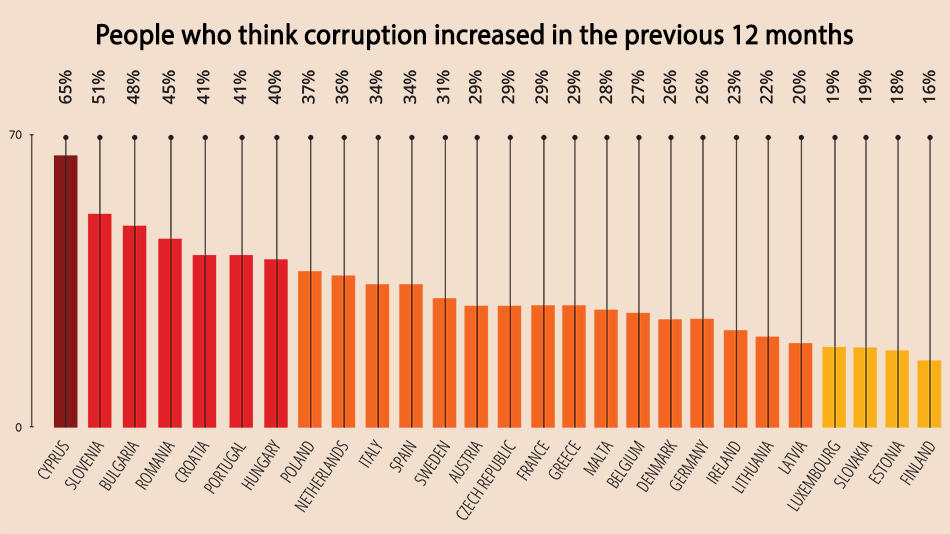
Cypriots believe their country most corrupt in EU

More Cypriots believe that corruption has increased in their country over the past year than their fellow European citizens.

According to Transparency International’s Global Corruption Barometer, Cyprus tops the list as 65% of Cypriots thought corruption had worsened over the past 12 months, compared to the EU average of 32%.

Second on the list is Slovenia, with 51% of its inhabitants believing that corruption has risen in the same period.

Furthermore, the survey found that four out of ten Cypriots used personal connections to access a public service during the past year.

The findings, however, follow the trend across the EU, with three out of ten using a personal connection to access a state service.

Cypriots believe their country most corrupt in EU

“While bribery rates remain low at 7%, we found that around three in ten people [across the EU] used a personal connection to access healthcare, education, and other public services,” Transparency said.

This was equivalent to more than 106 million people across the bloc.

Although just 6% of people paid a bribe for healthcare, 29% of EU residents have used personal connections to receive medical attention.

Transparency International reported that healthcare is a hotspot for corruption, noting it is of particular concern, especially during the pandemic when people urgently need medical support and vaccinations.

“During a health crisis, using personal connections to access public services can be as damaging as paying bribes,” said Delia Ferreira Rubio, Chair of Transparency International.

“Lives can be lost when connected people get a Covid-19 vaccine or medical treatment before those with more urgent needs.

“It’s crucial that governments across the EU redouble their efforts to ensure a fair and equitable recovery from the ongoing pandemic,” she added.

Overall, almost two-thirds of people in the EU think that government corruption is a problem in their country.

It is compounded by widespread perceptions of impunity, with only 21% of people believing that officials often face appropriate penalties for corruption.

Citizens are divided over which institutions have the biggest corruption problems.

MPs most corrupt

In half of EU countries, prime ministers and members of parliament are seen as the most corrupt. In the other half, it is business executives and bankers.

Yet trust in the police, local government, and the courts are high across the region. More than 60% of EU residents said they trusted these institutions.

In Cyprus, 69% believe the government is run on behalf of private interests, second on the index in this category. The EU average was 53%.

Cypriot mistrust in the government and the political system is fuelled after a series of scandals involving officials in high places, with the culprits seemingly unpunished.

President Nicos Anastasiades has come under fire himself over alleged involvement in the controversial citizenship by investment programme.

An undercover Al Jazeera sting operation portrayed the then-House Speaker Demetris Syllouris and AKEL MP Christakis Giovanis, appearing ready to help a dodgy Chinese investor secure Cypriot citizenship for cash.

Both have since resigned, with a police investigation into their actions underway.

Although the video did not reference a state official, it did shoot down the government’s claim that Cyprus was unfairly targeted over its investment scheme from foreign media and EU partners.

Warnings from international bodies for Cyprus to get its act together have also played their role in shaping a negative image of the political system.

The Council of Europe’s Group of States against Corruption (GRECO) has said Cyprus was among countries that have not fully complied with its recommendations on corruption prevention.

According to the EU Commission, Cyprus has failed to comply with the EU’s latest anti-money laundering directive, leaving a legal gap that could be exploited at the bloc’s expense.

It has also threatened legal action over the disgraced passport scheme.

Up to nine complaints a day about estate agents

The Cyprus Real Estate Registration Council revealed on Monday that on average three to nine cases of malpractice within the sector are reported daily in the island.

According to the council’s president Marinos Kynageiros the negative trend in the real estate profession has reached uncontrollable proportions during the last year due to the coronavirus pandemic, as real estate agents who were affected by the closures of their businesses attempted to make a profit illegally.

“In the last year, we have seen a spike in cases of real estate malpractice, which were reported to us by private individuals and other real estate companies alike,” Kynageiros told newspaper Politis.

“In the last five years, over 500 such cases ended up in court and dozens of people working in the real estate industry got eventually convicted for having illegally practised the profession.”

Kynageiros added that the main reason 2020 was particularly bad was linked to the difficulties they faced especially during the lockdown period.

“We receive several complaints every day, but, unfortunately, they are dealt with very slowly in court, due to the notoriously slow justice system in Cyprus,” Kynageiros said.

“Usually, the majority people who are found guilty of malpractice are fined from €400 to €620, which is by no means a significant deterrent, as the fines do not reflect the severity of their actions.”

According to Kynageiros, the law states that real estate agents found guilty of malpractice and who are eventually fined, cannot practice the profession until they pay their fine, as their licences get temporarily revoked.

If they fail to comply with the court orders, they risk getting arrested and consequently suspended from the Real Estate Registration Council.

“However, according to our information, this rarely happens and real estate agents who are found guilty of malpractice usually continue to work in their businesses undisturbed.”

Kynageiros added that the issue not only affects private individuals, it also has an impact on the Cypriot economy as a whole, as it gives way to tax evasion.

“However, ultimately, the public are the most affected party,” he said.

“The best way for individuals to protect themselves against all sort of malpractices is to ask the real estate agent to see proof of his qualification and whether he or she is registered at the Real Estate Registration Council.”

Surge in the construction of new homes

March 2021 saw a surge in the planned number of new homes to be built in Cyprus according to the building permit statistics published by the Statistical Service.

During the month a total of 747 building permits were authorised by the municipal authorities and the district administration offices in Cyprus; an increase of 88% compared to the 379 authorised in March 2020.

The total value of these permits reached €199.8 million and their total area 206.1 thousand square meters and provided for the construction of 1,033 new homes.

The 747 permits were authorised for the following:

  • Residential buildings – 534
  • Non-residential buildings – 105
  • Civil engineering projects – 37
  • Division of plots of land – 49
  • Road construction – 22

Building permits for new homes

The 534 residential permits provided for the construction of 663 new homes, comprising:

  • Single houses – 369 (+132.1% compared to March 2020)
  • Buildings with 2 or more units – 96 (-73.7% compared to March 2020)
  • Residential Apartment blocks – 548 (+131.3% compared to March 2020)
  • Residential/Commercial apartment blocks – 20 (+81.8% compared to March 2020)

Building Permits Issued for the Construction of New Homes
(Number of Dwellings)

Month 2020 (Dwellings) 2021 (Dwellings) Increase/Decrease %age Change
January 696 702 6 0.9%
February 680 663 -17 -2.5%
March
524
1,033
509
97.1%
Totals 1,900 2,398 498 26.2%

Of those 1,033 new homes, 415 are destined for Nicosia, 285 for Limassol, 214 for Larnaca, 109 for Paphos and 10 for Famagusta.

Annual construction figures

During the first quarter of 2021, 1,897 building permits were issued compared to 1,526 in the same period last year; an increase of 24.3%. Their total value rose by 9.1%, their total area by 11.9% and the number of new homes by 26.2%.

The 1,362 building permits that were authorised for the construction of new homes during the first quarter of 2021, provided for the construction of 866 new homes in Nicosia, 783 in Limassol, 475 in Larnaca, 239 in Paphos and 35 in Famagusta.

Further reading

CYSTAT press release: Building Permits March 2021