Cyprus property sales recovery continues

The positive trend in the number property sales in Cyprus continued in May with the number of contracts deposited at Land Registry offices up by 81% compared to May 2020 and up 36% year-on-year.

This increase in sales is not particularly surprising when you consider that 12 months ago Cyprus was in total lockdown because of the COVID pandemic. Cyprus went into a nationwide lockdown on 24 March 2020 and did not reopen its airports to commercial flights until 9 June.

What is more notable is that, according to Land Registry figures, property sales have almost recovered to their 2018 levels when 3,612 sales were achieved in the first five months of the year.

Paphos is struggling due to the fall in non-EU citizens buying property.
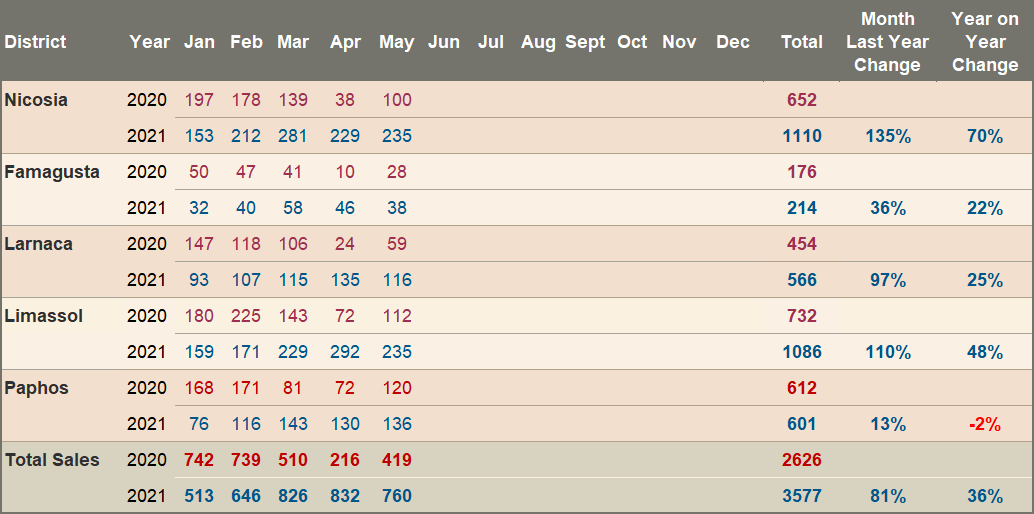
Total Property Sale Transactions
Total Property Sale Transactions – 2020/2021 Comparison

Domestic property sales

Property sales to the domestic market in May rose by 123% compared to the same month last year.

Sales to the domestic housing market have been encouraged by government incentives such as the interest subsidy scheme and historically low interest rates at around 2.5%.

However, the figures will include an unknown number of ‘non-sale’ agreements such as loan restructurings, recoveries and debt-to-asset swaps agreed between the banks and defaulting borrowers in efforts by the banks to reduce their non-performing loan portfolios. Unfortunately, the Department of Lands and Surveys does not publish these figures separately.

Domestic Property Sale Transactions
Domestic Property Sale Transactions – 2020/2021 Comparison

Foreign sales

Foreign sales also rose in May, up 34% compared to May 2020. But with travel advice and restrictions dissuading holidaymakers (including Britons) visiting Cyprus, it’s going to take some time for the numbers to recover.
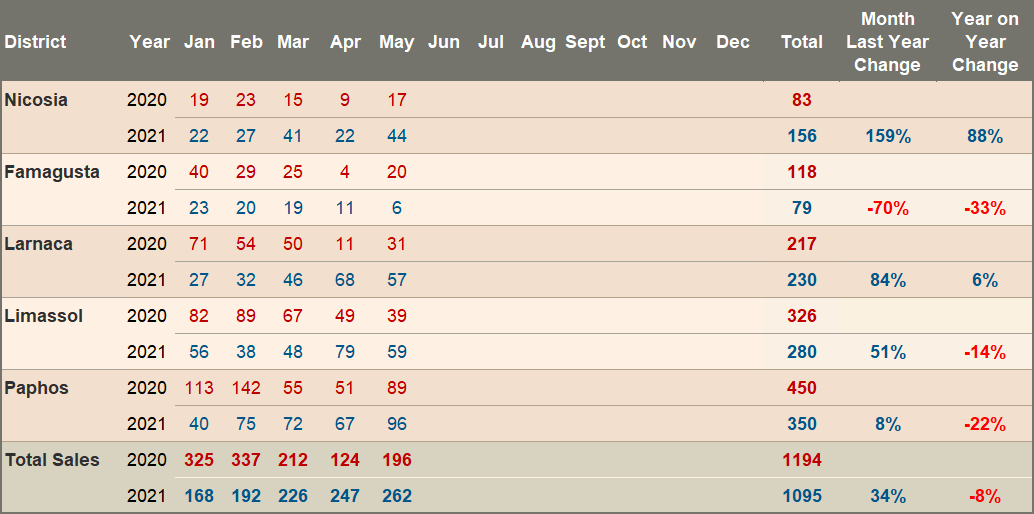
Foreign Property Sale Transactions
Foreign Property Sale Transactions – 2020/2021 Comparison

Sales to EU citizens

Sales to EU nationals rose by 177% in May and have almost returned to their 2018 levels when 539 sales were achieved in the first five months of the year.

Foreign (EU) Property Sale Transactions
Foreign (EU) Property Sale Transactions – 2020/2021 Comparison

Sales to non-EU citizens

Following the cancellation of the Cyprus disgraced ‘Citizenship by Investment Scheme’ (a.k.a. Golden Passport) following the expose by Al-Jazeera, it will come as no surprise that property sales to non-EU citizens are not performing well.

In terms of the number of property sales, Limassol is weathering the storm better than the other districts.
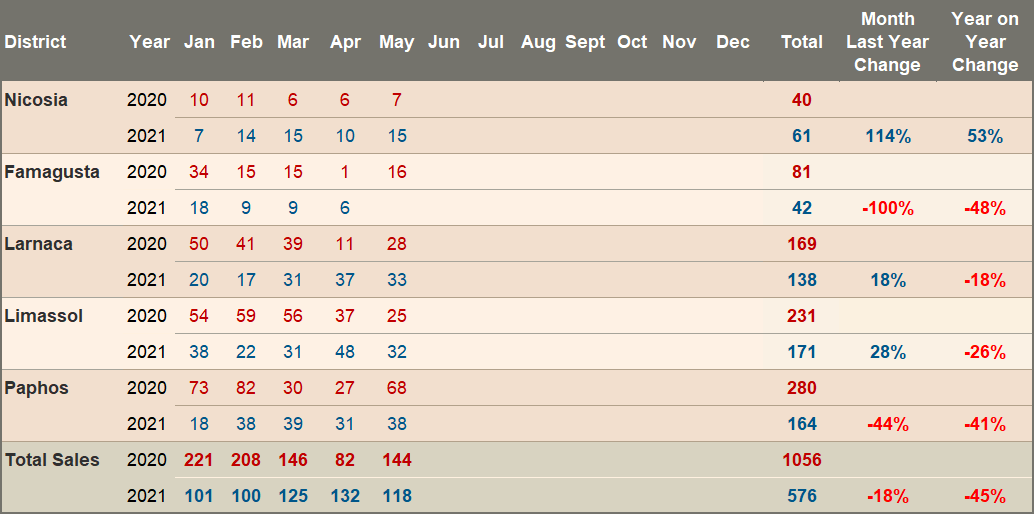
Foreign (Non-EU) Property Sale Transactions
Foreign (Non-EU) Property Sale Transactions – 2020/2021 Comparison

Golden Passport investigation progress

A further 22 foreign nationals face losing their Golden Passports and Cypriot citizenship according to local media reports, bringing the total to 44.

The final report into the scheme is reported to contain the details of a further 100 cases deemed to be “high-risk” individuals. The committee intends to recommend that the citizenships of these foreign investors and their family members are revoked for criminal and political crimes.

Analysis of property sales since 2000

Year Overseas Sales Domestic Sales Percentage
Overseas Sales
Total Sales
2000 450 12,214 3.6% 12,664
2001 1,207 12,849 8.6% 14,056
2002 2,548 14,111 15.3% 16,659
2003 3,981 15,294 20.7% 19,275
2004 5,384 11,947 31.1% 17,331
2005 6,485 10,106 39.1% 16,591
2006 8,355 8,598 49.3% 16,953
2007 11,281 9,964 53.1% 21,245
2008 6,636 8,031 45.2% 14,667
2009 1,761 6,409 21.6% 8,170
2010 2,030 6,568 23.6% 8,598
2011 1,652 5,366 23.5% 7,018
2012 1,476 4,793 23.5% 6,269
2013 1,017 2,750 27.0% 3,767
2014 1,193 3,334 26.4% 4,527
2015 1,349 3,603 27.2% 4,952
2016
1,813 5,250 25.7% 7,063
2017
2,406 6,328 27.5% 8,734
20181 4,367 4,875 47.3% 9,242
2019
4,482 5,884 43.2% 10,366
2020
2,985 4,983 37.5% 7,968
2021 (May)
1,095 2,482 30.6% 3,577
Totals
73,953 165,739 30.9% 239,692

1 The Department of Lands & Surveys has advised that overseas sales in 2018 and subsequent year should not be compared to sales in previous years due to changes in the methodology used to classify ‘Aliens’ (foreigners).

New high-rise in Limassol

The Department of the Environment has given the green light for the construction of a 15 storey high-rise in Limassol.

The proposed development is located on Alasias and Dimitri Glinou streets close to Makarios Avenue in four plots with a total area of 2134m2. An abandoned building on the land will be demolished to make way for the development.

The commercial development will rise to a height of 75.55 metres with independent office and green spaces and parking. The high-rise building will comprise

  • Three basement levels will provide parking for 185 cars, including 12 disabled parking spaces.
  • Ground floor will provide parking for 22 vehicles (including 2 disabled parking spaces), reception and waiting area and a green area of 750m2.
  • Floors 1 – 5 will provide office accommodation, kitchen and bathrooms.
  • Floor 6 will provide for the installation of mechanical equipment.
  • Floor 7 will provide an exhibition area, kitchen and bathrooms.
  • Floors 8 – 15 will provide office accommodation, kitchen and bathrooms.
  • There will be a garden on the roof and space for photovoltaic panels.

In addition, the basement levels of the proposed project will be amalgamated with the basements of 2 adjacent existing buildings, which are currently used as offices and belong to the same owner.

The local area comprises residential, commercial and tourist developments, public and private service offices, schools, churches, shops, etc.

Approximately 30 metres to the southeast of the proposed high-rise is the site of the “Neocleous Tower“; a 14 storey high-rise commercial building with a single luxury apartment on Makarios Avenue.

Paphos marina delayed yet again

The creation of a long-anticipated marina to serve Paphos has been held up again, following a complaint raised by one of the parties, the Paphos Chamber of Commerce, EVE, informed the Cyprus Mail on Wednesday.

“One of the interested parties submitted an objection to the ‘tenders review authority’. They have issued an interim order, which means that nothing can go on until the matter is resolved,” said Marinos Stylianou of EVE.

The deputy tourism ministry which is the responsible authority had awarded the tender for the preparation of a relevant study for Paphos marina and the provision for a cruise ship infrastructure.

Initially, the proposal to cater for cruise ships was earmarked for Kato Paphos harbour, however it was then suggested to combine the facility with a proposed marina in Kissonerga as the antiquities department said the development would have a negative impact on the archaeological environment of the area.

The award was challenged by Ernst and Young Cyprus Ltd, the Cyprus News Agency reported. As a result the tender review authority with the consent of the contracting authority has issued a decision suspending the process of awarding or executing the decision to sign the contract.

The appeal sets out a number of reasons as to why the decision should be annulled and requested that temporary measures be suspended for the award and signing of the contract pending the decision over the appeal.

“We now have to wait, as the procedure has been stopped by an interim order and is being examined. This was raised in April and usually takes two or three months, we hope it will not be that long as all involved are pushing for a swift conclusion,” Stylianou added.

The design for a marina in Potima (Kissonerga) will accommodate 1,000 boats, which is a ‘huge’ scale for the area.

The government has over many years invited and rejected tenders for the construction of the project.

The tender was first announced in 2007 and since then has faced numerous delays and objections from vying consortium and companies.

“This is a high priority project for Paphos and all of the relevant authorities.” he concluded.

Real estate indicators improving

Cyprus’ macroeconomic performance throughout 2021 will remain under pressure, with downward annual variations in several indicators influenced by the ongoing pandemic.

However, when the health side improves, so will the economy, both on the demand and supply side. According to the latest real estate outlook publications by the European Commission, the Cyprus economy is expected to expand by 3.1% and 3.8% for 2021 and 2022, respectively.

Unemployment will gradually decrease to 7.2% by 2022, and inflation will record positive rates of 1.7% in 2021 and 1.1% in 2022.

Stabilising Covid-19 infections and achieving herd immunity will be the turning point for the Cyprus economy in 2021, signalling the start of the long uphill battle for complete recovery of the economy and the return to ‘conventional’, pre-pandemic economic cycles.

Real estate

The cessation of the Cyprus Investment Program was a huge blow to the high-end real estate market.

There were significant drops in the number of transactions involving foreign buyers but, most importantly, a substantial decrease in the value of these transactions.

The construction sector is expected to adapt to new norms within the market, emphasising real estate targeting local demand.

Besides, it is predicted that local investment appetite will keep growing in search of yielding prospects in an environment of low interest rates.

Investment demand is strong, and there is capital available for real estate investment, although significant activity should resume after mid-2021.

Retail

Due to consumer mobility limitations, retail has recorded some of the most significant losses; however, consumers are back, but retail will have to reinvent itself post-pandemic with fundamental changes, including incorporating online shopping into their operations.

Other sectors expected to attract attention are logistics assets due to the increase in e-commerce and Grade A office spaces required to house multinational companies planning to relocate their headquarters to the island.

E-commerce soared with the pandemic, boosting logistics take-up and rents, as well as reducing yields. It was the star sector of real estate in 2020, and it is well situated on the investor’s radar.

Tourism

Tourism will contribute significantly to the economic recovery, despite the fact we do not expect to see the numbers recorded in 2019 before 2022-2023.

The first tourist arrivals began last month, and as the weeks go by, more people are being vaccinated, and we will see more tourist markets being unlocked.

In addition, recent events regarding the conflict in neighbouring Israel and Turkey and Greece are still in bad shape epidemiologically, contributing to redirecting tourists our way.

The hotel sector is suffering the consequences of tourism’s paralysis.

Investment started promisingly in 2020 but has frozen due to COVID-19.

We have seen many hotel establishments either freezing their operations completely or working on a semi basis throughout the whole of 2020.

However, it is expected that the sector will rebound strongly and be a key contributor to the economy’s recovery.

About the author

Panos Danos is CEO Danos / BNPRE Group

Central Bank worried about falling property prices

In its recent financial stability report, the Cyprus Central Bank notes that “even a relatively small deterioration in the performance of the property sector could have a significant negative impact on the profitability and capital adequacy of banks and other credit institutions.”

Currently, Cyprus banks are saddled with thousands of properties, which have either been used as collateral for loans or acquired through debt to asset swaps.

By the end of June 2020, various credit institutions owned 7,629 properties with a total market value of €2.4 billion on their balance sheets, which represented 3.2% of the banking sector’s total assets. These properties included:

  • 4,330 residential properties worth €943 million
  • 1,030 commercial properties €910 million
  • 1,464 agricultural plots worth €139 million
  • 805 other properties worth €403 million

By the end of September 2020, €8.9 billion (29.6% of total loans) had been granted to households and secured against residential property. A further €8.5 billion (28.1% of total loans) had been granted to businesses and secured against commercial property.

The Central Bank explained that “the property sector has generally proved resilient to the effects of the pandemic to date. However, the transmission of the effects of the pandemic may be delayed and therefore the assessment of the vulnerabilities of the sector should be carefully and continuously monitored”.

It also noted “the pandemic and the subsequent fall in economic activity have had a negative impact on the property market and construction activity” and that “the cancellation of the Citizenship by Investment scheme is expected to lead to a further reduction in property prices.”

However, the pandemic has changed lending to the property sector, due to either reduced demand or the imposition of stricter lending criteria.

“Nevertheless, the fiscal support measures taken during the pandemic and incentives targeted to support domestic demand for property has prevented substantial falls in property prices” said the Central Bank.

High rise buildings collapse

Demand for new high rise buildings in Cyprus has collapsed following the demise of the island’s disgraced citizenship by investment (aka golden passport) scheme.

While the golden passport scheme was in operation demand for permits to build ‘skyscrapers’ was high and a total of 87 permits for their construction were authorised.

Limassol was at the forefront of the demand. In total, 55 building permits were approved by the authorities for high rise buildings that started to sprout like mushrooms along the city’s coast transforming its skyline.

At the peak of demand in 2018, property developers obtained permits for eight high rise buildings in Limassol exceeding 26 floors, four for buildings between 21 and 25 floors, nine for buildings between 16 and 20 floors and thirteen permits for buildings between 11 and 15 floors.

By the end of 2019, the authorities had granted permits for the construction of 71 towers across the island. But as concerns about money laundering grew and the golden passport scheme was cancelled – and the pandemic hit a mere 16 permits for high rise buildings were granted in 2020.

Given that the golden passport scheme has been cancelled, it’s likely that some of the towers will not be built, while others will be reduced in size due to lack of demand.

During the first four months of 2021 just two permits have been issued for 11 to 15 floor buildings, one in Limassol and one in Larnaca.