Domestic property sales leading the recovery

Figures released by the Department of Lands and Surveys reveal that Cypriot purchasers are leading the recovery with property sales in April up an incredible 536% compared to April 2020.

Sales rose in all districts with Limassol leading the way with sales up by 826%, followed by Nicosia (+614%), Famagusta (+483%), Larnaca (+416%) and finally Paphos (+200%.)

Property sales to Cypriot purchasers in the first four months of 2021 stood at 1,984, surpassing the number of sales in the first four months of pre-Covid 2019 by more than 100.

However, the figures will include an unknown number of ‘non-sale’ agreements such as loan restructurings, recoveries and debt-to-asset swaps agreed between the banks and defaulting borrowers. Unfortunately, the Department of Lands and Surveys does not publish these figures separately.

It’s also worth noting that the number of sales transactions include commercial, retail, office and land in addition to residential properties (houses and apartments.)
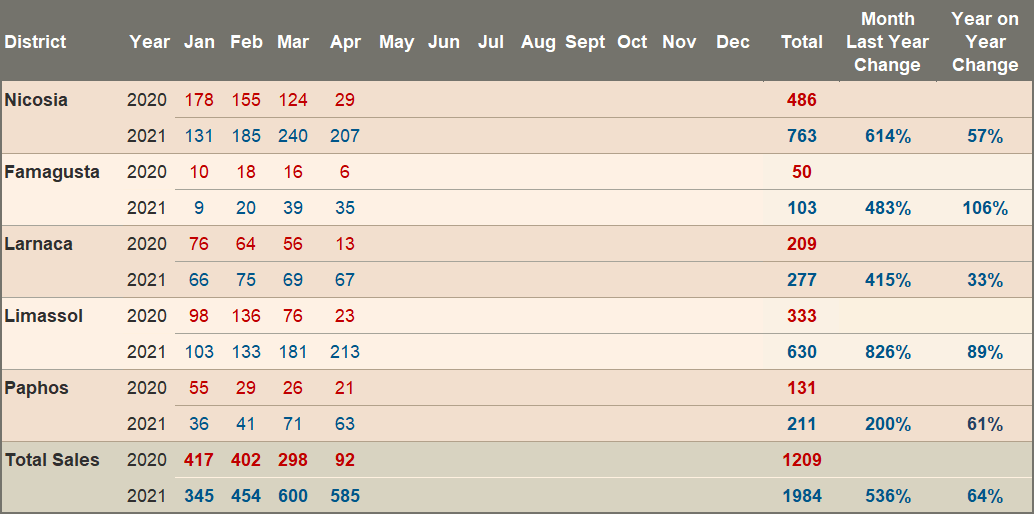
Domestic Property Sale Transactions
Domestic Property Sale Transactions – 2020/2021 Comparison

Property sales to the overseas market

Sale transactions to non-Cypriots almost doubled in April compared to the same month last year, with sales rising in all districts.

In percentage terms, Larnaca led the way with sales up 518%, followed by Famagusta (+175%), Nicosia (+144%), Limassol (+61%) and finally Paphos (+31%.)

Property sales to non-Cypriot in the first four months of 2021 stood at 833, 46% lower than the 1,540 sold in the first four months of pre-Covid 2019.

We expect sales will increase as international travel becomes easier and more foreigners are able to travel to Cyprus. But this will require the Cyprus government and all those residing in Cyprus to keep the number of Covid infections under control to encourage foreign visitors.
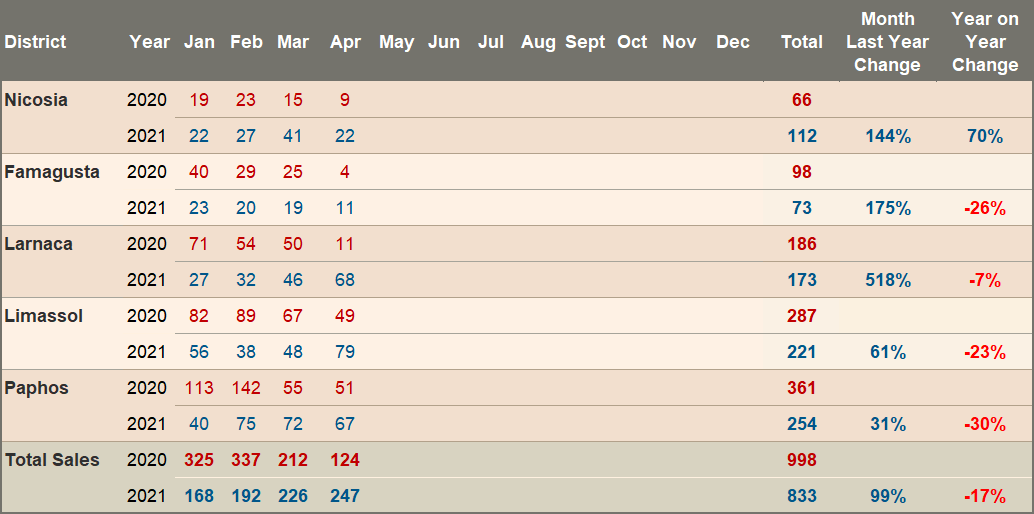
Total Foreign Property Sale Transactions
Total Foreign Property Sale Transactions – 2020/2021 Comparison

Property sales to EU citizens

Sales to the EU segment of the overseas market, which accounted for 14% of all sales, performed well with sales up by 174% compared to April 2020, with sales rising in all districts.

Over the first four months of 2021, the number of sales stood at 375, 23% lower than the 484 sold in the first four months of pre-Covid 2019.
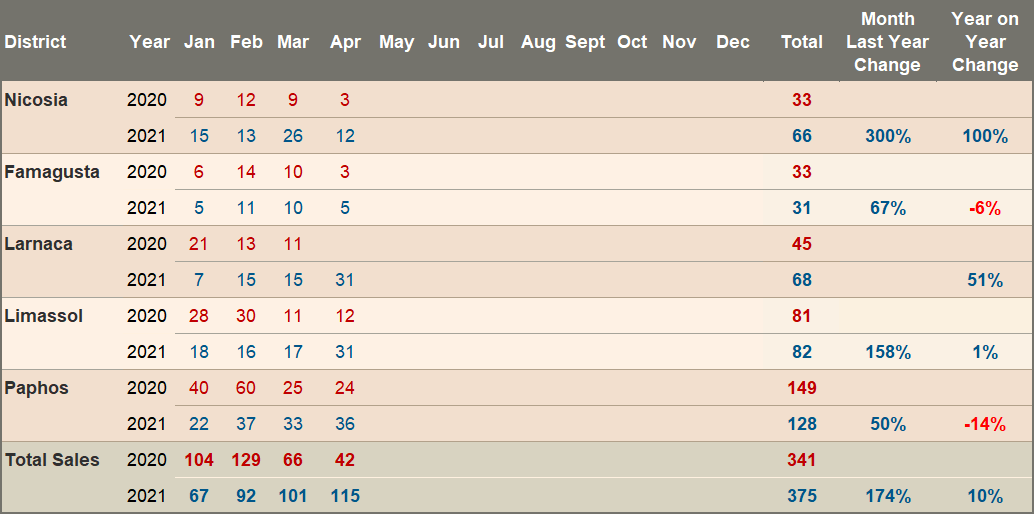
Foreign (EU) Property Sale Transactions
Foreign (EU) Property Sale Transactions – 2020/2021 Comparison

Sales to non-EU citizens

Sales to the non-EU segment of the overseas market, which accounted for 16% of all sales, didn’t perform as well as other segments but still achieved a 61% rise in transactions compared to April 2020, with sales rising in all districts.

During the first four months of 2021, the number of sales reached 458, 57% lower than the 1,056 sold in the first four months of pre-Covid 2019.
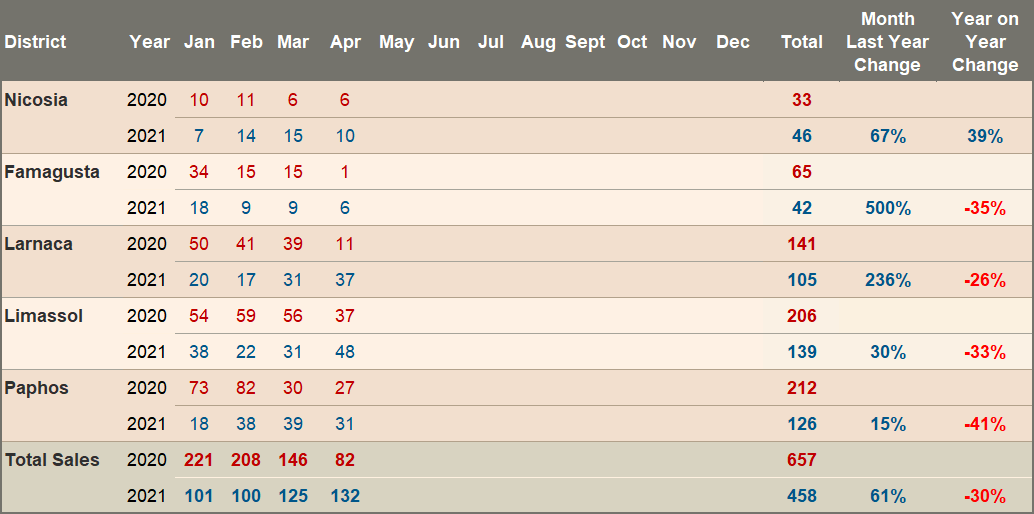
Foreign (non-EU) Property Sale Transactions
Foreign (non-EU) Property Sale Transactions – 2020/2021 Comparison

Analysis of property sales since 2000

Cyprus Property Sale Contracts 2000 – 2021

Year Overseas Sales Domestic Sales Percentage
Overseas Sales
Total Sales
2000 450 12,214 3.6% 12,664
2001 1,207 12,849 8.6% 14,056
2002 2,548 14,111 15.3% 16,659
2003 3,981 15,294 20.7% 19,275
2004 5,384 11,947 31.1% 17,331
2005 6,485 10,106 39.1% 16,591
2006 8,355 8,598 49.3% 16,953
2007 11,281 9,964 53.1% 21,245
2008 6,636 8,031 45.2% 14,667
2009 1,761 6,409 21.6% 8,170
2010 2,030 6,568 23.6% 8,598
2011 1,652 5,366 23.5% 7,018
2012 1,476 4,793 23.5% 6,269
2013 1,017 2,750 27.0% 3,767
2014 1,193 3,334 26.4% 4,527
2015 1,349 3,603 27.2% 4,952
2016
1,813 5,250 25.7% 7,063
2017
2,406 6,328 27.5% 8,734
20181 4,367 4,875 47.3% 9,242
2019
4,482 5,884 43.2% 10,366
2020
2,985 4,983 37.5% 7,968
2021 (Apr)
833 1,984 29.6% 2,817
Totals
73,691 165,241 30.8% 238,932

1 The Department of Lands & Surveys has advised that overseas sales in 2018 and subsequent year should not be compared to sales in previous years due to changes in the methodology used to classify ‘Aliens’ (foreigners).

Property sales making a strong recovery

Cyprus property sales surged for a second consecutive month in April as buyers continued to return to the market in the wake of the Coronavirus pandemic.

The property market saw a steep rise in sales with 832 contracts deposited at Land Registry offices across the island in April up a staggering 285% compared to the same month last year.

With the exception of Paphos, all districts report increased sales in the first four months of the year.

Sales to the domestic housing market have been encouraged by historically low interest rates and government incentives such as the interest subsidy scheme.

The interest subsidy scheme covers housing loans to individuals in Cyprus for which a contract was made from 01/03/2020 and will be approved by 30/06/2021 for the purpose of owner-occupied housing, and, specifically, for the primary residence’s purchase or construction, including purchasing the plot.

The maximum duration of the interest subsidy is four years and the interest rate will be subsidised up to 1.5 percentage points (150 basis points). The loan amount for which the interest rate will be subsidised cannot exceed €300,000.

The scheme does not apply for loans where the interest rate has been subsidised through other special government schemes and/or existing housing loans restructurings.

Total Property Sale Transactions – 2020/2021 Comparison

The Department of Lands & Surveys has yet to publish the figures for overseas property buyers for April but March figures, which were released yesterday, reveal a 53% rise in sales to EU citizens and a fall of 14% in sales to non-EU citizens compared to March 2020. (We expect part of the fall to non-EU citizens can be attributed to UK citizens looking to buy holiday homes. Since Brexit all the money to purchase a property must come from abroad and they are no longer able to borrow money from the banks in Cyprus.)

How Golden Passport providers cheated the system

The 515-page interim report into the disgraced Cyprus Citizenship by Investment (aka Golden Passport) scheme revealed that more than half the 3,000 citizenships granted between 2007 and August 2020 were unlawful.

Further analysis of the interim Golden Passport report (in Greek) reveals some of the tricks used by the service providers to mislead the authorities and the banks.

According to a statement by the Cyprus Central Bank’s Governor: “in many cases, local financial institutions were misled by various tricks used by service providers and property developers, which made it extremely difficult to identify suspicious transactions.”

Amongst the most popular tricks was (a) splitting investments into a number of smaller transfers to avoid drawing the bank’s attention to the investor and (b) depositing the money directly into the property developer’s bank account thereby avoiding opening a bank account in the depositor’s name.

The top eight ways to cheat the Golden Passport system

  • Using deposits as collateral that enabled investors to obtain loans for an appropriate amount. Finance Minister Constantinos Petrides told the Commission that this trick was used “to such an extent that they can safely be classified as fraudulent.” An investor could deposit €5 million in a bank account and apply for a loan secured on the basis of that deposit, and then remit the money back to his country.
    In essence, the intermediary’s start-up costs and the interest difference were simply paid and the applicant received a passport, Petrides said.
  • Submitting an application for the citizenship of an investor’s spouse rather than the investor themselves. This usually happened in circumstances where the actual investor had a criminal record and their application would have been subjected to detailed scrutiny by the authorities and possibly rejected.
  • Selling the same property to several investors.
  • Returning money to the investors. The Commission noted that the money for management should have been paid by the buyer rather than the seller, but in many cases, it was the seller who paid the buyer. The Commission noted that a particular property developer “seems to be involved in all possible attempts to defraud the state.”
  • Making false or misleading statements. In some cases, service providers knew that the investor did not meet the criteria to apply for a Golden Passport but nevertheless submitted false or misleading applications for scrutiny in the full knowledge that those applications did not reflect the true situation.
  • Illegal use of client accounts. In some cases, investors transferred money into  client accounts of service providers that was subsequently used to buy a permanent residence. The Commission noted that this could have been done to avoid banking system’s checks and controls. (The investor should have paid the money into their own company’s account.)
  • Misleading advertising used by service providers to attract investors. Although the government tried to stop illegal advertising by introducing a code of conduct in 2018, the Commission reported that “no one controlled how the service providers and their various partners around the world presented the Citizenship by Investment program or what they promised potential investors.”
  • Service providers’ employees acting as the investor’s “guarantor”. In a significant number of cases the Commission discovered that the person who acted as the investor’s guarantor had the same address as the service provider, ” breaching the conditions of the application with a nod from the Ministry of Internal Affairs.” According to the Commission, the explanation for this seems to lie in the fact that most investors did not have close ties with Cyprus and therefore found it difficult to find people to vouch for their integrity.

It is obvious that the laws and regulations governing the disgraced Cyprus Golden Passport scheme had more holes than a Swiss cheese. Lawmakers who featured in the Al Jazeera undercover video must have known about these shortfalls, which begs the question why didn’t they raise their concerns in Parliament? (That’s a rhetorical question, which I think everyone could answer.)

Marginal fall in residential property prices

Residential property prices dropped a marginal 0.2% in the fourth quarter of 2020, its second marginal consecutive quarterly reduction, with the government’s interest rate subsidy scheme offsetting the negative impact of the COVID-19 pandemic.

According to the Residential Property Price Index (RPPI), compiled by the Central Bank of Cyprus, residential properties in the fourth quarter of 2020 recorded a quarterly reduction of 0.2%, following a decline of 0.4% in the previous quarter.

On an annual basis, the index marked a slowdown showing in increase of 0.8% in Q4, compared with a rise of 1.2% in the previous quarter.

The residential property sector found itself in dire straits due to the COVID-19 pandemic and a drastic reduction in demand due to the termination of the Cyprus Investment Scheme, the central bank said in a memo.

However, as the CBC noted, “the state scheme for interest subsidisation for housing loans seems to have boosted domestic residential demand, particularly in 2020”.

CBC also noted that recent years showed a change in customer preference to cheaper or smaller residences resulting in an increase demand for apartments over houses.

According to the CBC, house prices dropped 0.5% quarter on quarter as opposed to apartment prices which rose by 0.7% in the last quarter of 2020. Compared with the fourth quarter of 2019, house prices declined marginally by 0.1%, while apartment prices rose by 2.7%.

“The restrictions imposed in 2020 due to the COVID pandemic, as well as the termination of the Citizenship for Investment Scheme inevitably affected transactions in the real estate sector,” the CBC said.

It added that the real estate market, despite the decline in demand from foreign buyers, was boosted by domestic demand, facilitated by the government’s interest rate subsidy scheme.

Limassol is king of the Cyprus real estate market

Limassol continues to be the most important real estate market in Cyprus, and all available information supports this: sales, rentals, and prices.

Contrary to popular opinion, the Limassol real estate market is not showing signs of saturation, and despite existing issues and occasional fluctuations, it continues to be dynamic.

The repeal of the Cyprus Citizen by Investment Programme, for example, has had an evident effect.

Yet, interest for high-end properties in Limassol has not completely disappeared, with real estate companies adjusting accordingly.

In 2020, 54% of the transactions for Real Estate assets worth over €1.5 million were recorded in Limassol, according to a PwC Cyprus report.

Given that there are still quite a few available high-end properties in the district, the developers behind them must make appropriate adjustments.

At any rate, in 2020, Limassol was well ahead in terms of transactional value (the total amount exceeded €1.1 billion), and it was second in the volume of transactions (28% of the total).

With the pandemic and its effects on economic growth coming under control, we estimate that property development in the city and the wider Limassol area will continue at a rapid pace.

Limassol real estate projects

After all, it’s not a coincidence the Limassol district has historically absorbed the greatest number of building permits issued.

There are two main reasons why the sector’s growth will mostly head west of the city: several important projects west of Limassol are currently under construction or being planned.

These include the casino resort, a golf course, the expansion of the local mall and large residential developments; secondly, the largest available plots are west of Limassol.

To the east of the city, the available areas for development are quite limited.

We could see some tourism-oriented projects, some of which have already been announced and some new ones; however, there isn’t much room for further development.

For residential properties, which mainly involve locals, the areas of Ayia Fyla and Ayios Athanasios, north of the highway, have more potential for growth.

These areas have seen solid development in the last few years, they are relatively close to the city centre, and there’s still available land for further development.

In the last few years, we’ve seen how the city centre and the coastal front were utilized or purchased for future use, as well as how many vacant plots have remained.

In this specific area, rather than new developments, we estimate that existing buildings will be converted, modified, renovated, and upgraded in the next few years.

As shown by the 28% drop in the sales contracts submitted in 2020, compared to 2019, the real estate market in Limassol largely depends on foreign buyers.

Despite the drop, Limassol consolidated its position as the front-runner in Cyprus, accumulating 31% of the total sales contracts.

The future of the Real Estate sector in Limassol might be full of challenges but brims with potential that will allow the city to continue to be the country’s capital in property development.

About the author

Andreas Anastasiades is Director, WiRE FS

Al Jazeera ‘Cyprus Papers’ up for BAFTA award

The Al Jazeera undercover documentary The Cyprus Papers that exposed some of the players involved in the island’s citizenship by investment scheme has been nominated for a BAFTA award, it emerged on Wednesday.

BAFTA, the British Academy of Film and Television Arts on Wednesday announced the nominations for the Virgin Media British Academy Television Awards and British Academy Television Craft Awards.

These awards reward the very best in television craft and television programmes broadcast in the UK in 2020, BAFTA says.

The Virgin Media British Academy Television Awards ceremony takes place on Sunday June 6 on BBC One and BBC One HD, and the British Academy Television Craft Awards will be streamed on BAFTA social channels on Monday May 24.

The al Jazeera documentary on Cyprus was released late last year and brought the citizenship by investment programme crashing down with the revelation that politicians were ready to facilitate a fictitious Chinese investor with a criminal record to obtain a Cyprus passport.

It led to the resignation of the then House President Demetris Syllouris and his close friend Akel MP Christakis Giovanis. Both men are to appear before the committee probing the scheme later on Wednesday. An interim report on the whole passports scheme was released on Tuesday laying out a litany of irregularities by the authorities in the implementation of the programme.

Al Jazeera tweeted on Wednesday about the BAFTA nomination: “Huge news! The Cyprus Papers undercover investigation has been nominated for best Current Affairs programme this year. Good luck to all nominees and huge congratulations to the I-Unit team. Fantastic achievement,” the channel tweeted.