Cyprus to fast-track building permits starting October

Cyprus is moving to cut red tape in order to fast-track the issuance of planning and building permits, slashing the waiting time down to just 2-3 weeks.

Interior Minister Nicos Nouris said a project to fast-track building permits would-be set-in motion on October 1 to bring down the time needed to process an application from an average 18 months to just 10 or 20 days.

He said on Wednesday that with the fast-track process, those submitting their applications in writing will obtain their permit within 20 days while those who apply online can have the permit in their hands within ten days.

The Interior Minister acknowledged that, “the current procedure for granting planning or building permits is exceedingly difficult and time consuming, whether it concerns a multi-million project or a simple residence”.

He said that at present, the majority are applications by ordinary citizens and concern about 62% of planning permits and need on average 18 months to be processed.

As of October 1, applications can be submitted to all district offices of the planning department, as well as the four main municipalities – Nicosia, Limassol, Larnaca and Limassol.

Nouris explained that submitting applications online at this time can only be done at the District Offices of Urban Planning and not at the four municipalities that are not yet ready.

As of October 1, applications for building permits and the land division permits can be submitted to the offices of the local authorities, that is some 30 municipalities of the Republic.

However, in the case where applications are only submitted physically to an authority, the application should still be examined within a set period of time, said Nouris.

He explained that if the submission of the application is in writing then the time of issuance will be 20 days.

“Our efforts to simplify the procedure of issuing a permit do not stop here,” said Nouris, pledging that his ministry would also prepare a bill to reform the method used to calculate the fees for the permit.

“Rather than the current complicated system, the new one will be based per square metre of the project”.

Arguing that “authorities need to move forward, leaving the mindset of the past behind us,” Nouris said that “steps to be taken will be under constant review by the technical services and the district planning departments”.

He added that the ministry also plans to issue a work schedule and timetable indicating the period required for all permits to be issued by various authorities.

Fugitive businessman’s villa in Ayia Napa frozen

An order freezing the luxury Ayia Napa villa owned by fugitive businessman Jho Low, who was granted a Cyprus passport in September 2015, has been secured by the Unit for Combatting Money Laundering (Mokas), it was reported on Wednesday.

According to Phileleftheros, the order was secured with the collaboration of the attorney-general’s office through the Nicosia court.

Sale or transfer of the €5 million villa had already been blocked by the land registry department, the report said.

The new court order opens the way for confiscation of the property down the line and the proceeds for sale to go to the Malaysian authorities where Low is wanted on alleged fraud charges.  Low is said to have been a key figure in the scandal at 1Malaysia Development Berhad (1MDB), which US and Malaysian prosecutors say was used to siphon out hundreds of millions of dollars.

Malaysian authorities withdrew Low’s passport, issued an arrest warrant and have been seeking him since. A report from Malaysia on Wednesday said he is now believed to be in Macau.

Low came to Cyprus in September 2015 and obtained the passport under the citizenship by investment scheme within two days after investing in some property in the Famagusta district. He was not wanted at the time in connection with the 1MDB scandal.

Parliament to vote on tougher citizenship rules

The House interior affairs committee on Monday wrapped up discussion of new regulations aimed at tightening up the citizenship-by-investment programme, previously flagged by the EU as a potential money-laundering risk for Cyprus.

Lawmakers apparently reached consensus on a clause, as part of an amendment to the government regulations submitted earlier, that provides for a transition period regarding the examination of applications for citizenship filed by foreign nationals.

Under the proposal, by Diko MP Panicos Leonidou, all citizenship applications filed prior to the date on which the government submitted to parliament the new regs, will be assessed according to the rules as these applied up to January 31 this year.

The government formally tabled the new regs on June 19, 2020. That means that between January 31 and June 19 – roughly five months – there was an unclear framework on how to handle applications submitted during this period, said committee chair Eleni Mavrou.

During the five-month period in question, applications kept coming in. Some 200 applications have been filed since the beginning of the year. Despite this, the interior ministry had paused processing these applications during this time.

Therefore, Mavrou explained, the new regulations now being discussed would apply to those citizenship applications filed after June 19.

The pending applications – those filed between January 31 and June 19 and which were put on hold – would be processed under the previous regulations – which were laxer.

Mavrou said MPs inserted a number of amendments to the government regs governing the citizenship scheme, rendering it more robust and plugging a number of loopholes.

But Greens MP Giorgos Perdikis sounded his displeasure at the fact the committee rejected an amendment designed to bolster transparency – the obligation of the government to publish the names of those granted citizenship, and the nature of their investment.

Another proposal, also rejected by the majority of MPs, would have seen foreign investors contributing €100,000 to the fund for depositors who suffered a haircut and to the bond holders wiped out in 2013.

Of the additions that did make it, foreign nationals seeking the Cypriot passport will now be able to invest in sectors other than real estate, such as the primary sector, research and development, technology, healthcare and renewable energy sources.

The House plenum will be voting on the regulations and two related bills, and on any amendments or additions to them, on Friday.

One of the features in the updated rules includes the revocation of a citizenship where the state would be able to invoke “reasons of public interest”.

It’s also understood the new rules allow the state to withdraw Cypriot citizenship from a person if within 10 years of the date of naturalisation they have: been convicted in the Republic or any other country for a serious criminal offence which entails a prison sentence of five years or more; are wanted by Europol or Interpol for a serious criminal offence; or have been placed on a sanctions list.

The new ordinances also hold accountable entities registered as service providers assisting foreign nationals in filing their applications.

Once the new rules apply, the screening of applicants begins not from the moment they file an application, but earlier – once they select their service provider.

Service providers would retain their status for one year only, after which they would need to renew their licence.

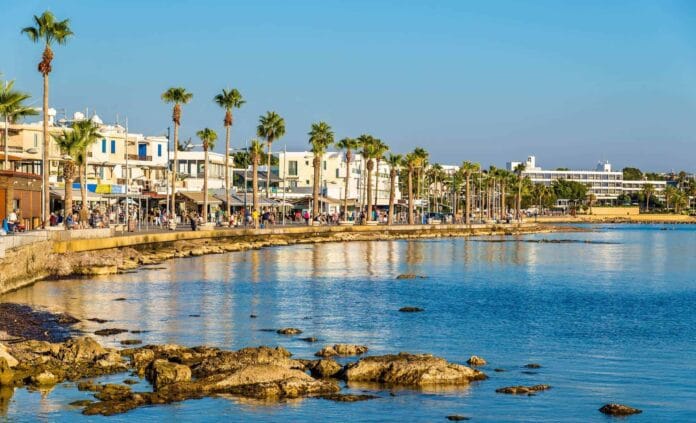
Paphos undergoes multi-million facelift

Paphos is in for a facelift with its fair share of new developments while getting smarter with digital projects worth tens of millions of euros nearing completion or in the making.

Once lagging behind other towns in Cyprus regarding development activity, Paphos is catching up with the construction industry picking up from where it left off before the coronavirus outbreak with the municipality pushing ahead.

Paphos Mayor Phedon Phedonos told the Financial Mirror that while the private sector is gaining speed, resuming projects in building villas and luxury apartments connected to the Citizenship for Investment scheme, the municipality is putting forward its own pioneering projects.

“At the moment there are 10 major projects that will radically change the way the town looks and function, including a facelift of the public transport network,” said Phedonos.

The Paphos Mayor said these projects will not only add value and upgrade the tourist experience but also entirely change the town’s landscape.

“There are currently 10 development projects in the pipeline, worth tens of millions of euros, which will help Paphos change gear.”

The municipality has taken on a €9 million project to connect the town’s archaeological sites with a 14 km long linear park to upgrade the visitor’s experience.

More than €12 million is to be spent on restructuring Hellas, Griva Dhigenis and Neophytou Nikolaides avenues with a budgeted expenditure of €8.3 million.

Psarochori, the traditional centre of Kato Paphos will be revamped at a cost of €3.8 million.

“Development is not only about building new roads and sidewalks, it is about offering a better quality of life to our citizens and upgrading tourists’ experience.”

The municipality is to invest €7.6 million in upgrading public transport infrastructure in Paphos and Geroskipou which includes the creation of a Central Bus Station in Karavella, the creation of 2 smaller transit hubs at the port and in the Tombs of the Kings area.

The public transport network will also install 196 “smart” bus stops in Paphos and Geroskipou.

Smart bus stops inform passengers on the real-time arrival of their bus.

Phedonos told the Financial Mirror that a total of €20 million will be spent on making the town smarter.

Smart street lighting and smart poles collecting information on the environment and the weather are to be installed.

The smart poles will be able to pick-up basic information regarding weather conditions such as temperatures, humidity levels, wind speed and direction.

They will also be able to collect data on more complicated issues such as noise and air pollution, while also providing internet access to drivers on the roads by acting as Wi-Fi access points.

“A novelty to be introduced, making life easier for citizens and municipality workers in the adoption of a digital Geographic Information System (GIS) which will be a virtual map of the town with information on almost everything in the town,” said Phedonos.

The system will be able to provide a real-time x-ray map of Paphos giving real-time information on water consumption at green spots, archaeological parks, the progress of building permits applications, and even parking places.

The project is to cost some €360,000.

GIS will interact with another application called ‘Lora’ which will feed mobile applications with data which can be used by citizens to settle bills with the municipality and find a free parking spot.”

The mayor said the town hall will be spending some €600,000 on developing smart applications.

“Our aim is to make people’s lives easier creating an online one-stop-shop, where citizens and foreign investors will be able to carry out most of their daily tasks online.”

Real estate measures to counter the impact of Covid-19 in Cyprus

The Cyprus real estate market is held hostage by the coronavirus, and its performance is going to get worse before it gets better.

The effects on real estate will vary and the extent of the effects will depend upon the duration of the virus, the development of the vaccine, and how quickly we apply real estate measures.

When it comes to the Cypriot real estate, most local experts they do reassure the public opinion that the real estate market will rebound by 2021.

However, without the provision of property measures this scenario does not seems realistic.

To date, the only real-estate oriented measure that has been launched by the government is the 4-year subsidy of the interest rate (up to 1.5%) for housing loans with a loan value of up to €300,000.

To this end, the fact that this measure is applied only for owner occupancy and up to the threshold of €300,000 spark concerns as to its potential effectiveness.

Moreover, for boosting the confidence in an industry a combination of measures needs to be launched.

For this purpose, we propose five measures that if launched by the government within 2020, they will provide grounds for the rebound of the real estate market by 2021 – 2022.

  1. An exemption from future capital gains tax for properties purchased until the end of 2021

This effective measure has been applied in 2015 and it was active until the end of 2016.

The potential re-introduction of this measure will act as an exceptional incentive for real estate investors and first-time buyers.

This tax-benefit should be also transferred from parents to their children for the subject properties.

  1. The current discount in Transfer fees by 50% to become 70% until the end of 2021

The current discount in transfer fees by 50% has been initially launched in 2015 and it is still active.

A further reduction by 20%, thus equalling a discount of 70% will offer a better transaction environment.

  1. The existing 4-year subsidy of the interest rate to be extended from €300,000 to €500,000

Similar help-to-buy schemes in other countries, like the UK, offering support for properties up to £600,000.

Extending the threshold up to €500,000 will make the programme accessible to a greater pool of candidate buyers and to different type of homes.

  1. Cyprus Investment Programme needs to be protected

This programme is significant for the Cypriot economy since it has positively contributed either directly or indirectly to all sectors and professions of the economy.

Its immediate impact in 2017 and thereafter in 2018 and 2019 can be better understood when we recall that the programme has become really useful only after its updates of September 2016; which several unreasonable investment barriers were abolished.

For instance, in September 2016 the government abolished the provision of collective investment of €12 million and replaced it by an individual investment of €2 million.

This modification alone was sufficient enough to provide to the Cypriot economy the necessary boosting for eliminating the pessimistic environment of 2013.

This fact reminds us the need to shield this programme and the necessity to devote more attention and funds for improving it and introducing it to other continents as well.

  1. Change the Definition of an “Old” Property from 10 years to 3 years (with retrospective effect)

The current classification in Cyprus of an “old” property is any property that is at least 10 years old. However, in other EU countries, this is not the case, for example in France an old property (Exempt from VAT) is classified as any property that is completed for more than 5 years, while other countries have different definitions and different thresholds of even up to 2-3 years.

By changing the Cyprus classification of an old property from 10 years to 4 or 3 years there are several benefits.

First, owners who bought or will buy a home with a reduced VAT will have the option to sell or rent their home well before the lapse of 10 years, without taking the burden of the onerous EU VAT policies.

Secondly, the developers will be able to sell their unsold stock in better conditions than otherwise. Finally, together with the increasing demand (measures 1,2,3 and 4) all buyers will have larger property options and better quality of homes to choose from – than otherwise. This measure will also smooth-out the negative effects of the existing EU VAT policies in the Cypriot real estate industry.

The above-mentioned measures are important for creating the necessary real estate conditions for sparking and bringing back the interest in the Cyprus real estate industry.

By successfully doing so, we equivalently stimulate the consumption in all sectors of the economy, stabilise and reduce the unemployment, minimize the risk of non-performing loans and all of their associate severe consequences and also the government increases its revenues.

To this end, it is important to recall that back in 2013 crisis the government has introduced its previous “boosting real estate measures” very late, by July 2015 and September 2016.

However, despite that delay, it became immediately apparent how positively fast Cyprus real estate market responded to those 2015 & 2016 real estate reforms.

The complications of Coronavirus in our real estate market should not be underestimated and therefore collective real estate measures need to be launched immediately by the government to make sure that this time we don’t waste again another 2 – 3 years of recession and of low economic performance.

About the author

Dr. Charalambos Pitros is a Real estate Investment Consultant and MRICS Valuer at Zyprus Property Group – Property Consultants & Estate Agents.


Pissouri homeowners say government decision ‘long overdue’

Homeowners in Pissouri on Friday were uncertain over a government pledge that works would begin in the area in 2021 to stabilise the soil.

“It is very difficult to have confidence” after eight years of nothing, Anthony Walker, affected homeowner and retired chartered surveyor told the Cyprus Mail.

“I was present in September 2015 when the interior minister at the time gave a press conference and said €20m would go to solve problems. In the intervening time, nothing happened.”

On Thursday, the government said earthworks would commence in early 2021 at a cost of around €33m to stabilise the soil in the Pissouri area, where subsidence has caused serious damage to dozens of properties there throughout the years, with houses falling apart.

Following a visit to the site, Interior Minister Nicos Nouris said a study has recommended excavations at several points in the area, some to a depth of 39 metres, and the insertion of a mesh of shoring piles in a bid to stabilise the soil.

The project will also feature the construction of rainwater runoff and sewerage systems. Upon the project’s completion, said Nouris, there are plans to build public amenities for the community, such as sports grounds and sports facilities.

In addition, some of the land in the area would need to be expropriated.

The final report on the action to be taken will be submitted around January 2021, after which the government will immediately invite tenders for the construction project.

“This ambitious project is not expected to be finished before the end of 2022,” said the minister.

According to surveys, the land has been shifting by approximately 8 centimetres a month.

Many of the affected homes in Pissouri have virtually collapsed, the result of a continuous and accelerating landslide, and a number of residences are deemed unfit for habitation.

The problem dates back to at least 2012.

Lawyer for the Pissouri housing initiative Georgia Elina Zoi said on Friday this was one of the largest projects to be undertaken in Cyprus and there was trust towards Nouris as so far “he hasn’t delayed anything.”

Problems with delays tend to come from the district authority but the minister has pledged that the safety and security of the residents is a priority, according to Zoi and has even gone as far to say that means if they need to be relocated, this will be done.

Chairman of the initiative Peter Field said “we are obviously very much in the problem. We were evicted five years ago, rented and now established a new house in a new area.”

The government decision is “long overdue,” he told the Cyprus Mail.

Nonetheless, there is still uncertainty as to whether there will be compensation for people such as himself that have lost their home.

According to Zoi, the minister said it would be irresponsible to talk about compensation at the moment, stressing that the government is focused on stabilising the area and resolving a chronic problem.