Stop vulture attacks on trapped buyers

Government intervention is needed to stop Credit Acquiring Companies, better known as Vulture Funds, demanding money from debt-free trapped buyers to release title deeds for the properties they purchased.

(“Vulture” is a metaphor that compares vulture funds to the behaviour of vultures, birds that prey on carcasses to extract whatever they can from their defenceless victims.)

Elikkos Elia, the permanent secretary of the interior ministry, said on Wednesday that “progress” is being made in addressing the challenges faced by Cyprus’ estimated 9,497 trapped buyers.”

But tell that to the 5,417 trapped buyers still waiting for their title deeds. While the government drags its feet, Vulture Funds are demanding money from some of them.

Who are trapped buyers?

These are people who paid for their homes in full, only to find out they couldn’t get title deeds because developers or previous owners had saddled the properties with mortgages. These buyers are now caught in a nightmare they never saw coming.

Here’s how buyers got trapped:

No legal advice – Some buyers chose not to hire a lawyer when purchasing property, trusting the honesty of the vendor and believing they were saving money. Without proper legal advice, these buyers unknowingly put themselves at significant risk of becoming trapped.

Poor legal advice – Lawyers instructed by buyers often failed to conduct proper due diligence. This would have uncovered issues like outstanding mortgages, other debts and legal disputes. (Due diligence involves checking title deeds, identifying debts, confirming the vendor’s reputation, and verifying a property’s condition and value.)

Conflict of interest – In some cases, lawyers worked in the interest of vendors rather than protecting their clients (the buyers). They used vendor-prepared contracts that heavily favoured the seller, leaving buyers exposed with very little to no legal protection.

Bank waivers

Buyers whose lawyers conducted proper due diligence discovered that their vendor had mortgaged the property. While some buyers walked away, others sought bank waivers – agreements where the lending bank waived its rights to repossess the property if the vendor failed to repay the loan.

While waivers allowed buyers to eventually obtain title deeds, they came with limitations. For example, if the buyer wanted to sell the property before receiving the title deed, the new buyer would need to apply for their own waiver, as waivers are not transferable.

Non-performing loans and Vulture Funds

To address their high levels of non-performing loans (NPLs), Cyprus banks sold much of this distressed debt to Vulture Funds.

  • Vulture Funds specialize in purchasing non-performing loans at a steep discount – believed to be between 15% and 20% of their original value.
  • This helped Cyprus banks reduce NPL ratios from 49% in May 2016 to a record low of 6.8% in August 2024. While this was a success for the banks, the consequences for buyers have been severe. These distressed debts included the underlying non-performing loans on properties purchased by trapped buyers.

Vulture Funds use aggressive tactics to recover more than they paid for these loans, including legal action, demanding repayments, and seizing assets like real estate.

Debt-free trapped buyers targeted by Vulture Funds

Buyers who are debt free are now being pursued by Vulture Funds. These funds are demanding additional payments, despite buyers having paid in full for their properties (and have proof of payment).

  • In one case, a Vulture Fund demanded over €20,000 from a trapped buyer.
  • In another, a trapped buyer was asked to pay €5,000.

These Vulture Funds also demand proof that payments were made directly into the developer’s bank account, even though developers ceased trading over 15 years ago and the records demanded are no longer available.

No transparency, no accountability

These Vulture Funds don’t tell buyers how much debt is linked to their property or how they calculated it. They operate in total secrecy, bullying people who have done nothing wrong.

Government must step in

This situation is scandalous. The government must stop these vultures from destroying lives by:

  • Banning them from targeting trapped buyers who have already paid for their homes.
  • Forcing complete transparency on debt claims.
  • Protecting debt-free trapped buyers from losing their homes.

Trapped buyers have suffered long enough – it’s time to end this exploitation once and for all!

Most acquitted in golden passports fraud case

A Nicosia criminal court on Thursday acquitted most of the defendants in a case concerning the disgraced Golden Passports scheme, ruling that the charges of conspiracy to defraud the state were not proven beyond reasonable doubt.

The case involved the naturalisation of a foreign national named Mohamed Salem, as well as two of his relatives – Bahaa Salem and Esraa Salem. Salem had invested in Cyprus to obtain a Cypriot passport.

In August last year, Salem and a further seven individuals saw their golden passports go up in smoke and their Cyprus citizenship revoked as investigators uncovered discrepancies in the personal data submitted to the authorities.

Salem himself was not a defendant in the trial. The defendants included property developers, businesspeople, and solicitors who had facilitated the citizenship application. At the time, the requirement for obtaining citizenship was a €2 million investment in real estate.

According to prosecutors, the defendants had allegedly conspired to defraud the state by submitting forged documents, falsely claiming the €2 million investment criterion had been met. The alleged offences occurred at various times between 2017 and 2019.

However, the court found no evidence of intent to defraud the Republic. Instead, it identified irregularities and mistakes in the documentation submitted.

As a result, the court acquitted the following defendants of the charge of conspiracy to defraud: solicitors Fotos Tsangarides and Elli Michaelidou, Michalis Michael – the director of the Zavos Group – and the companies PHC Tsangarides LLC and Fullserve Secretarial Ltd.

Nevertheless, the court found two of the defendants guilty of fraudulent avoidance of VAT. These were Michalis Zavos, CEO of Larina Estates Ltd, and Larina Estates itself.

The court determined that these defendants had deliberately concealed invoices relating to the sale of apartments. These properties, as it transpired, were not used as permanent residences by the foreign investor.

Under the applicable law, sales of real estate intended as permanent residences for the purposes of the naturalisation programme were subject to a reduced VAT rate.

The inquiry into the citizenship-by-investment programme, more commonly known as the Golden Passports scheme, was completed in June 2021.

A damning report put together by a probe committee headed by former supreme court judge Myron Nikolatos said over half (53%) of the 6,779 golden passports were granted illegally, encouraged by a due diligence vacuum or insufficient background checks.


Trapped Buyers resolution formula being reviewed

The new formula designed to help as many Trapped Buyers as possible to get Title Deeds has been handed over to political parties and stakeholders for review. There are currently 9,497 pending cases, while 11,462 titles have already been issued.

A legal framework has been developed by the Ministry of Interior in collaboration with a special working group to help genuine Trapped Buyers obtain Title Deeds. This follows a court ruling that deemed the 2015 legislation unconstitutional.

According to reports, the new regulation discussed by the working group yesterday allows forced transfer of Title Deeds to buyers if no property encumbrances existed at the time the sales document was submitted. This measure aims to support Trapped Buyers who bought in good faith.

In cases where a Title Deed cannot be issued due to planning violations, the Land Registry has been instructed to issue the Title Deed to the original owner if the violations are covered by the latest urban planning amnesty. The goal is to resolve as many cases as possible.

Since the 2015 ruling, 9,497 Trapped Buyers applications remain unresolved. Out of 21,461 applications submitted since September 2015, 11,462 titles have been issued, 502 applications were rejected, and the remaining cases involve 4,080 titles delayed due to planning issues and 5,417 titles still under the name of the original developer.

Trapped Buyers meeting

These issues were discussed at a meeting chaired by Dr. Elikkos A. Elias, Director-General of the Ministry of Interior. Participants included MPs Aristos Damianou and Panikos Leonidou from the Legal Affairs Committee, representatives from the Land Registry, the Ministry of Finance, the Legal Service, the Cyprus Bar Association, the Bankers’ Association, and credit acquisition companies.

“We’re making good progress on amendments to the law so that the Land Registry can resume processing application from Trapped Buyers,” said Dr. Elias. The Ministry’s proposed regulation was reviewed, and participants are expected to submit comments next week. “We will finalise the draft and submit it to Parliament to start discussions and move forward with the legal changes,” he added.

Aristos Damianou, MP and head of the Parliamentary Interior Committee, noted the complexity of the legal issue. He explained that buyers acting in good faith who have fulfilled their financial obligations should be able to proceed with title issuance and transfer, provided that financial institutions agree. However, he acknowledged there are many procedural requirements.

“We are very close to finding solutions that could significantly address the Trapped Buyers problem,” said Panikos Leonidou, a member of the Legal Affairs Committee. He emphasised that collaboration between all parties, including the Ministry, Parliament, Legal Service, and banks, is key.

When asked about banks’ willingness to continue suspending foreclosures, Dr. Elias confirmed that banks have committed to maintaining the suspension for properties involving Trapped Buyers who have submitted applications.

Translated from an article published in Politis

Developers call for jointly-owned buildings law reform

Mersina Isidorou, the director general of the Cyprus Property Developers Association, has called for reforms to laws governing jointly-owned buildings as the House examines new legislation to address regulatory shortcomings.

She highlighted that the 2023 law on managing common buildings, currently under review by the House committee on internal affairs, aims to resolve longstanding regulatory issues.

“The term ‘communal living’ has regrettably become synonymous with various challenges for property owners, tenants, and the broader real estate sector,” Isidorou noted.

She emphasised the need for a robust legal framework to accommodate the rapid growth in shared ownership properties.

Key jointly-owned buildings law reforms

To enhance the legislation, Isidorou said the association recently hosted a roundtable discussion with Interior Minister Louiza Zannetou, MP Panicos Leonidou of DIKO, and other stakeholders. Based on this meeting, the association, with guidance from its legal team, drafted a memorandum of proposals, which was submitted to the Interior Minister and the commissioner of legislation, advocating key reforms.

Among these, she highlighted the need to establish management committees when building permits are issued to ensure effective management of common areas. Temporary management committees should be managed by the original owner or the property developer until such time as the unit owners elect a regular committee at their first general meeting, she said.

Isidorou proposed allowing committees to outsource services, provided funds are available, and suggested that common charges be calculated based on square meterage. Adjustments could be made by the general assembly according to property usage (residential, commercial, office). She added that charges should be certified by the committee and settled within 28 days to minimise disputes and suggested charging compound interest on overdue payments.

Recognising the uncertainty of future needs, Isidorou stressed the need of mandatory sinking funds, to be maintained by management committees. These sinking funds will be topped up annually by a small percentage (e.g. 0.02%) of the property’s value based on its Land Registry valuation.

Regarding shared amenities like swimming pools, Isidorou advocated for appointing designated managers and restricting usage to private use (for family and guests) unless otherwise approved by the management committee.

To streamline management, the association proposed creating a register of common buildings, linked to the Land Registry, accessible through platforms like the ‘Ippodamos‘ system or digital IDs.

Acknowledging the potential impact on vulnerable groups, Isidorou suggested a financial assistance fund with clear eligibility criteria to support those in need.

She concluded by underscoring the urgency of creating a modern legal framework for shared buildings to improve quality of life, ensure safety, and promote sustainable development. With collective effort, she expressed confidence that meaningful reform could be achieved by 2025.

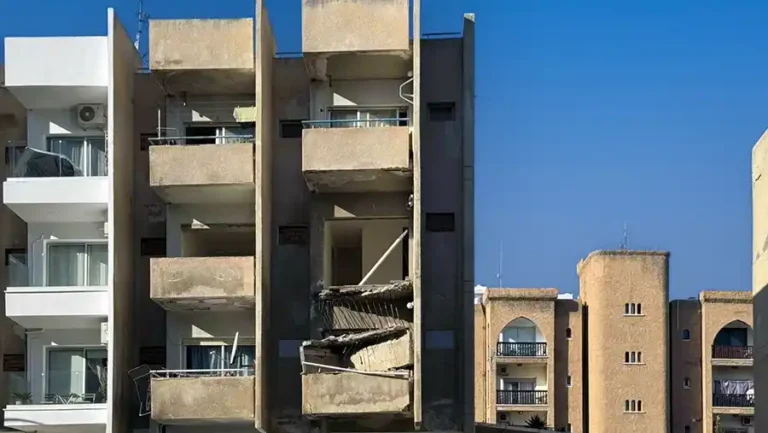
Balcony collapse in Limassol tourist area

A second-floor balcony of an apartment building in the Germasogeia tourist area of Limassol collapsed on Tuesday, falling onto the first-floor balcony below.

The incident occurred shortly after midday. Amathus mayor Kyriakos Xydias highlighted the ongoing issue of ageing and potentially unsafe apartment buildings, which he described as a longstanding problem.

The mayor noted that the collapsed building is one of four identical structures that have caused concern for years. He mentioned that the former Germasogeia municipality had repeatedly raised the matter with the building’s operator through official correspondence. The operator had even been brought before the Germasogeia municipal council to address the concerns.

According to Xydias, the collapse resulted from renovation work, with vibrations during the attempt to stabilise and refurbish the building causing the balcony to give way. He plans to contact the Limassol district government to assess whether the company overseeing the renovations complied with health and safety regulations. However, he viewed the effort to repair the building as a positive step.

“The next step is to confirm whether the contractor obtained the necessary permits and adhered to the building’s safety plan,” he stated.

Addressing the broader issue of building safety, Xydias said his municipality has catalogued all dangerous buildings in the seafront area. However, he stressed that implementing legislation to repair such buildings, temporarily rehouse tenants, and later charge owners is practically impossible.

“We would need three or four municipal budgets to undertake this work, and we’d never recover the costs because, in most cases, the owners rent out their flats and do not live there themselves,” he explained.

Despite these challenges, Xydias aims to propose amendments to legislation. His plan would allow the municipality to declare buildings unsafe, shut them down, address safety concerns, and prevent owners from collecting rent until all necessary repairs are completed.


The highs and lows of rental prices for apartments and houses in Cyprus

A report from Landbank Analytics released earlier today analyses the rental prices of houses and apartments in Cyprus.

Andreas Christophorides, CEO of Landbank Group, noted that the average asking rental price for apartments across Cyprus is estimated at €1,803/month and €3,249/month for houses.

Rental prices vary considerably in each of the island’s five districts.

Limassol: the most expensive option

Limassol has the highest rental prices in the country. Apartments in the district cost an average of €2,742 per month, with two-bedroom units being the most common, priced at €2,460. One-bedroom apartments go for €1,599, while three-bedroom apartments reach €3,225.

Rental prices for houses in Limassol are even higher, averaging €4,492 monthly. Three-bedroom homes are the most available, costing €2,773, while four-bedroom houses average €5,000. Five-bedroom houses are rare and come with a hefty price tag of €8,936.

Famagusta: the most affordable area

In contrast, Famagusta offers the most affordable apartments, with an average rental price of €745 per month.

Nicosia: the budget-friendly option

Nicosia is the second most economical choice for apartments, with an average rent of €1,017 per month. Two-bedroom apartments dominate the market, costing €996 on average, followed by three-bedroom units at €1,319 and one-bedroom apartments at €674.

The district also has 190 houses for rent, with rental prices averaging €1,900 per month. Three-bedroom houses are the most common, renting for €1,335, while four-bedroom houses cost €2,094.

Larnaca & Paphos: mid-range options

Larnaca has 536 apartments for rent, averaging €1,120 per month. Most are two-bedroom units priced at €1,114. The district also has 219 houses for rent, with an average cost of €2,340.

Paphos offers 289 apartments with an average rent of €1,193. Two-bedroom units are the most common, costing €1,228. Houses in Paphos average €2,692 per month, making it the second most expensive district for house rentals after Limassol.

Rental prices snapshot

Across Cyprus, there are currently 3,257 apartments and 1,227 houses available for rent. The average rent for an apartment is €1,803, while houses average €3,249 per month.

Andreas Christophorides, CEO of Landbank Group, noted that Limassol’s high prices have a significant impact on the overall rental market in Cyprus.