Cyprus property sales edged down in September

The number of Cyprus property sales achieved in September fell slightly compared with the numbers sold in the same month last year according to official statistics published by the Department of Lands and Surveys.

The total number of Cyprus property sales (as measured by the number of sales contracts deposited in Land Registry offices in the free areas of the island) stood at 1,289; a fall of 4% on the 1,336 sold in September last year.

What’s noticeable in the September numbers is that foreigners appear to be focussing their attention onto the less expensive areas of the island, namely Famagusta and Larnaca.

Overall sales declined 4% and although sales in Famagusta and Nicosia increased by 15% and 8% respectively, these increases were wiped out by falls of 13% in Larnaca, 8% in Paphos and 4% in Limassol.
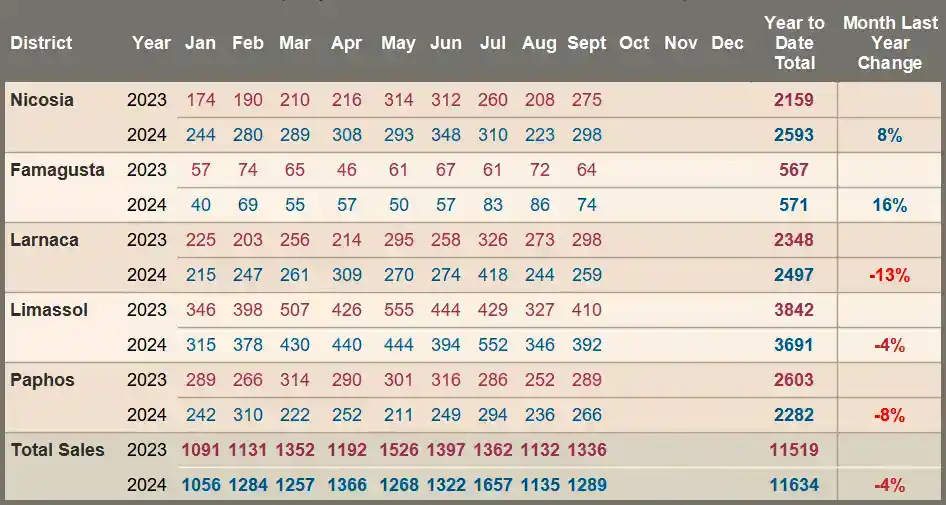
Total Sale Transactions – 2023/2024 Comparison

Property sales in the first nine months of 2024 have risen 1% compared with the same period last year.

Total contracts of sale deposited – 2023/2024 Comparison (Jan-Sept)

Cyprus property sales – market segment analysis

Sales to the domestic (Cypriot) market

The total number of sales to the domestic market in September 2024 rose 4% compared with September last year and accounted for 59% of the total number of sales in the month.

While sales in Limassol and Nicosia rose by 16% and 14% respectively, they fell 20% in Larnaca, 10% in Famagusta, and 6% in Paphos.
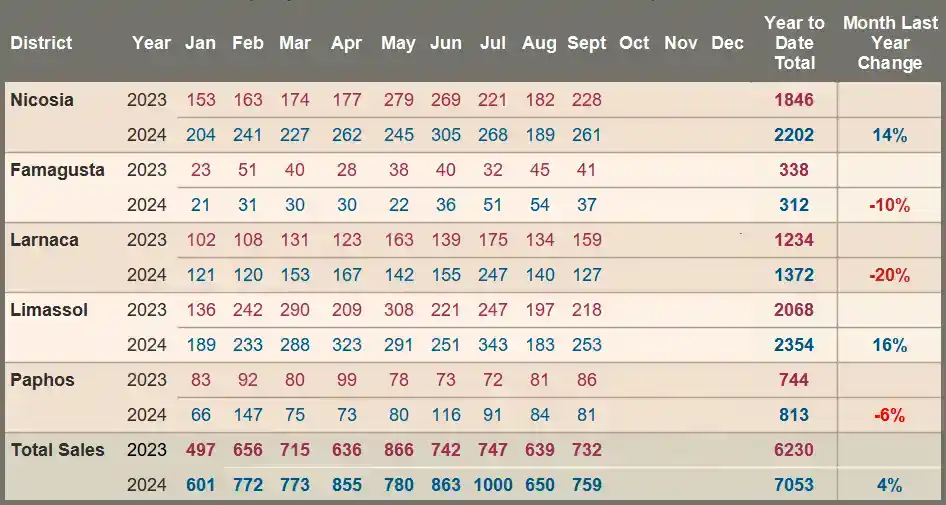
Cyprus property sales to Cypriot citizens September 2024
Domestic Sale Transactions – 2023/2024 Comparison

Sales to the domestic market in the first nine months of 2024 reached 7,075; an increase of 13% on the 6,230 achieved in the same period of last year. With the exception of Famagusta, where sales fell by 8%, all districts recorded gains.

Domestic contracts of sale deposited – 2023/2024 Comparison (Jan-Sept)

Property sales to the overseas market

The total number of Cyprus property sales to the overseas market (both EU and non-EU citizens) in September reached 530, falling 12% on the 604 achieved in September last year.

Sales fell in all districts with the exception of Famagusta, which recorded a double-digit increase of 61%.
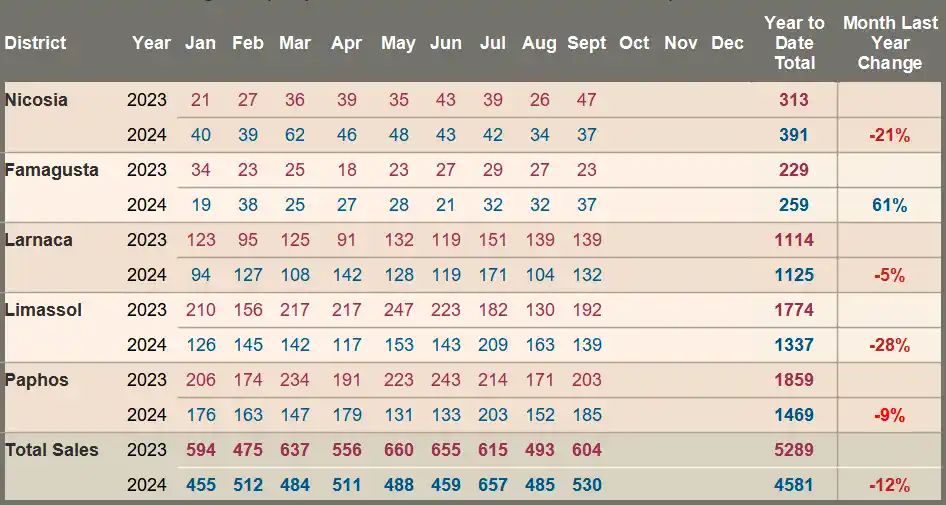
Cyprus property sales to EU and non-EU citizens September 2024
Overseas Sale Transactions – 2023/2024 Comparison

On an annual basis, overseas sales have fallen 13%. Although sales in Nicosia, Famagusta, and Larnaca have risen 25%, 13% and 1% respectively, they’ve fallen 25% in Limassol and 21% in Paphos.

Overseas contracts of sale deposited – 2023/2024 Comparison (Jan-Sept)

Property sales to EU citizens

Sales to EU citizens fell 3% to reach 171 in September compared to 176 in the same month last year.

Although sales in Larnaca and Famagusta rose 26% and 17% respectively, they fell by 23% in the other three districts.
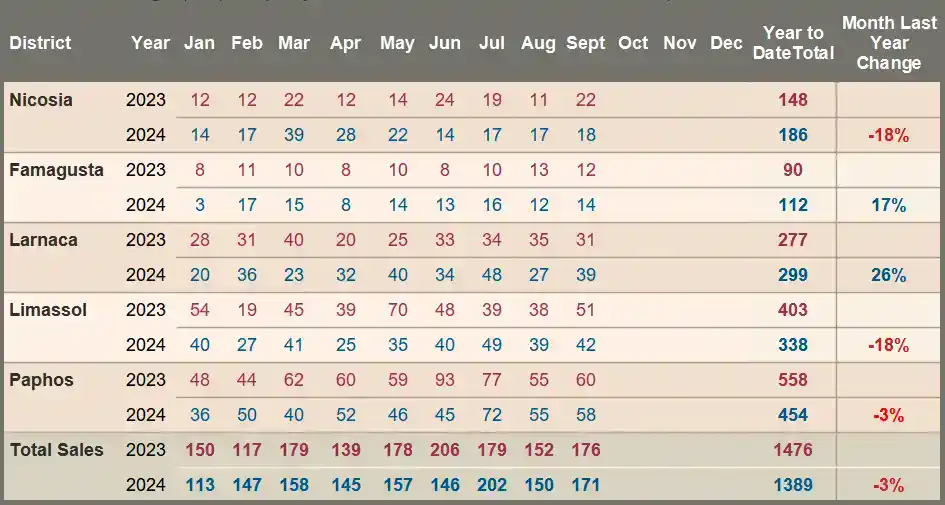
Cyprus property sales to EU citizens September 2024
Overseas (EU) Sale Transactions – 2023/2024 Comparison

Sales to EU citizens in the first nine months of 2024 reached 1389; a fall of 6% compared to the 1,476 sold in the same period last year, with sales in Paphos and Limassol 8% and 16% respectively, while sales rose by 26% in Nicosia, 24% in Famagusta and 8% in Larnaca.

Contracts deposited by EU Nationals – 2023/2024 Comparison (Jan-Sept)

Property sales to non-EU citizens

Sales to non-EU citizens fell 16% in September compared to September last year. The only district to record an increase in sales was Famagusta where they more than doubled.
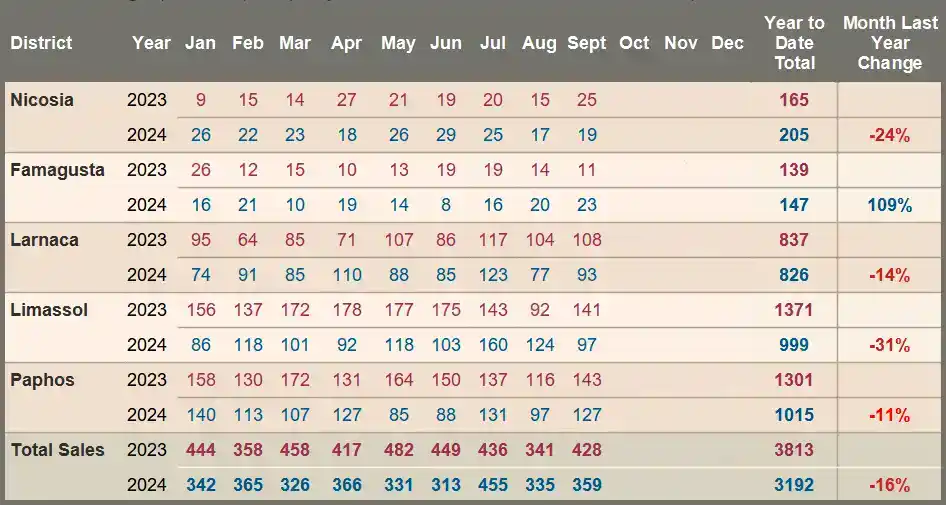
Cyprus property sales to non-EU citizens September 2024
Overseas (Non-EU) Sale Transactions – 2024/2024 Comparison

Sales to Non-EU citizens in the first nine months of 2024 reached 3,192, falling 6% compared to the 3,813 achieved in the first nine months of last year. The only district recording an increase was Nicosia, where sales so far this year have risen 24%.

Contracts deposited by non-EU Nationals – 2023/2024 Comparison (Jan-Sept)

Cyprus property sales market segment summary analysis

The chart below shows each of the district’s popularity with each of the market segments. Sales to the overseas market segments (EU nationals + non-EU nationals) exceed domestic sales in Paphos.

In Paphos, the most popular with those looking for a holiday home in the sun, sales to non-EU nationals alone exceed sales to the domestic market (Cypriots.)


Market Segment Summary Analysis 2024 (Jan-Sept)

Contracts Deposited 2008 to 2024 in the First Nine Months of Each Year

Golden passports trial postponed yet again

The highly anticipated trial involving the Al Jazeera golden passports case has been postponed yet again.

The criminal case stems from a 2020 Al Jazeera investigative report alleging corruption. Three individuals are charged: former House Speaker Demetris Syllouris, former AKEL MP Christakis Giovanis, and Antonis Antoniou a senior executive at Giovani’s company, is now scheduled to begin on January 13, 2025..

The charges include bribery, conspiracy to defraud, and influence peddling, primarily related to the naturalisation of foreign investors.

The Nicosia Criminal Court will convene on December 16 to finalise the trial plans. Today’s hearing was delayed due to an ongoing murder trial.

The disgraced Cyprus citizenship-by-investment scheme (known as the golden passports scheme) was “definitively and irrevocably terminated” following an undercover investigation by Al Jazeera.

The Al Jazeera film revealed rampant corruption and that the government approved issuing passports to international criminals and fugitives, sparking protests in Cyprus.

Meanwhile, the European Commission initiated infringement proceedings against Cyprus over the matter. It considered “that the granting of EU citizenship for pre-determined payments or investments without any genuine link with the Member States concerned, undermines the essence of EU citizenship.”

Under the scheme, foreign nationals were able to acquire a Cypriot passport by investing more than €2 million in the country.

Limassol offices priced higher than London

The price of offices in Cyprus, particularly in Limassol are, in some cases, higher than London and Amsterdam, according to major technology companies operating in Cyprus.

This issue was presented as one of the barriers to further growth in the information technology sector (ICT), and more generally for investments, which have seen rapid growth in recent years.

During the discussion “Establishing Tech Island: Developing a Competitive Digital Economy for Cyprus” at the Cyprus Forum, the performance of the sector and the challenges facing its further development were discussed.

“The goal of transforming Cyprus into a technology hub is not a distant or unattainable objective,” said Deputy Minister for Research, Innovation, and Digital Policy Nikodimos Damianou, adding that the ICT sector has seen the greatest growth over the last decade with an average rate of around 10%, contributing to the diversification of the economic model. “We must focus on how to leverage it to ensure we maintain this momentum,” he emphasized.

According to Mr. Damianou, the key components are digital infrastructure, fast high-speed connectivity, data centres, a digitally educated workforce, an environment that supports a startup ecosystem, as well as a legal and regulatory framework that ensures and supports the sector’s growth.

Cumulative contribution of €5.6 billion to the economy

For his part, Christophoros Anayiotos, head of DEAL, a KPMG advisory firm, referred to a study assessing the impact of the sector on the economy in terms of gross value added (GVA), which includes ICT companies and part of the professional and scientific services sector.

“By this measurement, the sector makes a direct contribution to the Cyprus economy of €3.3 billion, or about 12% of the country’s gross value added,” he said, adding that when indirect effects on all sectors are included, the contribution reaches €5.6 billion.

Mr. Anayiotos also noted that the estimate is conservative, as it does not include technology companies such as financial technology (fintech) companies, which are classified in the financial services sector.

He also pointed out that, based on official statistics, 60% of employees in the sector are Cypriots, countering the perception that jobs in the sector are only for foreigners.

CEO of Payabl, Ugn? Bura?ien?, said that her company is struggling to expand its activities. “The cost of offices is actually higher than we pay in London and the Netherlands in some cases,” she said.

Mr. Anayiotos said that the issues of schools, public transportation, and finding affordable workspaces needed by the sector, and highlighted the issue of connecting higher education with the labor market..

Elena Protsaskova, Director of Jetbrains, stressed the need for stronger collaboration between universities and the tech industry to better prepare future talent for the workforce.

“The demand for innovation continues to escalate and requires more and more skills,” she said, adding that collaboration between universities and technology companies will enable them to prepare the new generation to be more competitive in the job market.

Elena Grigoryan, CEO of My Games, which has one of its centres in Cyprus, referred to the progress of the sector and the advantages that Cyprus offers, which have made it an attractive destination, such as tax incentives, double taxation agreements, and the issue of employee spouses moving to Cyprus.

AKEL MP Aristos Damianou acknowledged the progress of the sector and emphasized the need to monitor the implementation of legislation established by the legislative authority and called for a reduction in bureaucracy. He described the rental prices in Limassol as “outrageous” not only for offices but also for housing purposes. He also stated that it is “shocking to ask businessmen to run here and there to create schools because the economy itself cannot create the infrastructure.“

August most expensive property sold for €5.4 million

The ten most expensive property sales across Cyprus in August totaled €20.9 million, with the highest transaction being a house in Ayios Tychonas, Limassol, sold for €5.4 million, according to data from Ask Wire.

Limassol and Paphos each recorded four transactions in the top 10, followed by Nicosia and Larnaca. The total value of these sales in Limassol reached €10.3 million, while Paphos transactions amounted to €7.5 million. Nicosia recorded €1.7 million in sales, and Larnaca €1.25 million.

According to Ask Wire, the 50 largest transactions in August, with 10 from each district, amounted to a total value of €45.6 million.

Limassol accounted for 32.9% of the top 50 transactions’ total value, while Paphos made up 27%. Larnaca’s 10 priciest properties sold for €7.9 million, representing 17.3%, slightly higher than Nicosia’s €6.6 million. The 10 most expensive properties in the Famagusta district were valued at €3.8 million.

Pavlos Loizou, CEO of Ask Wire, commented “In August we see a continuation of the trend that we had seen dominate in July as once again residential properties are high in high value real estate transactions. Land sales are also quite an event, which demonstrates the increased interest in buying land and new developments in the future. As far as the provinces are concerned, we see that Limassol and Paphos dominate the sales of high-value properties, while Nicosia and Larnaca moved for the second month in a row at much lower values ??compared to the levels of June.”

New Urban Amnesty: Applications & Compensation Payments

The new Urban Amnesty Plan was approved by Cyprus’ Council of Ministers on 13 September and applications may be submitted until Monday 23 March 2025.

The Interior Ministry has published details of the Planning Amnesty Plan on its website. An English translation of the Planning Amnesty FAQs, may be downloaded by clicking here.

As well as residential property, the planning amnesty covers industrial, office developments, agricultural storage and some recreational centres (bars, restaurants, etc). Full details (in Greek) may be found at Planning Amnesty Scheme to Legalize Arbitrary Constructions in Approved Developments.

To help non-Greek speakers get a better understanding of how to apply under the provisions of the New Urban Amnesty, I have translated the amnesty clarifications document provided by the Interior Ministry below. Also below are two relevant forms; for applying for the amnesty and the compensation payable. (Please note that applications have to be submitted online via the Ippodamos system.)

My thanks to Steven Kimberley for his contributions.

Amnesty clarifications

Urban Amnesty Plan for the Legalization of Unauthorized Constructions in Approved Developments

Application Framework

  1. The Council of Ministers approved on 13/9/2024, following a proposal by the Minister of Interior, the “Urban Amnesty Plan for the Legalization of Unauthorized Constructions in Approved Developments,” which will be valid for six (6) months for the review of applications regarding unauthorized extensions in existing residential and other developments. The aim is to issue Approval Certificates and Title Deeds, while simultaneously improving the surrounding environment and strengthening the Affordable Housing Funds.
  2. This Circular concerns the implementation process of the provisions of the Urban Amnesty Plan and was prepared based on the Delegation of Powers Decree to facilitate authorities, the public, and consultants. A new detailed Circular will be published in the coming days with answers to common questions from the public and consultants.
  3. Initially, it is announced that to allow time for planning by the public and consultants, urban planning applications can be submitted from Monday, 23/9/2024, and the 6-month validity of the Plan will be calculated from the aforementioned date, meaning the ability to submit urban planning applications will end on 23/3/2025.
  4. Urban Planning Applications under the Urban Amnesty Plan are submitted through the computerized “IPPODAMOS” system to the five competent Urban Planning Authorities (Provincial Local Government Organizations of Nicosia, Limassol, Larnaca, Paphos, and Famagusta). Therefore, for submitting applications, interested members of the public should consult registered consultants from ETEK.
  5. A new option has been introduced in the Application Form EA15 of the computerized IPPODAMOS system specifically for submitting applications under the Urban Amnesty Plan, marked “URBAN AMNESTY 2024-2025”. Additionally, because under the provisions of the Urban Amnesty Plan, the documents must necessarily include the attached Declaration of the Responsible Consultant regarding the implementation date of the unauthorized additions, so that the responsible consultant takes responsibility that the unauthorized additions were made before the date of the Council of Ministers’ Decision. When the user selects the above application marking, the “Consultant’s Declaration for the Date of Implementation of Unauthorized Constructions” is set as a mandatory attachment.
  6. It is important for the public and consultants to know that the Urban Planning Authorities will accept the urban planning application provided it is complete and includes all required documents. It is reminded that the required documents for applications concerning additions/alterations necessarily include the submission of a copy of the building permit (permit, conditions, approved plans), and in the submitted plans, color-coded marking of the additions/alterations is required.
  7. After the application is reviewed by the Urban Planning Authority and a decision for approval is made, the Urban Planning Authority will inform the applicant to pay the required amount to the Special Fund of KOAG (Cyprus Land Development Corporation) for Affordable Housing. The amount is calculated by the Authority based on the “SPECIAL FORM FOR THE PURCHASE OF EXCESS BUILDING COEFFICIENT” in cases of requests for exceeding the building coefficient or the “COMPENSATION TABLE” in cases of deviation from regulatory provisions, and after a 10% deduction from said compensation, the remaining amount will be paid to the Urban Planning Authority’s Fund (Provincial Local Government Organization – EOA).

The applicant must pay both these amounts before the urban planning permit is granted, first the 10% compensation to the EOA Fund and the remaining amount to the KOAG Special Fund for Affordable Housing. The relevant KOAG receipt is then submitted to the Urban Planning Authority to enable the issuance of the urban planning permit.

  1. It should be noted that since the primary goal of the Plan is the issuance of Approval Certificates and Title Deeds, the public should be aware that the special amnesty conditions set by the Urban Planning Authorities will broadly concern the following:
    1. Limited validity of the urban planning permit, given that the development has already been implemented.
    2. The possibility of extending the validity of the urban planning permit only in exceptional cases.
    3. A specific timeframe for submitting the building permit application, so that it is filed shortly after the urban planning permit is issued, otherwise, the urban planning permit will become inactive and invalid.
  2. Finally, the public and consultants should know that regardless of the provisions of Article 10(2) of the Law on the Regulation of Streets and Buildings, the application to the competent Building Authority (relevant EOA) for the issuance of an Approval Certificate must be submitted immediately after the building permit is issued, in order to achieve the final goal of issuing Title Deeds.

Department of Town Planning and Housing – Nicosia, 18/9/2024


Urban Amnesty Plan for the Legalization of Unauthorized Constructions in Approved Developments

Consultant’s declaration for the date of implementation of unauthorized extensions

I hereby declare, knowing the consequences of the law, that the extensions to the building for which this urban planning application is submitted were implemented before the Council of Ministers’ Decision for the Urban Amnesty Plan (13/9/2024).

Additionally, both the applicant and I are aware that if an urban planning permit is granted for these extensions, which were declared to have been implemented before 13/9/2024, and it is found that the extensions were carried out later, this permit may be revoked.

Consultant’s Full Name: ………………………………………….

ETEK Registration Number: ………………………………………….

Signature: ………………………………………….

Date: ………………………………………….


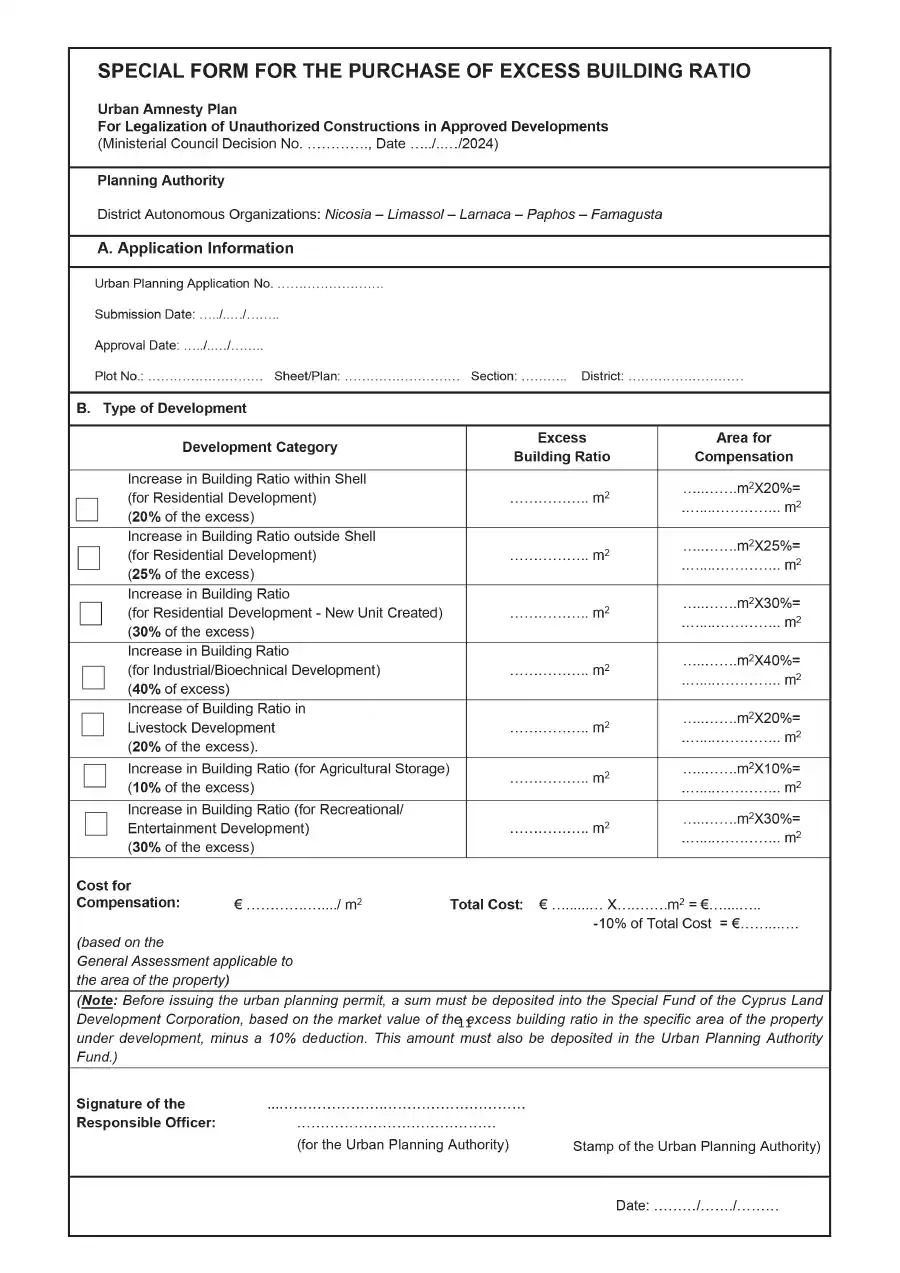
Planning Amnesty Application Form

(For clarification only)


Cyprus Planning-Amnesty Application

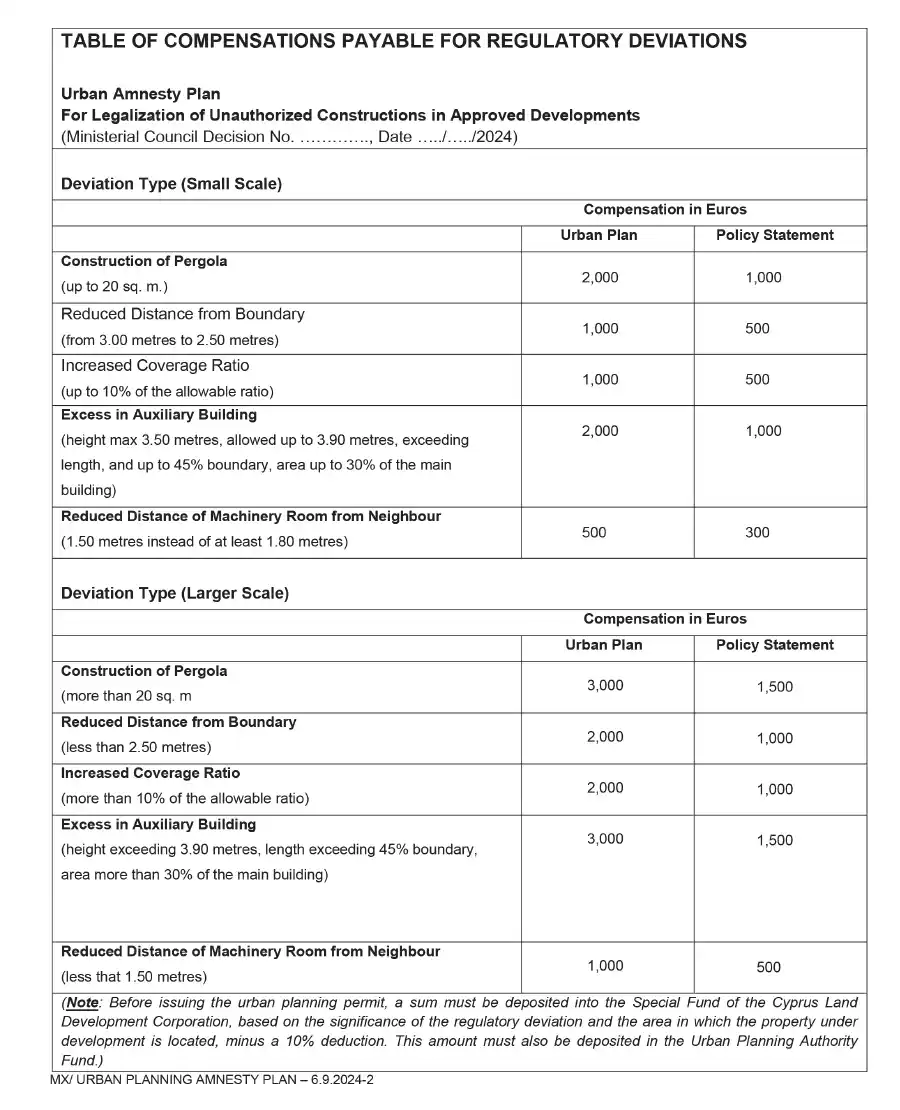
Planning Amnesty Compensation Payments

(For clarification only)

Cyprus Planing Amnesty Compensation Payments

Illegal estate agents thriving amid weak penalties

Illegal estate agents continue to defraud unsuspecting buyers and tenants, extending their reach into occupied territories, according to the Cyprus Real Estate Agents Registration Council.

However, council president Marinos Kineyirou warned even in cases where illegal practitioners were successfully found guilty, the resulting fines and penalties were too small to be considered a strong enough deterrent.

“We have mentioned many times in the past the problems caused by illegality in the real estate agent profession, especially for unsuspecting citizens, potential buyers, or tenants, who fall victim to scammers, often losing their life savings,” said Kineyirou.

“The examples are numerous and, unfortunately, recurring,” he added.

Kineyirou explained that despite significant efforts by the council, “the situation is becoming particularly concerning”.

“We are now seeing illegal agents expanding or transferring their activities to the Turkish-occupied territories of our country,” he stated.

“These illegal agents, simply put, are taking it a step further, becoming usurpers by selling off refugee properties without hesitation,” he added.

“Their only concern is profit,” the council president stated.

In this context, Kineyirou outlined a number of actions taken by the council to stop these illegal real estate agents.

“We have placed great emphasis on combating illegal real estate agents in recent years,” he said.

“We have strengthened our team of inspectors, both in quantity and quality, so that they can respond better and more effectively to their duties,” he added.

“At the same time”, he continued, “we have invested in systematic, continuous public awareness campaigns about the dangers of working with illegal agents”.

In addition, he noted that the council has previously explained how citizens can quickly and easily verify whether the person presenting themselves as a real estate agent is indeed licensed.

He pointed out that buyers can visit the council’s website, where they can find properties sold solely by licensed agents.

“We have also made it clear to licensed agents that we will be uncompromising in our strictness if they are found collaborating with illegal agents,” he stated.

He said that the “results of our actions and the strategy we have implemented are evident, as we are pleased to see that the public is now contacting us to verify the credentials of agents”.

Kineyirou also said that reports have also increased, leading to illegal agents being brought to court.

“The numbers are there, proving our efforts, always with the aim of protecting citizens and our profession,” he said.

The council noted that in the two years from 2022 to 2023, it has filed around 627 criminal cases against individuals and companies violating the provisions of the relevant real estate agents law.

According to the council, 40 companies and 90 individuals involved in 90 cases have been tried and convicted for illegal real estate practices, while many more cases are pending trial.

Weak penalties for illegal estate agents

“We fully respect the justice system, recognise the important role it plays, and are fully aware that no one can interfere with its work,” Kineyirou said.

“However, it is with regret that we observe that the penalties imposed on offenders are not sufficiently deterrent,” he added.

He pointed out that the law provides for fines of up to €3,500 or imprisonment of up to 12 months for illegal agents, or sometimes even both.

Those are the harshest scenarios, however, with the council mentioning that fines typically imposed on convicted offenders range from €150 to €200 per charge.

“We note that there is a tendency to treat these cases as inferior to others,” Kineyirou said.

“However, since the profits made by illegal agents are substantial, after the penalties are imposed, they continue their illegal activities,” he added.

“This is why”, he explained, “in many cases, we find ourselves bringing the same individuals back to court after discovering they are still operating illegally”.

He described the legal framework as “adequately satisfactory” for the council to do its job and bring illegal agents to justice.

“Unfortunately, we are forced to publicly highlight some significant weaknesses, which over time have been identified and exploited by the offenders,” he stated.

“We have now reached the point where illegal agents extend their activities to the north and become usurpers of Greek Cypriot properties in the occupied territories of our homeland,” he added.

He cited a recent example involving an Israeli national “arrested for usurping Greek Cypriot properties in the occupied areas, while he also appeared to be operating illegally in the free areas”.

“We at the council will not throw in the towel or surrender to those who exploit the profession of legitimate, licensed real estate agents,” Kineyirou said.

“We call on everyone to stand by our side because the damage is growing and now concerns our homeland,” he added.

He also reiterated that the council is available to the government to “discuss ideas and ways to strengthen the council’s toolkit to more effectively combat illegality”.

“Finally, we stress that anyone collaborating with illegal agents – whether the seller or the buyer of a property – is also committing a criminal offence, and will not hesitate to bring them to justice,” Kineyirou concluded.

CM