Planning permission axed for low-risk developments

As of October 2, Cyprus will axe the requirement to obtain planning permission for low-risk developments, such as the construction of one or two residences providing certain conditions are met.

This change, announced by Interior Minister Constantinos Ioannou, is aimed at simplifying the planning application process and reducing the workload for local authorities.

Under the new decree, planning permission will be granted automatically based on a checklist that planners must complete. This reform is part of a larger initiative that includes 22 measures to accelerate the approval of pending applications.

The policy applies to land designated for residential, tourist, or mixed-use development within existing Development Plans.

Important conditions for exemption from planning permission include:

  • the development must not interfere with road plans;
  • no more than two residential units are allowed per plot;
  • all zoning and regulatory requirements must be met;
  • height and floor limits must not be exceeded (which would otherwise require additional approvals);
  • the land cannot be located in a Special Character Area or under conservation orders;
  • access must not be from a national highway or primary road.

This announcement was first published in ekathimerini

Multi-million-euro property fraud

Police have forwarded a multi-million-euro property fraud complaint against a Greek Cypriot businessman, to their Crime Combating Department (CCD) for further investigation.

The case was reported to the Larnaca Police in early September and it involves accusations of a €3 million fraud targeting Israeli investors in a property development scheme.

Due to the complexity of the allegations, the case and supporting evidence were transferred to the CCD, according to police sources.

The complainants allege that the businessman, involved in real estate, fraudulently obtained funds from Israeli investors for a land purchase in Larnaca that never took place. The investors allege that the funds were diverted to other projects instead.

The alleged fraud involved an escrow account in Israel, with funds to be released upon receipt of documents from the Larnaca Land Registry. The lawyer representing the investors claims these documents were falsified.

The investigation is focusing on potential charges of forgery, circulation of forged documents, and money laundering.

The complainants allege that the businessman submitted and later cancelled the property sale documents at the Land Registry to generate receipts for investor payments and manipulated other documents for tax purposes.

Registration of Airbnb properties surges

There has been a recent surge in the registration of properties rented online, including those listed on platforms like Airbnb.

By law, properties must be registered with the Deputy Ministry of Tourism in order to be advertised and offered for short-term rentals. Despite this requirement, a large number of these properties remain unregistered.

Estimates suggest that approximately half of the 15,000 accommodations advertised on various platforms are not officially registered.

Recent efforts by the Deputy Ministry of Tourism and other services have led to a continuous rise in registrations. According to data obtained by Philenews in mid-September, the number of registered properties reached 7,800, an increase from 7,312 in July. This means 500 accommodations were added to the registry in less than two months. In comparison, there were only 4,765 registered properties in April of last year. The current figure of 7,800 registered accommodations represents roughly 35,000 beds.

A significant number of registration applications are still pending approval, according to a source from the Deputy Ministry of Tourism, indicating that the registration process is actively progressing. There is also the possibility of another campaign being launched to combat illegal rentals; a move hoteliers are pushing for due to their claims of unfair competition.

Registration fee and penalties

The registration fee for self-catering accommodations in the registry is €222 for a three-year period. Registration is completed online via the Deputy Ministry’s website, with specific details and certificates required.

Under current legislation, anyone operating a self-catering accommodation without a registration permit, or whose permit has been revoked, is committing an offence. On conviction they face a prison sentence of up to one year, a fine of up to €5,000, or both. If the offence continues after conviction, additional fines of up to €200 per day may be imposed.

Building permits backlog & brown envelopes

Building permits surged by 150% in June as local authorities rushed to clear a backlog before transferring responsibility from municipalities and district administration offices to the newly established district self-governance organizations (EOAs.)

According to the Cyprus Statistical Service (CySTAT), the number of building permits authorised by the municipal authorities and the district administration offices during June 2024 stood at 1,528 compared with just 610 in June last year.

The total value of these permits reached €781.6 million and the total area 594.9 thousand square metres. These building permits provide for the construction of 2,772 dwelling units.

During the first six months of 2024, a total of 4,782 building permits were issued compared to 3,608 in the same period last year; an increase of 32.5%.

The total value of these permits increased by 44.4% to €2.04 billion and their total area by 46.5%. The number of dwelling units recorded an increase of 44.4%.

Planning permit disputes & brown envelopes

According to media reports, disputes between municipalities and the EOAs have revealed that one of the major issues is issuing planning permits.

On Thursday, Greens MP and House interior affairs committee member Stavros Papadouris highlighted the urgent need for reform in how building permits are processed.

Papadouris alluded to corrupt practices, hinting at the use of brown envelopes to fast-track permit applications. He pointed out that pushing permits ahead of others in the queue through unethical means was a well-known problem.

The MP cited instances where applications submitted just three months earlier were given priority over those that had been waiting for a year.

“We must shift our mindset and avoid reverting to pre-reform practices. I’ll stop here to avoid discussing bribery within certain services,” Papadouris said.

The committee also heard reports of permit applications being lost while being transferred from previous urban planning authorities to the EOAs.

Meanwhile, the chairman of Cyprus’ Scientific and Technical Chamber (ETEK), Constantinos Constanti, confirmed that these delays in licensing were causing backlogs and creating opportunities for illegal construction.

Constanti criticized the interior ministry’s poorly timed building amnesty, which added 15,000 applications to an already overwhelming backlog of 30,000 pending cases. He also noted the lack of communication between the ministry and ETEK as a significant issue.

He emphasized the need for a standardized approach among EOAs, warning against each one operating independently with different procedures.

Constanti also raised concerns about unsafe buildings, a responsibility that neither the municipalities nor the EOAs want to take on due to the high costs involved. A proposal was submitted to delay the transfer of this responsibility by a year, in the hope of finding a solution to cover these costs for the EOAs, which are intended to be self-financing.

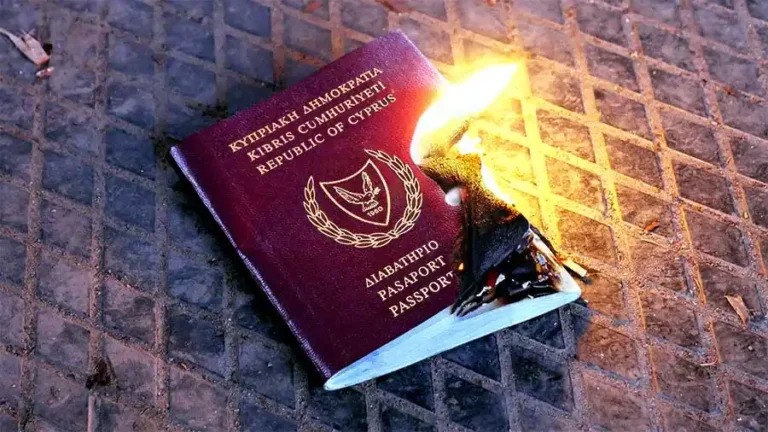
Eight golden passports go up in smoke & citizenship revoked

No less than eight further individuals have seen their golden passports go up in smoke and their Cyprus citizenship revoked, as investigators were led to discrepancies in the personal data submitted to the authorities.

Amongst the ‘no longer Cypriots’ is 61-year-old Igor Kolomoyskyi, also of Israeli descent, once considered the leading oligarch in Ukraine and formerly part of the inner power circle in Kyiv, after it was confirmed that the passport was secured under false pretences and withholding vital information, some pertaining to criminal charges being faced by the Ukrainian oligarch.

In a decision reached by the Cabinet on September 4th, it is further noted that even before he was considered for citizenship, it was evident that Kolomoyskyi, the 2nd richest man in Ukraine, was an individual of ‘suspicious character’, as he was referred to, with his naturalisation creating a severe risk of more bad reputation for the Republic of Cyprus.

The passport was taken away fundamentally because Kolomoyskyi failed to report in his application that he had faced criminal charges for tax evasion in Russia back in 2008, with his citizenship coming through in June 2010.

Over the past year, the Ukrainian tycoon, who owns significant shares in energy and mass media companies found himself in the whirlwind of a Zelenskyi crackdown, despite the fact that Kolomoyskyi strongly supported Zelenskyi’s campaign to unseat former President Petro Poroshenko, with the Ukrainian President, an actor by trade, having his own successful comedy show in a television station under the tycoon’s control.

In 2023, Kolomoyskyi was arrested by the Security Service of Ukraine (SBU) on charges of money laundering and fraud, and placed under pre-trial arrest. His criminal activity is mostly connected with the Ukrnafta oil company and the Ukrtatnafta refinery. He is also accused of embezzling almost 145 million dollars from the largest private bank in Ukraine and even conspiracy to commit murder by hiring a paid assassin.

According to the Ukrainian investigation, he ordered the killing of the head of one ‘of the legal companies’, as it was referred to, who refused to succumb to a decision that benefited his own interests.

In September 2023, Kolomoyskyi was found guilty of acquiring property under false pretences and money laundering of more than 36 million dollars, transferring massive amounts of funds abroad between 2013 and 2020.

In 2021, the US put Kolomoyskyi and his family on a blacklist of no entry, accusing him of corruption and using his position as former governor of the Dnipnopetrofsk region, near the border with Russia, for personal again.

Kolomoyskyi, who also has an Israeli passport since 1995, is also being investigated for embezzling 250 million dollars from Ukrainian Privatbank, which included a Cyprus branch, while in 2020, the US Justice Ministry confiscated Kolomoyskyi properties in various states, acquired through money laundering.

Beyond Kolomoyskyi, the Cabinet also stripped seven other individuals of their Cypriot citizenship, including Egyptian investor Mohammed Salem and his dependents, as well as Russian investor Maxim Zachartsenko, his wife and two children.

Salem, who was naturalised in 2018, was considered not to have invested the amount of money he had initially declared, but only a small fraction of it, while also acquiring the naturalisation certificate under false pretences and withholding vital information.

He had initially bought a two-million-euro apartment in Limassol, but then the seller returned more than half that amount to the Egyptian man’s accounts in the UK, with authorities concluding that he never actually invested the amount that he had declared and was the prerequisite for naturalisation.

Zahartsenko had faced charges of financial irregularities in the US with his assets being frozen by American authorities, not least buying thousands of shares of public companies, illegally obtained by hackers between 2010 and 2014.

In 2019 he was handed down a massive fine of more than USD 32 million in a civil case tried by a New Jersey court.


Trapped buyers still saddled with developers’ debts

This week, the Cyprus Borrowers Association (Syprodat) expressed “disappointment, discouragement, and a sense of failure” on behalf of trapped buyers who find themselves paying off the debts of property developers from whom they purchased their homes.

Despite fulfilling their financial obligations and paying the full purchase price, these buyers have not received ownership of their properties due to delays in acquiring title deeds. Without these deeds, they remain at risk, as developers’ outstanding loans could lead to the foreclosure of the properties in question.

Syprodat noted that many buyers, even those who have fully repaid their loans, continue to be burdened by the developers’ unresolved financial obligations. In a statement, the association suggested that banks have “turned a blind eye” to the loan agreements they were supposed to enforce with developers.

Rather than ensuring that developers used funds from property sales to repay construction loans, banks allowed them to divert the money for other purposes, according to Syprodat. This, the association claimed, raises serious concerns about the accountability of the banks involved.

Syprodat also questioned whether the predicament of nearly 10,000 trapped buyers could have been avoided if banks had not been complicit in the developers’ actions. Many buyers have fully paid off their loans but remain trapped due to the developers’ unpaid debts.

The association urged the government, along with banks and credit acquisition companies, to urgently address the issue through new legislation. In July, Syprodat began discussions with various political parties to explore the possibility of introducing laws to resolve the issue of trapped buyers.

Syprodat stressed the gravity of the situation and called for immediate action from both the government and political leaders. This followed statements from Interior Minister Constantinos Ioannou, who affirmed the government’s commitment to finding a legislative solution.

Ioannou had stated that the government is “determined to make every effort to find a solution for trapped property buyers, who are now at risk of losing their properties.” These efforts gained further urgency after a recent court of appeal ruling declared certain provisions, which allowed trapped buyers to obtain ownership titles, unconstitutional.

The government has since announced plans to introduce a new bill, expected to be submitted to parliament later this month.