Paralimni marina phase one set to complete by end of year

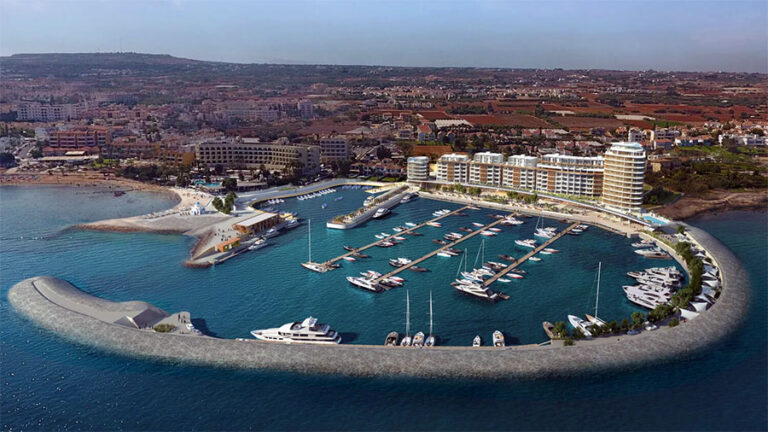
The first phase of the Paralimni marina is set to be completed by the end of the year, according to Paralimni-Deryneia mayor Giorgos Nikoletos, who visited the site on Monday.

The first phase will include 300 mooring spaces, with the initial vessels expected to arrive before the start of the tourist season. The development is anticipated to positively impact the area and attract nautical tourism, as an official entry point to the Republic of Cyprus will be established.

During his visit, Nikoletos was informed by PMV Maritime Holdings CEO Anthoulis Kountouris about the progress of the project.

The phase includes the completion of port works, administrative offices and commercial facilities, with operations planned for the next tourist season.

Nikoletos said that the commercial developments and the establishment of an official entry point from Protaras will significantly boost the area’s growth.

The Paralimni marina project is the only marina development in Cyprus fully funded by a Cypriot investor with a total investment of €100 million.

During the visit, Nikoletos was accompanied by municipal secretary Gavriela Gavriel, municipal engineer Andreas Genagritis, and the dead of cultural and tourism affairs, Marinos Pavlikkas.

CM

Foreigners buying more affordable properties

Foreign investors in Cyprus are increasingly turning their attention from luxury properties to more affordable housing, prioritizing residency permits over citizenship. This shift, highlighted in a 2023 report from real estate firm Danos, marks a significant change in market dynamics.

The Cypriot real estate landscape has transformed, with demand moving away from luxury homes towards properties that offer residency permits. This change reflects a departure from the previous focus on high-end residences under the disgraced ‘golden passport’ scheme, which was ‘definitively and irrevocably terminated’ in November 2020.

The trend, which first emerged in 2023, is expected to continue into 2024, according to Danos International data. Luxury property sales, particularly those exceeding €1.5 million, saw a sharp decline in 2023, indicating a downturn in the premium segment of the market.

Danos reported that while there was a slight year-on-year increase in transactions of homes priced above €1.5 million in early 2024, the market is still recovering from a significant drop in sales in 2023. The luxury segment saw a 26 per cent decrease in 2023 compared to the previous year, with 164 transactions totalling €440 million recorded. Despite the large sum, luxury properties accounted for only 8 per cent of the total transaction value, the lowest share since 2013.

The luxury property market has been in decline since 2018, following peak sales in 2016 and 2017, driven by foreign investors seeking Cypriot citizenship through the Cyprus Investment Programme. In 2017, a record 260 luxury properties, valued over €1.5 million, were sold, reflecting a 24 per cent increase in demand. This boom helped revive the broader property market, which had been struggling since the 2013 financial crisis, with luxury sales growing by 43 per cent in 2016.

However, after the citizenship programme ended in 2020, demand for high-end properties waned as foreign investor interest shifted towards mid-range homes aimed at securing residency permits. Danos noted that the market for luxury properties had remained stable from 2010 to 2013, with around 40 sales per year, but surged after programme changes in 2014, peaking in 2017. Since then, the market has slowed down.

Looking ahead, the Cypriot real estate market is expected to see moderate growth, despite challenges. Kyriakos Kiliaris, Chief Marketing Officer at Danos, believes that stabilizing interest rates will help regulate demand. While the luxury market is unlikely to return to its 2017 peak, foreign investment will continue to support the wider property market.

Additionally, geopolitical factors, particularly tensions in the Middle East, are expected to sustain interest from European and Asian buyers. The Cyprus Residency Programme, known as the ‘golden visa,’ remains a key driver of foreign investment, offering residency to non-European citizens who invest in Cypriot real estate.

Despite rising construction costs and regulatory changes, Kiliaris stated that foreign investors remain strongly interested in the Cypriot property market.

Millennials set to account for 70% real estate market customers

0

In its S1 2024 Market Insight Report, Danos International Property Consultants & Valuers forecasts that “Millennials (Gen Y) and Gen Z are going to represent 70% of real estate market customers by 2025.”

In its report, Danos highlights the impact of other trends on the Cyprus property market.

New data and trends in real estate

Highlighting new data and trends, Danos reports:

It is a common finding that the war between Israel and Hamas, and the war in Ukraine have brought about significant changes in our daily lives and lifestyles.

At the same time, EU regulations on moving towards a carbon neutral economy, push up the cost of buildings.

Combined with the hike of the cost of living, an increase in interest rates has also forced families and households to reconsider goals and priorities.

There is increased demand in rentals which are more affordable.

Cyprus, with the comparative advantages it brings together and the opportunities it offers, is an attractive destination for starting a new life experience.

  • Technology has become a very important part of the real estate purchase process, imposing the need for the highest standards in 2D / 3D virtual photos, videos and electronic tours. Shoppers now prefer virtual browsing visits, zoom meetings for further information and clarification, personalized videos that can be shared with family and friends, searching for services and favourite locations via Google Maps/Google Earth, etc.
  • Millennials (Gen Y) and Gen Z are going to represent 70% of real estate market customers by 2025.
  • The provision of many and important services and amenities has now become necessary. A more holistic approach to housing search is needed. Experienced buyers / investors are very demanding in their quest and emphasize detail, preferring properties that are environmentally friendly and close to communities that are committed to using sustainable practices and are family and animal friendly.
  • Finally, high end buyers are much more demanding with experienced real estate brands that offer authenticity and trust, personalized management services, top online experiences and highly professional service that meets their needs and expectations.

Further reading

The Danos S1 2024 Market Insight Report on Cyprus

New Urban Amnesty Plan approved (Update)

The new Urban Amnesty Plan is expected to be approved at today’s afternoon session of the Council of Ministers, and it will come into effect immediately for a period of only six months.

The amnesty aims to allow people to legalize unauthorized constructions in approved developments that involve small-scale planning infringements that do not significantly affect the overall development, its type, or their neighbour’s comfort.

Examples include covering open spaces, closing verandas, building pergolas and BBQ areas, etc. According to official sources, thousands of unauthorized constructions exist in buildings that, due to planning violations by the owners, cannot receive final approval and, consequently, title deeds.

As well as the many buyers who are ‘trapped’ because their developer/their lawyer failed to disclose the land on which their properties were being built was mortgaged to the bank/financial institution, many other buyers cannot get their Title Deeds, due to planning infringements.

Lionel Grancourt is just one example. His roads have not been completed, his whole site has not been completed, his apartment block encroaches on someone else’s land, his chemical sewerage system has not been installed. Others can’t get their Title Deeds because pavements and green areas have not been completed, their properties do not comply with fire regulations, their apartment balconies are unsafe as they’ve not been built correctly, their development has been overbuilt and a whole host of other problems, including their developer having abandoned the development.

Phileleftheros article

According to an article in Phileleftheros, which I’ve translated from Greek:

“First and foremost, there is the major and ongoing issue with foreigners who have bought properties and other assets in Cyprus but have not yet secured a Title Deed. This issue has been reported by British buyers to their country’s media, defaming Cyprus.

“In fact, some British publications have stated that property purchases in Cyprus are not secure because title deeds are not issued. With such publications, we understand that no Briton is likely to be interested in buying property in Cyprus again.

“However, apart from foreigners, there are also many Cypriots who, although they have purchased and fully paid for property, have not yet received a Title Deed. This is because the contractors of these properties have committed so many irregularities and possibly illegalities that prevent the Town Planning and Land Registry from approving the issuance of Title Deeds.

“Furthermore, there is a third category of buyers who bought property and have paid for it in full, but due to violations of building permits by the contractors or their own interventions in the property, they have received a title of ownership with ‘notes’” This means they cannot sell or mortgage their property unless they correct the violations by the contractor at their own expense. However, the violations and interventions may be such that correcting them could be impossible.

“In this context, there are also many property owners who, regardless of whether they have a title of ownership, have made serious alterations (such as adding parking spaces, constructing additional floors, creating new rooms, closing verandas, etc.) to their properties. The situation in these cases is chaotic, resulting in most title deeds no longer reflecting the actual state of the properties.”

Although I agree with virtually everything above, I reject any claim that myself (and others) who report these problems in the UK media are “defaming Cyprus”. It’s the Cypriot authorities and their seeming inability (or perhaps unwillingness) to get to grips with these violations and punish those responsible who are defaming their country.

Who Can Apply for Amnesty?

Owners of the following types of properties can apply for the amnesty:

  • Residential units.
  • Industrial, artisan, storage, livestock, and agricultural developments.
  • Commercial and office developments (additions to approved ground-floor shops).
  • Recreation/entertainment developments, such as cafes, restaurants, snack bars, etc.

A key requirement for applying for the amnesty is that the properties with planning infringements must have obtained a planning permit or/and building permit by the date the Council of Ministers decides on the implementation of the scheme, i.e., by today, September 13, 2024.

Why a new amnesty?

In July 2015, the Council of Ministers introduced a plan offering urban planning incentives titled: “Measures for the legalization and licensing of unauthorized/new constructions in approved developments.” This plan, initially valid for four years until December 31, 2019, was extended three times by the Council of Ministers until December 31, 2023.

However, since this plan only applied to buildings licensed before 2015, it resulted in just 3,151 applications, which was not representative of the total number of unauthorized constructions across Cyprus.

According to the Interior Ministry, many more buildings have irregularities, but their owners did not take advantage of the scheme to obtain approval certificates and, consequently, Title Deeds. Therefore, the Ministry of the Interior deemed it beneficial to implement a new policy framework for granting urban amnesty.

Amnesty terms and conditions

The basic conditions for participation in the scheme are:

  • The building must be approved, and the development must have been granted a planning permit and/or building permit before the expected decision of the Council of Ministers today (September 13, 2024.)
  • The unauthorized additions must have been completed before the expected decision of the Council of Ministers today. It should be noted that, when the application is submitted, the responsible planner must provide a sworn declaration regarding the date of completion of the unauthorized additions.
  • Illegal modifications, both outside and within the shell of the approved building, must comply with the building’s morphology and architecture, be constructed with high-quality and aesthetically pleasing materials, and not negatively impact the environment, neighbour’s comfort, or third-party property rights.
  • In cases of exceeding the building density coefficient, the planning permit will include a requirement to pay a financial compensation, a percentage of the excess value, to the Special Funds of the Cyprus Land Development Corporation (KOAG) for Affordable Housing. Before the planning permit is issued, ten percent of the compensation will be deposited into the accounts of the Planning Authorities (District Administrative Organizations) to cover administrative costs. Where the building deviates from the building regulations, financial compensation must be paid for each deviation category before the planning permit is issued.
  • The Planning Authority will instigate a process for purchasing additional parking spaces, which are required in cases where these cannot be allocated within the development property, even if the development is in an area where the ministerial decree for purchasing parking spaces does not apply. Approval of the minister’s deviation order is not required.

Key provisions

The “Urban Amnesty Plan for the Legalization of Unauthorized Constructions in Approved Developments,” expected to be approved in today’s session of the Council of Ministers, provides the following key measures:

  • Introducing an obligation to pay financial compensation for residential developments with three categories of building density coefficient excess, either within the main shell of the existing building, outside the main shell (horizontal or vertical expansion), or in cases where an additional residential unit has been created through unauthorized construction. Compensation is also required for other categories of development in cases of building density excess.
  • Introduction of the obligation to pay financial compensation for regulatory deviations (covered veranda/pergola, reduced distance from the property boundary, increased coverage percentage, increased height or length of an auxiliary building along a shared boundary, etc.).

The financial compensation will be calculated based on the current General Valuation Tables of the Department of Lands and Surveys. In cases of regulatory deviations from the provisions of Development Plans, a specific amount is determined for each deviation category, depending on its scale and significance, as well as the administrative region in which the property falls.

Residential developments deviations and payments

In cases where residential developments have undergone extensions without obtaining the required planning permit, resulting in an excess of the maximum allowed building density coefficient, the Planning Authority may approve an increase in the coefficient by 20% or up to 60 square meters, whichever is greater.

Unauthorized extensions may have been carried out either within the shell of the building (incorporation of auxiliary spaces, carports, and covered verandas into the interior of the unit), or outside the shell (horizontal or vertical extension).

The Planning Authority may also approve an extension for an additional unauthorized residential unit, provided it is used exclusively to meet the housing needs of the landowner’s family, as long as the legalization of the additional unit does not infringe on the comfort or property rights of co-owners.

The plan can also be applied to existing residential apartments in buildings for the purpose of legalizing constructions related to the incorporation of covered verandas, provided that written consent from all joint-owners is submitted with the application.

In cases of excess building density in residential developments, compensation will be required depending on the type and category of the development. The market value will be derived from the General Valuation of the Department of Lands and Surveys, and the compensation obligation will vary as follows:

  • 20% of the value of the excess building density for applications involving an increase in buildable area within the shell of the originally approved building.
  • 25% of the value of the excess building density for applications involving an increase in buildable area through vertical or horizontal extension outside the shell of the originally approved building.
  • 30% of the value of the excess building density coefficient, in cases where the application concerns an increase in buildable area due to an unauthorized additional residential unit.

Friday evening amnesty update

Earlier this afternoon, the Cyprus Mail reported that the Council of Minister approved the Urban Amnesty Plan.

August property sales make small headway

The latest analysis of sales contracts issued by the Department of Lands and Surveys reveals a marginal increase in property sales in August compared to the same month last year, while sales to foreign buyers continue their earlier decline.

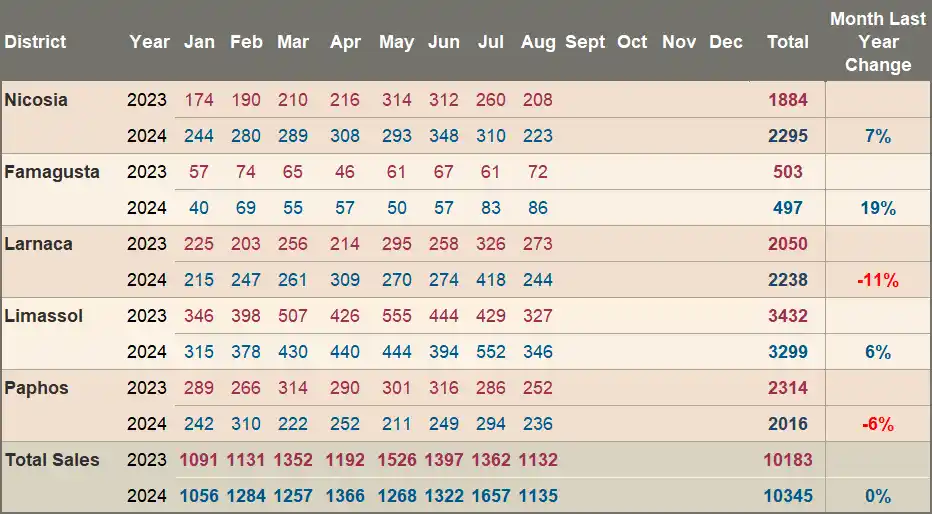
The total number of property sales in August (as measured by the number of sales contracts deposited in Land Registry offices in the free areas of the island) stood at 1,135; an increase of just 0.27% on the 1,132 contracts deposited in August last year.

The island’s property market remains on course to achieve the highest number of sales since 2008.

While sales in Famagusta, Nicosia, and Limassol rose by 19%, 7% and 6% respectively, they fell by 11% in in Larnaca and by 6% in Paphos.

Total Sale Transactions – 2023/2024 Comparison

Sales in the first eight months of 2024 rose 2% compared with the same period last year. While property sales in Paphos fell 13%, 4% in Limassol, and 1% in Famagusta, these falls were more than outweighed by sales in Nicosia and Larnaca rising by 22% and 9% respectively.

Total contracts of sale deposited – 2023/2024 Comparison (Jan-Aug)

Property sales – market segment analysis

Sales to the domestic (Cypriot) market

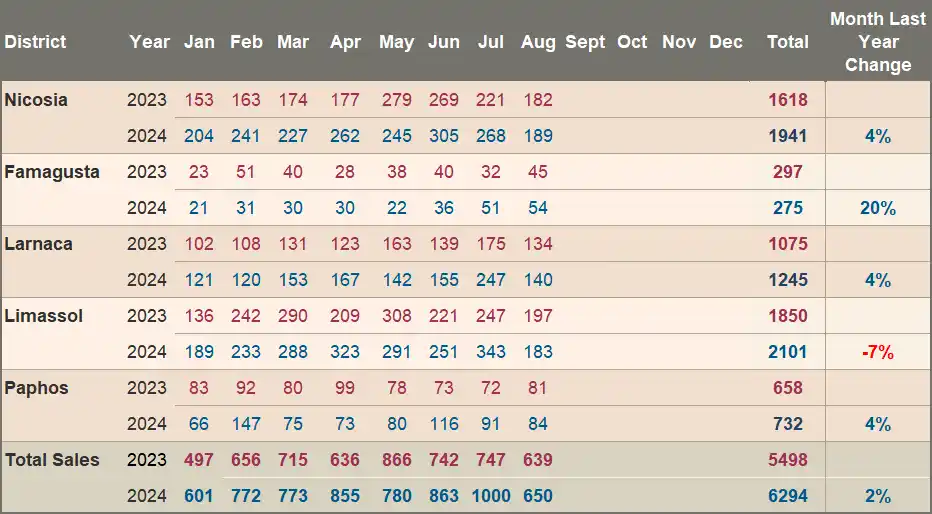
The total number of sales to the domestic market in August 2024 rose 2% compared to the same period last year and accounted for 57% of the total number of sales in the month.

Sales rose in all districts with sales in all districts with the exception of Limassol where they fell by 7%.

Cyprus property sales to Cypriot citizens August 2024
Domestic Sale Transactions – 2023/2024 Comparison

Sales to the domestic market in the first eight months of 2024 reached 6,294; an increase of 14% on the 5,498 achieved in the same period of last year. With the exception of Famagusta, where sales fell by 7%, all districts recorded gains.

Domestic contracts of sale deposited – 2023/2024 Comparison (Jan-Aug)

Property sales to the overseas market

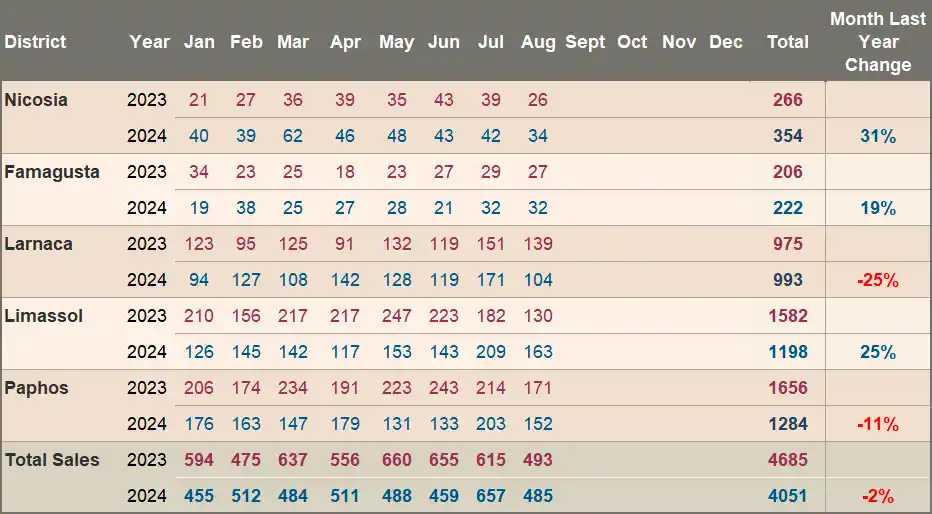
The total number of property sales to the overseas market (both EU and non-EU citizens) in August reached 485; a fall of 2% on the 493 achieved in August last year.

Cyprus property sales to EU and non-EU citizens August 2024
Overseas Sale Transactions – 2023/2024 Comparison

While Limassol, Nicosia, and Famagusta recorded double-digit increases in sales, the number of sale contracts in Larnaca and Paphos fell by 25% and 11% compared to August last year.

On an annual basis, overseas sales fell by 14%. Although sales in Nicosia, Famagusta, and Larnaca rose by 33%, 8%, and 2% respectively, they fell by 24% in Limassol and 22% in Paphos.

Overseas contracts of sale deposited – 2023/2024 Comparison (Jan-Aug)

Property sales to EU citizens

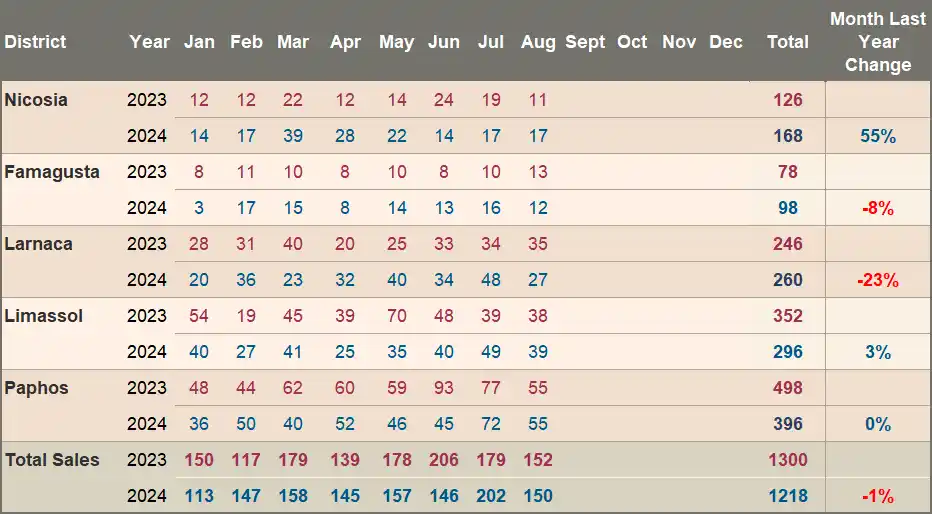
Sales to EU citizens fell 1% to reach 150 in August compared to 152 in the same month last year and accounted for 13% of the total number of sales (1,135) achieved during the month.

Although sales in Nicosia and Limassol rose 55% and 3% respectively – and sales in Paphos remained steady, they fell by 23% in Larnaca and 8% in Famagusta.

Cyprus property sales to EU citizens August 2024
Overseas (EU) Sale Transactions – 2023/2024 Comparison

Sales to EU citizens in the first eight months of 2024 reached 1,218; a fall of 6% compared to the 1,300 sold in the same period last year, with sales in Paphos and Limassol falling 20% and 16% respectively, while sales rose by 33% in Nicosia, 26% in Famagusta and 6% in Larnaca.

Contracts deposited by EU Nationals – 2023/2024 Comparison (Jan-Aug)

Property sales to non-EU citizens

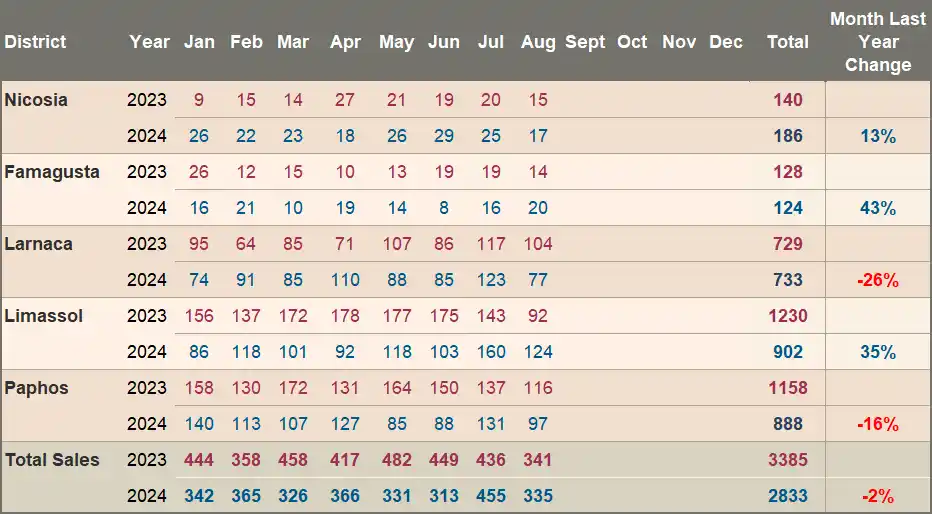
Similarly, sales to non-EU citizens fell 2% in August compared to August last year accounting for 30% of the total number of sales (1,135) achieved during the month.

Although sales in Famagusta, Limassol, and Nicosia rose by 43%, 35% and 13% respectively, these increases were outweighed by falls in Larnaca and Paphos.

Cyprus property sales to non-EU citizens August 2024
Overseas (Non-EU) Sale Transactions – 2024/2024 Comparison

Sales to Non-EU citizens in the first eight months of 2024 reached 2,833; a fall of 16% compared to the 3,385 achieved in the same period last year, with sales in Paphos and Limassol falling by 27% and 23% respectively.

Contracts deposited by non-EU Nationals – 2023/2024 Comparison (Jan-Aug)

Property market segment summary analysis

The chart below shows each of the district’s popularity with each of the market segments. Sales to the overseas market segments (EU nationals + non-EU nationals) exceed domestic sales in Paphos.

In Paphos, the most popular with those looking for a holiday home in the sun, sales to non-EU nationals alone exceed sales to the domestic market (Cypriots.)

Market Segment Summary Analysis (Jan-Aug 2024)

Year to date sales performance

The chart below is an analysis of sales since 2008, showing total domestic sales and total overseas sales during the first eight months of each year.

Contracts Deposited 2008 to 2024 in the First Eight Months of Each Year

Will Pissouri landslide victims be relocated?

The Pissouri landslide is a significant and ongoing geological issue affecting the village of Pissouri, located in the Limassol district of Cyprus.

The area has experienced substantial land movements for over a decade, leading to substantial damage to homes, infrastructure, and roads. The landslide, which has been gradually worsening, has caused homes to crack, walls to collapse, and roads to buckle, creating safety concerns and financial losses for residents.

The on-going landslide has destroyed more than 250 homes in the area, cracking walls, buckling streets and driveways and smashing water and drainage pipes. Eviction orders have been issued for many of the homes.

In 2015, property owners formed the Pissouri Housing Initiative Group (PHIG) to seek compensation from the Government for the damage to their homes caused by this natural disaster. However, their calls fell on deaf ears with numerous press reports placing the blame for the damage caused to homes on architects, developers, poor construction materials, etc.

Will the Pissouri landslide victims be relocated?

However, according to a report by Phileleftheros on Saturday, authorities may resort to relocating the Pissouri community as a last option if ongoing landslides cannot be controlled or if the costs of mitigation become too high.

Geological experts analysing the area have warned that, even if relocation is not necessary, restricting further development in certain zones is crucial to prevent worsening the situation.

The final decision will depend on the outcome of a comprehensive investigation, launched after the Technical Chamber of Cyprus (ETEK) recommended halting a €35 million retaining wall project. The first phase of this project, valued at €8.5 million, has already been completed.

Recent studies indicate that the landslide’s slip surface extends around 40 metres deep, significantly deeper than the initial estimate of 7 metres, which complicates the search for solutions.

Christodoulos Hadjigeorgiou, Director of the Geological Survey Department, advised Phileleftheros that efforts are underway to determine the cause of the landslides, helping the government make well-informed decisions.

The investigation features Cyprus’s first 3D modelling study, with contributions from geological experts from the United Kingdom, Austria, Greece, and Spain.

Hadjigeorgiou also noted that the department is considering expanding its studies beyond Pissouri to investigate whether similar issues exist in the surrounding areas. He also raised concerns about the possible impact of strong earthquakes on the region’s already complex geology.