Short-term rentals are driving up apartment prices and causing accommodation shortages for students, particularly in coastal cities, according to the president of the Cyprus real estate agents association Marinos Kineyirou.
Kineyirou told state broadcaster CyBC that the diversion of apartments to platforms such as Airbnb has significantly reduced the supply of long-term rentals, pushing prices upwards. He suggested that authorities should consider restricting or abolishing short-term rentals to address the issue.
As the new academic year approaches, Limassol remains the most expensive city for renters. One-bedroom apartments in Limassol cost between €1,000 and €1,100 per month, nearly double the price in the capital, Nicosia, where similar properties range from €600 to €700. Larnaca and Paphos follow with prices between €500 and €600.
Two-bedroom apartments in Limassol command €1,400 to €1,500 monthly, compared to €800 to €900 in Nicosia and Paphos, and €700 to €800 in Larnaca.
Kineyirou noted that Limassol’s steep prices are also attributed to increased demand from foreign workers, particularly in the IT sector.
“This is largely due to the fact that short-term rentals have absorbed part of the supply of properties for long-term or student rentals,” Kineyirou said.
He added, “Unfortunately, today, everyone is converting residential apartments into tourist ones, and we wonder who ultimately controls the zones and licenses.”
Kineyirou called for a review of current practices, stating that “serious consideration should be given to discontinuing or restricting short-term rentals to avoid creating problems for those seeking apartments for rent and for organised tourist complexes.”
Selling immovable property in Cyprus offers a unique opportunity to engage with a very active real estate market. Whether you are selling a holiday home, a family residence, or an investment property, it is crucial to understand the local processes, legal requirements and the costs involved for a smooth and stress-free transaction.
Many sellers fall into common traps by not fully understanding the costs involved, which often leads to unnecessary stress, lengthy delays, unexpected expenses, and reduced profits.
This article highlights the main costs involved in a sale transaction, aiming to help navigate the complexities of selling property in Cyprus, and ensuring the sellers are informed about potential costs.
Why sellers need to be informed of costs
Maximize Profit: Understanding the processes and procedures and all costs involved helps to better plan and to accurately calculate the net proceeds, allowing the opportunity to maximize the seller’s profit.
Protection of Interests: Engaging experienced and professional lawyers and knowing what to expect gives to the sellers the opportunity and the power to protect their interests throughout the whole transaction.
Risk Mitigation: Understanding the processes protects the sellers from wrong, improper, and costly advice.
Avoid Surprises: Being aware of potential expenses ensures that there are no unexpected surprises that could cause delays or even jeopardise the sale.
Main costs associated with sale transactions
Estate agent fees
The estate agent commissions in Cyprus usually range from 3% to 5% of the sale price. This fee usually includes the marketing and advertising of the property, arranging viewings with potential buyers, and negotiating offers. Following the offer acceptance, the case is usually being passed to the seller’s lawyer to handle the transaction.
Legal fees
Engaging expert legal representation prior to the initiation of the conveyancing process gives the sellers protection from improper and costly advice, ensures full compliance with all regulatory and legal requirements, and allows them to prepare better for the sale process.
Legal fees range from 1% to 1.5% of the value of the property, and these usually cover all the works associated with the sale transaction, such us drafting of contracts, liaising and submitting applications with the authorities (i.e. Land Registry and Inland Revenue), preparing for and completing the sale transaction at the Land Registry.
Government fees and taxes
Capital Gains Tax (CGT)
CGT is charged at a rate of 20% on the profit the sellers make from the sale of their property in Cyprus. The purchase price that the seller paid for the property is being deducted from the sale price in order to calculate the profit.
There is also an indexation allowance which the Inland Revenue takes into account when they calculate the CGT liability of the sellers.
(Original price + indexation) – sale price = profit
Personal CGT allowances
There are also personal tax-free allowances of:
€17,086 if the seller has not sold immovable property in Cyprus before.
€85,000 if the seller has not sold property in Cyprus before, and he/she can prove that the property has been their permanent residence a minimum of 5 years.
Other CGT Deductions
Certain costs can be deducted from the profit of the seller before calculating the CGT liability.
Transfer fees – The amount paid at the Land Registry for the transfer fees to get the title deed transferred into the purchaser’s name.
Estate Agent’s Fees – Commission paid to a registered estate agent in Cyprus for the sale of the property. If the agent involved in the sale is a non-registered estate agent, then the marketing fees are not CGT deductible.
Legal Fees – Legal fees payable to the legal representatives of the seller for the sale of the property.
Interest paid to a Bank – If the seller obtained a loan to purchase the property, the interest paid to the Bank is CGT deductible as well, provided that the seller can obtain the bank statements showing the total interest paid.
Extra works – Any extra works or structural changes of permanent nature done to the property, such as building of a fence, garage, swimming pool etc., may be taken into consideration by the Inland Revenue, provided that the seller has all the relevant invoices and payment receipts.
0.4% Levy – New Tax
As of November 2022, a new tax of 0.4% on the sale price has been imposed and must be paid by all sellers of immovable property in Cyprus.
The introduction of the 0.4% levy is aiming to compensate the Greek-Cypriot refugees who are unable to possess, access, or rightfully use their properties after the Turkish invasion in 1974.
Immovable Property Tax
Immovable Property Tax (IPT) was an annual tax on real estate ownership levied on the total market value of the immovable property registered in the name of an owner. The IPT was abolished in 2017.
The seller may be liable to pay IPT for the years 2014, 2015 and 2016, if this has not already been paid.
GESY and Defence Tax
Sellers of immovable property who have been earning income since 2019 from renting out the property that they are selling, and have not declared this to the authorities, will be required to file tax assessments for income tax and make payments for the General Healthcare System (GESY) and the Special Defence Contribution.
The Inland Revenue will issue a statement with the exact amounts to be paid.
Other expenses
Other expenses include:
Costsassociated with providing the buyer with documents relating to the property, such as a Land Registry search, copies of stamped architectural plans and permits, and energy performance certificates.
Debts relating to a mortgage, or any amounts owed to the developer of the property.
Outstanding amounts due to the management committees for the communal fees, water and electricity bills, property tax payable to the Municipality, refuse collection fees, sewerage fees etc.
Understanding the processes and costs involved in a sale transaction of immovable property in Cyprus is essential for avoiding common mistakes.
Engaging experienced professionals at the outset ensures an efficient and smooth process, as well as protection of the financial interests of the seller.
This proactive approach empowers the seller to address potential issues in advance, tailor the process to each case, and facilitate a seamless and profitable sale.
Prior to initiating a sale process, it is advisable to seek legal advice and consider the specific circumstances of each transaction, as some points mentioned in this article may not be applicable to all cases.
Around 600 new housing units are to be constructed in Limassol in the next six years for rent or purchase as part of the state’s affordable housing policy, the Cyprus Land Development Corporation (Koag) said on Thursday.
Director general, Eleni Symeonidou, told the Cyprus News Agency that work on the first phase batch is due to begin in October or November in collaboration with the Limassol municipality.
“We will build 138 units in the first phase to rent to the municipality,” Symeonidou said.
Once work begins, it will take 17 months for the first 37 units to be available for rent and then work will start on three more apartment buildings with another 138 units.
“Our proposal is to implement the same plan in two other blocks to produce over the next six years 600 units for rent in Limassol, where we see that the problem is particularly acute in terms of rents,” she added.
Regarding the cost of renting, Symeonides, said the project would be financed to some extent by the state, “which will have some requirements regarding the amount of rent”.
She said the terms of the funding were still under discussion, “so we can’t say the exact amount right now”.
“It will definitely be affordable. Our intention is that the rent will be at least 30 per cent below market prices, with the intention of going even lower,” Symeonides said.
In Nicosia, she said, there were currently apartments for sale in Kaimakli and by next February, there will be apartments for sale in Larnaca for around €153,000 for a two-bedroom with solar panels and cooling-heating appliances included in the price.
Plans are also afoot to build houses in Polemidia, near Limassol and Kokkinotrimithia, near Nicosia, and also apartments in the Nicosia suburbs Ayios Dhometios, Aglandjia and Lakatamia. The location will determine whether houses or apartment blocks will be built.
“If I have a plot of land in Ayios Dhometios with a high building factor, I cannot ‘waste’ it by producing houses. I have to make apartments,” Symeonides said. “The investments we have made in real estate recently have been in the inner cities. This means we will produce flats,” she said. “We try to use the land we have in a way that will produce the greatest number of units.”
There has been interest from construction companies because they would be granted additional building factors. For instance, if the permit allows 100 units, they would be granted an extra 20 on condition they make them available for lower prices or rents to beneficiaries nominated by Koag.
Beneficiaries are determined by criteria decided periodically by the cabinet and concern medium to low-income workers.
This had already happened in Ypsonas in Limassol where six additional units were allowed as part of a construction. These are being sold as affordable housing for €123,000. This would be for an apartment of around 75 square metres.
Despite the affordable price of the units, Symeonidou said that there were problems in the approval of financing for the beneficiaries.
“People are interested, they are submitting their applications, but there are some issues as regards financing,” she said. The increase in interest rates and the amount of monthly instalments was making it difficult for some to get loans.
“People are struggling,” Symeonides said.
“We are working on some things that might help, but they have to be compatible with the economic environment. We cannot regulate the market. We do everything we can to keep the selling price low so that people who can benefit.”
The latest analysis of sales contracts issued by the Department of Lands and Surveys reveals a strong growth in property sales to the domestic (Cypriot) market while foreign buyers continue to turn their backs on Paphos.
Sales in July seem to have recovered from their earlier slump in May, with numbers rising in all market segments, with the domestic market segment in particular performing well.
Property sales – market segment analysis
Sales to the domestic (Cypriot) market
The total number of sales to the domestic market in July 2024 rose 34% compared to the same period last year and accounted for 60% of the total number of sales in the month.
Sales rose in all districts with sales in Famagusta up 59%, Larnaca 41%, Limassol 39%, and sales in Paphos and Nicosia up 26% and 21% respectively.
Domestic Sale Transactions – 2023/2024 Comparison
Sales to the domestic market in the first seven months of 2024 reached 5,644; an increase of 16% on the 4,859 achieved in the same period of last year. With the exception of Famagusta, where sales fell by 12%, all districts recorded gains.
Domestic contracts of sale deposited – 2023/2024 Comparison (Jan-Jul)
Sales to the overseas market
The total number of property sales to the overseas market (both EU and non-EU citizens) in July reached 657; an increase of 7% on the 615 achieved in July last year.
With the exception of Paphos, where sales fell by 4%, all districts reported Increased sales.
Sales in Limassol rose 15%, Larnaca 13%, Famagusta 10%, and Nicosia 8%.
Property sales to the overseas market – 2023/2024 Comparison
On an annual basis, overseas sales fell by 15%. Although sales in Nicosia rose 33% and 6% in both Famagusta and Larnaca, They fell by 29% in Limassol and 24% in Paphos.
Overseas contracts of sale deposited – 2023/2024 Comparison (Jan-Jul)
Property sales to EU citizens
Sales to EU citizens rose 13% to reach 202 in July compared to 179 in the same month last year and accounted for 12% of the total number of sales (1,657) achieved during the month.
Although sales in Nicosia and Paphos fell by 11% and 6% respectively, these falls were more than outweighed by increased sales of 60% in Famagusta, 41% in Larnaca and 26% in Limassol.
Overseas (EU) Sale Transactions – 2023/2024 Comparison
Sales to EU citizens in the first seven months of 2024 reached 1,068; a fall of 7% compared to the 1,148 sold in the same period last year, with sales in Paphos and Limassol falling 23% and 18% respectively compared to the same period last year.
Contracts deposited by EU Nationals – 2023/2024 Comparison (Jan-Jul)
Property sales to non-EU citizens
Sales to non-EU citizens rose 4% in July compared to July last year accounting for 27% of the total number of sales (1,657) achieved during the month.
While sales in Nicosia and Limassol fell, these were outweighed by increased sales in the three remaining districts of Nicosia, Limassol and Larnaca.
The Fiscal Council has warned that Cyprus’ economy could face a significant setback if Ukrainian businesses, which have relocated to the island following the Russian invasion, choose to leave.
According to the Council, the Ukrainian presence in Cyprus, which has grown as a consequence of the Russian invasion, has provided many economic benefits.
An estimated 24,000 Ukrainians remain in Cyprus, with 7,000 holding tourist status. This growth has had a significant positive impact on government revenues, real estate, education, technology services, etc.
Overseas (Non-EU) Sale Transactions – 2024/2024 Comparison
Sales to Non-EU citizens in the first seven months of 2024 reached 2,498; a fall of 18% compared to the 3,044 sales in the same period last year, with Limassol and Paphos being worst affected with falls of 32%and 24% respectively.
Contracts deposited by non-EU Nationals – 2023/2024 Comparison (Jan-Jul)
Property market segment summary analysis
The chart below shows each of the district’s popularity with each of the market segments. Sales to the overseas market segments (EU nationals + non-EU nationals) exceed domestic sales in Paphos.
In Paphos, the most popular with those looking for a holiday home in the sun, sales to non-EU nationals alone exceed sales to the domestic market (Cypriots.)
Market Segment Summary Analysis (Jan-Jul 2024)
Year to date sales performance
The chart below is an analysis of sales since 2008, showing total domestic sales and total overseas sales during the first seven months of each year.
Contracts Deposited 2008 to 2024 in the First Seven Months of Each Year
The 58th quarterly publication of the RICS Cyprus Property Index with KPMG in Cyprus records the property price and rental index, tracking property and rental prices across all Cyprus districts and main property types.
On behalf of KPMG in Cyprus, Christophoros Anayiotos, Head of the Real Estate Industry Group, stated:
“According to the index for the second quarter of 2024, the market has shown increases when comparing with last year’s price index, apart from Retail which appears the least favourite asset during this period.
“On a quarterly basis, there is an interestingly visible variation between districts. Apartments seem to be a favourite asset across all districts. However, the highest category increase is recorded in Nicosia Houses. Marginal increases are also recorded in Warehouses and Offices, whilst Retail recorded decreases, with the highest fall arising in Larnaca.
“The best performing district was Nicosia, while Limassol and Larnaca recorded decreases in most asset categories. Paphos and Famagusta recorded a few slight increases and remained stable in most asset pricing.
“Rental values continued to exhibit increases, with Offices in the lead, and the residential sector properties (apartments, houses) following closely. Overall, the Index this quarter continues the rental value increase from previous quarters; however, it records a slowdown in some categories.”.
On behalf of RICS, Simon Rubinsohn, RICS Chief Economist, commented:
“Despite the flatter picture evident in the latest assessment of real estate prices in Cyprus, the macro backdrop remains generally supportive.
“Growth forecasts are on balance being revised upwards after a strong start to the year and although inflation has broken above the target in recent months, it should gradually return to the 2% area.
“Moreover, higher investment and positive demographics are likely to improve the longer-term prospects for the economy”.
Extracts from the RICS/KPMG price and rental index
Market values year-on-year
Looking at the data on a year-on-year comparison, the Q2 numbers show increases in most asset classes, with the largest by far in Apartments, followed by smaller gains in Houses, Offices and lastly Warehouses. Retail once again stands out showing a decline compared with a year earlier.
Apartments +6.32%
Houses +2.89%
Retail premises -0.55%
Warehouses +1.77%
Offices +2.41%
Holiday home prices
Over the past year both Holiday Apartments and Holiday Houses are still showing price increases, with Apartments slightly leading the way..
Holiday apartments +3.29%
Holiday houses +2.96%
Rental values year-on-year
Year-on-year, rental values showed increases in most asset categories, the highest being in Offices, followed by Houses and Apartments. Warehouse assets are at the lower end of the scale, whilst Retail recorded slight decreases.
Apartments +5.48%
Houses +5.61%
Retail premises -0.84%
Warehouses +1.38%
Offices +6.56%
Holiday apartments +4.11%
Holiday houses +4.50%
Rental yields
Yields have recorded slight movements since last year most of which are minor decreases. However, Offices recorded a more material increase.
Apartments -5.43%
Houses +3.00%
Retail -5.80%
Warehouse -4.25%
Office +5.61%
Holiday Apartments +5.77%
Holiday Houses +2.78%
Notional buildings
The RICS Cyprus Property Price Index with KPMG in Cyprus monitors hypothetical or notional buildings, each having specific characteristics. The methodology underpinning Index was developed by the University of Reading.
The price per sqm is based on the Gross External Area of the property (as defined in the RICS’ Code of Measurement Practice 8th Edition), which includes the living area and covered verandas but excludes common areas.
The estimation of price levels is carried out by accredited RICS property professionals who are active in the relevant markets.
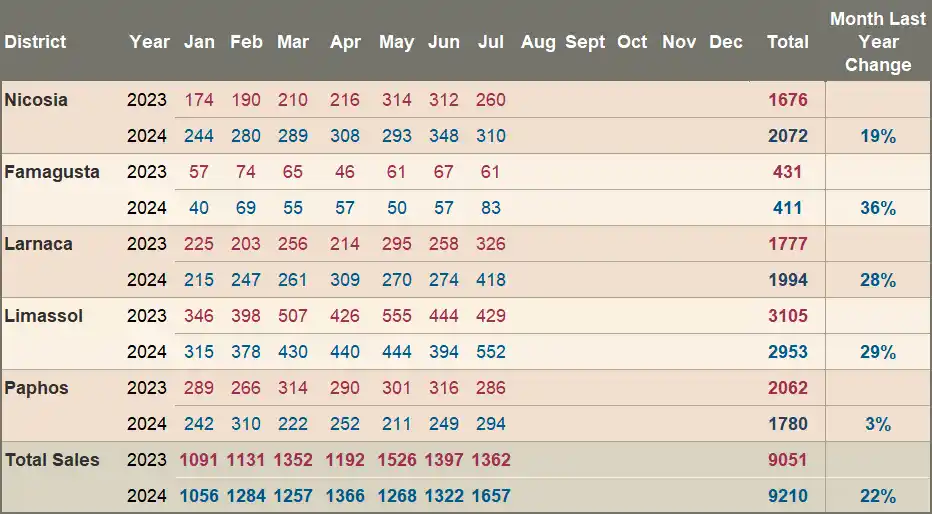
According to the Land Registry, the number of property sales contracts deposited in the first seven months of 2024 reached 9,210 – up 2% from the 9,051 recorded in the same period last year and the highest number recorded since 2008 when 9,385 contracts were deposited in the first seven months of the year.
Compared to July last year, the total number of sales rose by 22%, with sales rising in all districts. Sales rose by 36% in Famagusta, 29% in Limassol, 28% in Larnaca, 19% in Nicosia, and 3% in Paphos.
In terms of the number of sales, Limassol lead the way achieving 552 followed by Larnaca with 408. Nicosia was in third place with 310 sales, Paphos was just out of the medals in fourth place with 294 sales and finally Famagusta with 83 sales.
Sales in the first seven months of 2024 rose 2% compared with the same period last year. While property sales in Paphos fell 14% and by 5% in both Limassol and Famagusta, these falls were more than outweighed by sales in Nicosia and Larnaca rising by 24% and 12% respectively.
Total contracts of sale deposited – 2023/2024 Comparison (Jan-Jul)