Planning & building permits to be axed for small developments

The Ministry of Interior is striving to complete the simplification of the development control system by July 1 of this year through a package of 22 measures agreed upon with the Cyprus Scientific and Technical Chamber (ETEK).

One of the key measures is the elimination of urban planning and building permits for small developments, specifically for houses and buildings with up to 12 apartments.

It is noteworthy that obtaining even simple permits used to take months or even several years. While the procedures have been streamlined over time, delays persisted, depriving citizens of the opportunity to commence construction promptly, incurring costs and inconvenience.

Interior Minister Konstantinos Ioannou, who regards this package as the most significant and crucial restructuring of urban planning licensing, states, “The actions taken will significantly alleviate the current major problem of delays, which is a burden on developments. Especially with the abolition of urban planning and building permits for small developments and greater involvement of private architects, development completion is expedited, as each citizen can proceed with their own schedules.”

The Minister also emphasizes the substantial change brought about by the digitization of the submission and examination of urban planning applications through the “Hippodamus” System.

A significant change in the licensing process, expected to reduce delays in application reviews, is the advance consultation with services such as the Fire Department, Water Development Department, Environmental Authority, and the Public Works Department.

The modification was deemed necessary because, in many cases, delays in reviewing applications were due to incomplete submissions and the delayed provision of necessary information by applicants.

Through the “Hippodamus” Information System, relevant processes will be handled electronically, reducing the time for application reviews by the Planning Authority.

Another significant challenge causing delays in issuing urban planning permits was the understaffing of Planning Authorities.

Identifying the problem, the Ministry of Interior, in collaboration with Municipal Authorities, has hired 105 individuals who will be trained and eventually staff Provincial Self-Government Organizations. By June 30, the hired individuals will process a number of pending applications in existing municipalities, with the first 35 taking on duties on January 15.

It has also been revealed that different Planning and Building Authorities applied different practices during the application review, resulting in divergent processes, inconsistency, and time-consuming bureaucratic procedures causing delays in decision-making.

To eliminate practices causing unjustified delays, a working group from relevant Departments and ETEK is in the process of developing a standard/examination handbook to be followed by all Provincial Self-Government Organizations.

© In-Cyprus.com
Property sales to foreigners continue to stumble

Property sales to the overseas market, as measured by the number of sales contracts deposited at Land Registry offices, continued to stumble in December falling 19% compared to December 2022 according to official statistics from the Department of Lands and Surveys.

The only market segment that recorded an increase in sales in December was the domestic (Cypriot) market.

Market segment analysis

Property sales to the domestic market

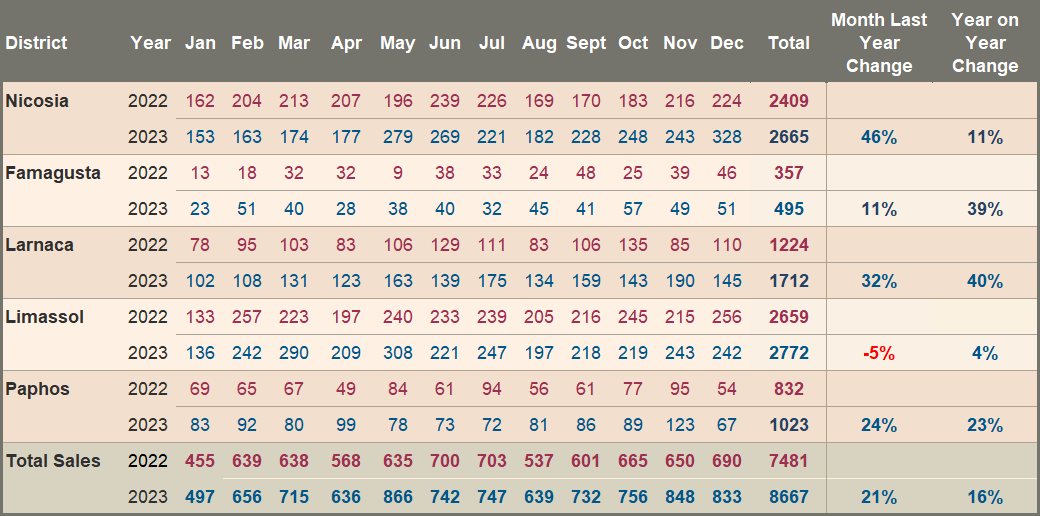
The total number of sales to the domestic (Cypriot) market December 2023 rose 21% compared to December 2022 and accounted for 56% of the total number of sales in the month.

With the exception of Limassol (where sales fell by 5%) sales in Nicosia, Larnaca, Paphos, and Famagusta rose by 46%, 32%, 24% and 11% respectively.

Domestic Sale Transactions – 2022/2023 Comparison

Sales to the domestic market in 2023 reached 8,667; an increase of 16% on the 7,481 achieved in 2022.

Property sales to the overseas market

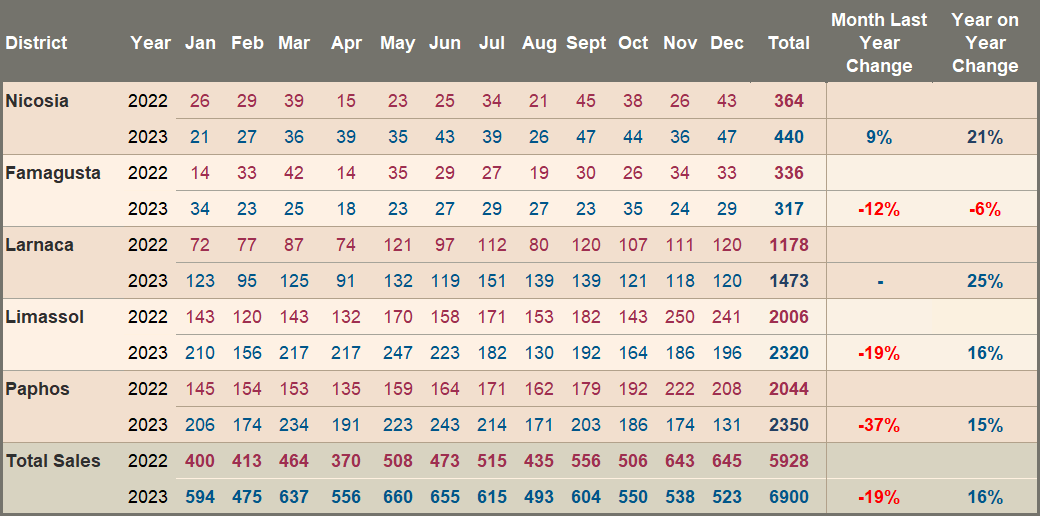
The total number of property sales to the overseas market (both EU and non-EU citizens) in December 2023 fell 19% compared to December 2022, with sales falling in all districts with the exception of Nicosia, where they rose 9%, and Larnaca, where they remained steady.

Property sales to the overseas market – 2022/2023 Comparison

On an annual basis, overseas sales rose by 16%, with increased sales in all districts with the exception of Famagusta. Despite the recent fall in sales, 2023 saw the highest number of sales to the overseas market since the market peaked in 2007.

Sales to the overseas market started to decline in November most probably as a consequence of the Gaza–Israel conflict.

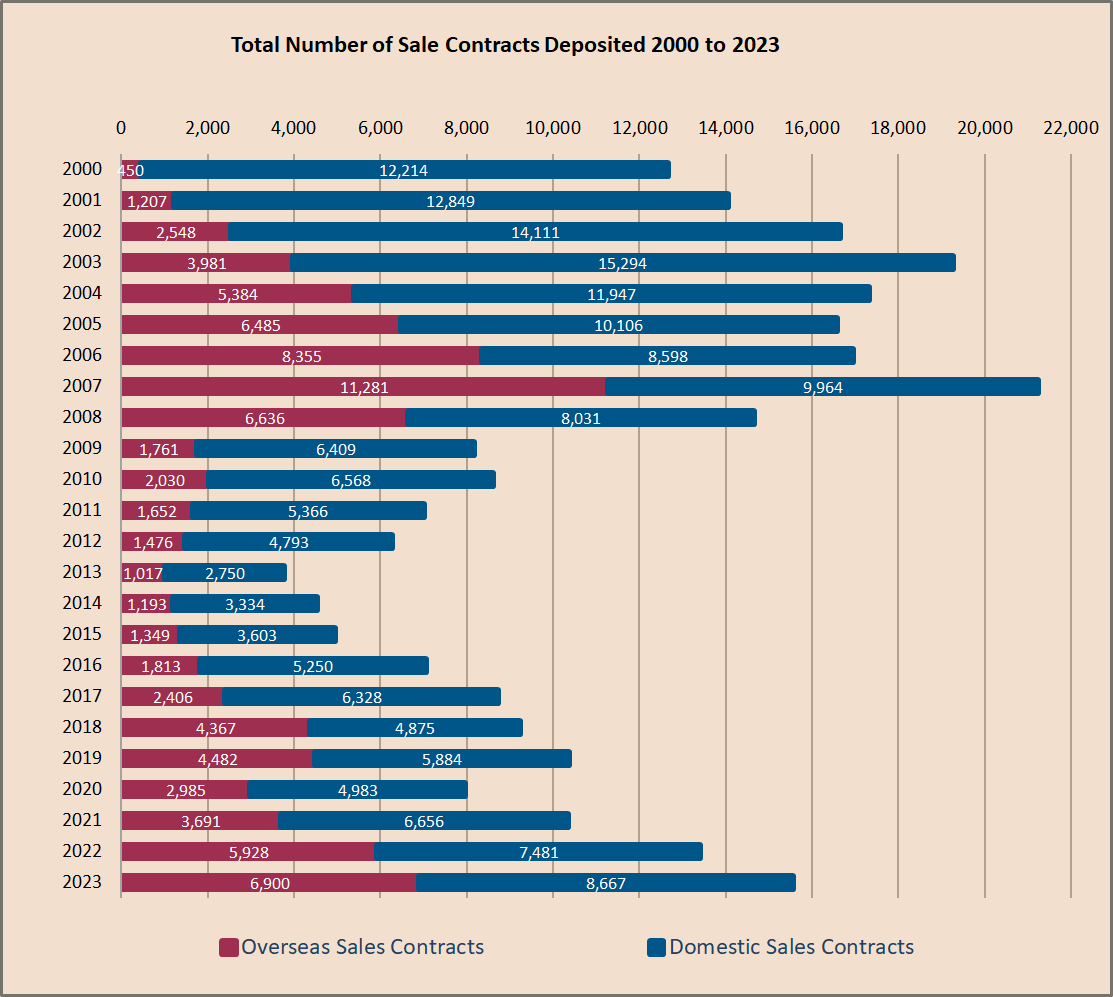
Cyprus property sales to the domestic and overseas market 2000 to 2023

Property sales to EU citizens

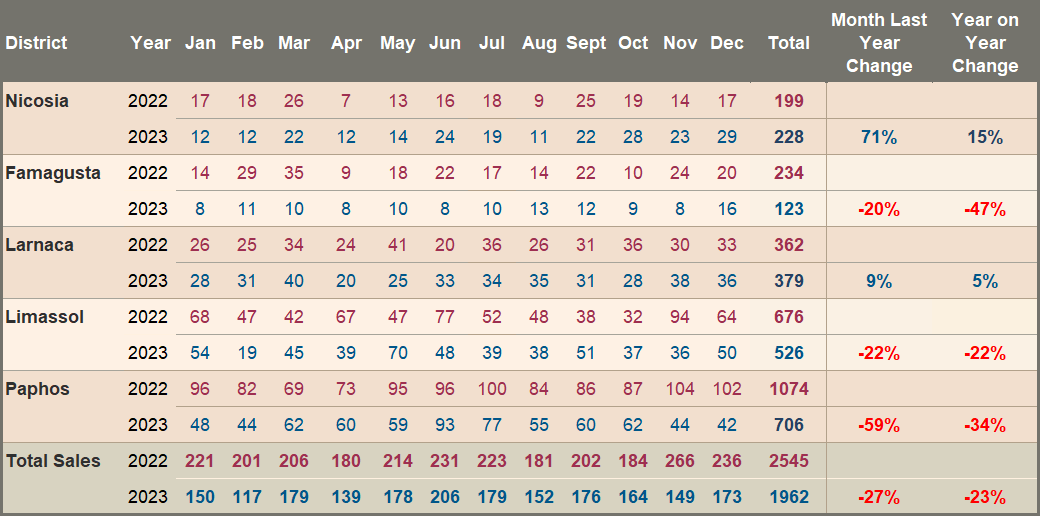
Sales to EU nationals fell 27% compared to December 2022 accounting for 13% of the total number of sales (1,358) achieved during the month.

The only two districts bucking the downward trend were Nicosia and Larnaca, where sales rose by 71% and 9% respectively.

Overseas (EU) Property Sale Transactions – 2022/2023 Comparison
Overseas (EU) Sale Transactions – 2022/2023 Comparison

Sales to EU nationals during 2023 reached 1,962; a fall of 23% compared to the 2,545 achieved in 2022.

Property sales to non-EU citizens

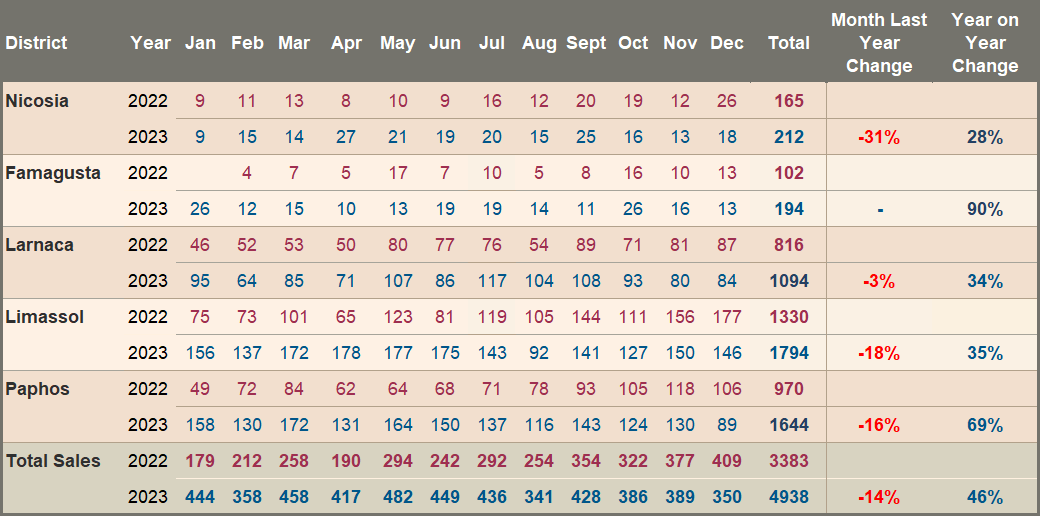
Sales to non-EU citizens in December 2023 fell 14% compared to December 2022 accounting for 26% of the total number of sales (1,358) achieved during the month.

With the exception of Famagusta district, where sales remained steady, sales fell in all districts.

Overseas (non-EU) Sale Transactions – 2022/2023 Comparison

Sales to non-EU nationals in 2023 reached 4,938; a 46% increase on the 3,383 achieved 2022.

Overseas market preferences in 2023

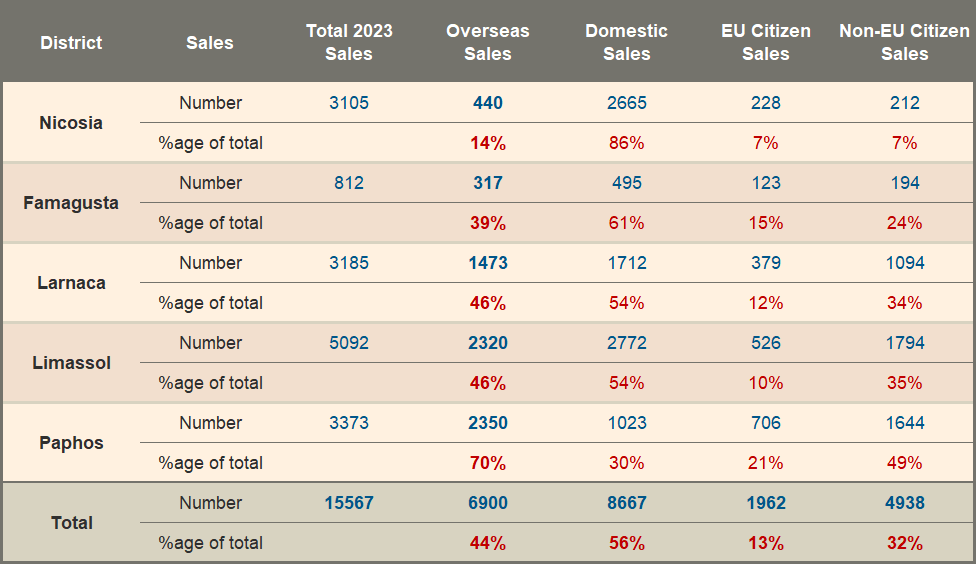
An analysis of property sales to the overseas market during 2023 reveals that foreign buyers prefer to buy in the coastal areas of the island.

Property sales in Paphos dominated by overseas buyers who accounted for 70% of total sales in the district. Paphos is followed by Limassol and Larnaca (each with 46%), Famagusta (39%) and finally Nicosia with overseas buyers accounting for less than 1 in 5 sales in the district.

Overseas market location preferences in 2023

Property sales hit highest level since 2007

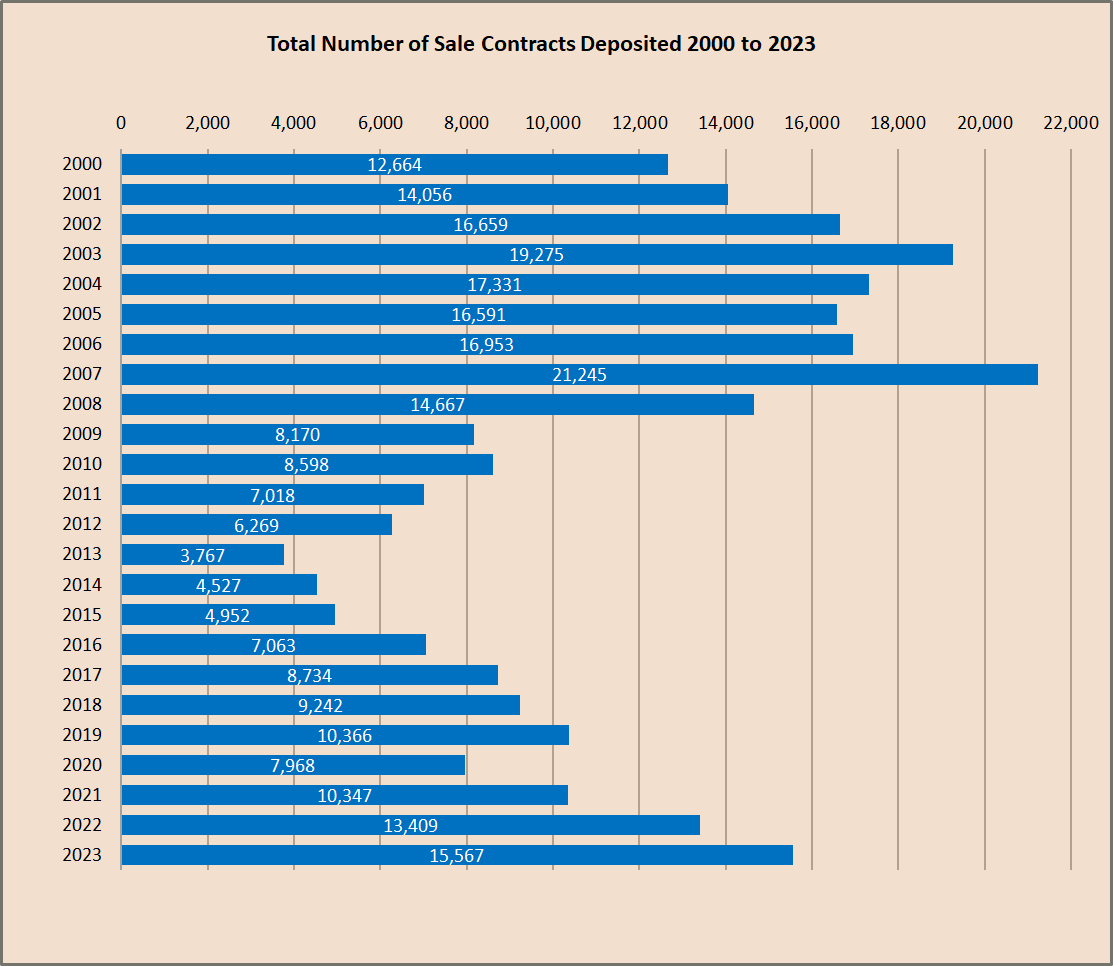
The number of property sales in 2023 reached the highest level on record since 2007, with a total of 15,567 contracts deposited with the Department of Lands and Surveys.

Sales reached a record 21,245 in 2007. But then the global financial crisis, the most severe worldwide economic crisis since the 1930’s depression, caused property bubbles around the world to burst.

In Cyprus, property sales declined until the island had its own financial crisis in 2012/13. In March 2013, a troika of international lenders (European Commission, International Monetary Fund and European Central Bank) and Cyprus agreed a €10 billion bailout package. In return for the bailout, the troubled Laiki Bank was shut down, uninsured bank deposits over €100,000 were taken (‘haircut’) and what remained of the Laiki Bank was transferred to the Bank of Cyprus.

As a consequence of the dire economic situation, a mere 3,767 properties were sold in 2013.

Since 2013, the property market has improved, but there have been ‘problems’ along the way, including the impact of the COVID pandemic in 2020, the notorious ‘Golden Passport Scheme’, and the long-standing issues with title deeds, property repossessions and non-performing loans.

total annual sales contracts 2000-2023

December 2023 property sales

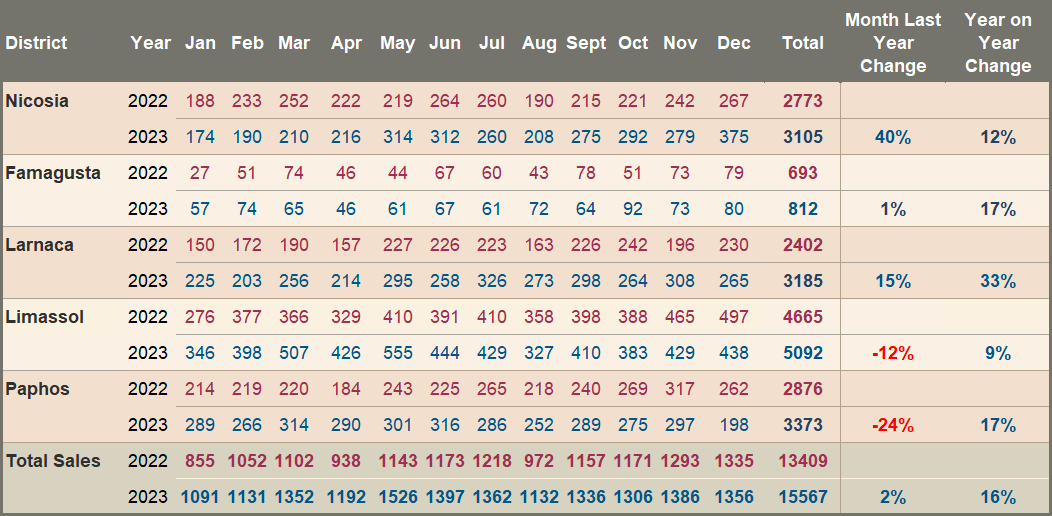
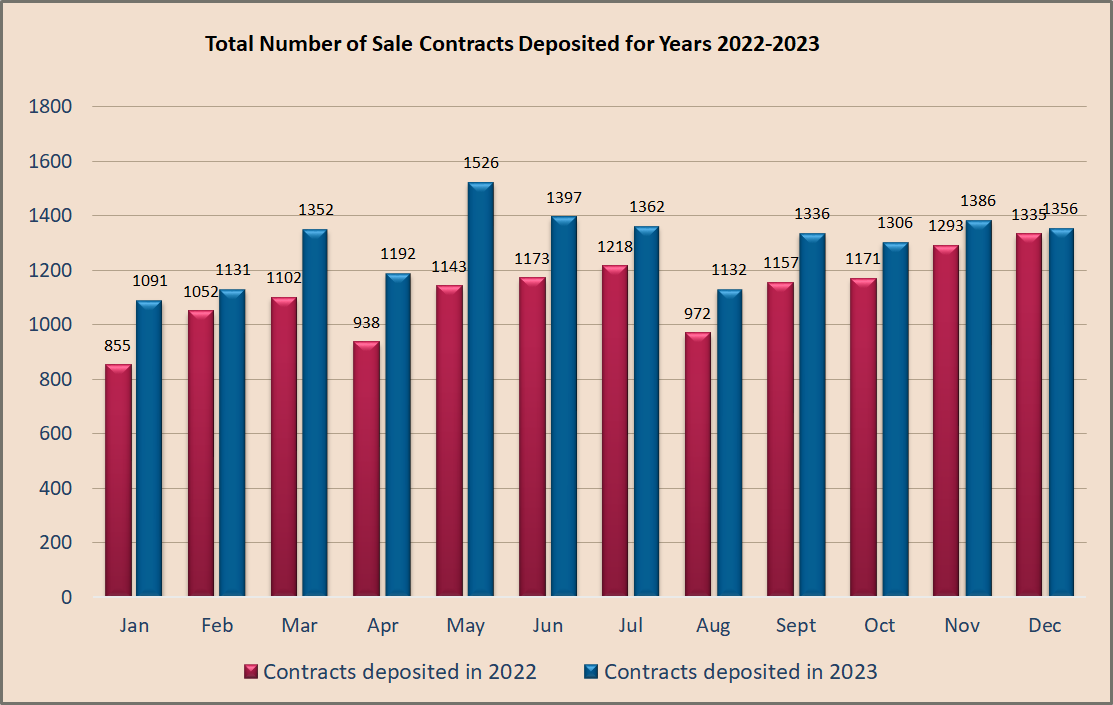
Sales in December, as measured by the number of contracts deposited at Land Registry offices, rose 2 per cent compared to December 2022 according to official figures from the Department of Lands and Surveys.

But while sales in Nicosia, Larnaca and Famagusta rose by 40%, 15%, and 1% respectively, sales in Paphos and Limassol fell by 24% and 12% respectively compared to December 2022.

Annual property sales
Total Property Sale Transactions – 2022/2023 Comparison

Annual sales in 2023

During the twelve months of 2023, sales reached 15,567; an increase of 16% compared to the 13,409 achieved in 2022 despite repeated hikes in interest rates and the economic impact of wars in Ukraine and Israel.

Sales chart

Hellenic Bank welcomes mortgage-to-rent scheme

“We welcome this plan as a favourable arrangement, ensuring housing for vulnerable households,” Hellenic Bank interim Chief Executive Officer Antonis Rouvas said in a statement.

“Those who have loans with Hellenic Bank, and who meet the criteria or wish to confirm their eligibility under the plan, are encouraged to contact Kedipes at their earliest convenience for further information and to submit the required application,” he added.

Under the mortgage-to-rent plan, homeowners facing property loss due to mortgage debts surrender their homes for five years to their lender.

The state-owned Kedipes entity buys the property, becoming the landlord, and tenants retain the residence.

Applicants meeting the criteria, and having a title deed, transfer it to Kedipes, who signs a 14-year lease while the state covers the rent.

Former owners or relatives may repurchase the property after five years at a price accounting for property changes, expenses, and rentals.

The eligibility covers loans securing residences up to €250,000 and certain beneficiaries, plus borrowers with homes valued up to €350,000, previously excluded from housing schemes or whose participation expired.

In its statement, the bank further clarified the three core groups eligible for the plan.

The categories of loan recipients eligible for the scheme include recipients of social benefits, such as single parents, large families, people with low pensions, and recipients of disability pensions, among others, who had non-performing loans as of December 31, 2021, and which remained non-performing as of December 31, 2022. This category can safeguard a primary residence with a market value of up to €250,000.

In addition, also eligible are applicants under the Estia and Oikia housing schemes, assessed as eligible but deemed unsustainable, with a market value of their primary residence up to €350,000.

Finally, the scheme can also include all applicants under the two aforementioned housing schemes, initially approved for inclusion but subsequently removed.

It should be noted that the scheme was also welcomed by the Cyprus Borrowers Association (Syprodat), which urged all eligible borrowers to seriously consider applying to the scheme in order to “seize the opportunity that it presents”.

What is more, the president of Kedipes Lambros Papadopoulos also expressed satisfaction with the positive response to the scheme so far.

Additionally, he urged eligible borrowers “to seriously consider this opportunity offered by the scheme, as it provides a very favourable settlement for their non-performing loans”.

For further details, interested parties can visit the Kedipes’ website.

Affordable housing units to bring down prices and rents

Developers in Cyprus have welcomed the Cabinet’s approval of a set of incentives for the construction of affordable housing units, promising a dynamic shift in the island’s real estate landscape, which has become financially burdensome for Cypriots.

Stelios Gavriel, the Secretary of the Federation of Cyprus Building Contractors Associations (OSEOK), said in an interview with state radio CyBC, that developers are already strategizing on how to leverage the scheme and overcome financing challenges.

Last week, the council of ministers gave the green light to new construction incentives proposed by the Interior Ministry.

The objective is to make approximately 800 residential units available in the market at an affordable price for both purchase and rental within the next three years.

As part of a strategic initiative to stimulate affordable housing development, the government has introduced a ground-breaking housing policy.

Landowners with a building block exceeding 1,000 sqm. and a building coefficient above 100% now have access to a lucrative 45% additional building factor. In contrast, plots below 1,000 sqm. will see a 25% increase in property development.

These incentives are specifically tailored for developers, with the scheme aiming to promote affordable housing through additional building coefficient.

Out of the 45% boost, 25% is earmarked for affordable home construction, while the remaining 20% is left to the discretion of the developer.

In the event that build units remain unsold, the state-owned Cyprus Land Development Corporation acts as a safety net.

Houses unsold within two years become the responsibility of the organisation, which purchases and integrates them into the affordable rent concession programme.

Available liquidity

Gavriel emphasised that while the new incentives are attractive to developers, interested parties will need to secure investors with available liquidity for larger projects.

“To put it in simple terms, if a developer will be building 100 apartments, with the scheme he will be allowed to build an additional 45, of which 25 must be made available at cost,” said Gavriel.

He explained that developers, with the new scheme, can build additional units, of which 25% must be made available at low cost.

For those choosing to rent out the 25% of units built with the extended building coefficient, a 30% discount on average prices for the same category property would apply.

He added that developers will need to find investors with cash and willing to play the long game before seeing any return on their investment from the additional housing units.

Gavriel noted that finding investors with cash and a willingness to play the long game is essential, as banks remain hesitant in providing loans to developers, who in turn must rely on self-financing or find affluent investors.

“While there is a great demand for housing, with rents and prices going up, banks keep a tight lid on loans to developers. Most projects are self-financed, as developers turn to investors for funding,” he explained.

“We are on the same page with the government’s plans to increase the stock of housing units in the market, while bringing down purchase costs and rents for fellow citizens in need,” he commented.

Gavriel expressed alignment with the government’s plans to increase the housing unit stock, aiming to reduce purchase costs and rents for citizens in need.

He anticipates a growing demand in the coming years, especially as Cyprus gains popularity as a relocation destination for fintech and high-tech companies, thanks to government incentive schemes.

Marginalisation

Real estate agents corroborate the high demand for housing, which has led to soaring prices and marginalisation of Cypriots from the market, particularly in coastal cities.

Eleni Averkiou of Danos/BNPRE Group explained to the Financial Mirror the challenges of renting in Limassol, describing it as a “mission impossible” due to long waiting lists and the dominance of high-earning expatriates willing to pay significantly higher rents than locals.

Averkiou pointed out that, “well-paid executives are willing to pay above the minimum wage, around €1,000, just for a studio flat. Highly paid employees are able and willing to pay up to €2,000 rent for an apartment, pushing up prices, creating a shortage of flats.

“As a result, estate agencies have long-waiting lists on their hands, with students and families essentially being excluded from renting in the city,” added the real estate expert.

The rental situation is particularly dire for students, with costs ranging from €500-700 a month for a second-class studio outside the city centre.

Rents for a one-bedroom flat start at €700, while a two-bedroom flat would cost between €1,000 to €1,200 per month.

Three-bedroom flats cost between €1,500 to €2,000.

“When it comes to new apartments, prices are well over the €2,000 mark,” she said.

Syllouris & Giovanis plead not guilty in golden passports trial

Former House President Demetris Syllouris and former Akel MP Christakis Giovanis pleaded not guilty to five charges read out to them at Nicosia criminal court on Friday. The charges stem from corruption allegations following an Al Jazeera documentary on Cyprus’ controversial citizen-by-investment scheme.

Currently, Syllouris, Giovanis and senior member of staff at the Giovanis Group, Antonis Antoniou, are facing a trial related to the findings of the Nicolatos report, which was carried out after the Al Jazeera documentary.

Antoniou who is currently abroad, will make his plea before the court on January 18 at 9.30am.

He is now being represented by lawyer Andreas Pittadjis – who was initially also on trial with the other three defendants.

In October, all charges against Pittadjis were dropped, and he transitioned from being a defendant to becoming Antoniou’s lawyer.

During Friday’s hearing, the court also rejected objections put forth by Giovanis’ lawyer George Papaioannou, who argued that the charges were not soundly based on any existing law.

The presiding judge said it was unnecessary for a ruling to be issued on the constitutionality of the charges, with Papaioannou later expressing his disagreement and telling the court he reserved the right to bring up the matter at a later stage of the proceedings.

Syllouris’ lawyer Chris Triantafyllides also agreed with Papaioannou, saying he too may raise an objection in due course.

Pittadjis and Triantafyllides informed the court they would be submitting a written request to the attorney-general asking for the release of witness material and transcripts used in the preparation of the Nicolatos report.

The Al Jazeera documentary caught high ranking officials including Syllouris and Giovanis on camera agreeing to give a Chinese investor nationality even though he was supposedly a criminal.

Copyright © Cyprus Mail

The Al Jazeera documentary on Cyprus’ disgraced Golden Passport scheme