Home Blog Page 14

High-end Cyprus property sales near €200m in Q1

The total value of the 50 most expensive property sales in Cyprus reached €197.7 million in the first quarter of 2026, according to data from the Department of Lands and Surveys, analysed by Ask Wire.

The firm, which uses technology to track transactions, asking prices and construction activity, analysed the largest deals completed between January and March 2026, including their distribution across districts.

High-value property sales focussed on Limassol and Paphos

The ten most expensive transactions alone were worth €83.9 million, with the single largest deal involving land with a building in Moni, Limassol, valued at €19.7 million.

Among the top ten sales:

  • Five were recorded in Paphos
  • Four in Limassol
  • One in Larnaca

This highlights a strong concentration of high-value activity in Limassol and Paphos.

Across Cyprus, Limassol led the market with 29 of the top 50 transactions, totalling €107.2 million. Paphos followed with 17 deals worth €71.8 million.

Paphos shows diverse property demand

Paphos stood out for its diversity of assets. Alongside land deals, it featured prominently in high-end residential sales within the top ten.

Notable transactions included:

  • A villa in Pegeia valued at €6.3 million
  • A residence in Agios Theodoros, Paphos, worth €5.8 million

Elsewhere, Larnaca recorded one transaction worth €9 million, Nicosia two deals totalling €7.5 million, and the free Famagusta district one sale valued at €2.2 million.

Land market signals new development cycle

Pavlos Loizou, Chief Executive of Ask Wire, said a key finding from the analysis is the strength of the land market.

Six of the ten most expensive deals involved fields and plots, suggesting that the market may be preparing for, or anticipating, a new wave of development.

He noted that the highest-value sale in each district across free Cyprus involved land:

  • Limassol: €19.7 million field
  • Paphos: €9.5 million field
  • Nicosia: €5.5 million plot
  • Larnaca: €9 million plot
  • Famagusta: €2.2 million field

The 10 most expensive property sales in Q1 2026

No Property Type Sale Price District / Municipality – Community
1 Building and 6 adjacent fields €19.7 million Limassol / Moni
2 Field €9.5 million Paphos / Pegeia
3 Plot (seaside) €9 million Larnaca / Chrysopolitissa
4 Field €8 million Paphos / Agia Marinouda
5 Field €7.25 million Limassol / Agios Athanasios
6 Commercial building €7.15 million Limassol / Mouttagiaka
7 House €6.3 million Paphos / Pegeia
8 House €5.8 million Paphos / Agios Theodoros
9 Apartment €5.7 million Limassol / Agios Tychonas
10 Field €5.5 million Paphos / Moutalos

Source: Department of Lands and Surveys, Analysis: Ask Wire

According to Loizou, first-quarter data provides a useful benchmark for Cyprus’ high-value property segment at a time of heightened geopolitical uncertainty.

He added that tracking transactions throughout the year will be key to assessing how regional developments influence demand, liquidity and investment decisions.

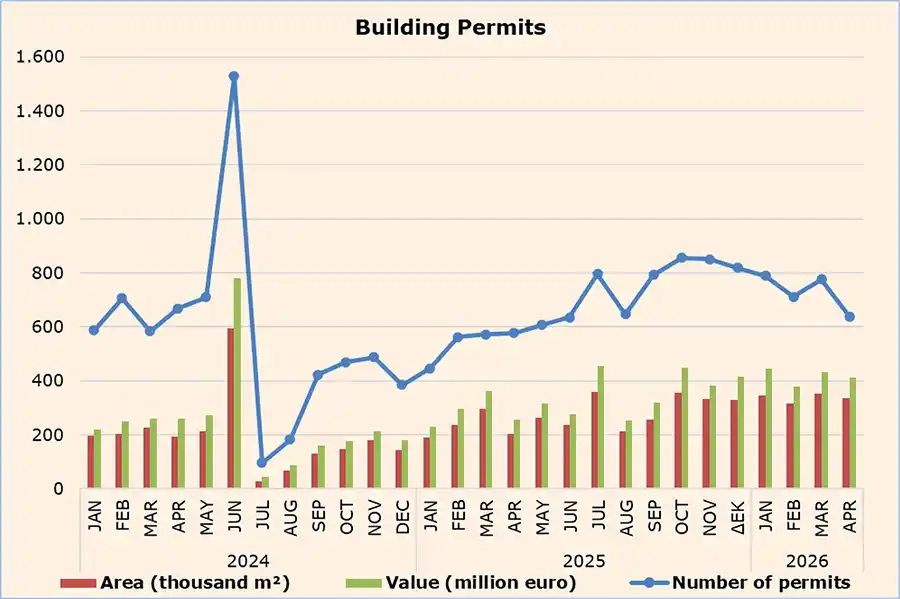
Building permits rise 76.9% as housing doubles

Cyprus recorded a sharp increase in construction activity in January 2026, with building permits rising significantly across all types of projects, according to official data from the Statistical Service of Cyprus.

Strong gains were reported in total floor area, project value, number of permits issued, and planned residential units.

A total of 789 building permits were issued in January 2026, up from 446 a year earlier — a 76.9% increase.

Residential building permits rose by 89.3%, while civil engineering permits increased by 92.9%. Land division permits climbed by 64.1%, and road construction permits surged by 333.3%. Non-residential permits recorded a more modest rise of 10.3%.

The number of residential units expected to be built more than doubled, reaching 1,755 units — a 109.4% increase compared with 838 units in January 2025.

Detached houses rose by 99.4% to 329 units, while semi-detached homes remained broadly stable. Apartment buildings saw the strongest growth, rising by 135.9% to 1,248 units, with mixed-use residential buildings also increasing by 137.5%.

CySTAT: Increase of 76.9% in the Number of Building Permits Issued

Total floor area jumps 82.5%

The total floor area of authorised projects reached 346,700 square metres in January 2026; an 82.5% increase compared with January 2025.

Residential developments drove the growth, with floor area soaring by 112.3% to 302,015 square metres, up from 142,287 a year earlier. By contrast, non-residential buildings declined by 37.0%, falling to 29,808 square metres.

Civil engineering projects posted an exceptional rise, with floor area surging by 4,603.5%, reaching 14,863 square metres from just 316 square metres in January 2025.

Project value climbs 92.9%

The total value of authorised projects reached €445.2 million in January 2026, reflecting a 92.9% increase year-on-year.

Residential building value surged by 113.9% to €336.6 million. Civil engineering projects also saw strong gains, rising by 301.5% to €50.3 million.

In contrast, non-residential buildings recorded an 11.9% decline in value. However, permits for land division increased by 213.2%, while road construction rose by 104.0%, albeit from a low base.

Record busting month for Cyprus property sales

The Cyprus property market reached a historic milestone in April, with property sales climbing to their highest level ever recorded.

Official figures released by the Department of Lands & Surveys show that 1,611 property sale contracts were lodged with Land Registry offices during the month. This marks a 15% increase from the 1,404 contracts recorded in April 2025.

The latest figure surpasses the previous April record of 1,556 sales set in April 2007, the strongest year in the island’s property market history, by 55 transactions.

The statistics cover all sectors of the market, including residential properties such as houses and apartments, commercial assets including offices, retail units and warehouses, as well as land sales involving fields and building plots.

Regional performance was broadly positive across the island, with most districts reporting notable year-on-year growth.

Paphos recorded the strongest rise, with sales up 41%, followed by Larnaca at 21%.

Meanwhile, Limassol posted a 10% increase, and Nicosia a small increase of 2%, while sales in Famagusta remained steady.

Total contracts of sale deposited – 2025/2026 Comparison (Apr)

Property sales year to date

In the first four months of 2026, the total number of property sales contracts deposited at Land Registry offices reached 6,320; a 14% increase compared to the 5,541 deposited in the first four months of 2025, with all districts recording gains:

Famagusta recorded the largest increase in the first four months, with sales up 25%, followed by Paphos at 18%.

Meanwhile, sales in Limassol rose 14%, followed by Larnaca at 12% and finally Nicosia at 11%.

Total contracts of sale deposited – 2025/2026 Year-to-Date Comparison

Property market outlook

Trump’s war in Iran is expected to place additional upward pressure on property purchase and rental prices in Cyprus, although the market has yet to show any signs of decline. A prolonged conflict could drive up construction costs and increase external demand, potentially pushing property prices even higher.

At the same time, Cyprus continues to be regarded as a safe haven for individuals and companies seeking stability and refuge from regional conflicts.

Market segment overview

Local buyers remained the driving force behind Cyprus property sales in April.

  • Cypriot buyers: 962 sales (59.7% of total transactions)
  • EU citizens: 197 sales (12.2%)
  • Non-EU citizens: 452 sales (28.1%)

The chart below illustrates the year-to-date performance of each market segment dating back to 2008. It should be noted that the Department of Lands and Surveys only began separating EU and non-EU buyer data in 2018. Prior to this, all overseas transactions were grouped together under “Overseas Sales Contracts”.

4 month real estate sales 2026

Market segment analysis

Domestic sales

Cypriot buyers deposited 962 property sale contracts in April 2026, compared with 852 during the same month last year, representing a 13% increase.

While sales in Nicosia fell by 4% and remained flat in Famagusta, the other districts posted solid growth:

  • Larnaca: +37%
  • Limassol: +20%
  • Paphos: +16%
Domestic (Cypriot) contracts of sale deposited – 2025/2026 Comparison (Apr)

Domestic sales year to date

During the first four months of 2026, Cypriot buyers deposited a total of 3,627 property sale contracts, up 9% from the 3,318 recorded during the corresponding period of 2025.

With the exception of Paphos, all districts reported gains:

  • Famagusta: +44%
  • Limassol: +12%
  • Nicosia: +8%
  • Larnaca: +8%
  • Paphos: -6%
Domestic (Cypriot) contracts of sale deposited – 2025/2026 Comparison

Property sales to EU nationals

EU citizens filed 197 property sale contracts in April, compared with 186 in April 2025, marking a modest 6% year-on-year increase.

However, performance varied considerably across the districts.

Limassol and Famagusta recorded declines of 43% and 7% respectively, while the remaining districts posted growth:

  • Paphos: +50%
  • Larnaca: +19%
  • Nicosia: +12%
Contracts deposited by EU Nationals – 2025/2026 Comparison (Apr)

EU sales year to date

In the first four months of 2026, property sale contracts deposited by EU nationals excluding Cypriots reached 872, representing a 20% increase on the 724 recorded during the same period last year.

All districts apart from Famagusta recorded growth:

  • Paphos: +39%
  • Larnaca: +25%
  • Nicosia: +21%
  • Limassol: +7%
  • Famagusta: -21%
Contracts deposited by EU Nationals – 2025/2026 Comparison

Property sales to non-EU nationals

Non-EU buyers deposited 452 property sale contracts in April, compared with 366 in April 2025, reflecting a strong 23% increase.

Almost every district recorded growth, with only a marginal decline in Larnaca:

  • Paphos: +64%
  • Nicosia: +60%
  • Limassol: +12%
  • Famagusta: +5%
  • Larnaca: -1%
Contracts deposited by non-EU Nationals – 2025/2026 Comparison (Apr)

Non-EU sales year to date

During the first four months of 2026, non-EU nationals deposited 1,821 property sale contracts, up 21% from the 1,499 recorded during the same period in 2025.

All districts posted gains:

  • Famagusta: +36%
  • Nicosia: +28%
  • Paphos: +24%
  • Limassol: +22%
  • Larnaca: +14%
Contracts deposited by non-EU Nationals – 2025/2026 Comparison

Overseas buyers remain crucial to the market

The latest figures once again underline the growing importance of overseas buyers in sustaining momentum across the Cyprus property sector.

Combined, EU and non-EU purchasers accounted for 42.6% of all property transactions recorded so far this year.

Paphos continued to stand out, with overseas buyers purchasing more than twice as many properties as Cypriots.

Overall, April’s figures reinforce the resilience of the Cyprus property market, with strong demand from both local and international buyers continuing to support market growth despite wider geopolitical uncertainty.

Market Segment Summary Analysis 2026 Year to Date

Cyprus expands water saving campaign amid drought pressure

Cyprus will distribute two million water-saving aerators for taps and one million shower flow reducers as part of a nationwide effort to curb water consumption and strengthen long-term water security.

Speaking at a press conference organised by EKO Cyprus, the Minister of Agriculture, Rural Development and Environment, Maria Panayiotou, said the equipment would help households and businesses reduce water use without affecting everyday living standards.

The initiative forms part of a broader public awareness campaign aimed at encouraging more responsible use of water across Cyprus as the island continues to face mounting pressure from drought and climate change.

Pilot distribution to businesses and professional premises with high water usage began in the first months of 2026. The programme is now expected to expand within weeks to households, public buildings and military camps.

Panayiotou said the campaign carries a simple message: if every resident reduces water consumption by just 10%, the overall impact on Cyprus’ water reserves would be substantial.

Desalination at the centre of Cyprus water strategy

The minister stressed that desalination remains central to the government’s long-term strategy to secure reliable water supplies.

Despite improved inflows into reservoirs this year, Cyprus continues to invest heavily in non-conventional water sources, upgrades to ageing infrastructure and public education campaigns aimed at changing consumption habits.

Over the past two years, three additional mobile desalination units have entered full operation in Moni, Kissonerga and Limassol Port, helping to address immediate supply pressures. A fourth unit is expected to begin operating later this month, with further mobile plants planned for 2026 and 2027.

At the same time, four permanent desalination facilities are moving forward in eastern Limassol, Ayia Napa – Ayia Thekla, Polis Chrysochous and Dhekelia. Existing facilities are also being expanded to create a more resilient and flexible water network for the coming decades.

Millions allocated to repair ageing networks

The government has also approved €10.5 million worth of projects for regional water organisations in 2025, alongside an additional €1 million for local communities, aimed at replacing ageing pipelines and reducing leaks.

Emergency grants of up to €300,000 for each DLGO have also been approved to speed up repairs and improve leak detection.

According to the minister, average daily water consumption in Cyprus currently stands at around 140 litres per person, above the European Union average of approximately 124 to 125 litres.

Alongside infrastructure investment, authorities are increasing efforts to improve public awareness through the “Water for Tomorrow” campaign, led by the Press and Information Office and the Water Development Department.

In partnership with the KIOS Research and Innovation Centre of Excellence, the government has also developed the “Stagona” application, allowing households to monitor and calculate daily water usage more accurately.

Panayiotou further announced that a new dedicated website on Cyprus’ water challenges will launch this week, bringing together information on drought pressures, infrastructure projects and practical advice for water conservation.

Water saving tips

Shower: For your shower, turn off the tap when not needed, and aim for 5 minutes of continuous flow (≈ 50 litres), instead of 9 minutes for an average shower (≈ 90 litres). The shower accounts for 65% of daily consumption.

Cold shower water: Collect cold water in a bucket while waiting for the right temperature (≈ 5-10 litres). It can be used for toilet flushing or for watering plants.

Leak detection: Check the meter reading when you are away for more than 2 hours, before and after. If there is flow in the meter, there might be a leak. A leak can waste 300-900 litres per day, equivalent to the consumption of 4-6 people!

Washing machine: Operate only when full, on Eco program (≈ 45 litres) whenever possible, instead of others that require more than 100 litres per wash.

Dishwasher: Fill completely before use (≈ 11-20 litres), instead of washing with running water (up to 100 litres in 10-15 minutes).

Drought-resistant plants: Choose plants that withstand drought for your garden, such as Rosemary, Lavender, Sage, Mastic, Thyme, etc.

Balcony cleaning: Sweep and if needed, pour 1-2 buckets of water (≈ 20 litres total) (which can be collected in the bathroom), instead of 5 minutes of hose spraying (≈ 100 litres).

Watering: Fill buckets (≈ 10 litres each) and water targeted areas. Watering with an open hose for 10 minutes wastes 300 litres of water, equivalent to the daily consumption of 2 people!

Brushing teeth & shaving: Turn off the tap while brushing your teeth or shaving (< 2 litres) instead of 3 minutes of open flow which corresponds to 20 litres!

Dawn/dusk watering: Reduces evaporation by up to 30%.

Car washing: Choose 2 buckets with sponge (≈ 20 litres) instead of a hose, which corresponds to 400 litres.

Cyprus to mandate electronic rent payments from July

The Cyprus Tax Department is preparing to introduce compulsory electronic rent payments as part of a wider crackdown on tax evasion and undeclared rental income.

Under the new legislation, which comes into force on 1 July, all rent payments for properties in the Republic of Cyprus must be made exclusively through bank transfers, debit or credit cards, or other recognised electronic payment methods. Cash and cheque payments will no longer be permitted.

The authorities say the measure forms part of a broader strategy to improve tax compliance after receiving numerous complaints that some landlords with significant rental income were failing to declare earnings in their tax returns.

Cash and cheque rent payments banned

The Tax Department is currently finalising procedures and preparing guidance documents ahead of the implementation date.

Under the new legal framework, landlords will also be prohibited from accepting rent payments in any form other than approved electronic methods. Officials believe the move will create a clear financial trail, making it easier to identify undeclared rental income and reduce tax avoidance.

The government expects the reforms to benefit both the state and the wider property market. Increased transparency is expected to boost tax revenues, while landlords and tenants could gain access to larger tax allowances and deductions.

Tax relief for tenants and landlords

Tenants will be eligible for an income tax deduction of up to €2,000 for rent payments and interest on performing home loans for a primary residence, provided annual income exceeds €22,000.

The reforms are also linked to revised income tax bands. Under the updated structure, income between €22,001 and €32,000 will be taxed at 20%, income from €32,001 to €42,000 at 25%, and income from €42,001 to €72,000 at 30%. Earnings above €72,001 will remain taxed at 35%.

These tax measures will apply from the 2026 tax year and will be reflected in tax returns submitted the following year.

Authorities have warned that anyone breaching the new payment rules could face penalties. Before the legislation comes into force, the Tax Department is expected to issue detailed guidance outlining the obligations of both landlords and tenants.

VAT declarations now Through Tax for All

Separately, the Tax Department has announced that declarations for the exemption of property leases and rentals from VAT must now be submitted exclusively through the Tax for All online portal.

The updated process follows a notice published in the Official Gazette of the Republic on 3 April 2026. The declaration form, T.F.1220 2026, must be submitted within 30 days of signing a lease agreement, although the Tax Commissioner may approve a later submission date following a formal request.

Applications must include a copy of the lease agreement, identification documents for the signatory, and, in the case of companies, a certificate of directors. Where the declaration concerns only part of a property, a detailed description must also be attached.

Property buyers risk becoming ‘trapped’ by court ruling

A controversial court ruling in Cyprus has brought an end to a long-standing Land Registry practice that warned property buyers about legal burdens attached to properties when filing their sales contract at their offices.

Critics of the court ruling say it leaves buyers dangerously exposed and increases the risk of becoming trapped by undisclosed mortgages, developer’s debts, etc. lodged against the property they are purchasing.

The decision has sparked concern across the Cyprus property sector, particularly among overseas buyers already wary of the island’s troubled history of hidden mortgages, developer debts and delayed title deeds.

Under the new interpretation confirmed by Attorney-General George Savvides, the Land Registry will no longer inform buyers during the contract filing process if mortgages, memos or other legal encumbrances exist on a property.

Officials argue the previous system caused delays and informed buyers too late in the process to be useful. However, property professionals warn that removing this safeguard weakens transparency at a time when confidence in the Cyprus property market remains fragile.

Critics also point out that identifying burdens is neither difficult nor time-consuming. A simple search of the Department of Lands and Surveys (DLS) database by Land Registry officers handling the contract could reveal mortgages, prohibitions and other encumbrances against a property within minutes. They argue that abandoning the practice altogether prioritises administrative convenience over buyer protection.

Responsibility shifted onto buyers

The ruling places total responsibility on buyers and their legal advisers to uncover risks before signing contracts.

Since December 2023, Cyprus law has required sellers to provide a recent search certificate as part of any property sale agreement. The certificate must be issued no more than five working days before the contract is signed.

While the legislation was introduced to strengthen consumer protection, critics argue the latest changes effectively shift the burden entirely onto purchasers, many of whom may not fully understand the legal complexities surrounding Cyprus property transactions.

Even if property buyers carry out thorough due diligence they could still find themselves buying properties carrying significant debts or legal restrictions.

Property buyers fear return of past problems

The issue is particularly sensitive in Cyprus because thousands of buyers, especially foreign purchasers, were historically caught in disputes involving unpaid developer mortgages and title deed delays.

Although reforms in recent years aimed to restore confidence in the market, the latest ruling risks reviving fears that buyers may once again become trapped in lengthy and costly legal complications.

The Land Registry has defended the changes, stating that all relevant legal information can still be obtained through a separate search certificate application before any contract is signed.

However, critics argue many buyers rely heavily on the filing process itself as a final safeguard and may wrongly assume the authorities will flag serious issues automatically.

Land registry introduces new digital application system

Alongside the changes, the Land Registry has introduced revised application forms designed to speed up processing times and modernise procedures.

New electronic forms have been launched for sale contracts, exchange agreements and land-for-development deals. The updated system requires key contract details to be clearly referenced by page and paragraph to reduce errors and improve efficiency.

The department says the reforms will streamline administration and improve public service. Yet for many in the property sector, concerns over buyer protection now overshadow the promised efficiencies.

For prospective purchasers, particularly overseas investors unfamiliar with Cyprus property law, the message has become increasingly clear: independent legal checks are no longer optional but absolutely essential!