Demand & most property prices increasing

0

Prices for most types of property in Cyprus are increasing according to the latest edition of the RICS Cyprus Property Price Index with KPMG.

The latest Property Price Index (for the fourth quarter of 2021) also reports that demand for property is increasing as the market continued to recover from the COVID-19 pandemic, with a 15% rise in transactions over the quarter.

The number of properties sold to non-EU citizens who registered contracts of sale at Land Registry offices increased by 20% compared to the previous quarter – and by 30% compared to the fourth quarter of 2021. The issue of non-performing loans and debt for asset swaps has decreased for most banks, although still present but at a minor scale than previous years.

On the subject of non-performing loans, last month the statistical office of the European Union (Eurostat) reported that:

“In 2020, Cyprus remained the country with the highest stock of non-performing loans (assets) of general government, at 28.3% of GDP, a far larger share compared with other EU Member States. This was due to a large transaction in 2018, whereby non-performing loans from a Cypriot public financial corporation (classified outside government) were transferred to a government unit.

“Three other EU Member States recorded a share higher than 1% of GDP: Slovenia (2.2%), Portugal (1.5%) and Croatia (1.4%). For Cyprus, Slovenia and Portugal, the majority of non-performing loans refer to loans of financial defeasance structures. In the case of Croatia, the figure mainly refers to the loans of a national development bank (classified inside general government).”

Property prices increasing

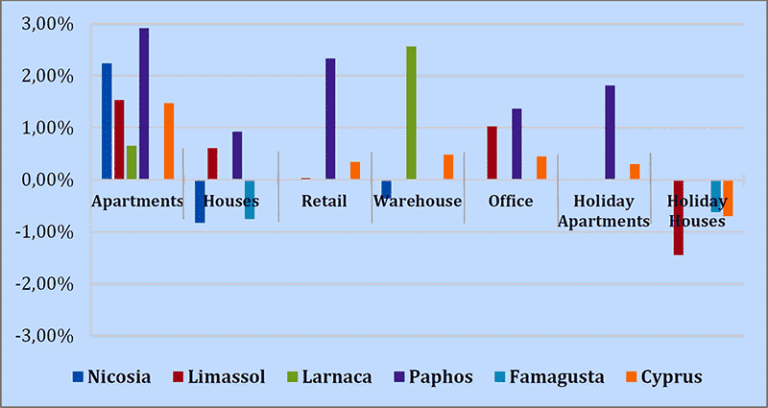
Prices for residential apartments increased by 1.47% and remained steady for houses. The largest increase in apartment prices were recorded in Paphos, up by 2.92%, and in Nicosia, up by 2.24%.

Values for holiday homes across Cyprus during the fourth quarter rose by 0.30% for apartments but fell by -0.70% for houses. The largest increase was recorded in Paphos by 1.81% for holiday apartments; the largest fall, while the largest fall in house prices, -1.5%, was recorded in Limassol.

On an annual basis, apartment prices rose by 1.47%, while house prices remained steady. Meanwhile retail, warehouse and office prices rose by 0.34%, 0.48% and 0.45% respectively.

Rental values increasing

Over the fourth quarter, most rental values rose; 0.65% for houses, 1.23% for apartments, 1.58% for offices and 1.34% for warehouses.

However, small falls were recorded in holiday homes with rental values apartments down 0.12% and house rental values falling by 0.53%.

Rental yields

Average gross rental yields stood at 4.9% for apartments, 2.6% for houses, 5.7% for retail, 4.5% for warehouses, and 5.2% for offices.

Further reading

RICS KPMG Property Price Index: Q4 2021

Alpha Bank secures deal to sell NPLs

0

Earlier today, Alpha Bank said that it has reached an agreement to sell a portfolio of Cypriot non-performing loans (NPLs) and real estate properties, with a total gross book value of €2.4 billion, to an affiliate of Cerberus Capital Management, L.P. (“Cerberus”).

According to a statement issued by the Bank, “Project Sky forms part of Alpha Bank Group’s strategy to reduction its stock of non-performing loans and is the culmination of a series of similar successful transactions completed by the Group over previous years.

“With this transaction, the Group further de-risks its balance sheet by reducing the NPL ratio by an additional approximately five percentage points to 3% (as of September 30, 2021 pro forma).”

This transaction will further de-risk the Group’s balance sheet by reducing its non-performing exposure (NPE) ratio by an additional five percentage points to 13%.

The impact of the sale on Alpha Bank’s income statement is fully in line with a budgeted loss of €200 million, while the impact on its total capital adequacy ratio will be around 20 basis points.

Completion of the sale is expected in the third quarter of this year, subject to the usual regulatory approvals.

Foreign buyers returning in droves

0

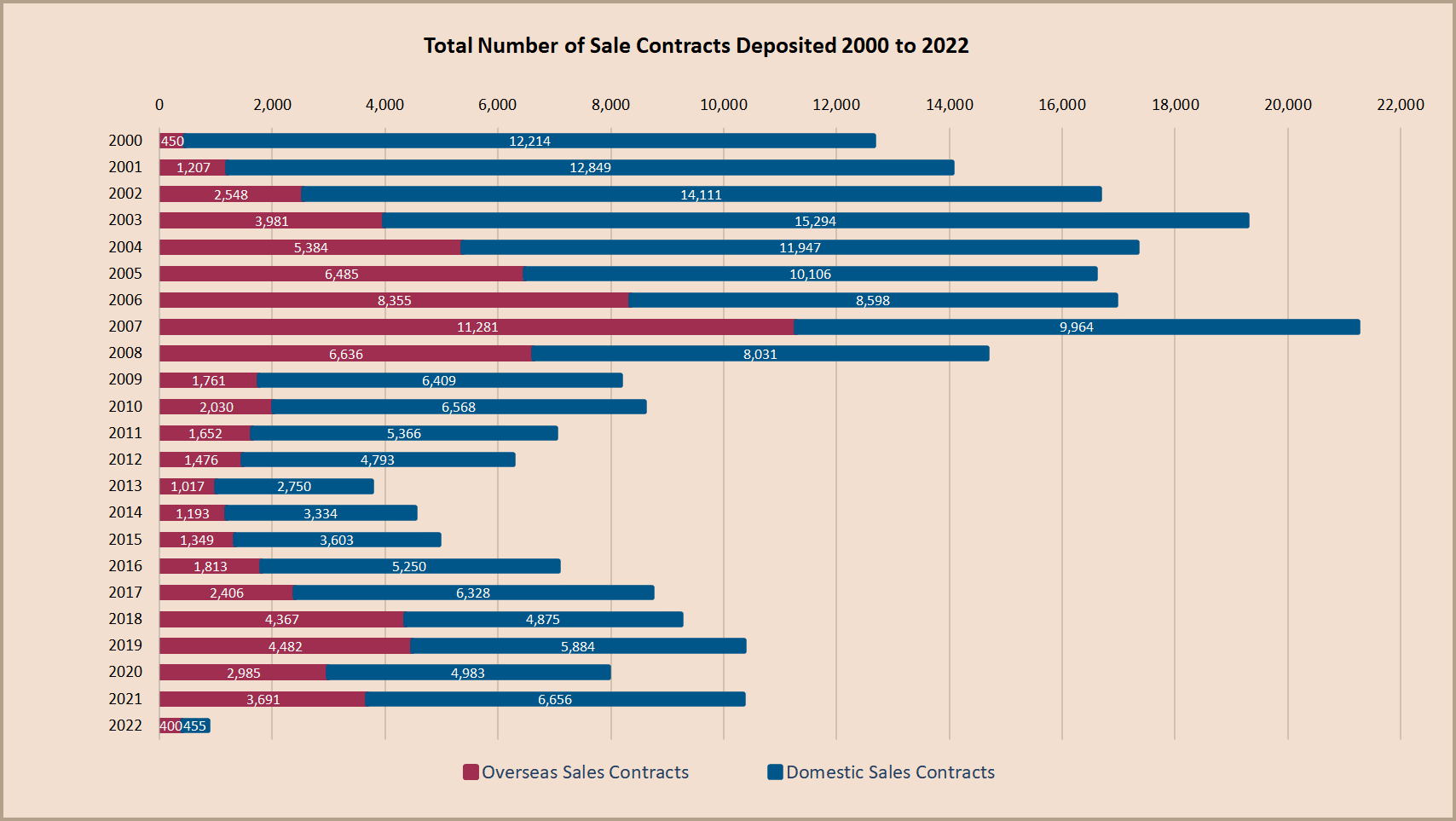
Foreign buyers deposited the highest number of property sale contracts for the last fourteen years according to official statistics published by the Department of Lands and Surveys.

January saw a surge in foreign buyers who deposited 400 contracts compared to 168 in January 2021; a rise of 138% and well above the number in pre-COVID January 2019. The last time the number of contracts deposited in January exceeded 400 was in 2008.

The surge in numbers suggests that the interest from foreigners has been encouraged by scaling back the preventive measures introduced by governments to control the spread of COVID-19.

Foreign nationals from EU member states lodged 221 contracts; an increase of 230% compared to the 67 deposited in January 2021. This is the highest January figure recorded since the Land Registry recorded EU buyers separately in 2017.

Contracts deposited by foreigners from non-EU countries (third country nationals) in January rose by 77% reaching 179 in January 2022 compared to 101 in the same month last year. However, the demise of the Citizenship-by-Investment scheme, which was scrapped in November 2020 means that Cyprus is now off the radar for many foreign investors looking for an EU passport.

In January, sales to foreigners accounted for 47% of total sales (885).

Domestic sales

Cypriot citizens deposited 455 contracts in January compared to 345 in January 2021; an increase of 32%, back to pre-COVID levels and the highest January figure for a decade. Increased demand from Cypriots has been encouraged by the government’s interest rate subsidy scheme that concluded at the end of 2021.

However, the figures include an unreported number of ‘non-sale’ agreements such as loan restructurings, recoveries and debt-to-asset swaps agreed between financial institutions and defaulting borrowers in efforts by the banks to reduce their non-performing loan portfolios.

Cyprus property sales 2000-2022

Residential market powers ahead, commercial wobbles

0

WiRE FS, combining real estate know-how with technology, has published its Q4 2021 edition of the WiRE Index for property and rental values, which covers all districts and main property types, with values from Q4 2009.

Sale market values

Across Cyprus, on a quarterly basis sale values increased by 1.4% for apartments and 0.5% for houses and decreased by 0.5% for retail, 2.0% for warehouses and 0.3% for offices.

As for holiday apartments sale values increased by 1.0%, while holiday houses decreased by 0.1%.

On an annual basis, prices increased by 2.2% for apartments and 0.7% for holiday apartments, and decreased by 0.5% for houses, 3.4% for retail, 4.5% for warehouses, 2.1% for offices and 3.7% for holiday houses.

Larnaca stands out from the districts, as sale values of apartments continued to rise for the fourth quarter in a row (2.5% in Q4 2021).

Rental values

On a quarterly basis rental values increased by 1.0% for apartments, 1.7% for houses, and decreased by 0.6% for retail, 1.3% for warehouses and 1.4% for offices.

As for holiday apartments and holiday houses, rental values increased by 1.5% and 2.0% respectively.

On an annual basis, rental values increased by 2.0% for apartments, 0.4% for houses and 0.9% for holiday apartments, and decreased by 5.5% for retail, 3.2% for warehouses, 6.7% for offices and 1.4% for holiday houses.

Larnaca stands out from the districts, as rental values of holiday apartments had a dramatic increase after a year of stability (6.3% in Q4 2021).

Pavlos Loizou, CEO of WiRE FS, commented that “the strong labour market, the availability of credit for mortgages, and pent-up demand over the past couple of years continues to drive the residential market as investors are looking at ways to generate income.

“In contrast, the changing landscape around office use and the structure of Cyprus’ banks (fewer staff, less branches), as well as the move to online purchases and the appeal of newly opened shopping malls/ destinations in Nicosia and Larnaca, is having a significant impact on the office and retail market.

“We are still away from seeing a return to stability, let alone observe an uptake in the commercial market or a sense of direction in purchase and prices for holiday homes.”

For a breakdown of movements in Sale and Rental values by district, visit https://goaskwire.com/blog/category/wire-index.

Property Type Sale Value Rental Value
Apartments 1.40% 1.00%
Houses 0.50% 1.70%
Commercial -0.50% -0.60%
Warehouses -2.00% -1.30%
Office spaces -0.30% -1.40%
Holiday apartments 1.00% 1.50%
Holiday houses -0.10% 2.00%
Source: WiRE FS – Quarterly percentage change in property values (Q3 2021 with Q4 2021)
Property Type Sale Value Rental Value
Apartments 2.2% 2.0%
Houses -0.5% 0.4%
Commercial -3.4% -5.5%
Warehouses -4.5% -3.2%
Office spaces -2.1% -6.7%
Holiday apartments 0.7% 0.9%
Holiday houses -3.7% -1.4%
Source: WiRE FS – Annual percentage change in property values (Q4 2021 with Q4 2020)

MPs work on making VAT on houses EU compatible

0

Lawmakers on Monday discussed how to tweak a government bill on VAT on houses so as to make it compatible with EU law.

The matter relates to a bill tabled only earlier this month amending the law governing VAT. It provides for levying 5 per cent VAT only on the first 140 square metres of a primary residence with a maximum area of 200 square metres.

Currently the law provides for the application of a lower rate of VAT of 5 per cent (the norm is 19 per cent) for the first 200 square meters of primary residences homes without any qualifications. This lower rate is applied irrespective of the income, property or economic conditions of the person or his family residing in the house. Moreover, the total surface area of the home bears no relevance.

But in July last year the European Commission said it was taking measures against Cyprus because of its failure to comply with the EU rules for VAT, in relation to homes.

The Commission sent a letter of warning to Cyprus, asking for the government’s position. If the reply is not to the Commission’s satisfaction, it may proceed with a reasoned opinion and even take action before the Luxembourg court.

The allegation is that Cyprus did not properly apply VAT rules for homes purchased or built here.

The EU VAT directive allows member states to apply a lower rate for first homes as part of social policy. But the wide interpretation of the Cyprus provision apparently exceeds the social policy aim stated in the directive, for such an exemption. It’s also understood that citizenship recipients of the ‘golden passports’ scheme benefited from the lower VAT rate.

But the tweaks to the legislation since proposed by the government – in a bid to mollify the EU – has created other complications.

For example, the auditor-general’s office said Monday that means testing should apply when determining eligibility for the lower VAT rate on homes.

“A wealthy citizen buys a 200 square metre apartment for €2 million, and for the first 140 square metres instead of paying €260,000 in VAT, they will pay only €70,000. Is this social policy? For us certainly not,” said an official from the Audit Office.

Some MPs suggested that the new bill, once enacted, should not apply immediately but rather be subject to a transition clause.

But an official with the Tax Department said the European Commission would most likely reject the idea of a transitional phase.

Lawmakers asked the finance ministry to share its correspondence with the European Commission so as to get a clearer picture of what leeway the government has.

Peyia residents plead, no more big development projects

Peyia residents are up in arms over a number of big building projects earmarked for the area, including two large hotels, citing a lack of infrastructure and arguing that development should slow right down.

“Enough is enough. The character of Peyia is being lost completely,” resident Marios Antoniades told the Sunday Mail.

“We have become so greedy, not caring about our countryside and beautiful, natural areas, instead destroying them and building more and more ugly, empty buildings. We are over developed already.”

Other residents highlight that Peyia is already struggling to cope with its mushrooming size, which is greatly increased during the main summer holiday season, as thousands descend on the popular Coral Bay and the surrounding areas for holidays.

“We can’t manage as it is and often have water or power cuts. There’s one coastal road in and out, too much rubbish and a rising crime rate,” an elderly Cypriot resident said.

Graham Angel moved to Peyia with his wife 19 years ago, and said it is now like a different place. When he chose Peyia, it had more of a village vibe, and he could see green fields and hills from the balcony. Now it’s a small town made up of around 12,000 to 15,000 permanent residents according to official figures, and his view is mostly empty buildings.

Constant development has meant that around 3,000 properties remain unoccupied, he said, adding that it makes no sense to build more hotels, as there are already plenty, and private development should also be slowed down.

“It’s madness to keep building when we have more than enough and so many are empty.”

The projects due to get underway include a new five-floor hotel by developer Carducci Estates Co Ltd. which has just been given the green light by the environment department.

Hesperus hotel is estimated at €40 million and will include 324 luxury rooms, a restaurant, offices, recreation rooms, a spa, a gym, two outdoor swimming pools, a public green area and parking. The total building area will be 29,720 square metres.

There is also the large development planned for a hillside above the town, at Ayia Vouni (Sacred Mountain). The project is on a steep slope and will include four-storey apartment blocks of 145 units and 125 villas.

The municipality challenged the government’s decision to issue a planning permit saying that it would irreversibly damage the environment, put pressure on infrastructure and create new homes whilst thousands remain empty. However, they lost the case, which they are currently appealing.

The project’s developer is former president George Vassiliou who acquired around 330,000 metres square of land in Peyia. The design, described as a sustainable development project and a near zero energy settlement, is receiving funding from the EU as part of its zero-energy initiative.

Peyia council previously raised documented concerns over the development and requested that the town planning department refrain from approving any permits until all of the necessary studies were completed and examined.

“They can’t start building until we give them permission and at the last majority vote we declined,” said Peyia councillor Linda Leblanc.

In addition, Leptos has plans for the development of ‘Plot1’, known better as the car park at Coral Bay, which has commanding views of the beach and Mediterranean.

The plans include the construction of 22 villas and services, such as restaurants and cafes.

The blue-flagged beach attracts thousands of visitors every year. Currently, Peyia municipality has a court case against the council of ministers for granting relaxations to the developer, which ii says are a violation of the law.

“It’s a long-standing desire of the developer to build here and it is his right, but things have to be done the right way and to protect the environment of the area which is hugely important to the public and nature,” she said.

Leblanc disagrees with the argument that more hotels will bring great benefits for the community as there are currently six or seven hotels that still owe hundreds of thousands of euros in room taxes, water bills and rubbish collection fees. Constant development also destroys the natural areas which are so popular with visitors, she said.

“Cheap flights fill hotels which are mostly all inclusive. I believe that we need a study to see what the is cost of a hotel to the community. Are they viable and do they actually give anything back?”

Although many of the residents have raised concerns at the way things are going, others are in support of further development.

“We should be able to build what we want and have a right to make money. This is our land,” one man said.

However, Leblanc believes that the way forward is to take a step back and reintroduce small family businesses, such as tavernas and small hotels.

“I think people were much happier with the way things and hospitality used to be.”