Record sales in January

0

Property sales in got off to a flying start in 2022 according to official statistics from the Department of Lands and Surveys.

The total number of property sales (as measured by the number of contracts deposited at Land Registry offices) in January 2022 rose 67% compared to January 2021. This is the highest January figure on record since 2008.

The contracts will have included houses, apartments, commercial buildings and land.

In Paphos, 214 contracts were deposited at the Land Registry; an increase of 182% compared to the 76 deposited in January 2021.

In Larnaca, 150 contracts were deposited, compared to 93 in January 2021; an increase of 61%.

In Limassol, 276 contracts were deposited, compared to 159 in January 2021; an increase of 74%.

In Nicosia, 188 contracts were deposited, compared to 153 in January 2021; an increase of 23%

Finally, in Famagusta, the number of contracts deposited fell 18% to 27 compared with the 32 deposited in January 2021.

It’s possible that the record number of sales resulted from a last-minute dash by Cypriots looking to take advantage of the government’s interest rate subsidy scheme that concluded at the end of 2021. The scheme provided an interest subsidy of 1.5% for a period of four years for loans not exceeding €400,000 for house purchases.

Also, it’s likely that that the record figures include an unreported number of ‘non-sale’ agreements such as loan restructurings, recoveries and debt-to-asset swaps agreed between the banks and defaulting borrowers in efforts by the banks to reduce their non-performing loan portfolios.

(Although the number of debt-to-asset swaps isn’t published, some indication of their extent can be found in the quarterly accounts of the Bank of Cyprus. As the bank is the island’s largest lender it is likely that it has agreed more debt-to-asset swaps than other banks and financial institutions.)

Possible change in VAT on new dwellings

1

Cyprus allows a reduced rate of VAT of 5% on the first 200 square metres of dwellings used as the principal and permanent residence by the beneficiary, without any other limitations.

This 5% reduced rate is applied regardless of the income, assets and economic situation of the beneficiary, the members of the family that will reside in the dwellings, and the maximum total area of the dwellings concerned.

In July 2021, the European Commission decided to send a letter of formal notice to Cyprus for its failure to properly apply EU VAT rules, which does allow EU Member States to apply a reduced rate of VAT on housing as part of a social policy. However, the wide scope of the Cypriot legislation and the lack of limitations indicate that the measure goes beyond the objective of a social policy.

Following the letter of formal notice, a bill that that reduces the VAT rate of 5% to the first 140 square metres of a dwelling was presented to parliament earlier this month. As explained in the memo accompany the bill, this change is in line with social policy and will therefore comply with EU Directive 2006/112/EC of 28 November 2006 on the common system of Value Added Tax.

In 2020 the Auditor General pointed out that the reduced VAT rate fell outside the framework of Cyprus social policy. He also pointed out that investors who bought properties under the (now defunct) ‘Golden Passport Scheme‘ would also pay VAT at the reduced rate and warned of the possibility that taxpayers would be asked to cover the VAT saved by those who bought property under the scheme. (Based on information available at the time, investors paid €125 million in VAT while at the standard rate of 19%, they would have paid four times the amount.)

However, the Cyprus Architects Association has now called on the government to “reconsider the bill”. It argues that that together with the increased costs of building materials, the reduction in VAT will create difficulties in starting new projects, delays in completing projects under construction and pressure to stop work.

Building permits fall in value and area

0

The October 2021 figures show that a total of 663 building permits were authorised during the month; an increase of 13.7% compared to the number authorised in October 2020. However, their total value fell by 33.4% to 173.7 thousand square metres and their total area fell by 27.4% to €186.0 million compared to the corresponding month in 2020.

The October 2021 permits provided for the construction of 801 new homes (dwelling units), a fall of 11.3% from the 903 new homes authorised in October 2020.

The 663 permits were authorised for the following:

  • Residential buildings – 463
  • Non-residential buildings – 97
  • Civil engineering projects – 41
  • Division of plots of land – 50
  • Road construction – 12

New home construction

The 463 permits issued for the construction of residential buildings provided for the construction of 801 new homes, comprising:

  • Single houses – 231
  • Buildings comprising two units – 81
  • Residential apartment blocks – 462
  • Residential/commercial apartment blocks – 27

Of those 801 new homes, 325 are destined for Nicosia, 256 for Limassol, 139 for Larnaca, 52 for Paphos, and 29 for Famagusta.

Building Permits Issued for the Construction of New Homes
(Number of Dwellings)

Month 2020 (Dwellings) 2021 (Dwellings) Increase/Decrease %age Change
January 696 702 6 0.9%
February 680 663 -17 -2.5%
March 524 1,033 509 97.1%
April 339 955 616 181.7%
May 956 1,061 105 11.0%
June 976 998 22 2.3%
July 1,141 874 -267 -23.4%
August
790 554 -236 -29.9%
September
704
907
203
28.8%
October
903
801
-102
-11.3%
Totals 7,709 8,548 839 10.9%

Building permits: year to date

During the first ten months of 2021, 6,671 permits were issued compared to 5,689 in the same period in 2020; an increase of 17.3%. While the total value of these permits fell by 8.2%, their total area rose by 3.1%.

These permits provided for the construction of 8,548 new homes, an increase of 10.9% compared to the 7,709 new homes authorised in the same period last year.

According to the Cyprus Statistical Service “Building permits constitute a leading indicator of future activity in the construction sector.”

Further reading

Building Permits: October 2021

House price index up 2.4%

0

The Cyprus House Price Index (HPI) rose by 2.4 per cent in the third quarter of 2021 compared to the previous quarter according to preliminary figures in a press release issued by the island’s Statistical Service (CYSTAT).

The HPI also reports that residential property prices in Cyprus rose by 2.2 per cent on an annual basis.

The base year for the HPI is 2015=100 and the index now stands at 106.55.

According to CYSTAT, the Cyprus House Price Index (HPI) “is a quarterly index which measures the change in the average prices of residential dwellings. It captures all types of residential properties, both new and existing. The land component of the residential property is included.

“The data source used for both, indices and weights, is the Department of Lands and Surveys, Ministry of Interior. The data cover all areas which are under the control of the government of the Republic of Cyprus.

“Data are marked as provisional and are revised as soon as new information is available.”

Year Quarter House Price Index
(2015=100)
Quarterly Change
(Compared to the
previous quarter) (%)
Annual Change
(Compared to the same quarter
of the previous year) (%)
2010 Q1 114.37 -1.6 -6.6
Q2 112.79 -1.4 -6.9
Q3 112.39 -0.4 -5.7
Q4 112.05 -0.3 -3.6
2011 Q1 111.56 -0.4 -2.5
Q2 113.99 2.2 1.1
Q3 111.22 -2.4 -1.0
Q4 107.60 -3.2 -4.0
2012 Q1 106.40 -1.1 -4.6
Q2 106.02 -0.4 -7.0
Q3 110.14 3.9 -1.0
Q4 108.22 -1.7 0.6
2013 Q1 104.54 -3.4 -1.7
Q2 104.77 0.2 -1.2
Q3 103.05 -4.7 -9.3
Q4 100.78 0.9 -6.9
2014 Q1 98.08 -2.7 -6.2
Q2 103.55 5.6 -1.2
Q3 102.70 -0.8 2.8
Q4 101.56 -1.1 0.8
2015 Q1 97.52b
Q2 100.59 3.1
Q3 102.49 1.9
Q4 99.40 -3.0
2016 Q1 97.29 -2.1 -0.2
Q2 99.18 1.9 -1.4
Q3 101.87 2.7 -0.6
Q4 102.72 0.8 3.3
2017 Q1 99.64 -3.0 2.4
Q2 102.74 3.1 3.6
Q3 102.46 -0.3 0.6
Q4 105.24 2.7 2.4
2018 Q1 103.10 -2.0 3.5
Q2 104.01 0.9 1.2
Q3 103.12 -0.9 0.6
Q4 107.04 3.8 1.7
2019 Q1 107.93 0.8 4.7
Q2 112.73 4.5 8.4
Q3 105.64 -6.3 2.4
Q4 106.51 0.8 -0.5
2020 Q1 109.13 2.5 1.1
Q2 109.48 0.3 -2.9
Q3 104.21 -4.8 -1.3
Q4 109.10 4.7 2.4
2021 Q1 102.82 -5.8 -5.8
Q2 104.07 1.2 -4.9
Q3 106.55 2.4 2.2

b There is a break in the series in the first quarter of 2015 due to redefinition of the model variables.

Property price rises linked to demand for apartments

0

The Cyprus Central Bank’s Residential Property Price Index for the third quarter of 2021 reports that the index rose by 0.5% over the quarter following a 0.3% rise in the second quarter and by 1.2% on an annual basis.

However, the price of houses fell in some districts on an annual basis and the Central Bank attributed the rise in the index to an increased demand for apartments. It notes that households appear to have a preference for apartments as their first home due to the government’s interest rate subsidy scheme and the increased cost of renting.

The Central Bank acknowledges that increased cost of construction materials affects all sectors of construction activity and contributes to the increase of prices.

Price of houses

On a quarterly basis, while house prices in Nicosia and Limassol fell by 0.3%, they rose in Larnaca, Paphos and Famagusta by 2.1%, 1.5% and 0.7% respectively.

On an annual basis, house prices in Nicosia and Famagusta fell by 1.2% and 0.7% respectively, while hose prices in Limassol and Larnaca rose by 2.9% and by 1% in Paphos.

Price of apartments

On a quarterly basis, prices rose in all districts with the exception of Famagusta, where they fell by 0.2%. Prices in Paphos rose by 1.7%, followed by Limassol (0.8%) and Nicosia and Larnaca, where they rose by 0.7%.

On an annual basis, apartment prices rose in all districts. Prices in Larnaca rose by 5.5%, followed by Famagusta (4.9%). Meanwhile, prices in Limassol, Paphos and Nicosia rose by 3.9%, 3.6% and 2.4% respectively.

The Central Bank reports that the rise in residential property prices is mainly attributable to increased domestic demand. Demand from foreign buyers is stabilising and, according to unofficial estimates, demand is for lower valued property compared to previous years resulting from the cancellation of the ‘Cyprus Golden Passport scheme‘.

Spiralling building materials costs set to continue

0

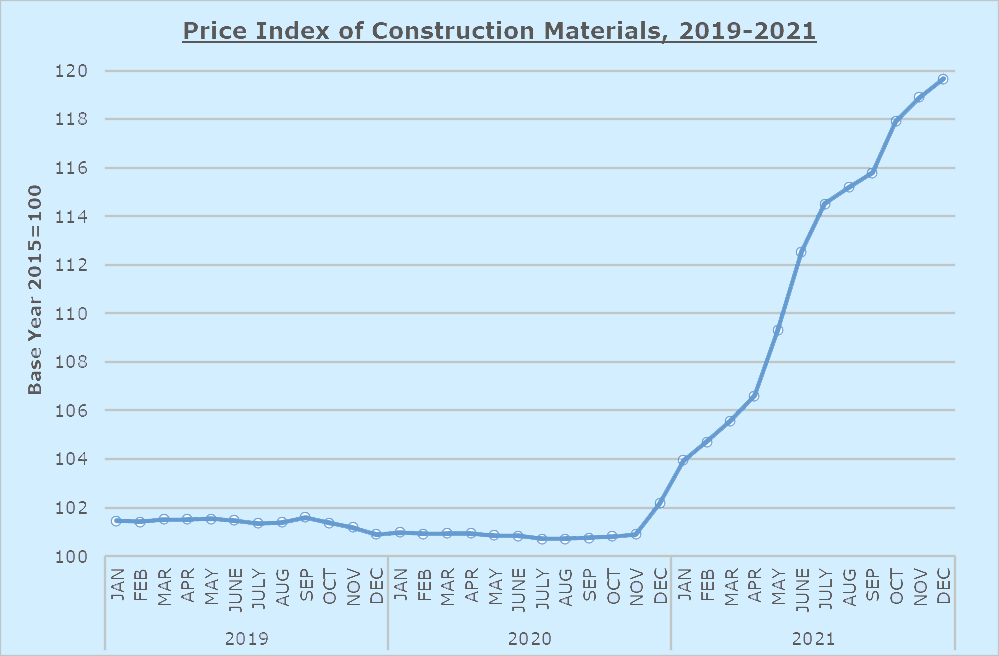
According to the Cyprus Statistical Services, the price of building materials rose by 17.1% in December 2021 compared to the December 2020, increasing the pressures on the construction and property sectors that are trying to recover from the impact of the COVID-19 pandemic.

The abrupt cancellation of Cyprus’ infamous ‘Golden Passport scheme‘ in November 2020 and the termination of the Cyprus government’s interest rate subsidy scheme, which ran until the end of 2021, is putting added pressure on the island’s construction and property sectors.

Compared to the same month of the previous year, the Cyprus Statistical Service reports increases in metallic products of 30.17%, products of wood, insulation materials, chemicals and plastics (+19.04%), electromechanical products (+13.02%), mineral products (+5.41%) and minerals (+4.75%).

Cyprus building materials price index December 2021

The increase of the construction materials index in 2021 over the previous year is mainly due to increase in the prices of:

  • Structural steel +46.56%
  • Building iron +44.34%
  • Copper pipes +32.78%
  • Steel pipes +32.69%
  • Iron rails +30.28%
  • Structural grid +27.06%
  • Bitumen asphalt +26.54%
  • Wires and cables +24.64%
  • Raw +sawn timber +22.71%

Shortage of materials set to continue

Construction material shortages and price hikes are set to continue with news that China will close 64 cities in the north of the country to improve air quality in the build up to the Beijing Olympics in February.

Delays at shipping ports expected to last until the third quarter of 2022 at least. China has 7 of the 10 largest container ports, which close when workers test positive for COVID-19. (China has a “zero COVID” policy that enforces strict lockdowns and immediate mass testing.)

Last August, Jason Chiang from Ocean Shipping Consultants told the BBC that the global shipping industry is likely to feel the impact of the pandemic for several more months.

“We don’t expect to see any new shipping capacity until two years down the road. So everything between now and two years will be dependent on how the pandemic plays out,” he said.

Further reading

Press release – Price Index of Construction Materials: December 2021