Partners fined for letting non-lawyer take control of group litigation

2

Two partners in a former City law firm have each been fined £7,500 for allowing a non-lawyer to have sole and unsupervised conduct of multi-jurisdictional group litigation involving 1,500 clients.

Siu Young Alan Ma and Taut-Yang Cheung (also known as Daniel Cheung) admitted letting Person A exercise “almost total control” of funds held in the firm’s client account on behalf of Cypriot property investors.

Approving an agreed outcome between the pair and the Solicitors Regulation Authority (SRA), the Solicitors Disciplinary Tribunal (SDT) heard that the investors had been hit by the collapse in the property market on the island, leaving them either exposed to claims by Cypriot banks when their properties were only half built, or with devalued properties.

The initial strategy pursued by Mr Ma, senior partner of Maxwell Alves, and Mr Cheung, the junior partner, was to “file claims in the UK on a protective basis” to stop them becoming time-barred and “then seek to negotiate individual settlements with the Cypriot banks”.

Person A was not a qualified lawyer; rather, he had a background in banking and connections in Greece and Cyprus. He was taken on by the law firm as a business development consultant to work on what it referred to as the ‘Cyprop’ litigation.

Over three years from November 2012, the SRA said Company A, which was “owned and operated” by Person A and his wife and was not an authorised entity, provided “the bulk of the work” in relation to the Cyprop litigation.

Within Maxwell Alves, four paralegals worked on Cyprop, paid by the law firm, but charged to Person A. Company A employed eight people to work on the litigation. Maxwell Alves recruited a solicitor, ‘Person B’, in 2013 to “deal solely” with Cyprop.

“The Cyprop litigation was highly complex multi-jurisdictional litigation. Person A was given access and allowed to use the firm’s resources, including the client account, to manage the Cyprop work.

“The firm did not have adequate resources to handle such litigation on its own and so was reliant on Person A (and Company A) to provide extra staff to manage the work.”

As litigation is a reserved legal activity, Person A and unqualified employees of Company A needed to be supervised by someone from within Maxwell Alves. “It is agreed… that in this case there was no effective supervision of Person A,” the SRA said.

The SRA said the relationship between the law firm and Person A broke down in late 2015, and with the firm unable to handle the litigation itself, they entered into a deed of settlement and termination, along with a ‘continuity agreement’.

The effect of these was to create a transition period during which the litigation would be either settled or transferred to a new firm or entity – the Firm had no control over when, or to whom, the work would be transferred.

The agreements meant that Maxwell Alves nominally remained responsible for the work, with Person A continuing formally to act as consultant, but he retained “all practical control over the Cyprop client matters”.

A deal to transfer the files fell through in March 2016, and for the next year Person A ran the Cyprop litigation himself, with the assistance of Company A.

Clients “nominally remained the clients of the firm, and the firm remained on the court record, but the firm had no effective control or supervision over the matters, the conduct of the litigation, the client files, or the fees that were being charged”.

Mr Cheung wrote to the SRA about Person A in November 2016 “to report that he had client files and was not operating with the supervision of a solicitor”.

The law firm’s indemnity insurer took legal action to restrain Person A from working for the Cyprop clients, and Mr Justice Hickinbottom granted an interim injunction in February 2017.

The litigation was then transferred to Firm C, a law firm set up by Person B whose registered address was that of Company A, which would act as a ‘facilitator firm’ and later instructed Firm D to continue the litigation. Maxwell Alves closed in March 2018.

In an earlier SDT decision in October 2019, Mr Ma and Mr Cheung were each fined £17,500 and ordered to pay £22,000 in costs after they were found to have failed to properly advise international investors in off-plan property developments.

Conditions were imposed on their practicing certificates preventing them from being sole practitioners or compliance officers.

The tribunal said that given the “significant overlap” in terms of time and conduct, it was appropriate to “have regard” to those previous fines.

The solicitors were each fined £7,500 for their latest offences and ordered to pay costs of just over £9,000. They were made subject to the same conditions imposed in 2019 for an “indefinite period”.

About the author

Associate Editor Nick Hilborne is an experienced legal journalist and qualified solicitor. Formerly news editor of Solicitors Journal, he has also worked for the Law Society Gazette and The Lawyer, as well as The Times Educational Supplement.

(This this article was originally published on the Legal Futures website
on 20th January, 2021)
House prices up by 9.2% in EU member states

0

House prices in the euro area rose at the highest annual rate since they were first collected in 2005 with more than half of the member states experiencing double-digit increases.

The price of houses rose 8.8% in the euro area and 9.2% in the EU and in the three months from July to September last year compared to the same quarter in 2020, according to the EU’s statistical service Eurostat.

The highest increases in EU Member States were recorded in Czechia (+22.0%), Lithuania (+18.9%), Estonia (+17.3%) and The Netherlands (+16.8%), while the lowest increases were recorded in Italy and Spain (+4.2% each) and Cyprus (+2.2%).

Compared with the previous quarter, prices increase in all members states, with the lowest increases in Romania (+0.1%), Finland (+0.2%) and Denmark (+0.3%) and the highest increases were recorded in Czechia (+7.3%), The Netherlands (+5.9%), Lithuania (+5.4%) and Ireland (+5.1%).

House prices and rents since 2010

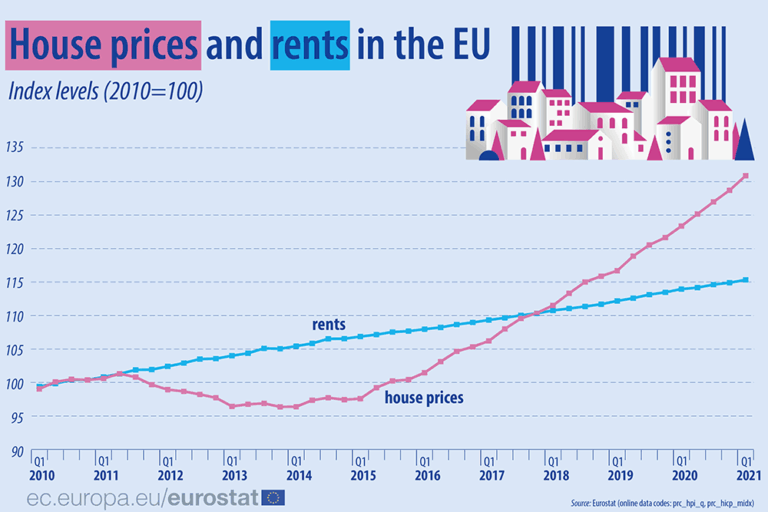
In a separate article, Eurostat reports that rents and house prices in the EU have risen by 16% and 39% respectively since 2010.

When comparing Q3 2021 with 2010, house prices increased in 23 EU countries and decreased in four, with the highest rises in Estonia (+141%), Hungary (+118%), Luxembourg (+117%), Latvia (+106%) and Austria (+104%), with falls recorded Greece (-28%), Italy (-12%), Cyprus (-6%) and Spain (-0.5%).

house prices and rents

The pattern for rents was different. When comparing Q3 2021 with 2010, rents increased in 25 EU Member States and decreased in two, with the highest rises in Estonia (+162%), Lithuania (+111%) and Ireland (+68%), with falls recorded in Greece (-25%) and Cyprus (-3%).

Further reading

House prices up by 8.8% in the euro area In the EU up by 9.2%

Rents up 16%, house prices by 39% since 2010


Cyprus progress against money laundering

Cyprus has room to improve in fighting money laundering and the financing of terrorism, despite ‘some’ progress recorded in the past year, the Council of Europe’s anti-money laundering body (Moneyval) said.

According to a follow-up report by Moneyval: “Cyprus has made some progress in improving its level of compliance with Financial Action Task Force (FATF) standards on combatting money laundering and the financing of terrorism”.

In its 2019 initial mutual evaluation report, Moneyval concluded that Cyprus complied or largely complied with 37 of the 40 FATF recommendations.

Although Cyprus has taken some of the measures to improve compliance with FATF recommendations, it communicated actions too late to Moneyval.

The monitoring body asked the Cypriot authorities to report back under its enhanced follow-up procedure on progress to address the remaining shortcomings for the three FATF recommendations in which Cyprus had been assessed as “partially compliant”.

Moneyval’s follow-up report published two years later examines a range of legislative, regulatory and institutional measures taken by authorities concerning risk assessment and monitoring of its non-profit sector and assessment by correspondent banks of respondent relationships.

It also evaluates the powers available to investigative authorities to intercept communications and apply controlled delivery techniques to cash and bearer negotiable instruments.

The follow-up report also assesses the implementation of new international requirements for virtual asset service providers established in a revised FATF Recommendation.

Cyprus’ rating on implementing this revised recommendation was downgraded from “largely compliant” to “partially compliant”.

Nicosia has taken several measures to implement these new FATF requirements, including the publication in December 2021 of an assessment of money laundering and terrorist financing risks presented by virtual assets and the related services providers.

However, these measures were taken too late to be assessed in the follow-up report, said Moneyval.

As a result, Cyprus remains “compliant” with 16 of the forty FATF Recommendations, “largely compliant” with 20 recommendations and “partially compliant” with four recommendations (non-profit organisations, correspondent banking, new technologies, and powers of law enforcement and investigative authorities).

Cyprus has no “non-compliant” ratings.

Authorities are expected to communicate further actions and progress to Moneyval in a year.

The Council of Europe’s anti-money laundering body expects that countries will have addressed most, if not all, shortcomings by the end of the third year from the adoption of their mutual evaluation report.

Meanwhile, corruption in public life has risen to the top of the political agenda after an AKEL MP and the House Speaker resigned when captured on video willing to facilitate a Cyprus passport for a Chinese investor with a criminal record.

Following revelations, Cyprus scrapped its lucrative passports for foreign investment in November 2020 amid corruption allegations and pressure from Brussels.

A damning public inquiry said that over half (53%) of the 6,779 passports granted were done so illegally, encouraged by a due diligence vacuum or insufficient background checks.

Since the revelations concerning the island’s Citizenship for Investment Scheme came to the forefront, corruption in public life has remained a hot topic.

Last year, President Anastasiades and the Justice Ministry had announced a series of measures in the fight against corruption and money laundering.

However, the president’s name was implicated in the Pandora Papers scandal, in which leaked documents exposed the secret offshore accounts of 35 world leaders and more than 100 billionaires, celebrities, and business leaders.

The leaked documents suggested that the president created shell companies abroad for personal enrichment.

A law firm founded by President Anastasiades has been named in the so-called Pandora Papers.

According to the investigation, the “law firm appears as a key offshore go-between for wealthy Russians.”

The Cypriot law firm allegedly helped a Russian billionaire and former senator, Leonid Lebedev, conceal ownership of four companies by listing law firm employees as owners of Lebedev’s entities.

Anastasiades strongly refuted these allegations.

Moneyval’s money laundering report

Anti-money laundering and counter-terrorist financing measures Cyprus

All market segments gained ground in 2021

0

Figures released by the Department of Land and Surveys reveal, perhaps not surprisingly, that all segments on the market achieved increased sales in 2021 compared to 2020.

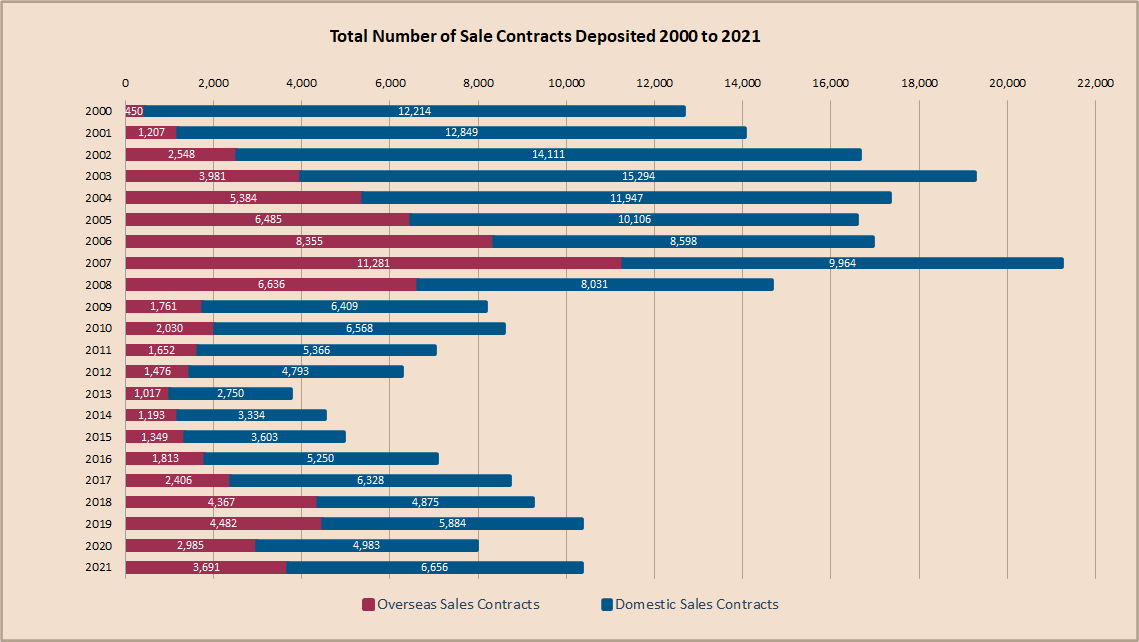
More interestingly, the number of sales to the domestic and EU segments of the market in 2021 have exceeded the numbers sold in pre-pandemic 2019, while total sales are a mere 0.18% lower.

  • Total sales 2021 (10,347) 2019 (10,366) –0.18%
  • Sales to EU nationals 2021 (1,836) 2019 (1,529) +20%
  • Sales to non-EU nationals 2021 (1,855) 2019 (2,953) –37%
  • Sales to Cypriots 2021 (6,656) 2019 (5,884) +13%

But note that Britons became non-EU citizens (third country nationals) on 1 January 2021 and the Citizenship-by-Investment scheme was scrapped in November 2020. The figures above for the EU and non-EU segments of the market reflect these changes.

Market segments sales 2021 vs 2021

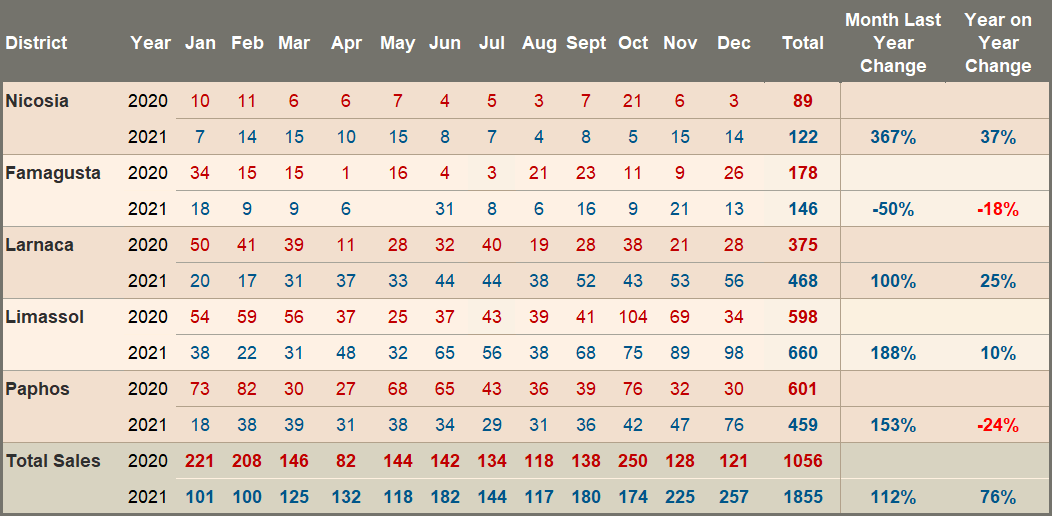
According to the statistics published by the Department of Lands and Surveys, the total number of property sales (as measured by the number of contracts deposited at Land Registry offices) in 2021 rose 30% compared to 2020 with sales rising in all districts as shown in the table below.

Cyprus total sales 2021 vs 2020
Total Property Sale Transactions – 2020/2021 Comparison

Domestic sales

Sales to the domestic segment of the market, which accounted for 64% of sales in 2021, rose 34% compared to 2020.

In percentage terms, Paphos led the way followed by Limassol, Nicosia, Famagusta and Larnaca.

Domestic Property Sale Transactions – 2020/2021 Comparison

EU Sales

Sales to EU citizens, which accounted for 18% of all sales in 2021, rose 59% compared to 2020.

In percentage terms, Larnaca led the way followed by Limassol, Nicosia, Paphos and Famagusta.

Foreign (EU) Property Sale Transactions – 2020/2021 Comparison

Non-EU sales

Sales to the non-EU segment of the overseas market, which accounted for 18% of all sales 2021 rose 76% compared to 2020 despite the abrupt termination of the Citizenship-by-Investment in November 2020. (However, sales in Paphos and Famagusta fell by 24% and 18% respectively.)

Foreign (Non-EU) Property Sale Transactions – 2020/2021 Comparison


Larnaca property sales hit €3 billion in last 5 years

Property sales in the Larnaca district nearly reached €3 billion in value over the past five years, a report from independent real estate asset management and advisory firm WiRE has shown.

The majority of property sales took place in the Larnaca municipality, where transactions reached €1.1 billion in value, representing 30 per cent of the entire district.

In the district’s three largest municipalities, Larnaca, Aradippou and Livadia, property sales exceeded €1.6 billion in value, while 9,600 transactions took place.

According to the report, the total amount of property sales across Cyprus over the past five years approached €25 billion, with more than 100,000 transactions taking place.

In the Larnaca municipality, the aforementioned amount of €1.1 billion in property sales was generated from 6,000 transactions over the past five years.

The average price for a property was €105,740, with the typical price range being between €69,000 and €170,000.

The majority of sales in the municipality took place in 2019 (1,378) while the lion’s share of transactions (approximately 5,000) involved properties with a price ceiling of €225,000.

The most expensive property sale in the Larnaca municipality during this time was valued at €13.2 million.

In Aradippou, the total value of property sales came up to €300 million, with 2,400 transactions taking place during this time.

The average price for a property was €103,108, while properties typically ranged between €54,811 and €173,573 in price.

The majority of sales in the municipality took place in 2019 with 521 transactions, while most of these sales (1,700) were worth a maximum of €224,000.

The priciest property in Aradippou over the past five years was sold for €4.4 million.

In the Livadia municipality, property sales hit €200 million in total, with 1,200 transactions being completed during this time.

The average property price was €110,000, while the typical price for a property ranged between €71,122 and €222,667.

Most sales in Livadia took place in 2021 with 221 property sales. Moreover, the majority of transactions ranged between €59,000 and €169,000.

The priciest property sale during the past five years was valued at €2 million.

“As was the conclusion with municipalities in other districts, the majority of transactions in the Larnaca municipality involved apartments, while in the municipalities of Aradippou and Livadia they concerned house sales,” WiRE explained.

In the Larnaca municipality, 4,083 apartments were sold for a total value of €604 million, while in Aradippou and Livadia those figures stood at €41 million (401 apartments) and €33 million (320 apartments) respectively.

Conversely, in the Larnaca municipality, 542 houses were sold for €78 million, while 486 houses were sold in Aradippou for €110 million and 372 houses in the Livadia municipality for €101 million.

The average house price in Aradippou was €218,000, while the average house price in the Livadia municipality was €250,000.

Rising costs could derail house prices

0

The Central Bank of Cyprus has expressed its concern over the soaring price of building materials, sending the cost of construction to skyrocket to new highs and pushing property prices further up.

In its December bulletin on the island’s economy, CBC noted that the real estate market would have to be closely monitored in a bid to stop house prices from being derailed by rising construction costs.

The monthly financial bulletin states that, “increased demand from domestic buyers is favoured by the continuing environment of low interest rates, while lending criteria remaining relatively stringent indicates that, to a large extent, new mortgage lending will continue to be viable”.

It noted that the increase in the cost construction materials, especially in the third quarter of 2021, has played a significant role in the rise of housing prices.

“This makes it particularly important to continuously monitor the real estate market to determine to what extent if it will affect prices in the sector and its recovery,” said the CBC.

Real estate stakeholders have said that the unprecedented increase in the cost of building materials pushes prices of new properties up by more than 20%.

The central bank noted that it will be monitoring how the rise in the cost of building materials will interact with the island’s epidemiological data and the commercial banks’ efforts to offload property obtained through foreclosures and debt to asset deals.

As recorded by the CBC, housing prices in Cyprus marked a recovery in the first half of 2021, especially apartments, in contrast to the prices of commercial real estate, which saw reductions during the same period.

House prices up in Q1 and Q2

According to available data from the Residential Property Price Index (RPPI), compiled by the CBC, during the first and second quarters of 2021, house prices recorded quarterly increases of 0.5% and 0.3%, respectively.

On the other hand, according to data from the RICS Cyprus index, prices of shops, warehouses and offices decreased in the first half of 2021 by 5.2%, 4.3% and 0.9%, respectively.

Apartment sales have been the driving force behind the increase of housing prices in the third quarter, according to CBC preliminary data.

“This upward trend in prices is supported by the government’s scheme for a partial interest rate subsidy for new mortgages and the low-interest environment in the domestic market. Also by the promotion of investments and incentives for headquartering high-tech companies, as well as the programme for obtaining a permanent residence permit in Cyprus through the purchase of real estate by foreign investors”, it pointed out.

As the CBC noted, the increase in house prices is in line with broader macroeconomic developments, such as the island’s GDP growth rate.

More recent indicators, such as the real estate price expectations index for the next three months published in the European Commission’s Economic Conjuncture Surveys, are in line with the upward trend of the sector, recording a positive sign in the first half of 2021.

Nicosia main driver

Once more, Nicosia has proven to be the driving force behind the industry’s recovery following the demise of the citizenship for investment scheme in late 2020, which had been powering the growing construction and real estate sectors in recent years.

During the first ten months of 2021, real estate sales recorded an island-wide annual increase of 21.6%, which corresponds to an annual increase of 29.4% and 9% in sales to domestic and foreign buyers, respectively.

Compared to the first ten months of coronavirus-stricken 2020, sales in the capital increased by a whopping 37.6%. Even more striking, sales in Nicosia increased by 38%, compared to the same period in 2019.

Although short of pre-2008 levels, before the real estate property crisis hit, property sales figures have been on the rise in recent years, seeing the market stabilise at its highest mark for over a decade.

Property prices in Cyprus have bounced back by 87%, compared to the first quarter of 2008, according to a recent bulletin from rating agency DBRS.