From houses to apartment blocks: Cyprus property boom

Over the past twelve years, the Cyprus housing market has undergone a dramatic transformation, with detached houses gradually giving way to high-rise apartment blocks that now dominate both urban skylines and the property sector’s value.

According to data from the Statistical Service of Cyprus (Cystat), processed by StockWatch, the first four months of 2013 saw permits issued for 852 detached houses, 464 semi-detached houses, 401 residential apartment blocks, and 71 mixed-use apartment blocks.

Twelve years later, in January – April 2025, the figures had shifted dramatically: 1,003 detached houses, 367 semi-detached houses, 2,789 residential apartment blocks, and 162 mixed-use apartment blocks.

Apartment blocks now dominate, accounting for around two-thirds (65%) of all residential units in 2025, compared with less than 25% in 2013.

While overall construction volumes fluctuated, the structure of housing development has been fundamentally reshaped. The transformation is reflected not only in the number of new units, but also in their total floor area and project value.

Detached houses: the decline of a once-dominant category

In January – April 2013, amid the financial crisis, permits were issued for 852 detached houses, covering 220,600 m² and valued at €214 million.

The following year saw a steep fall to 490 units (-43%), while both floor area and project value also dropped sharply.

A mild recovery followed in 2015 – 2016, with further strengthening in 2017 – 2019 when detached houses reached their highest pre-pandemic levels (894 and 907 units respectively). Floor area peaked at nearly 240,000 m², and project value exceeded €230 million.

The pandemic year 2020 brought another downturn (-22%), followed by a strong rebound in 2021 – 2022. However, 2023 and 2024 recorded fresh declines. In 2025, permits rose slightly to 1,003 units, but not enough to regain early 2020s levels.

Detached houses remain a significant part of Cyprus’ construction sector but have gradually lost their former dominance.

Semi-detached houses: modest but resilient

Semi-detached homes totalled 464 units in January–April 2013, with 48,300 m² and €46.5 million in value. In 2014, they plunged by 63% to 170 units, reflecting the pressure of the economic crisis.

From 2016 onwards, gradual recovery set in. By 2018, permits climbed to 316 units. Despite some dips in 2019 – 2020, the upward trend resumed, reaching 367 units in 2025, valued at €66.8 million.

Though their share of total housing output remains limited, semi-detached homes have shown steady resilience.

Apartment blocks: from the margins to the centre

In January – April 2013, permits for residential apartment blocks stood at just 401 units. By 2014, they had more than halved to 181.

The tide turned in 2015, with steady growth leading to an extraordinary surge in 2019 (1,232 units, €166 million). After a small dip in 2020, 2021 marked a turning point with 1,874 units and a project value of €282.7 million.

Growth resumed after minor fluctuations, culminating in a record-breaking 2,789 units in 2025, with 402,800 m² and a value of €441.8 million.

Apartment blocks have now become the central pillar of Cyprus’ housing sector, representing nearly two-thirds of new residential units.

Mixed-use apartment blocks: volatile but significant

Mixed-use apartment blocks have seen dramatic swings. From 71 units in early 2013, they collapsed to just 2 in 2014, before bouncing back to 74 in 2015. Numbers have fluctuated since, with sharp rises and falls depending on individual large-scale projects.

In 2025, permits stood at 162 units valued at €39.3 million, lower than 2024 but still well above the early 2010s.

Overall trends: bigger, denser, higher value

In January – April 2013, residential building permits totalled 1,788 units, with a floor area of 357,200 m² and project value of €336.8 million.

By January – April 2025, the figures had soared to 4,321 units (+142%), 738,600 m² (+107%), and €857.8 million (+155%).

The shift from detached houses to apartment blocks is clear: construction has grown not only in scale but also in value, with larger and more complex projects dominating the market.

Cyprus’ housing development has entered a new era – one where vertical living, density, and urban apartment blocks define the future.

Cyprus emerging as a hub for foreign entrepreneurs

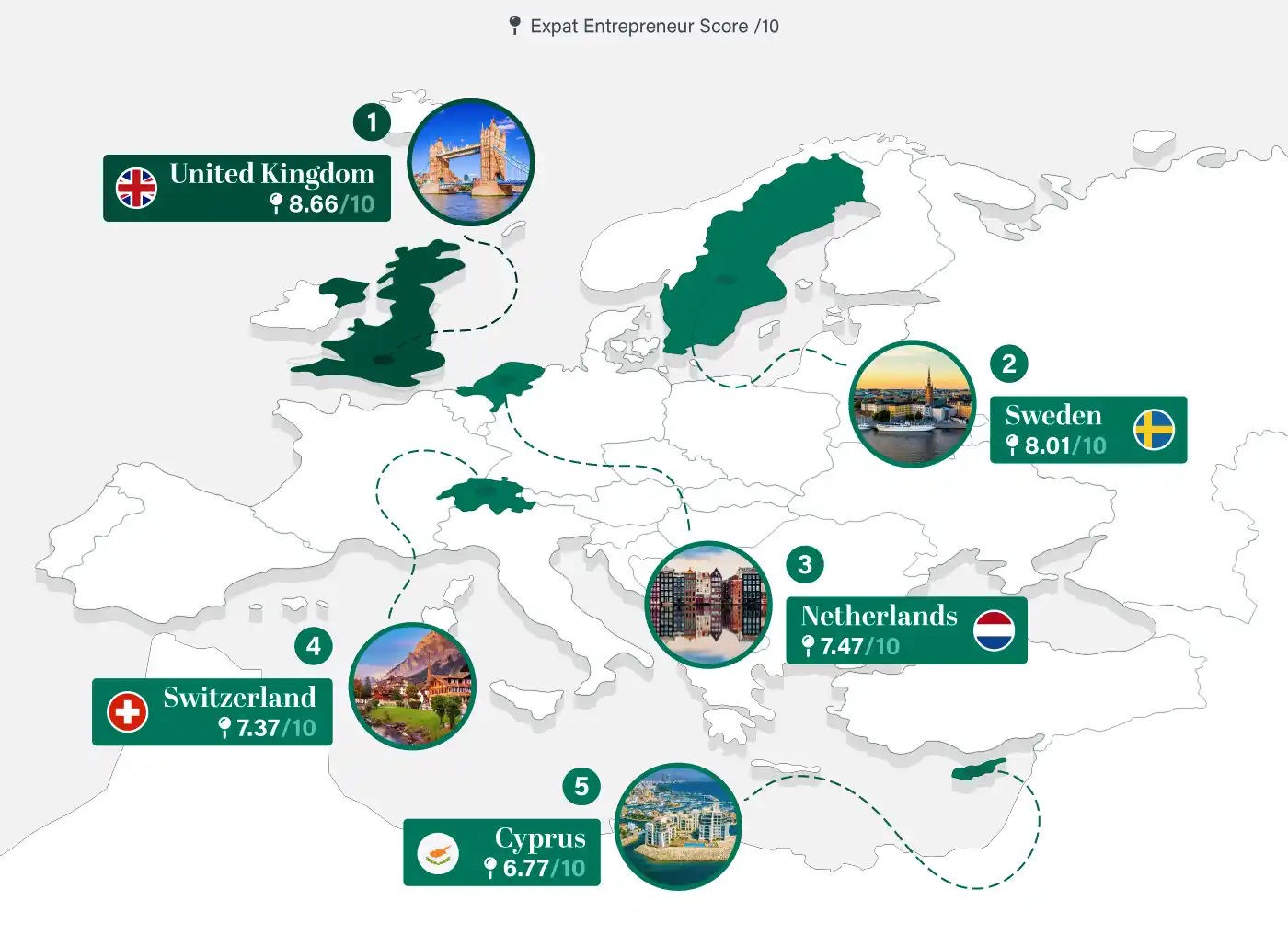
Cyprus is rapidly gaining ground as one of Europe’s most promising business destinations, ranking among the top five countries for entrepreneurs relocating from abroad.

According to William Russell’s report Best European Countries to Start a Business as an Expat, Cyprus secured fifth place across Europe, scoring 6.77 out of 10.

Why Cyprus stands out

William Russell’s research assessed several key indicators for entrepreneurial growth, including new business density, first-year survival rates, coworking space availability, labour force participation, and venture capital investment levels.

Cyprus shines as a rising startup destination, offering entrepreneurs a strategic base in the Mediterranean with direct access to the European market.

  • Business Density: 12.79 new companies per 1,000 employees.
  • Survival Rate: 87.8% of startups remain active after their first year, showing stable conditions for new ventures.
  • Funding Challenge: Venture capital investment remains low, at just $500,000, highlighting limited financing opportunities.

Despite modest investment levels, Cyprus is increasingly seen as a hotspot for digital nomads and small business founders seeking a Mediterranean hub within the EU.

Infographic credit: William Russell

Rankings across Europe

  • United Kingdom – 1st place (8.66/10): Leads the list with a thriving venture capital ecosystem worth £3.15 billion, 18.62 new businesses per 1,000 employees, and strong infrastructure.
  • Sweden – 2nd place (8.01/10): Europe’s champion in business survival, with 97.1% of startups surviving their first year. Advanced tech infrastructure and social stability add to its appeal.
  • Netherlands – 3rd place (7.47/10): Boasts the highest labour force participation among the top five (57.71%) and a 95.7% business survival rate, making it a solid choice for expats.
  • Switzerland – 4th place (7.37/10): Combines high productivity and $879.5 million in venture capital investments, despite a smaller domestic market.

Category leaders across Europe

The report also highlighted standout performers in specific categories:

  • Estonia: Highest density of new businesses (24.32 per 1,000 employees).
  • Sweden: Best survival rate for startups (97.1%).
  • Luxembourg: Most coworking spaces per capita (10.5 per 100,000 residents).
  • Hungary: Highest labour force participation (88.61%).
  • United Kingdom: Largest venture capital investment (£3.15 billion).
  • Germany: Highest number of Forbes-listed billionaires (121).

Conclusion

Cyprus may still face funding hurdles, but its entrepreneur-friendly environment, strategic location, and strong survival rate for startups make it a rising star on the European entrepreneurial map. For expats, it offers the perfect balance of Mediterranean lifestyle and EU market access.

When one lawyer acts for both sides

Cyprus is home to one of the most active real estate markets in the Mediterranean. From luxury seaside villas and modern urban apartments to traditional stone houses in charming villages, the island’s property scene attracts thousands of transactions every year.

The real estate sector plays a significant role in Cyprus’s economy, directly contributing to growth, employment and the country’s international image as an investment destination. Sale and purchase agreements are being signed daily, involving both local and foreign buyers and the pace of activity shows no sign of slowing down.

To reach completion, each transaction brings together multiple parties: the buyer and seller, real estate agents, lawyers, banks, surveyors and government departments, such as the Land Registry and Tax Office. Every link in this chain matters, but perhaps none more so than the role of the lawyer.

The lawyer’s role in a sale and purchase agreement in Cyprus is central to ensuring that the transaction is legally sound and the client’s interests are protected. A competent lawyer will conduct due diligence on the property, review and draft the engagement letter, the sale agreement, ensure compliance with Cyprus law, safeguard the deposit, handle applications to relevant authorities and guide the client through every legal requirement until title transfer.

They act as the safeguard against future disputes or unforeseen liabilities. When this role is performed well, it gives the client confidence and security. When it is not, the consequences can be serious: unresolved debts attached to the property, incomplete or invalid contracts, delays in title transfer or even complete loss of funds.

Given the importance of this work, it is worth examining a practice that, while legal under certain conditions, raises serious questions: a single lawyer acting for both the buyer and the seller. The Cyprus Code of Conduct for lawyers makes it clear that a lawyer’s duty is to represent their client’s interests to the best of their abilities. But can a lawyer truly protect both sides at the same time?

The interests of a buyer and seller are, by nature, different. The buyer seeks to pay a fair price, ensure the property is free of encumbrances and secure maximum legal protection in the contract. The seller aims to receive payment promptly, limit liability and close the deal under terms favourable to them.

In the middle stands the lawyer and if representing both parties, they must navigate between two potentially opposing objectives. A lawyer lacking the necessary skill or ethical approach can mishandle such a situation, leaving one or both clients dissatisfied or even harmed.

Cyprus law allows the conflict of interest to be waived if both parties are informed in advance and agree to proceed with the same lawyer. That agreement, however, must be based on truly informed consent. For a first-time or foreign buyer, this point is crucial.

Situations where this arises often involve a foreign buyer dealing with a local seller or developer who recommends “their” lawyer. Sometimes, the buyer is not told that the same lawyer is acting for both sides or is given little choice by the real estate agent.

In other cases, the buyer may be told but not fully understand the implications. A foreign buyer, unfamiliar with local laws and practices, may assume that the recommendation is made purely for convenience, without realising the potential risks.

The risk is simple: by relying on a lawyer, you did not choose yourself, you may end up with legal representation that does not meet your expectations or requirements. If issues arise, the cost of rectifying mistakes, both financial and emotional, can far exceed what you hoped to save by taking the recommendation.

It is therefore essential that buyers take an active role in selecting their legal representation. Ask the seller or agent directly: who will be the lawyer? Will they be representing both sides? Is there a conflict of interest? If the answer is yes, consider whether you are truly comfortable waiving that conflict.

Choosing the right lawyer should be a deliberate process. Look for someone experienced in property law under Cyprus jurisdiction, ideally with a track record in transactions involving foreign clients. Ensure they communicate clearly in a language you understand, provide transparent fees and demonstrate an ability to act independently of the seller or agent. Ask for references, check professional memberships and verify that they are registered with the Cyprus Bar Association.

Ultimately, the sale or purchase of property in Cyprus can be a positive, rewarding experience, but only if approached with care. For foreign buyers especially, awareness is the key. Be informed, be cautious and ask questions until you are fully satisfied.

The lawyer you choose is not just a facilitator; they are your legal shield. Make sure it is one you have selected based on trust, competence and independence. In a market as dynamic as Cyprus, protecting your interests is not just a legal formality but it is the foundation for peace of mind long after the keys are in your hand.

Konstantinos Kaousliades is a lawyer at Elias Neocleous & Co LLC

Disclaimer

The content of this article is valid as of the date of its first publication. This publication has been prepared only as a general guide and for information purposes. It does not constitute or should not be read as legal advice. One must not rely on it without receiving independent advice based on the particular facts of his/her own case. No responsibility can be accepted by the authors or the publishers for any loss occasioned by acting or refraining from acting on the basis of this publication

Cyprus’ golden visa praised; fast-track citizenship sparks debate

Praised as one of the world’s leading residency programmes, Cyprus now faces questions at home over new citizenship rules that critics warn could echo the scandals of its disgraced golden passport scheme.

Cyprus has secured seventh place in Nomad Capitalist’s ranking of the world’s top nine Golden Visa programmes for 2025, underlining its growing profile as a destination for investors seeking residency through investment.

Yet, as the country earns plaudits for its residency scheme, controversy is mounting over recent changes to its citizenship laws that some fear could amount to a revival of the disgraced “golden passport” scheme.

Cyprus golden visa & fast-track citizenship appeal

The Cypriot Golden Visa offers permanent residency with some of the most flexible terms in Europe. Applicants need only visit once every two years, while spouses and minor children are automatically included. Non-domiciled residents benefit from favourable tax treatment, and importantly, successful applicants may later apply for Cypriot – and EU – citizenship.

Investment options start at €300,000 (plus VAT) for residential or commercial property, but also include stakes in Cyprus-registered companies or collective investment schemes. This variety, combined with relatively modest thresholds, positions Cyprus as a competitive alternative to higher-cost programmes in countries such as Italy and the UAE.

The global ranking placed Greece in first position, with one of the most popular residency-by-investment schemes worldwide, requiring property investments between €250,000 and €800,000. Portugal ranked second, emphasising targeted investment funds and cultural projects, while Malta came third, offering a combination of property commitments, government contributions and donations. Other countries recognised include Italy, Hungary, the UAE, Latvia and Oman.

Fast-track citizenship sparks debate

While the Golden Visa is gaining international recognition, Cyprus’ naturalisation rules have drawn domestic criticism. Recent amendments introduced a fast-track route for “highly specialised” employees at designated firms, particularly in the technology sector. These individuals can apply for citizenship after just four years of residence – compared with the usual eight – with only elementary (A2) Greek. Over 200 people have already been approved under the scheme, with 360 applications still pending.

MP Alexandra Attalides has raised concerns that the measure represents a “softer return” of disgraced “golden passport” scheme, which was shut down in November 2020 amid corruption scandals. She plans to propose legislation requiring authorities to keep detailed records of applicants’ employers, roles and qualifications to prevent potential abuse.

The government, however, argues the scheme is part of its strategy to position Cyprus as a hub for innovation. With the tech sector already contributing more than 14% of GDP, officials say attracting global talent is vital for sustaining growth.

Questions of fairness

Critics counter that the system privileges a narrow group of professionals while many long-term residents – including domestic workers, entrepreneurs in traditional sectors, and children of mixed-status families – struggle to gain citizenship despite deep ties to Cyprus.

The debate cuts to the heart of what citizenship should represent: a reward for sustained contribution to society, or a tool for boosting economic competitiveness.

Attalides has warned that unless transparency improves, Cyprus risks facing “the next big scandal” in the years ahead.

Housing demand grows as young couples dominate applications for state aid

Cyprus has received more than 560 applications under its new affordable housing schemes since their launch last year, with officials saying the early response from both households and developers points to growing demand.

Interior Minister Constantinos Ioannou, replying to parliamentary questions from AKEL’s Marina Nikolaou and EDEK’s Andreas Apostolou, said 525 submissions were made under the housing grant for young people and couples up to 41 years old.

Of these, 152 were approved, unlocking about €5.4 million in aid, 172 were rejected, one was withdrawn and 200 are still under examination.

Another 43 applications were filed under the Renovate-to-Rent scheme, with 28 approved for funding of €727,000, six pending and nine rejected.

Ioannou said the measures are intended not only to help individual families but also to ease pressure in the housing market.

The aim, he noted, is to increase the overall stock of homes, bringing supply closer to demand and gradually easing both purchase prices and rents.

While the results cannot yet be fully measured, he said projects linked to planning incentives, ‘Build to Rent’ and Cyprus land development corporation’s (KOAG) own developments will feed new units into the market over the coming years.

Developers have also begun to participate. Seven companies have opted to buy out their urban development factor, generating around €5m in funding that will be channelled into affordable housing.

At the same time, KOAG has signed 16 agreements with private firms for 84 units in total, including 65 earmarked for sale and 19 for affordable rent.

On KOAG’s own pipeline, 16 homes were completed and offered for sale in 2023, while 24 are under construction this year for delivery in 2025.

Next year, work will begin on another 135 units for sale and 36 for rent. In 2026, a further 96 homes for sale and 156 for rent are scheduled, with all projects feeding into the market by 2027, when KOAG will reassess future plans depending on demand and resources.

In Larnaca, the organisation is building the Ianthi project of a 24-apartment complex due for completion in September 2025.

Six units have already been sold and 16 remain available.

On the adjacent plot, KOAG intends to construct another 16 apartments, with a budget allocation planned for 2026.

Separately, agreements with developers in the district cover 39 more affordable units, which will be sold to beneficiaries once finished.

The organisation is also breaking new ground in Limassol, where work has now started on the island’s first dedicated affordable rental housing project.

The development, carried out in partnership with the municipality, will deliver apartments at rents 25 to 30 per cent below market levels and forms part of a wider €100m plan to provide around 600 units across Ayios Nikolaos and Ayios Ioannis.

The first phase in Ayios Nikolaos includes four six-storey buildings with 138 apartments, of which 94 will remain under KOAG’s management and 44 will pass to the municipality.

The budget for this phase alone exceeds €22m. KOAG’s vice-president Theseas Ioannou described it as the culmination of more than three years of planning, and the first time the organisation has worked directly with a local authority.

Further housing schemes are also in the pipeline across the island. A limited number of three-bedroom units are currently available in the Ekali project in Kaimakli, while more are under construction in Kokkinotrimithia.

By the end of 2025, KOAG expects to begin another 135 units in locations including Pano Polemidia, Ayios Dometios, Lakatamia, Palouriotissa and Kaimakli, along with 10 additional homes in Kokkinotrimithia.
CM

How non-EU nationals exploit loopholes in Cyprus property law

A loophole in Cyprus’ legal framework allows non-EU nationals to acquire real estate, even as individuals, without attracting much attention.

In practice, non-EU nationals purchase property from local owners, file an assignment agreement with the District Land Office, and then enjoy full use of the property (whether a flat or other type of residence) with no real checks in place.

This means there is no need to sign a formal sale contract or secure prior approval from the District Officer (i.e., an acquisition permit). Simply submitting the assignment document to the District Land Office is enough to claim ownership rights.

This situation was highlighted in a recent reply by the Ministry of Interior to a six-part parliamentary question from MP Nikos Georgiou.

Ministry’s response

The Ministry clarified that “Assignment agreements are considered equivalent to sale contracts for the purposes of applying the Immovable Property Acquisition (Aliens) Law, Cap. 109. Therefore, the assignee is regarded as the new purchaser and, if they are a non-EU national, an acquisition permit is required from the District Officer when the transfer is processed in their name. However, this permit is not a prerequisite for lodging the assignment document with the competent District Land Office.”

The Ministry further noted that “All sale and assignment agreements concerning non-EU nationals as buyers or assignees have been filed at District Land Offices without an acquisition permit from the District Administration, as this is not required by law.”

A legal loophole

In simple terms, the restrictions intended to limit non-EU nationals owning property are being bypassed. As one legal expert explained, the current framework allows a non-EU national to acquire more than one property, despite regulations stating otherwise.

Moreover, foreign nationals can indefinitely exploit a property on the basis of an assignment agreement, without ever needing a title deed or an acquisition permit.

This has raised increasing concern in recent years, given the socio-economic consequences of widespread land sales to non-EU nationals.

In January, MP Nikos Georgiou tabled a bill to address these loopholes, reigniting debate over the outdated legislation. Historically, the law imposed limits on non-EU national acquisitions, but these were sidestepped by non-EU nationals using companies as legal vehicles to purchase property, thereby avoiding scrutiny.

In addition, a reply by the Ministry of Interior in July confirmed that, since 1999, the Council of Ministers transferred its powers to approve or reject non-EU national property acquisitions to the District Officers. Yet, as noted earlier, District Officers do not need to authorise non-EU nationals in order for them to file assignment agreements at the District Land Office.

Interior Minister Constantinos Ioannou has openly admitted that the law is outdated and “in need of revision.” He also confirmed that discussions have already taken place with the Legal Service, aiming to repeal the current law and replace it with a modernised framework.

A ministry official further clarified to Phileleftheros that work is already under way, with civil servants reviewing the legislation and drafting proposals for reform.

(Translated & summarised from a Greek article in Phileleftheros)