Cyprus housing market: prices, affordability and trends

Monetary policy decisions directly affect the economy by influencing how much households can spend, invest, and consume. This was highlighted in a recent article by European Central Bank (ECB) economists Niccolò Battistini and Johannes Gareis.

The housing market plays a crucial role in this process, as mortgage interest rates determine property transactions, which in turn impact household spending on goods and services.

The impact of interest rates on housing affordability

Between 2022 and 2023, the ECB raised its key interest rates at a historically fast pace to curb inflation, before beginning a gradual reduction at the end of 2023.

These changes were immediately reflected in housing affordability, measured by an index that compares income, property prices, and mortgage instalments.

The index has shown significant fluctuations: from its lowest point during the 2008 financial crisis to its highest in 2016, followed by a steady decline from 2017 and particularly in 2022.

Although affordability has been slowly improving since mid-2023, it still remains below 2021 levels.

Key factors and effects on consumption

From late 2021 to 2023, rising interest rates placed greater pressure on buyers than could be offset by income growth or price corrections, leading to fewer property transactions and reduced household consumption.

According to the ECB’s analysis, a 25-basis-point increase in short-term interest rates can reduce housing sales by 2% and household goods consumption by 0.3% over three years.

The so-called “housing sales channel” is proving to be a decisive mechanism in transmitting monetary policy to consumer spending.

The 2022–2025 period

The years 2022–2023 were marked by a sharp decline in affordability, resulting in a drop of about 10% in household goods consumption and a reduction of overall private consumption by 0.6 percentage points.

Since 2024, stable interest rates and rising incomes have supported a modest recovery, which is expected to continue into 2025.

Outlook and uncertainties

The outlook for the coming period appears positive, with improving affordability boosting both property transactions and household consumption.

However, ECB analysts warn that factors such as trade uncertainty, US tariffs, and geopolitical tensions may slow down this recovery.

Housing affordability in Cyprus

Housing affordability is a growing concern in Cyprus, especially for young couples, as home ownership becomes increasingly difficult.

According to Central Bank data, the average mortgage interest rate rose noticeably in June, reaching 3.97% compared with 3.74% in May.

For fixed-rate mortgages up to one year, the rate increased to 3.95% in June from 3.81% in May, placing Cyprus fifth highest in the eurozone and above the euro area average of 3.61%.

Meanwhile, for fixed-rate loans between one and five years, Cyprus recorded 3.09% in June, slightly down from 3.16% in May, and below the euro area average of 3.41%.

The Housing Price Index (HPI) from the Statistical Service of Cyprus stood at 113.71 points in Q1 2025, marking a 2% rise compared with the same period last year.

At the same time, the Central Bank’s Residential Property Price Index recorded a 4.8% annual increase, with detached house prices rising 5.6% and apartment prices up 3.5%.

Yet, Cyprus slipped to 42nd place in the Knight Frank Global House Price Index for Q1 2025, with a nominal rise of 2% and a real increase of just 0.4%, continuing its downward trend from 2023 when prices had surged by 8.5%.

Flash: New Cyprus swimming pool law & regulations in English

Following numerous email requests, a printable version of the new Cyprus swimming pool law and regulations in English may be downloaded from my website by clicking here.

(You may send the 40-page document to anyone who may be interested, but please respect the copyright notice by acknowledging the source.)

Please remember that my translations are for general guidance only and should not be treated as legal advice. If you’re unsure how the new law affects your property, I recommend seeking professional legal advice or consulting local authorities.

What has changed?

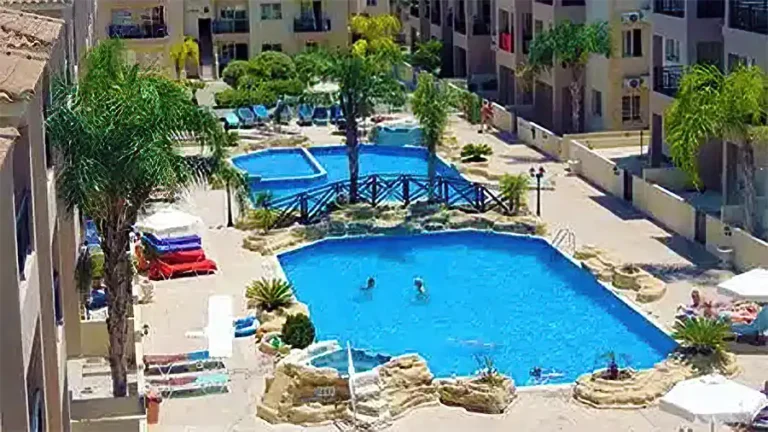
The most significant changes apply to people living in apartment complexes or other developments with six or more residential units that share a swimming pool.

Key updates

  • No more lifeguard requirement – Shared pools are no longer obliged to employ a lifeguard.
  • No pool operating permit needed – Applications for pool operation licences are no longer required.
  • Reduced inspections – Only occasional inspections will be carried out, mostly during the summer season.
  • Auxiliary facilities optional – Pools no longer need to provide changing rooms, cloakrooms, or toilets. However, if such facilities already exist, they must remain clean, safe, and in good condition whenever the pool is in use.

New Role: Swimming Pool Manager

A new obligation has been introduced: every shared pool must now have a ‘Swimming Pool Manager’.

  • This manager must be a registered property owner within the development.
  • The manager is responsible for appointing a ‘Responsible Pool Operator’, who must meet specific criteria to oversee pool safety and operation.
  • Failure to comply with the law can result in fines of up to €2,000, with the swimming pool manager personally liable.

Additional swimming pool safety & maintenance rules

The 2025 law also introduces stricter safety standards:

  • Swimming pools must be equipped with basic safety equipment, a first-aid kit, and clear signage displaying pool rules.
  • A list of emergency contacts (hospital, doctor, ambulance, etc.) must be posted in a visible location.

General rule for all swimming pools

When it’s no longer in use, the swimming pool area must be securely fenced and must be fitted with a protective cover. (This requirement applies to all swimming pools.)

Why the swimming pool changes matter

The updated law, which has been 20 years in the making, strikes a balance between reducing bureaucracy for residential complexes and ensuring safety standards remain in place. By removing the costly obligations of lifeguards and permits, it eases the administrative and financial burden for property owners, while still demanding responsibility through the introduction of a designated pool manager.

Final note

Once again, please remember: my translation is for informational purposes only. For tailored guidance, always consult with:

  • Your lawyer or legal advisor
  • Your municipal office
  • Your management committee (if applicable)

For the complete unofficial English translation of the 2025 Cyprus swimming pool law regulations, you can download a printable version the 40-page document directly from my website.

Five years on the Cyprus golden passports scandal continues

0

Five years after Cyprus scrapped its disgraced Citizenship by Investment Programme (CIP), the scandal surrounding its so-called golden passports continues to haunt the island.

What was once marketed as an economic lifeline became a stain on Cyprus’ credibility, leaving behind a trail of stalled investigations, courtroom battles and institutional failures.

Despite the programme’s official abolition in November 2020, its legacy remains alive in courtrooms, police case files and international headlines. The numbers alone reveal the sheer scale of the crisis:

  • 195 cases under active investigation since 2021
  • 26 individuals already charged in court
  • 306 people stripped of Cypriot citizenship, including investors and dependents
  • Investigations dragging on for up to four years due to cross-border deadlocks

The scandal has left Cyprus struggling not only with the practicalities of justice, but also with the erosion of trust in its institutions and its tarnished reputation within the European Union.

How Cyprus sold golden passports

The Golden Passports Scheme was introduced in 2007 and expanded after the 2013 banking collapse, when Cyprus faced a financial meltdown. Under its terms, wealthy foreigners could obtain a Cypriot – and therefore EU – passport by investing at least €2 million in real estate, businesses or government bonds.

For years, the scheme brought in billions. But it also attracted controversy, with critics warning it was open to abuse and ripe for exploitation by politically exposed persons, criminals and individuals with questionable backgrounds.

The turning point came in October 2020, when Al Jazeera released an undercover investigation exposing high-level corruption, including politicians willing to help criminals secure Cypriot passports. Within weeks, the government axed the programme.

Investigations: big numbers, slow progress

Since 2021, police have examined 195 cases linked to suspicious naturalisations. Yet, according to official sources, only seven have been fully investigated, with just four resulting in criminal charges.

One major case, involving eight defendants including a lawyer and his firm, collapsed entirely in 2022 when the Larnaca Criminal Court acquitted all accused. The Attorney General has since appealed, and a retrial has been ordered.

Police spokesperson Kyriaki Lambrianidou acknowledges the difficulties: “These are highly complex cases, with massive amounts of documentation. In some instances, a single complaint involves up to 30 different investors.”

She added that international barriers remain a major stumbling block. Requests for judicial cooperation, particularly to Asian jurisdictions where many investors originate, are often ignored. Some requests have been pending for up to four years.

Cross-border deadlocks

This lack of cooperation is more than a bureaucratic hurdle – it is paralysing prosecutions. Without access to overseas financial records, corporate documents or witness testimony, Cypriot investigators are unable to build airtight cases.

Police have resorted to sending reminders to foreign authorities, but responses remain slow or non-existent. The result: a mountain of stalled files sitting in police archives, unable to move forward.

High-profile trials, political fallout

The scandal has already drawn several prominent figures into the dock:

  • Marios Demetriades, former Transport Minister, is among ten defendants facing 59 charges including bribery, conspiracy and money laundering.
  • Demetris Syllouris, former Speaker of Parliament, and ex-MP Christakis Giovanis are standing trial after being caught on camera in the Al Jazeera exposé. In July 2025, the court ruled there was sufficient evidence for them to answer the charges.
  • Lawyers, developers and corporate service providers are also facing cases involving forgery, fraud and tax evasion.

But convictions are rare. The courts have acquitted several high-profile defendants, while other cases have collapsed under the weight of insufficient evidence.

Institutional failures exposed

Perhaps most damning are the findings of two official inquiries: the Kalogirou Report (2020) and the Nikolatos Report (2021).

Both concluded that 53% of naturalisations were unlawful, often involving family members of investors who did not meet the criteria. Some investors were flagged as high-risk – with criminal convictions, ongoing investigations or even international arrest warrants.

Former Securities and Exchange Commission chair Dimitra Kalogirou, who led both investigations, is unequivocal: “The problem was not the programme itself, but the absence of supervision. Oversight was non-existent – and that created fertile ground for abuse.”

Citizenship revocations: a belated cleanup

The Ministry of Interior has moved to strip citizenship from hundreds of individuals. Since 2021, the Cabinet has approved the revocation of 306 passports, including 88 investors and 218 family members.

The process is slow and legally complex. Each individual must be notified in writing, given a chance to appeal, and only then formally stripped of their passport and ID. To date, just 112 revocations have been finalised.

“We cannot afford to repeat this”

Kalogiou insists that the CIP itself was not inherently flawed – describing it as a necessary measure after the 2013 financial crisis. The failure, she argues, was the total lack of oversight.

“Any future investment programme must come with strong and transparent supervision. Otherwise, Cyprus risks repeating the same mistakes. The Cypriot passport is also an EU passport – and that makes this an issue of European security as well as credibility.”

A lingering stain on Cyprus’ reputation

The citizenship scandal has left Cyprus facing years of legal, political and reputational damage. It has exposed deep weaknesses in oversight, undermined public confidence in institutions, and left the country under scrutiny from its European partners.

What began as a scheme to attract investment has instead become a case study in how quick fixes can turn into long-term crises.

For Cyprus, the golden passports era may be over. But the shadow it casts – in courtrooms, in government files, and in the eyes of Europe – will not disappear anytime soon.

Over 53,000 Cyprus properties transferred to non-EU nationals

The ownership of 53,076 Cyprus properties have been transferred to non-EU nationals as of 7 July 2025 with a further 29,089 in the pipeline, according to Interior Minister Constantinos Ioannou.

(In the first seven months of 2025, a total of 1,349 properties have been transferred to non-EU nationals according to Land Registry figures.)

Properties transferred by district

The transfer of a total of 53,076 Cyprus properties were completed, with the majority recorded in Paphos (20,755) and Limassol (17,083). The remaining transactions were distributed across:

  • Larnaca: 9,175
  • Famagusta: 3,509
  • Nicosia: 2,554

At the same time, 29,089 contracts have been filed at Land Registry offices but have yet to be finalised. Of these, 9,460 are in Paphos, 7,297 in Larnaca, 7,208 in Limassol, 4,215 in Famagusta and 899 in Nicosia.

The minister presented these figures in parliament following a question raised by MP Nikos Georgiou.

Legal framework for non-EU buyers

Under the Immovable Property Acquisition (Aliens) Law (Cap. 109), nationals of third countries, foreign companies, or companies controlled by foreigners must obtain prior approval from the District Administration to purchase property in Cyprus. This approval is granted with specific conditions and restrictions.

Mr Georgiou asked for clarifications on how the ministry interprets the term “acquisition of immovable property”, including whether it covers only purchase contracts or also other forms of property rights. He also raised questions regarding:

  1. The timing of the District Officer’s consent – at contract signing or property transfer.
  2. Whether assignment contracts are treated the same as purchase agreements.
  3. How many purchase and assignment contracts have been filed without the required approvals.

Clarifications

The minister explained that acquisition under the law includes not only sales contracts but also:

  • Leases exceeding 33 years (including renewals/extensions).
  • Acquisition of shares in companies holding property, where control passes to foreigners.
  • Creation of trusts benefiting foreigners involving property or shares.

He stressed that a permit from the Council of Minister, which is delegated to the District Officer, is required to transfer title of a property to its buyer, but not for simply filing a sale or assignment contract with the Land Registry.

Assignment contracts are treated the same as sale contracts for legal purposes. Therefore, if the assignee is a third-country national, they must also secure a permit at the time of transfer of title to their name.

Assignment agreements in numbers

Currently, the Land Information System cannot distinguish assignees by nationality. However, in total, 9,746 assignment agreements have been filed at the Department of Lands and Surveys, covering Cypriots, EU nationals and third-country nationals, and remain in force.

(Translated & summarised from a Greek article in Politis)

Cyprus drops to 42nd in global house price index

Cyprus has slipped to 42nd place in the Knight Frank Global House Price Index for Q1 2025, recording a nominal rise of 2.0% in housing prices and a real increase of just 0.4% after inflation adjustment.

The Knight Frank Global House Price Index is a widely recognised benchmark that tracks and compares residential property price movements across dozens of countries and regions worldwide.

Cyprus’ journey from 18th to 42nd place

Cyprus has been on a clear downward trend since 2023.

  • Q1 2023: 18th place with an 8.5% rise
  • Q4 2023: 15th place with 6.5%
  • Q1 2024: 19th place with 5.5%
  • Q4 2024: 43rd place with 1.0%
  • Q1 2025: 42nd place with 2.0%

This marks a steep fall from its earlier momentum.

Greece holding firm

Greece, while also losing some of its 2023 strength, managed to maintain more stability.

  • Q1 2023: 6th place (14.5%)
  • Q4 2023: 4th place (11.8%)
  • Q1 2024: 6th place (10.4%)
  • Q4 2024: 23rd place (6.6%)
  • Q1 2025: 18th place (6.8%)

Global picture: inflation and monetary policy

Globally, house prices rose 2.3% in Q1 2025 — the highest since mid-2024, yet still well below the long-term average of 5.1%. The rebound is largely attributed to lower interest rates, easing borrowing costs. However, persistent inflation continues to erode real purchasing power.

  • Turkey topped the index with a 32.2% nominal rise, though in real terms prices actually fell by 4.2% due to high inflation.
  • Mainland China (–7.5%) and Hong Kong (–6.5%) remained at the bottom.

2023–2024 trends

  • End of 2024: Cyprus at 43rd (1.0%), Greece at 23rd (6.6%), Turkey still leading (29.4%).
  • Start of 2024: More resilience with a global 3.6% rise; Cyprus 19th (5.5%), Greece 6th (10.4%).
  • End of 2023: Stronger growth at 3.9%; Cyprus 15th (6.5%), Greece 4th (11.8%).
  • Start of 2023: Global slowdown at 3.6%, Cyprus 18th (8.5%), Greece 6th (14.5%), Turkey surging 132.8%.

Knight Frank Global House Price Index

The Knight Frank Global House Price Index is published quarterly and serves as a key tool for investors, analysts, and policymakers, offering a consolidated view of international housing market trends and cross-country comparisons.

Cyprus property market: stable prices and strong demand

In an article published in INBusinessnews, the President of the Cyprus Real Estate Agents Registration Council Marinos Kineyirou writes that the Cyprus property market has entered 2025 with vigour, continuing the resilience and strong demand that characterised the previous year.

Demand remains buoyant among both local buyers and international investors, particularly from non-EU markets such as Israel and Lebanon, with geopolitical tensions showing little sign of dampening appetite. Many of these transactions involve significant capital commitments.

Healthy supply underpins stability

A key positive in the current climate is the depth of supply. A broad selection of properties is available, catering to diverse buyer needs.

Provided there are no major shocks in the global environment in the months ahead, market sentiment suggests sustained purchasing activity throughout 2025. Prices are expected to hold steady at current levels, supported by a healthy balance between supply and demand.

Eurostat figures show that while housing prices are climbing sharply across much of Europe, Cyprus is charting a more measured path. In Q1 2025, Cypriot property prices rose by 2% year-on-year, well below the EU average of 5.7% and the Eurozone’s 5.4%, signalling a steadier and less inflationary trajectory.

What is driving demand?

Persistently high prices present challenges for local buyers. Despite gradually easing mortgage rates, the broader cost-of-living pressures are constraining household budgets, making home ownership increasingly difficult for many.

Foreign investment continues to play a major role in price trends. Locally, many investors are also turning to bricks and mortar as a safe-haven asset, given the negligible returns on bank deposits. With deposit interest rates at historic lows, property offers a more compelling route to generating meaningful returns.

Dispelling a common misconception

The belief that licensed estate agents are artificially inflating property prices is unfounded. Our role is to secure the best achievable terms for clients, facilitating transactions rather than distorting the market.

Ultimately, pricing is set by property owners and shaped by the fundamental forces of supply and demand.

District highlights

  • Limassol remains the leading market for high-end and luxury properties.
  • Paphos has seen marked demand growth over the past two years from both domestic and overseas investors.
  • Larnaca is attracting heightened interest in smaller units, primarily one and two bedroom apartments in suburban areas. While prices there have risen significantly over the past three years, they remain more competitive than in other cities, appealing to buyers from Nicosia and Limassol seeking better value.

Looking ahead

The Cypriot property market is in a phase of high activity and notable stability, offering attractive opportunities for investors while grappling with the challenge of affordability for local residents.

Ongoing market monitoring and responsiveness to evolving conditions will be essential to sustaining this momentum.

Marinos Kineyirou MRICS, President of the
Cyprus Real Estate Agents Registration Council