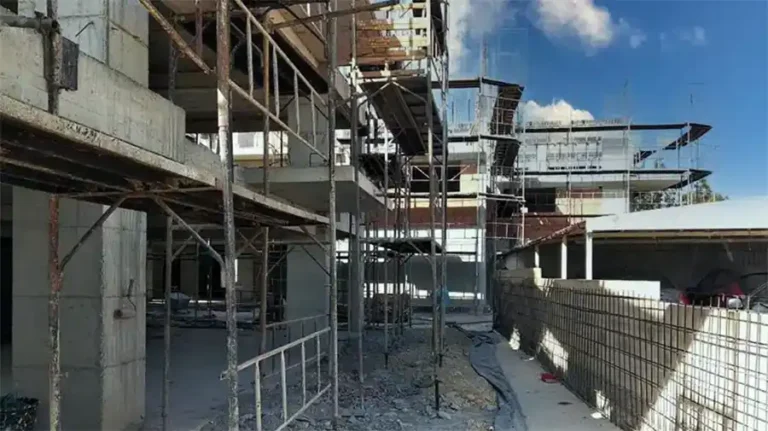
Construction costs for houses, apartments, hotels, etc.

When it comes to construction costs, the focus often falls on the price per square metre for building a home. But official data from the Statistical Service shows striking differences in costs between residential, commercial, and hospitality buildings.

Hotels lead construction costs

According to the latest figures, hotels are the most expensive buildings to construct per square metre, followed by clinics and medical practices, with tourist apartments ranking third.

The 2025 Statistical Service report on the average cost per m² for privately developed buildings completed in 2023 — and in previous years — reveals clear trends. However, the figures aren’t absolute, as construction materials, luxury levels, and building purposes vary widely.

Why costs/m² vary between building types

The data comes from the annual Building Permits and Housing Survey, calculated by dividing the total construction cost by the total floor area for each building type.

Small project numbers in some categories mean the data isn’t always fully representative. Factors like size, location, materials, and luxury level can vary greatly year-to-year, making direct comparisons difficult.

Importantly, these costs refer to projects completed in the survey year, regardless of when construction began or permits were issued.

What’s included in construction costs/m²

The construction cost per m² calculated by the Statistical Service covers:

  • Architectural and engineering fees (civil, electrical, mechanical, energy performance)
  • Urban planning and building permit fees
  • Labour and building material expenses
  • Main contractor service fees
  • VAT (where applicable)

Land value is not included in these figures.

Average construction costs/m² (2023 Data)

Building Type Average Cost €/m²
Hotels €2,202
Clinics & Medical Practices €1,988
Tourist Apartments €1,775
Restaurants €1,651
Educational Institutions €1,306
Houses €1,214
Flats €1,075
Industrial Buildings €727
Warehouses €781
Agricultural Buildings €213

The real cost of building a house

While official figures are useful, they often underestimate real-world building prices. This is because they exclude developer profit margins and additional costs.

Construction professionals say that in 2025, the cost to build a house or apartment typically ranges from €1,700 to €2,500 per m², excluding the price of land.

For a home built on owned land, a realistic starting figure is €1,700 per m², with costs increasing based on materials, finishes, and design choices. This estimate includes outdoor spaces and essential external works.

Anything below €1,700 per m² usually means not all essential works are included.

Key takeaways

  • Hotels remain the most expensive type of building per square metre.
  • Residential construction in 2025 realistically costs €1,700 – €2,500 per m² (excluding land).
  • Official statistics are helpful but may not reflect real on-site costs.
  • Location, materials, and design complexity can significantly impact the final price.

In summary: If you’re planning on building a home in 2025, budget realistically for €1,700 – €2,500 per square metre. And if you’re in the hospitality industry, prepare for even higher costs per m² – especially for hotels.

Top 10 property sales in the first half of 2025

The Cypriot property market maintained strong momentum in the first half of 2025, with the top ten most expensive property sales totalling €169 million, according to data from technology firm Ask Wire.

Limassol dominated the list, claiming six of the ten top transactions, including the most expensive deal – an apartment complex in Tsiflikoudia sold for €44.8 million.

The total value of the 50 largest sales nationwide reached €306.1 million, marking a 16.8% increase compared to the same period in 2024. Investor interest is spreading beyond Limassol to other regions such as Paphos and Larnaca, underlining the market’s steady growth.

Limassol’s six high-value transactions in the top ten amounted to €105.7 million. Nicosia followed with two sales worth €41.8 million, while Paphos also featured twice with deals totalling €21.5 million.

No Property Type Sale Price District / Municipality – Community
1 Apartment Complex €44.8 million Limassol / Tsiflikoudia
2 Offices €29.3 million Nicosia / Agioi Omologites
3 Commercial Property €28.5 million Limassol / Agios Athanasios
4 Land €13.9 million Paphos / Agios Theodoros
5 Plot €12.5 million Nicosia / Engomi
6 Apartment €9.35 million Limassol / Neapolis
7 Land €8.2 million Limassol / Tsierkezoi
8 House €7.6 million Kato Paphos
9 Other property €7.5 million Limassol / Mesa Geitonia
10 Apartment €7.4 million Limassol / Potamos Germasogeias

Source: Department of Lands and Surveys, Analysis: Ask Wire

Top 10 sales by district (first half 2025)

District Value of Top 10 Sales Share of Total
Famagusta €24.3 million 8%
Larnaca €27.8 million 9.1%
Limassol €132 million 43.1%
Nicosia €67.4 million 22%
Paphos €54.6 million 17.8%

Source: Department of Lands and Surveys, Analysis: Ask Wire

The CEO of Ask Wire, Pavlos Loizou, commenting on the above, stated that “the high-value property market performed exceptionally well in the first half of 2025.”

He also noted that “taking a look, for comparison purposes, at our corresponding analysis from last year, we observe that in the first half of the current year compared with that of 2024, there was an increase in the value of the 50 most expensive sales of around 16.8%.”

He further added that “it is encouraging to see the total value of the highest-priced sales remaining at high levels, with Limassol, Nicosia and Paphos contributing significantly, and Larnaca developing its own momentum.”

According to Mr Loizou, “this indicates a broad investment interest which is not confined to a single district, demonstrating both its resilience and the opportunities offered by the real estate sector as a whole.”

Finally, he emphasised that “it is also important that there are substantial investments in land with development potential, which we will soon see being utilised accordingly by the new owners.”

The Top 10 for June 2025

In addition to the data relating to the 10 most expensive sales in the first half of 2025, Ask Wire also published figures for the most expensive property transactions completed in Cyprus in June 2025.

The value of the 10 largest sales exceeded €27.1 million, with the most expensive property selling for €6.2 million – a house in Ayia Napa.

However, Limassol is the district with the highest number of sales (4) in the top ten, followed by Nicosia, Larnaca and Famagusta (free area) with two sales each, bringing the total value of the top 50 sales in June to more than €52.9 million.

The ten most expensive property sales in June 2025

No Property Type Sale Price District / Municipality – Community
1 House €6.2 million Famagusta / Ayia Napa
2 House €4.8 million Famagusta / Ayia Napa
3 Plot €4.5 million Limassol / Germasogeia
4 Plot €2.2 million Nicosia / Latsia
5 Apartment €1.9 million Limassol / Potamos Germasogeias
6 Other Property €1.8 million Limassol / Katholiki
7 Land €1.7 million Limassol / Ypsonas
8 Plot €1.4 million Nicosia / Archangelos
9 Apartment €1.4 million Larnaca / Skala
10 Apartment €1.2 million Larnaca / Agios Nikolaos

Source: Department of Lands and Surveys, Analysis: Ask Wire

Cyprus property sales at 17-year high in Jan–July 2025

The surge in Cyprus property sales continued in July, with the first seven months achieving the strongest seven-month performance since 2007.

According to official data from the Department of Lands and Surveys, a total of 10,561 sales contracts were deposited at Land Registry offices, exceeding the levels seen in 2008, just before the global financial crisis struck.

This figure reflects a significant recovery in the property market and a return to pre-crisis demand levels. Back in 2007, Cyprus recorded 12,355 transactions during the same period, making this year’s performance the second-highest in nearly two decades.

The sales figures include a broad range of real estate, including residential properties (houses and flats), commercial units, retail spaces, offices, warehouses, and land. While the Department of Lands and Surveys does not provide a breakdown by property type, past data suggests that residential property sales typically account for approximately half of all transactions.

Nationwide growth across all districts

The January–July period saw a 14.7% nationwide increase in property sales compared to 2024, when 9,210 contracts were deposited at Land Registry offices.

Nicosia led with a 17.4% rise in sales, a trend attributed largely to regional instability prompting foreign investment. Elsewhere, Famagusta saw a 21% increase, while both Limassol and Paphos recorded 13% growth. Nicosia, however, showed only a marginal 2% increase.

Total contracts of sale deposited – 2024/2025 Year-to-Date Comparison


This upward trend is fuelled both by sustained domestic demand and strong interest from international buyers.

July sees an 11% year-on-year rise

In July 2025 alone, 1,832 sales contracts were submitted across Cyprus, marking an 11% increase compared to July 2024 (1,657 transactions).

Nicosia recorded the steepest rise of 36% (422 sales), followed by Paphos with 16% (342 sales), Famagusta with 13% (94 sales), Limassol 5% (579 sales), but Larnaca recorded a slight year-on-year dip, falling by 6% (395 vs. 418), although it remains at historically high levels overall.

Total contracts of sale deposited – 2024/2025 Comparison (July)

Contracts Deposited 2008 to 2025 Year-to-Date Comparison

Market segment analysis

Domestic sales

In July 2025, 1,080 contracts were deposited in favour of Cyprus buyers, an 8% increase in the 1,000 deposited in July 2024, accounting for 59% of July’s total sales.

Nicosia recorded the steepest rise of 31% (351 sales), followed by Paphos with 10% (100 sales), Famagusta with 6% (54 sales), Larnaca 6% (54 sales), but Limassol recorded a fall of 7%, (319 vs 343) but despite the fall, Limassol still achieved the second highest number of sales in July.

Domestic contracts of sale deposited – 2024/2025 Comparison (July)

Over the first seven months of the year, domestic sales rose by 14% compared to the same period in 2024, with all districts recording gains.

Domestic contracts of sale deposited – 2024/2025 Year-to-Date Comparison

Sales to the overseas market

July 2025 saw 752 contracts were deposited in favour of international buyers, a 14% increase in the 657 deposited in July 2024, accounting for 41% of July’s total sales.

The strongest growth was recorded in Nicosia, with an increase in sales of 69% (71), followed by Famagusta with 25% (40 sales), Limassol with 24% (260 sales), Paphos 19% (242 sales). But Larnaca recorded a fall of 19%, (139 vs 171.)

Overseas contracts of sale deposited – 2024/2025 Comparison (July)

So far in 2025, property sales to the international market have risen 16% year-on-year, once again with all districts benefiting from the growing interest.

Overseas contracts of sale deposited – 2024/2025 Year-to-Date Comparison

Strong growth in EU buyers

July 2025 saw a strong growth in property sales to EU citizens with 274 contracts deposited, a 36% increase in the 202 deposited in July 2024, accounting for 15% of July’s total sales.

The strongest growth was recorded in Nicosia, with a remarkable increase in sales of 135% (40), followed by Limassol with 80% (88 sales), Paphos with 33% (96 sales), and Famagusta 6% (17 sales). But once again Larnaca recorded a fall of 31%, (33 vs 48.)

Contracts deposited by EU Nationals – 2024/2025 Comparison (July)

During the first seven months of the year, EU-buyer activity rose by 28%, with growth recorded in all districts.

Contracts deposited by EU Nationals – 2024/2025 Year-to-Date Comparison

Non-EU buyers still growing

In July 2025, 478 contracts were deposited in favour of non-EU citizens, a 5% increase in the 455 contracts deposited in July last year and accounting for 26% of July’s total sales.

Famagusta recorded the strongest growth with a 44% increase (23) in sales, followed by Nicosia with 24% (31), Paphos 11% (146), and Limassol 8% (172). But Larnaca recorded a fall of 14%, (106 vs 123.)

Contracts deposited by non-EU Nationals – 2024/2025 Comparison (July)

During the first seven months of the year, non-EU buyers’ activity rose by 11%, with growth recorded in all districts.

Contracts deposited by non-EU Nationals – 2024/2025 Year-to-Date Comparison

Paphos’ enduring appeal

In the first seven months of the year, non-EU buyers outnumbered local purchasers in Paphos, underlining the district’s enduring appeal to international investors and holiday home buyers.

The other coastal towns of Limassol, Larnaca and Famagusta are also popular with overseas investors looking for a permanent or holiday home, while foreign interest in Nicosia can be attributed to overseas companies and their employees.

Market Segment Summary Analysis Year-to-Date

Cyprus to plug loopholes in property law for non-EU citizens

The Cypriot government has pledged to repeal and replace a loophole-ridden law that currently governs property purchases by non-EU citizens.

Interior Minister Constantinos Ioannou made the announcement on Thursday, following a formal inquiry submitted by Nikos Georgiou, a DISY MP representing Famagusta.

At the heart of the issue lies the Acquisition of Immovable Property (Aliens) Law, Chapter 109. This outdated piece of legislation governs how non-Cypriots can acquire property on the island. In its current form, the legislation requires non-EU nationals to obtain Council of Ministers approval before owning immovable property.

Under current Cypriot law, a non-EU citizen is permitted to acquire residential or commercial properties, and may purchase land up to 4,000 square metres, provided the intention is to build a private home. However, the law is being bypassed systematically through the misuse of Cypriot companies. The result is massive property transfers without the state truly knowing what’s going on.

There are two main ways this happens:

  1. A Cypriot owns a company that holds property. Rather than selling the property, they sell the company to a non-EU citizen. Legally, it appears the property hasn’t changed hands. But in reality, control has shifted. The new owner demolishes what’s there and builds a block of apartments.
  2. A non-EU citizen pays a Cypriot to establish a company in the Cypriot’s name. That company acquires land. Later, through a simple transfer of shares filed with the Companies Registrar, the company – and by extension the land – is handed over to the foreign investor. On the surface, it’s legal. In substance, it’s an abuse of the system.

These tactics explain the rise of property developers from non-EU countries operating all over Cyprus. Behind the front of Cypriot-registered companies, they buy and sell land, renovate, evict, resell, or rent to their compatriots – often at exorbitant prices. The local population is priced out, and the state just sits back and watches it happen.

Rising foreign ownership and unrecorded transactions

MP Nikos Georgiou highlighted a sharp increase in property acquisitions by non-EU citizens, citing land registry data. He also noted that many transactions are not officially recorded, often taking place through “assignment/transfer contracts”. These allow ownership rights to be transferred from one party to another without requiring the consent of the original seller, thereby enabling foreigners to circumvent official restrictions.

This loophole enables these ‘shadow’ transactions and also deprives both the state and local municipalities of substantial property tax revenues.

Georgiou warned that if the government does not move swiftly to modernise the law, MPs will move forward with legislation they have already drafted. A bill submitted to parliament would cap non-EU acquisitions to one apartment or house not exceeding 200 square metres.

Foreign ownership by the numbers

According to the Department of Lands and Surveys, non-EU citizens now own nearly 10% of immovable property in the Paphos district, and 7% in Larnaca and Famagusta.

The most active foreign buyers include citizens of Israel, the United Kingdom, Russia, Greece, and Lebanon.

The government’s upcoming revision of the property law aims to introduce clarity, transparency, and fairness, ensuring foreign investment does not come at the cost of regulatory oversight or lost revenue.

Cyprus new swimming pool laws explained (2025 update)

If you own or manage a swimming pool in Cyprus, recent changes to the swimming pool laws and regulations, passed by Parliament on 10 July 2025, may directly affect you.

According to the government, the old law “made compliance either impossible or economically unviable, especially in small or large private developments with jointly owned or shared swimming pools.”

The ministry added that rapid residential growth in recent years has amplified the need for reform, noting that “the modernisation of the legal framework was the only way out.”

Whether you are a property owner in a residential complex, a holiday rental operator, a hotelier, or simply the owner of a private villa pool, the new law applies to you in some form.

These new rules introduce three clearly defined categories of swimming pools and outline specific compliance requirements for each.

In this post, I will break down what the new swimming pool laws & regulations mean for property owners, hotels, holiday rentals, and private residences.

New swimming pool categories explained

Under the 2025 legislation, swimming pools are now classified into three types:

Type 1 pools – public and high-risk pools

These pools fall under the most stringent regulations due to their high volume of users. This includes:

  • Recreational swimming pools
  • Public-access pools
  • Water parks

These are intended for general public use.

Type 2 pools – business-related pools

These pools support a primary business function and are also classified as public use pools. Examples include:

  • Hotel pools (including shared swim-up pools)
  • Pools at campsites
  • Spa pools and hydrotherapy facilities
  • Club swimming pools

Type 3 pools – private and shared-use pools

These include all other pools, including those in self-catering  accommodations, except:

  1. Type 1 swimming pools;
  2. Type 2 swimming pools;
  3. Pools intended for private use serving up to five (5) residential units;

Relaxed rules for Type 3 pools

If your property has a Type 3 pool, and it serves more than five residential units, the following changes apply under the new law:

  • No requirement for a lifeguard
  • No need to apply for a swimming pool operating permit
  • Occasional inspections only, mostly during summer

Where can I access the new swimming pool law?

The official 2025 law is available online in Greek: Click here and for the 2025 Regulations in Greek: Click here.

My unofficial English translation of the new law and regulations is also available for reference: View or download for viewing here

Disclaimer: My translations are for general guidance and should not be treated as legal advice.

New safety rules for ALL pools

To improve safety and prevent environmental and health hazards, the new law requires:

  • All unused or non-operational pools to be fenced off and fitted with a secure safety cover
  • If rainwater or stagnant water accumulates in a pool, the owner must drain it to:
    • Prevent mosquito breeding
    • Avoid risks to children, animals, and others

This applies to all Type 1, Type 2 and Type 3 swimming pool.

Key points of the 2025 swimming pool regulations

Pool Type Use Requirements
Type 1 Public & High-Risk Full compliance, lifeguards, permits, regular inspections
Type 2 Business/Commercial Public use rules apply, inspections required
Type 3 Private or Shared (more than 5 residential units) No permit, no lifeguard, occasional checks only

Need help understanding the new swimming pool law?

If you’re unsure how the new 2025 swimming pool law affects your property, I recommend seeking professional legal advice or consulting local authorities.

The twenty year swimming pool saga

Efforts to get a more sensible approach to managing swimming pools were on-going for two decades:

In November 2005 Lakis Tofarides, the then Chairman of the Land and Building Developers Association, suggested the following measures should be taken to alleviate the situation.

“The swimming pools in apartment buildings and complexes to be considered private (not public) because the residents and their guests use them. At the same time, residents, in proportion to the number of persons living on the building/complex, could be trained as lifeguards. This means that if there are large families on the building, the number of persons to be trained would be decided accordingly”.

“As far as public pools are concerned, the number of supervisory staff needed (lifeguards, etc.) should be reduced”.

In June 2007, Denis O’Hare, Linda LeBlanc and I met with the Permanent Secretary of the Interior Ministry, Dr Lazaros Savvides, and discussed the problems of the swimming pool laws with him.

In August 2008 it was reported that the Cyprus Government was looking to change the swimming pool laws. However, this was yet another vacuous announcement.

In September 2008 the European Committee for Standardization approved two standards relating to swimming pools:

Under these European Standards, which Cyprus could have adopted by March 2009 (but chose not to do so), complexes that share a pool for the use of the property owners, their families and guests are classed as a Type 3 swimming pool, making it subject to different standards than a public swimming pool and would therefore not require lifeguards, etc.

The standard defines ‘public’ pools as “open to everyone or to a defined group of users, not designated solely for the owner’s/proprietor’s/operator’s family and guests independently from paying an entrance fee.”

In 2011 Arlene McCarthy MEP questioned Cyprus swimming pool legal rulings in the European Commission after Paphos municipality took legal action against one of her constituents and others for not having a swimming pool licence for the pool in their holiday complex.

In 2012 a group of residents living at a complex in Kato Paphos had their passports confiscated temporarily for failing to comply with swimming pool regulations.

In January 2015 Phileleftheros reported that Interior Ministry is proposing a new law that would classify swimming pools into five different categories. A main concern is to ensure proper regulation to prevent accidental drownings.

The law will make a distinction between public and private swimming pools, and each category will have its own criteria for construction, operation and inspection.

In December 2016 Phileleftheros reported that an announcement from the Interior Ministry advised that a bill to amend the existing legal framework and regulation of swimming pools has been drafted and forwarded to the Attorney General for legal vetting.

However, during the vetting process it was identified that some of the provisions in the draft bill already existed the Streets and Buildings Law and Regulations; as a consequence, the draft bill was returned to the Interior Ministry for further work.

According to the ministry’s announcement, two pieces of legislation will cover:

  • Issues concerning the design and construction of public and private swimming pools will be included in the relevant legislation under the Streets and Buildings law. (A working document will shortly be issued for public consultation.)
  • Matters relating to the licensing of swimming pools will be included in separate legislation.

In 2018 a petition was launched calling on the Minister of Interior to change the law.

July 2025 a revised law (Law No. 137(I)/2025) was passed by parliament. Saga ends!

It’s taken 20 years for the government to finally change the law, which now takes a common-sense and practical approach and which is based on the EU regulation EN 15288-2: 2008 Swimming pools – Part 2: Safety Requirements for Swimming Pool Operation (English)

Have questions or insights? Please share your experience in the comments below.

Limassol inferno: Cyprus’ most catastrophic wildfire in decades

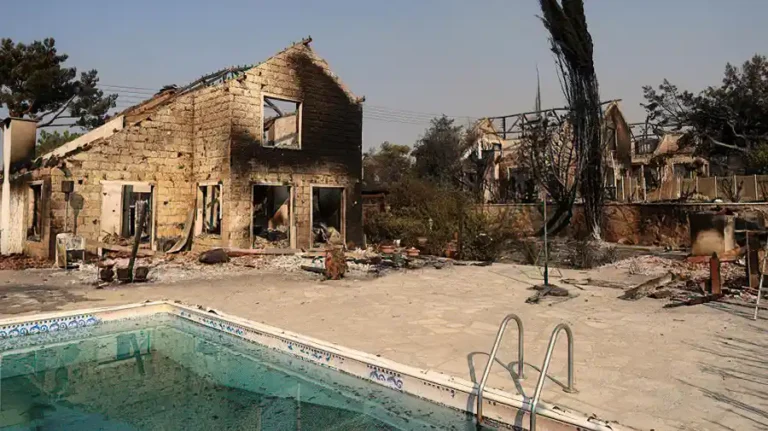
The local news this week has been dominated by one of the most ferocious wildfires in over half a century, with flames ripping through the Limassol district, scorching more than 120km² of land to the north of Limassol, killing two and destroying and damaging many homes and businesses.

Authorities report that the wildfire in Limassol destroyed 32 homes completely and damaged 53 others. Additionally, some reports say that 72 homes have been damaged, which may reflect early totals before final verification.

The blaze started around midday on Wednesday and quickly escalated under blistering 43–44°C heat, fanned by gale-force winds and exacerbated by drought-stricken terrain.

Tragically, two elderly residents, a couple aged 77 and 84, were found deceased in their vehicle on the Monagri–Alassa road, having been overtaken by the inferno as they attempted to flee. Dozens more were injured, with seven people hospitalised, two in serious condition but who are now stable.

The fire raged on multiple fronts across mountainous terrain, prompting evacuations from at least a dozen villages, including Souni, Omodos, Vasa Koilaniou, Alassa, Lofou, Malia and Agios Therapon. Over 100 local residents were placed in temporary accommodation, some relocated to hotels as emergency shelters overflowed.

An elderly lady I know fled her home with just the clothes she was wearing. The wildfire completely destroyed her home and its contents. She’s now staying with her sister and being supported by friends.

Together with other NGOs, my Rotary Club with others are appealing for essential supplies for those who’ve been displaced.

The Cyprus government opened a bank account at the Central Bank of Cyprus to collect donations for victims of the Limassol wildfire:

Wildfire donation account details:

Beneficiary: Republic of Cyprus
Account Name: Wildfire Support Account
Bank: Central Bank of Cyprus
Account Number: 6001027
IBAN: CY42 0010 0001 0000 0000 0600 1027
Swift (BIC) Code: CBCYCY2N

Under immense strain, more than 250 firefighters, supported by 75 fire engines and 14 aircraft – including water-bombing planes from Spain, Jordan, Israel, Greece, the EU’s rescEU fleet and Chinooks from RAF Akrotiri, worked tirelessly to bring the blaze under control.

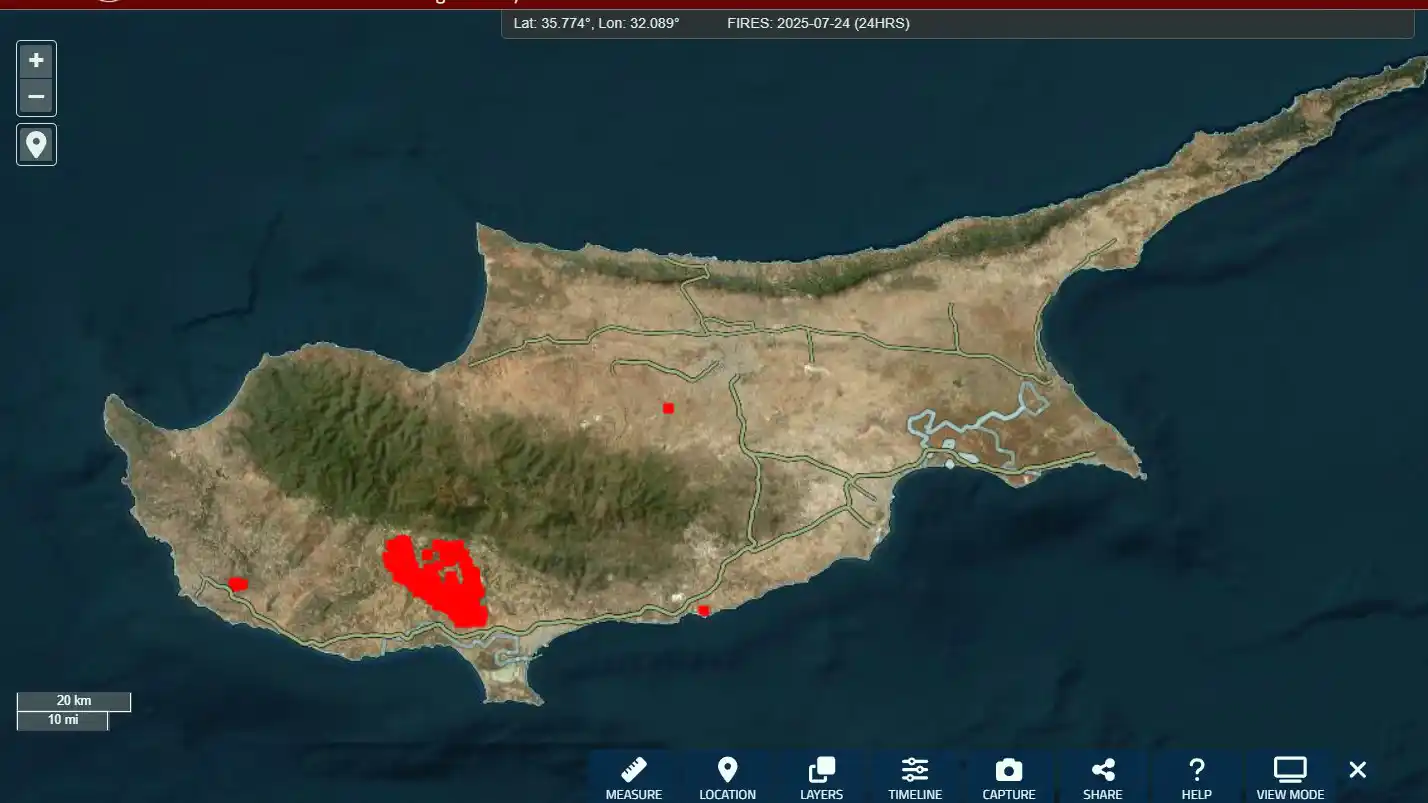
Wildfire highlighted in red

Satellite analysis by ESA (above) revealed the destruction: approximately 50% grassland, 31% hardwood vegetation, 16% tree cover and around 1% residential areas were reduced to ashes. In Souni-Zanakia, Agios Therapon, Lofou and Vouni, damage was particularly severe. Some 400 power poles were destroyed; electricity and telecom services remain disrupted for many affected communities.

In the aftermath, residents are grappling with loss of homes, livelihoods, farmlands and beloved pets. Community leaders like Yiannis Tsouloftas have appealed for solidarity, urging those with spare homes to open their doors to neighbours now displaced.

Authorities have expressed profound sorrow over the loss of life and the scale of devastation. Investigations are ongoing into possible causes, including suspected arson near landfill sites as winds and heat accelerated the spread. Meanwhile, heat warnings remain in force, with temperatures expected to persist in the low to mid 40s for days.