Local property taxes & rubbish fees set to rise this year

Local councils across Cyprus are facing new restrictions and obligations as Parliament steps in to curb runaway increases in waste collection and local property taxes.

While some local authorities had already approved steep rises, up to 85% for certain apartments, Parliament has now capped the hikes at 14% for waste collection and 10% for local property taxes for the 2025 fiscal year.

Local property taxes & waste collection fees

Originally, the government tabled legislation that would have allowed councils to increase these levies by as much as 35% annually, compared to the amounts imposed the previous year. This could have translated to homeowners paying up to 2.5 times more for waste collection and 3.5 times more for local property taxes than they did in 2024.

Some councils even pushed for unlimited increases, but these efforts were halted following parliamentary scrutiny.

Legal and ethical constraints

Parliament’s decision followed legal guidance cautioning against such steep hikes. A letter from the Law Office highlighted key principles: proportionality, transparency, and the need to avoid retroactive or surprise tax burdens on homeowners. These principles underpinned the decision to impose a firm ceiling on increases.

What homeowners can expect

While homeowners have been spared the more extreme increases, they will still see their bills rise. Waste collection fees are set to increase by up to 14%, and local property taxes by up to 10%, compared to 2024. There has been no indication that services will improve or even be maintained at last year’s levels despite the higher charges.

Further charges on homeowners

On top of these capped increases, further financial burdens may soon fall on homeowners. New legislation aims to give District Local Government Organisations (DLGOs) the power to impose additional charges on councils for a variety of environmental services, including:

  • Green point operations
  • Product reuse and repair centres
  • Community composting units
  • Green kiosks
  • Recycling corners
  • Specific waste collection points

These costs are to be distributed according to each local authority’s population; an administrative burden that will almost certainly be passed on to homeowners.

Who pays the bill?

Under the new legislation, local authorities will no longer be required to contribute 60% of the fees collected by DLGOs. Instead, the state will cover the €12 million required to fund these initiatives, an amount it intends to recover through general taxation.

Summary

Homeowners are being asked to shoulder a growing financial burden in the name of environmental responsibility and municipal funding. While Parliament has blocked the most excessive proposals, local property taxes and waste collection fees are still set to rise significantly in 2025. And with new levies and services being planned, the pressure on household budgets looks unlikely to ease anytime soon.

Stay informed, check your local council updates, and be prepared for these changes to take effect in the coming months.


Limassol and Larnaca: a tale of two city development projects

The Cyprus property sector continues to attract major investment, with two significant urban development proposals in Limassol and Larnaca.

Poised to reshape their respective skylines and local economies, both projects reflect growing confidence in the island’s coastal cities.

Limassol: twin towers development

In Limassol, SolidVes Ltd has submitted an €80 million proposal to the municipality for a landmark mixed-use development at the junction of Omonia and Paphos Avenues, which is one of the city’s busiest commercial corridors.

The project comprises two 13-storey towers rising on a 14,715-square-metre plot currently occupied by derelict structures and informal parking.

The development comprises 18,719 square metres of total built area, divided between a residential tower and an office building. The residential element will feature approximately 75 apartments of varying sizes, alongside five ground-floor retail units fronting Paphos Avenue. The office block is set to include 13 floors of office space, a cafeteria, gymnasium, meeting rooms, and a restaurant.

Rooftop gardens are planned for each building, while shared amenities include a swimming pool, 498 underground parking spaces, and 17 accessible spots for disabled users. The landscaped grounds will function as a gated private garden, with controlled access from three directions.

Although the towers exceed current Local Plan height regulations, the developer argues the site’s zoning, which is split between residential (58%) and commercial use (42%), supports the building volume. Nevertheless, a traffic impact study warns of potential congestion in this densely developed district. To mitigate this, SolidVes proposes several initiatives, such as:

  • A parking management system for office staff
  • Carpooling incentives linked to parking availability
  • Secure bike and motorcycle spaces with staff rewards
  • Local hiring strategies for nearby residents
  • Flexible hours and remote work policies

Pending planning approval, construction is projected to last around 30 months.

Larnaca: seafront tower development

Meanwhile, Larnaca is preparing for its own major transformation along the coastal skyline with Lumina Mare, a €40 million luxury tower spearheaded by an Israeli consortium. The group, which comprises Kishrey Teufa, the Shagrauy-Leibovitz Group, and attorney Amir Chen, will build a 19-storey residential and tourism-focused high-rise on a prime 2,000-square-metre plot near the expanding port.

With unobstructed sea views and immediate access to the upgraded waterfront, the development is designed to appeal to both international buyers and high-end tourists. The tower will host 54 sea-facing apartments and short-term rental units, complemented by ground-floor commercial space, a private residents’ lounge, and a rooftop swimming pool.

Construction is set to start this summer, following permit approvals. The joint venture will also provide property and hospitality management, combining real estate returns with sustained tourism appeal.

Notably, the same consortium has expressed interest in managing the Horizon Project, another large-scale development led by the Shagrauy-Leibovitz Group. Horizon is expected to deliver around 500 residences, alongside shops, restaurants, and spa facilities, further enhancing Larnaca’s urban revival.

Developers highlight Cyprus’ favourable investment climate, noting particularly strong growth in Larnaca’s coastal redevelopment, which is increasingly drawing international attention.

A tale of two cities: shaping Cyprus’ urban future

As Limassol and Larnaca pursue bold, high-rise visions, concerns remain about urban density, infrastructure readiness, environmental sustainability, and the lack of affordable housing for local residents. Yet both projects reflect the broader momentum driving Cypriot cities towards modern, mixed-use, and internationally attractive urban environments.

Cyprus’ urban planning amnesty scheme closes

The Ministry of the Interior has announced the conclusion of the Urban Planning Amnesty Scheme, which officially ended on 23 June 2025. A total of 2,841 applications were submitted as part of the initiative.

The vast majority of submissions – 2,495 applications (88%) – related to the legalisation of planning infringements in residential properties. The highest number of applications was received by the Nicosia District Local Government Organisation, with 1,049 applications (37%).

Statement from the Ministry

The deadline for submitting applications under the Urban Planning Amnesty Scheme for the legalisation of minor-scale planning infringements closed on 23 June 2025. The purpose of the scheme was to facilitate final approval and the eventual issuance of property titles.

A wide range of irregularities were covered by the scheme, including additions and alterations that increased the building coefficient, as well as minor infringements such as pergolas, covered verandas, reduced boundary setbacks, and exceeding the permitted coverage, building height, or number of storeys in both main and auxiliary structures.

Mis-named ‘amnesty’, applicants paid a fee to the Special Affordable Housing Fund of the Cyprus Land Development Corporation (KOAG).

Breakdown of amnesty applications by development type

  • Residential Units: 2,495 applications (88%)
  • Commercial Developments: 155 applications (5.5%)
  • Office Developments: 57 applications (2%)
  • Entertainment Developments: 55 applications (1.9%)
  • Industrial Developments: 44 applications (1.5%)
  • Tourism-related Developments: 10 applications (0.4%)
  • Agricultural/Livestock Developments: 10 applications (0.4%)
  • Educational Developments: 8 applications (0.3%)
  • Healthcare Developments: 7 applications (0.2%)

Geographic distribution

  • Nicosia District: 1,049 applications (37%)
  • Limassol District: 770 applications (27%)
  • Paphos District: 519 applications (18.3%)
  • Larnaca District: 328 applications (11.5%)
  • Famagusta District: 175 applications (6.2%)

Currently, the District Local Government Organisations are in the process of reviewing the applications. Approved applicants are being informed of the next steps required to obtain final approval for their property.

Cyprus property sales in June second highest ever recorded

Property sales in Cyprus experienced a notable rise in June 2025, with a total of 1,544 contracts deposited at the island’s Land Registry offices. This marks a 17% increase compared to the 1,322 sales recorded in June 2024 and represents the strongest June performance since 2007, when 1,950 sales contracts were filed.

The figures encompass a broad range of real estate, including residential properties (houses and flats), commercial units, retail spaces, offices, warehouses, and land. While the Department of Lands and Surveys does not provide a breakdown by property type, past data suggests that residential sales typically account for approximately half of all transactions.

Larnaca stood out with a significant 44% rise in sales, a trend attributed largely to regional instability prompting foreign investment. Elsewhere, Famagusta saw a 21% increase, while both Limassol and Paphos recorded 13% growth. Nicosia, however, showed only a marginal 2% increase.

Total contracts of sale deposited – 2024/2025 Comparison (June)

During the first half of 2025, a total of 8,729 property sales were registered across Cyprus, second only to the record 10,258 transactions during the same period in 2007.

Total contracts of sale deposited – 2024/2025 Year-to-Date Comparison

Sales to the domestic market

Sales to Cypriot buyers made up 63% of June’s total, with gains recorded in all districts except Nicosia, which saw a 2% decline. Notably, local purchases surged 45% in Larnaca, followed by 12% in Limassol, 9% in Paphos, and 8% in Famagusta.

Domestic contracts of sale deposited – 2024/2025 Comparison (June)

Over the first half of the year, domestic sales rose by 15% compared to the same period in 2024, with all districts recording gains.

Domestic contracts of sale deposited – 2024/2025 Year-to-Date Comparison

Sales to the overseas market

International buyers accounted for 37% of property sales in June, with all districts showing positive movement. Larnaca and Famagusta led with 43% increases each, followed by Nicosia (33%), Paphos (17%), and Limassol (15%).

Overseas contracts of sale deposited – 2024/2025 Comparison (June)

So far in 2025, foreign sales have risen 16% year-on-year, once again with all districts benefiting from the growing interest.

Overseas contracts of sale deposited – 2024/2025 Year-to-Date Comparison

EU buyers: a rising share

EU nationals bought 189 properties in June (12% of total sales), reflecting a 29% year-on-year rise. While Paphos remained steady and Famagusta saw an 8% decline, other areas performed strongly: Nicosia led with a 136% increase, followed by Larnaca (56%) and Limassol (15%).

Contracts deposited by EU Nationals – 2024/2025 Comparison (June)

During the first six months of the year, EU-buyer activity rose by 27%, with growth recorded in every district.

Contracts deposited by EU Nationals – 2024/2025 Year-to-Date Comparison

Non-EU buyers maintain momentum

Sales to non-EU nationals totalled 387 in June, comprising 25% of all transactions, an increase of 24% from June 2024. Famagusta led with a staggering 125% rise, followed by Larnaca (38%), Paphos (25%), and Limassol (15%). Nicosia, however, posted a 17% decline.

Contracts deposited by non-EU Nationals – 2024/2025 Comparison (May)

Year-to-date figures show a 12% increase in non-EU sales, with every district experiencing growth.

Contracts deposited by non-EU Nationals – 2024/2025 Year-to-Date Comparison

A shifting market landscape

In the first half of the year, non-EU buyers outnumbered local purchasers in Paphos, underlining the district’s enduring appeal to international investors and holiday home buyers. Meanwhile, increased interest in Larnaca and Famagusta, attributed largely to geopolitical instability, signals a broader geographical shift in foreign investment.

Market Segment Summary Analysis Year-to-Date

Analysis of Land Registry data from 2008 to 2025 highlights the evolving nature of Cyprus’ property market and the growing influence of international buyers in shaping regional trends.

Contracts Deposited 2008 to 2025 Year-to-Date Comparison

Is Cyprus losing control of its property market?

0

A quiet but significant shift is happening across Cyprus. While most eyes remain on tourism numbers and construction booms, something deeper is underway: more property across the island is being acquired by foreign nationals, often without the level of scrutiny or oversight one might expect from a modern European country.

This is not just about luxury villas or coastal plots, it’s turned into a feeding frenzy with properties ranging from residential flats and seaside homes to plots of land, entire buildings, private hospitals and businesses are falling into foreign hands – unchecked, undocumented, and unchallenged.

And while foreign investment isn’t inherently bad, the scale, speed, and lack of regulation in this case is raising serious concerns.

A property law that time forgot

The law governing property acquisition by foreigners in Cyprus, Chapter 109 of the “Acquisition of Immovable Property (Aliens) Law”, is so outdated it’s practically a relic. It’s barely more than a page and a half long. It was originally drafted to control the flow of non-Cypriots buying property on the island, limiting ownership to a single home, a secondary residence, and a plot of land under specific conditions.

But in practice, this limit is being ignored. Foreign nationals are easily bypassing restrictions by forming Cypriot-registered companies, often with the help of local legal firms, allowing them to purchase unlimited property under the guise of being a “local entity.”

That’s not a loophole, it’s a revolving door!

The numbers are climbing

A significant influx of foreign buyers, particularly from countries outside the EU, has accelerated this trend. Some are moving for safety reasons due to regional instability, others for business or investment opportunities. But either way, the numbers are growing fast.

Entire apartment blocks are being bought. Agricultural land is changing hands. Long-term rentals are disappearing as homes are snapped up for private use or short-term lets.

In some cases, neighbourhoods are being transformed almost overnight.

Where’s the oversight?

What’s troubling is not just the volume of foreign property acquisition, but how little scrutiny is applied. The state requires foreign nationals to apply for permission to buy, but approvals are almost automatic. No criminal background check. No financial due diligence. No consideration of national security, even in sensitive areas.

Astonishingly, Cyprus demands a clean criminal record and vetting process for domestic workers from third countries, yet applies none of the same rigour to foreign nationals purchasing substantial assets and land.

Political ripples, but no action yet

To their credit, some MPs from across the political spectrum have started to speak out. There are legislative proposals in the works that would restore limits, reintroduce proper approval processes, and ensure due diligence is carried out. But so far, these remain only talks on paper.

The executive branch appears largely indifferent. Some officials quietly argue that attracting foreign capital is essential to Cyprus’ post-crisis economic model.

But if foreign ownership continues unchecked, we risk undermining not just housing affordability, but sovereignty and long-term stability.

It’s time to get serious

No-one is suggesting that all foreign investment is harmful. Cyprus has long benefited from international business and multicultural ties. But every country has the right and responsibility to regulate who owns its land, how much, and why.

This is not about xenophobia or economic protectionism. It’s about modern governance, national interest, and future-proofing our communities. Cyprus must update its laws, enforce its rules, and strike a balance between welcoming investment and protecting its people.

The longer Parliament delays action, the more difficult it will become to undo the consequences.

EU house prices & rents rise in early 2025

The housing market in the European Union continues to see upward pressure in early 2025, with both house prices and rents rising notably.

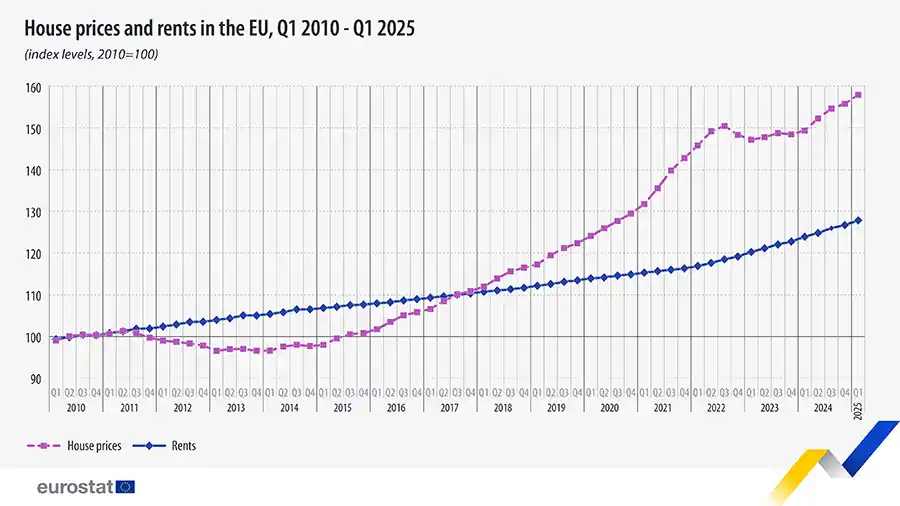
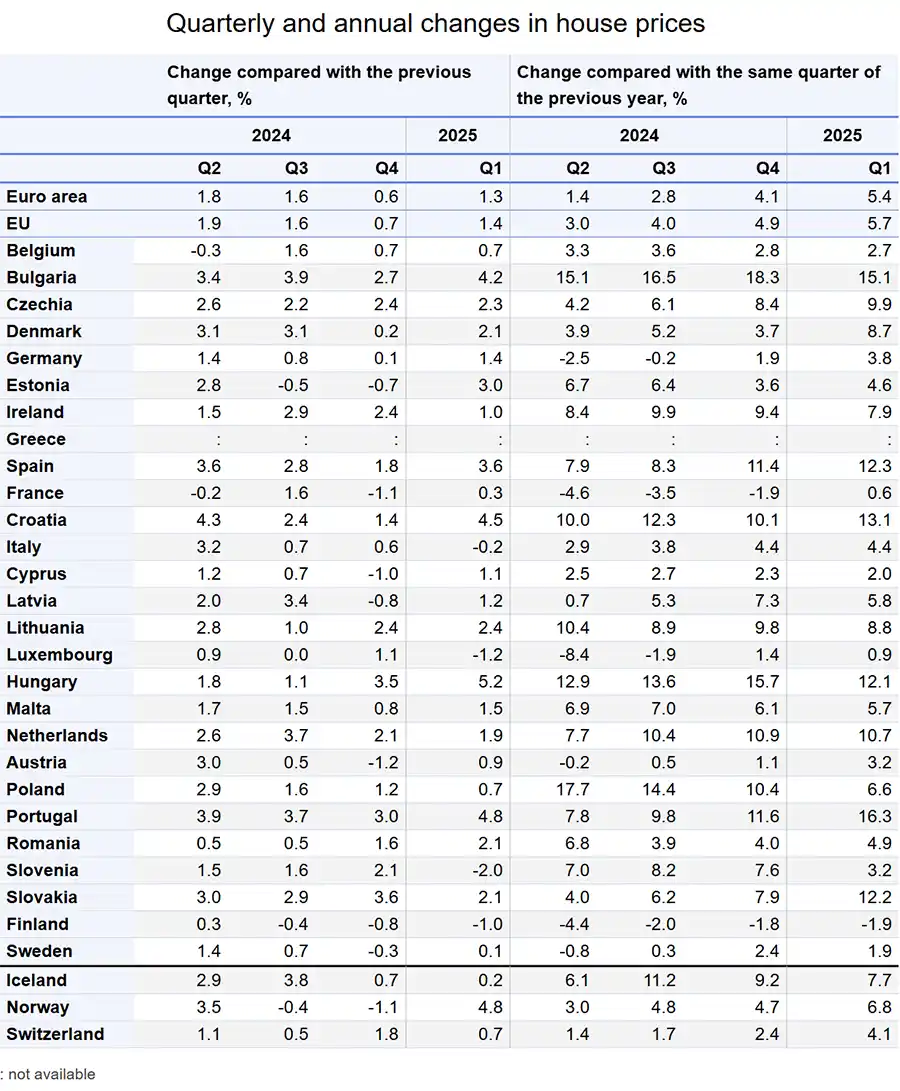
According to data published by Eurostat, house prices in the EU increased by 5.7% in the first quarter of 2025 compared with the same period in 2024. Rents also rose, albeit more modestly, by 3.2% year-on-year.

On a quarterly basis, prices were up by 1.4% compared to the fourth quarter of 2024, while rents rose by 0.9%. These figures highlight a continuing trend of housing costs outpacing wage growth in many parts of the EU.

Picture credit: eurostat

Taking a longer-term view, house prices across the EU have soared by 57.9% since 2010, while rents have grown by 27.8%. Rents have risen at a steady pace over the years, whereas prices have shown more volatility. A sharp rise in house prices occurred between 2015 and late 2022, followed by a brief dip and a period of stabilisation. However, since 2024, prices have resumed their upward climb.

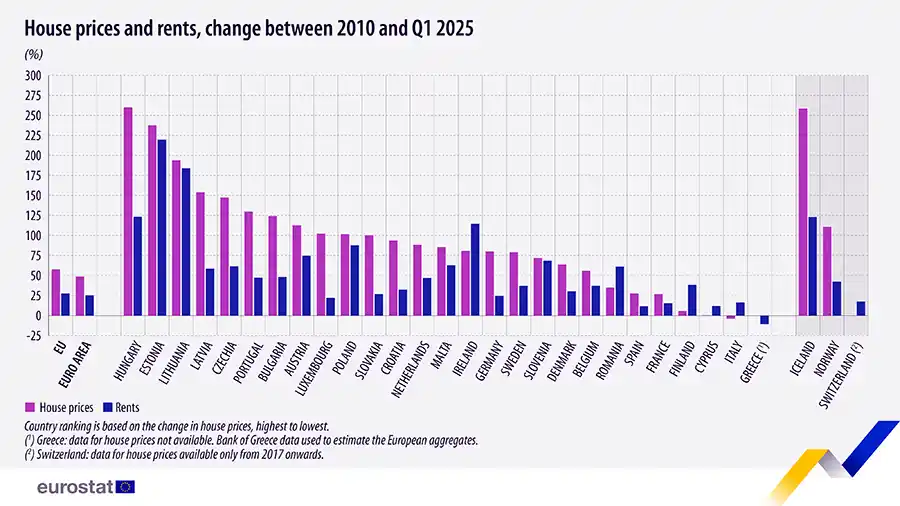
Looking at individual member states, house prices have outstripped rent increases in 21 out of the 26 countries for which data is available. Since 2010, Hungary has seen the most dramatic rise in property prices, with a staggering 260% increase. Estonia follows closely with a 238% rise, while Lithuania, Latvia, Czechia, and Portugal all saw prices at least double over the same period.

In contrast, Italy was the only EU country where house prices actually fell, dropping by 4%. Meanwhile, rents increased in nearly all EU countries, with Estonia once again leading the pack with a 220% rise. Lithuania, Hungary and Ireland also recorded rent hikes of over 100%. Greece stood out as the only country to experience a fall in rental prices, down by 11% since 2010.

Picture credit: eurostat

House prices development in EU Member States

Picture credit: eurostat

These latest figures reaffirm the continued pressure on housing affordability across much of Europe, with both buyers and renters facing increasingly higher costs.